Stop Guessing: How to Analyze Keywords for SEO Success

Stop Guessing: How to Analyze Keywords for SEO Success
Why Keyword SEO Analysis Is the Foundation of Getting Found Online
Keyword SEO analysis is the process of researching, evaluating, and selecting the search terms your target audience types into Google — so you can create content that actually ranks and drives traffic.
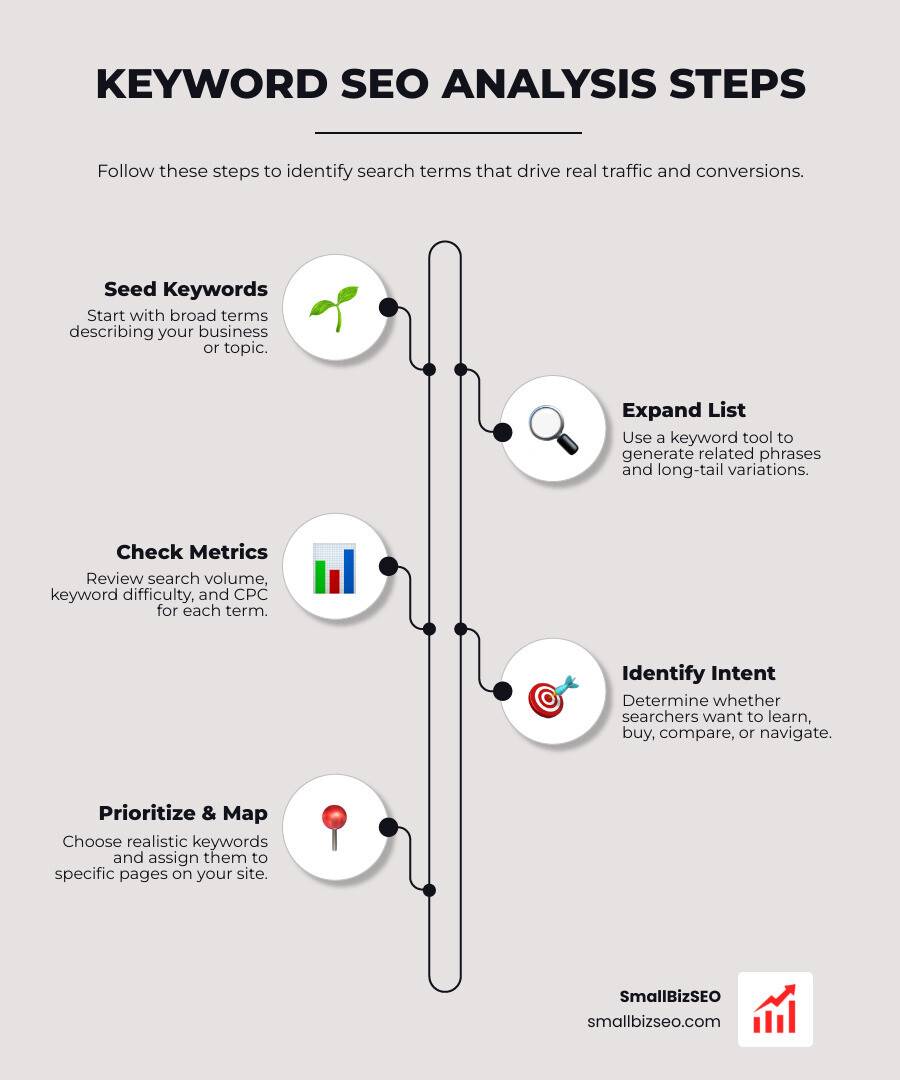
Here's a quick overview of how it works:
- Find seed keywords — Start with broad terms that describe your business or topic.
- Expand your list — Use a keyword tool to generate related phrases and long-tail variations.
- Check key metrics — Review search volume, keyword difficulty, and CPC for each term.
- Identify search intent — Determine whether searchers want to learn, buy, compare, or navigate.
- Prioritize and map — Choose realistic keywords and assign them to specific pages on your site.
Most small business owners pick keywords by gut feeling. That's a problem.
Without proper analysis, you end up targeting terms that are either too competitive to rank for, too vague to convert, or simply not what your customers are searching for. You waste time creating content nobody finds.
The good news? You don't need to be an SEO expert to do this well. With the right process and tools, keyword analysis is something any small business owner can learn — and it pays off fast.
I'm Clayton Johnson, a digital marketing and SEO specialist focused on building search visibility through data-driven campaigns, and keyword SEO analysis is one of the most powerful levers I use to help businesses stop guessing and start growing. Let's walk through exactly how to do it.
Discover more about keyword seo analysis:
The Core Pillars of Keyword SEO Analysis
To build a strategy that gets results, we must look beyond basic search volume. Modern search engines are highly sophisticated, meaning our approach to keyword analysis must be equally strategic.

When we analyze search queries, we focus on three main pillars:
- User Intent Alignment: What is the searcher actually trying to accomplish? If your content doesn't match their expectations, you won't rank—plain and simple.
- AI Search Visibility: Search is changing rapidly. Platforms like ChatGPT and Google AI Overviews are eating up clicks on broad, informational terms. We must target queries that AI engines reference and highlight as reliable sources.
- Contextual Authority: Can your website realistically compete for this term? If you run a local business in New York, trying to rank globally for "marketing tips" is a waste of resources. Instead, local terms or highly specific long-tail queries will yield much better returns.
Whether we are designing a local campaign in New York City or structuring a national campaign, understanding these core pillars ensures we don't waste budget on empty traffic. For a deeper look at how this fits into your overall marketing strategy, read our comprehensive SEO Services Guide.
Essential Metrics for Evaluating Search Queries
To separate high-value opportunities from dead ends, we need to look at concrete metrics. When you plug your seed ideas into the Free Keyword Tool: Find the Right Keywords for SEO & AI Search, you will be greeted with several data points. Here is how we interpret them:
- Search Volume: The average number of times a keyword is searched per month. While high volume is tempting, keywords with 100 to 1,000 monthly search volume are a much more practical starting point for newer or smaller sites.
- Keyword Difficulty (KD): Usually scored from 0 to 100, this tells you how hard it is to rank on the first page. Newer sites should focus on keywords with difficulty scores under 30. Anything above 80 is typically dominated by major brands with massive backlink profiles.
- Cost Per Click (CPC): The amount advertisers pay for a single click in paid campaigns. A high CPC of roughly $3 or more signals that the keyword drives revenue, making organic rankings for that term incredibly valuable.
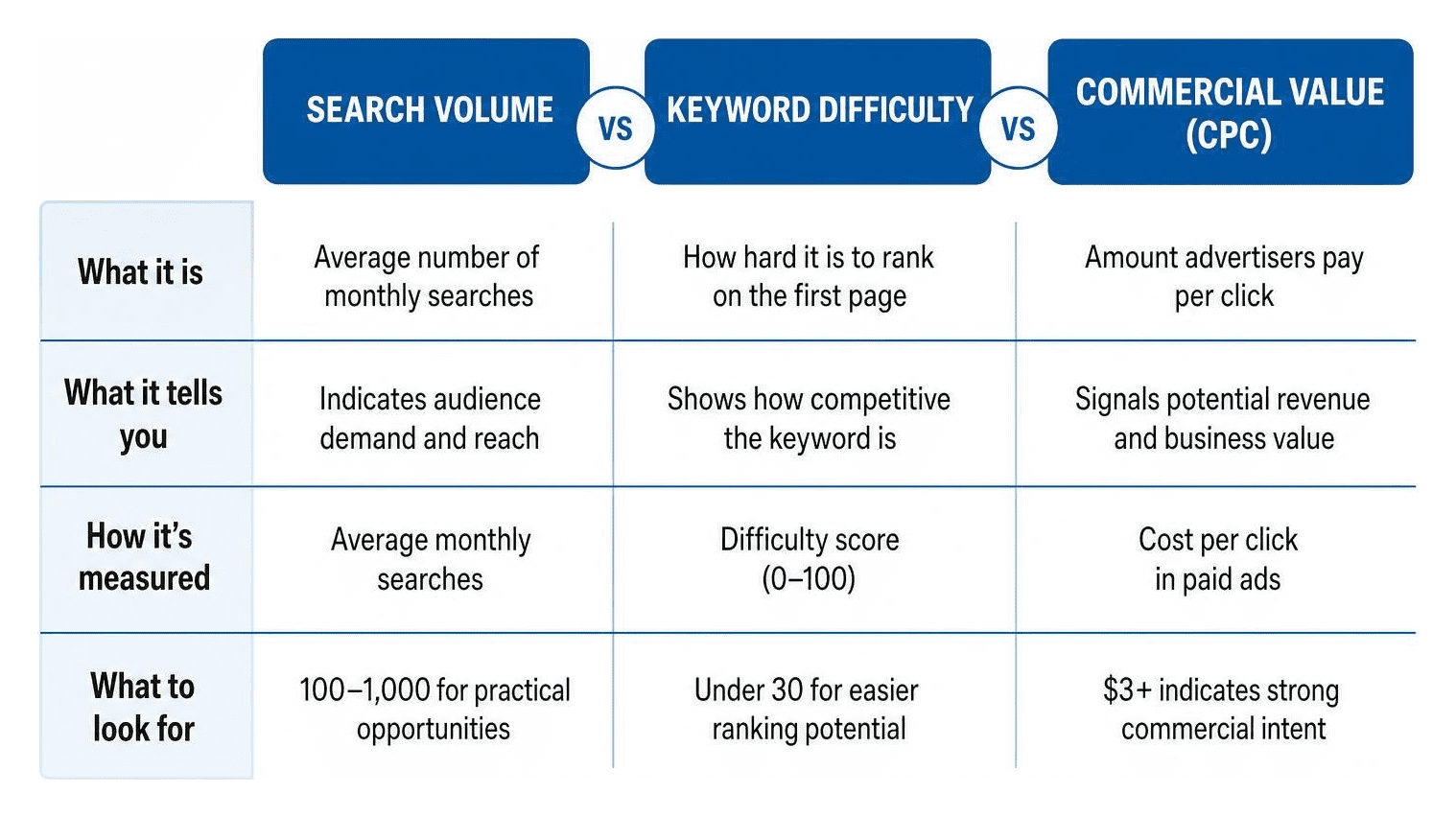
To help you visualize how these metrics interact, we have put together this simple comparison table:
| Metric Profile | Search Volume | Keyword Difficulty | CPC / Commercial Value | Action Plan |
|---|---|---|---|---|
| The Quick Win | Low to Moderate (100–1,000) | Low (< 30) | Moderate to High ($3+) | Create targeted content immediately. |
| The Authority Builder | High (5,000+) | Moderate (30–60) | Low | Build comprehensive pillar pages. |
| The Trophy Term | Very High (10,000+) | High (> 80) | Very High ($10+) | Avoid for now; target long-tail variations instead. |
Aligning Search Intent with Your Keyword SEO Analysis
Every search query has a motive. If you try to rank a product page for an informational search, Google will ignore it. We classify intent into four distinct categories:
- Informational: The user wants to learn something (e.g., "how to do keyword research").
- Commercial: The user is researching options before buying (e.g., "best SEO agencies in New York").
- Transactional: The user is ready to buy or sign up right now (e.g., "hire SEO company NYC").
- Navigational: The user is trying to find a specific website or physical location.
By mapping your keyword seo analysis directly to these intent categories, you can build pages that satisfy both search engines and human readers. To see how your current pages align with user intent, consider scheduling a Detailed SEO Analysis.
How to Conduct a Competitor Keyword Gap Analysis
One of the fastest ways to find high-performing keywords is to look at what is already working for your competitors. A competitor keyword gap analysis reveals the exact terms your competitors rank for, but your website does not.
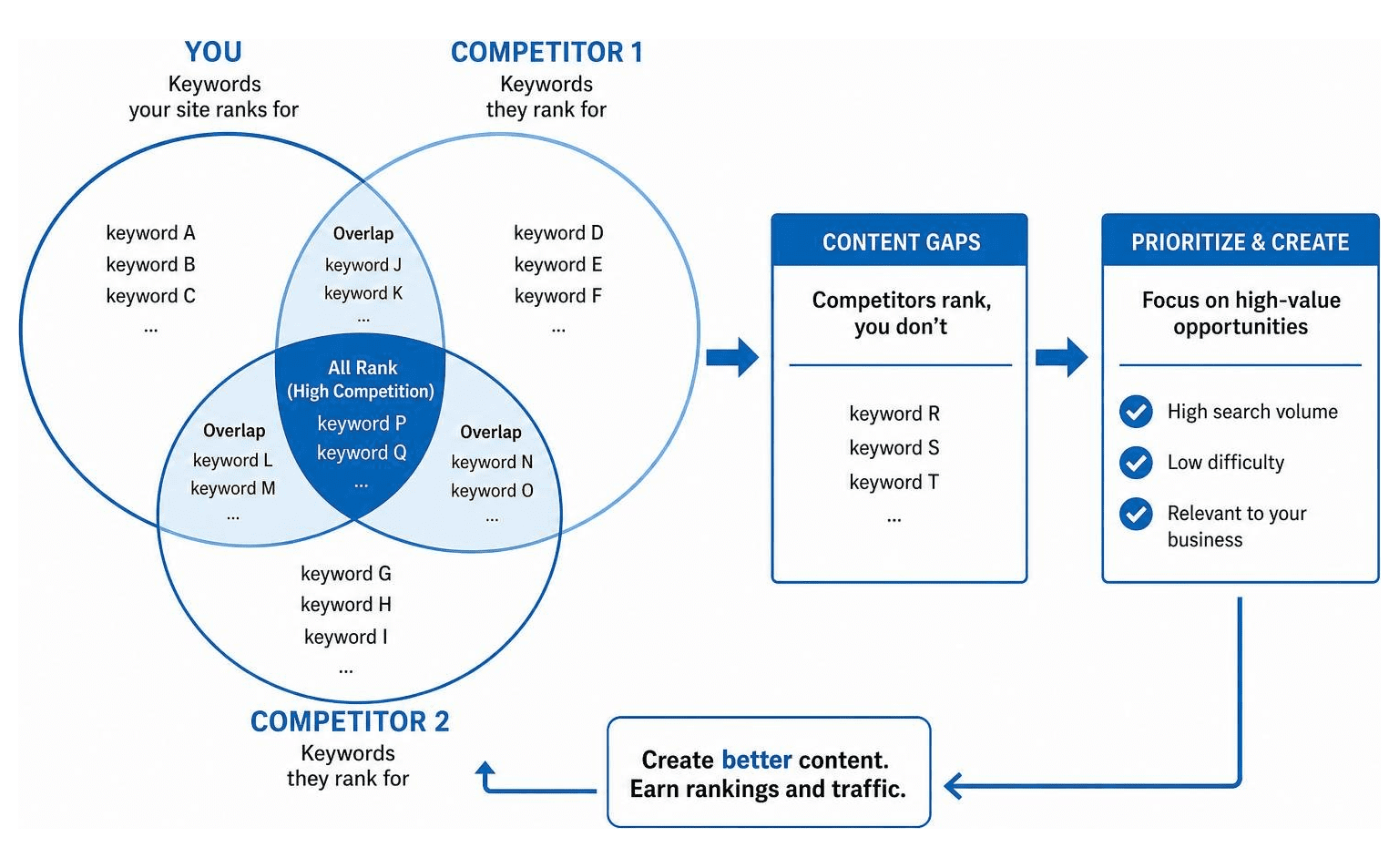
To perform this analysis:
- Identify your true organic competitors: These are the sites ranking on page one for your target terms, not necessarily the businesses you compete with offline. For example, if you are looking for top-tier competition in the metro area, you might analyze the leading local business sites ranking for your target terms.
- Extract their keywords: Use an SEO tool to pull the organic keywords of your top three competitors.
- Filter for gaps: Look for high-volume, low-difficulty keywords where your competitors rank in positions 1–10, but your site is nowhere to be found.
- Identify weak points: Look for search results where competitors have outdated content or thin pages. These are prime opportunities for you to sweep in with superior, E-E-A-T-compliant content.
For a complete walkthrough of this process, check out our guide on Keyword Gap Analysis: What It Is and How to Do It Right.
Step-by-Step Guide to Choosing the Best Keywords
Once you have a list of potential keywords, it is time to filter them down into an actionable strategy.
First, we recommend using a professional tool like Keywords Explorer by Ahrefs: Find Winning Keyword Ideas. At Scale. to generate clusters of related terms. Grouping keywords by a "Parent Topic" allows you to build topical authority rather than writing disconnected blog posts.
Next, organize your chosen terms into a structured content calendar. Focus on a mix of informational queries to build trust and transactional queries to drive leads. If you need help producing high-quality, optimized content at scale, our team can assist through our professional SEO Content Services.
Step 1: Brainstorming Seed Terms for Keyword SEO Analysis
The very first step is to write down your seed keywords. These are broad, 1- or 2-word phrases that define your industry, products, or services.
If you run a local agency, your seed terms might be "SEO services" or "digital marketing." From there, you expand those terms into specific search queries that your local audience actually types. For instance, a business targeting the New York market would analyze terms like "SEO New York" or look for regional variations that local searchers use.
Once you have your seed terms, you can begin optimizing your website's metadata and structure using core On-Page SEO principles.
Frequently Asked Questions About Keyword Analysis
What is the difference between free and premium keyword tools?
Free keyword tools are fantastic for beginners and ad-hoc research, but they come with strict search limits. For example, AnswerThePublic limits free users to 3 searches per day, KWFinder limits you to 5 daily searches, and Semrush's free tier provides up to 10 analytics reports per day.
Premium tools remove these limits and offer advanced features like historical SERP tracking, bulk analysis of up to 1,000 keywords, and automatic search intent classification. If you are just starting out, you can learn the basics by watching this helpful video on 6 Free Keyword Research Tools for SEO (and How to Use ....
How do long-tail keywords help with AI search visibility?
Long-tail keywords (phrases with 3 or more words) are highly specific and conversational. Because they mimic how real people speak, they are highly valuable for AI search platforms like ChatGPT and Google's AI Overviews.
AI engines look for direct, authoritative answers to complex questions. By targeting long-tail queries and providing clear, direct answers at the top of your pages, you increase your chances of being cited as the source in AI-generated answers. To build a comprehensive strategy around these conversational queries, check out our tailored SEO Services.
How does keyword research apply to both organic SEO and PPC?
Keyword research is the bridge between organic traffic and paid advertising (PPC). While organic SEO focuses on long-term rankings and informational content, PPC campaigns target immediate, high-intent transactional keywords.
By analyzing CPC and competition metrics, you can identify which keywords are too expensive to bid on—making them excellent targets for organic SEO. Conversely, you can use PPC to test new keywords quickly before investing months into organic content creation. We help small businesses balance both channels through our custom SEO Packages.
Conclusion
Conducting a thorough keyword SEO analysis is the single best way to ensure your marketing efforts translate into real business growth. By understanding metrics, analyzing search intent, and keeping an eye on your competitors, you can build a sustainable stream of organic traffic.
At SmallBizSEO, we help businesses in New York NY secure fast, reliable rankings. Using our proprietary "Velocity" framework, we deliver data-driven growth and E-E-A-T-compliant content backed by transparent, automated reporting.
Ready to stop guessing and start winning? Claim your free SEO Visibility Audit today, or partner with us to dominate the local search results.