Never Rely on Stale Data: How to Schedule Fact Checks for Evergreen Posts

Why Does Evergreen Content Need Scheduled Fact Checks?
Here is how to schedule fact checks for evergreen articles: list claims that could change, record each source and the date you checked it, then set the next review based on how quickly the claim may change. Review stable guides at least once a year. Check prices, rules, and other fast-changing facts more often, and recheck them when a relevant change is announced.
Evergreen posts can answer the same questions for years, but their facts may not stay accurate. A review schedule helps you catch stale information before readers rely on it, while keeping useful pages trustworthy and relevant in search.
I'm Clayton Johnson, founder of SmallBizSEO, where I develop practical content and SEO frameworks built around clear answers and credible evidence. That work informs how I explain how to schedule fact checks for evergreen articles without creating needless work for small teams.
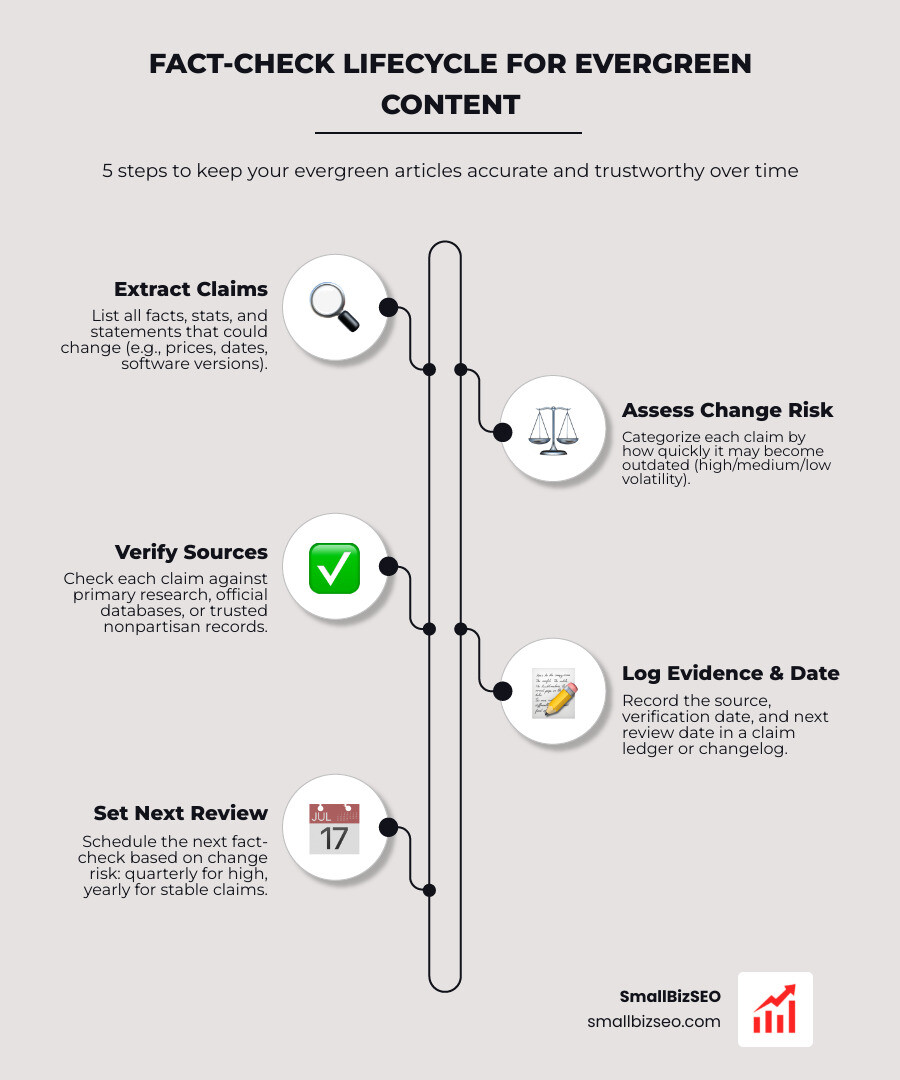
Evergreen topics are defined by demand durability rather than publication timing. While search interest for core subjects remains constant over many years, underlying supporting details naturally shift. When statistics, software tools, market benchmarks, or procedural steps silently expire, the entire page suffers from factual and content decay.
Fact-checking protects readers from acting on stale guidance. It also supports the accurate, people-first content Google recommends. E-E-A-T is not a checklist that guarantees rankings, and a recent date alone does not establish reliability. Preserve useful original research, explain its limits, and update only the facts that have changed.
How Can You Schedule Fact Checks for Evergreen Articles? A 5-Step System
To schedule fact checks effectively, extract all individual factual claims, categorize their volatility risk, verify each statement against primary sources, log substantive changes in an internal ledger, and set an automated calendar reminder for the next review.
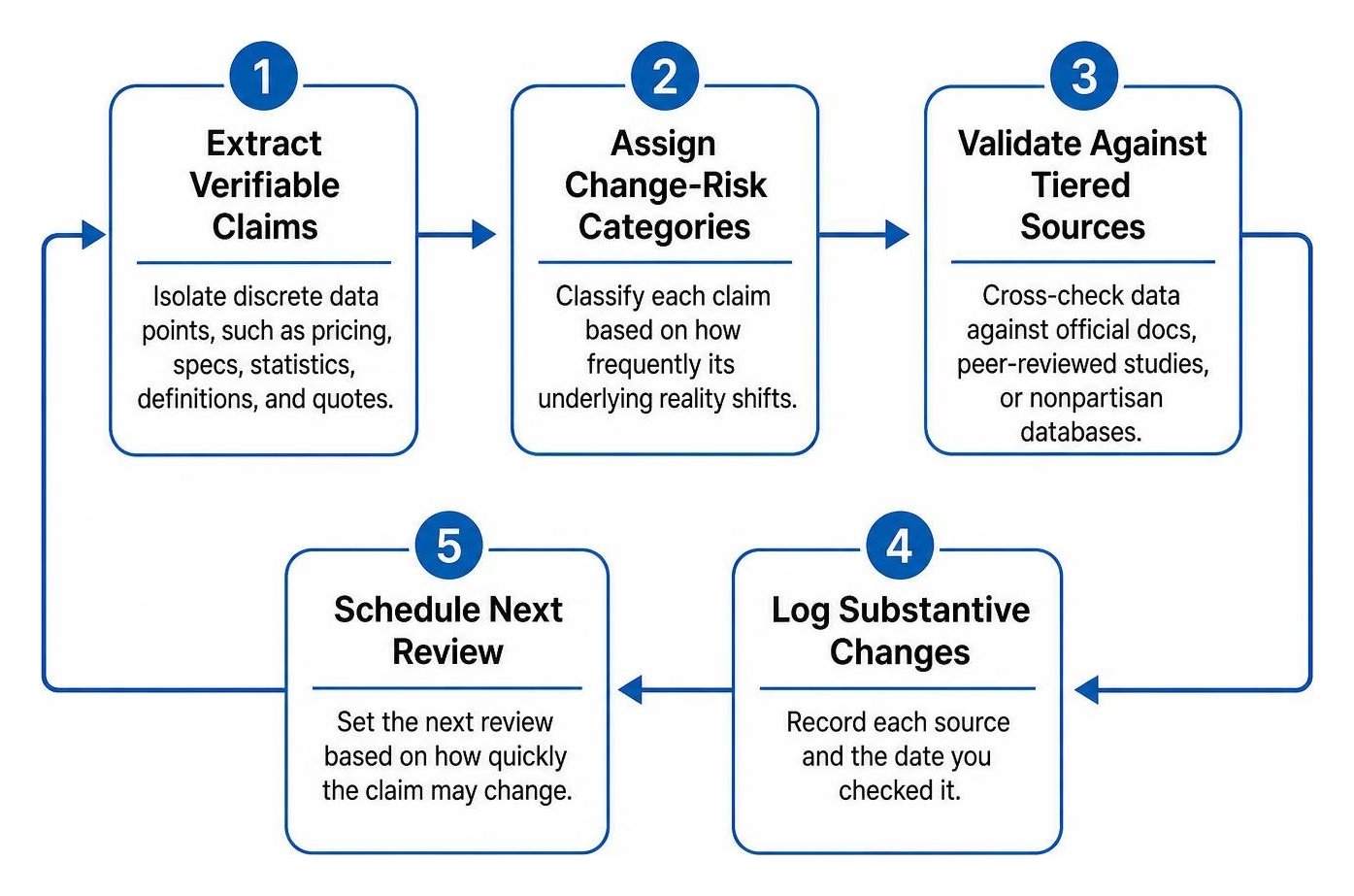
A repeatable editorial workflow ensures consistent quality control without requiring full rewrites of top-performing pages. Follow these five core steps:
- Extract Verifiable Claims: Isolate discrete data points, such as software pricing tiers, technical specifications, statistics, definitions, and direct quotes.
- Assign Change-Risk Categories: Classify each claim based on how frequently its underlying reality shifts.
- Validate Against Tiered Sources: Cross-check data against official documentation, peer-reviewed scientific literature, or nonpartisan databases.
- Log Changes and Evidence: Document updates, revisions, and source URLs within your master tracking sheet.
- Set Cadence and Event Triggers: Establish a hard calendar date for the next review while defining external event triggers that require immediate updates.
Which Editorial Framework Should You Choose: Magazine, Newspaper, or Hybrid?
Choose the magazine model for complex, high-risk, or heavily referenced long-form content, the newspaper model for rapid self-verification on low-risk posts, and the hybrid model for balanced day-to-day operations.
Brooke Borel’s KSJ Handbook chapter, The Three Models of Fact-Checking, describes magazine, newspaper, and hybrid approaches. Its cited 2018 science-journalism report found that 34% of surveyed outlets covering science used dedicated fact-checkers. That historical finding is not a current benchmark for all publishers. Source: https://ksjhandbook.org/fact-checking-science-journalism-how-to-make-sure-your-stories-are-true/the-three-models-of-fact-checking/
| Model | Workflow Structure | Best Use Case | Operational Speed | Resource Cost |
|---|---|---|---|---|
| Magazine Model | Dedicated checker separate from writer and editor; conducts deep source re-interviews and line-by-line audits | Comprehensive pillar pages, legal or financial topics, search ready long form content | Slower | High |
| Newspaper Model | Writer conducts self-verification; copy editors perform spot checks on names, basic data, and titles | Short how-to explainers, basic definition posts, low-risk informational guides | Rapid | Low |
| Hybrid Model | Tiered routing where standard posts use self-verification and high-stakes or flagged assets route to dedicated checkers | Balanced content libraries combining general tutorials with high-value commercial assets | Moderate | Moderate |
For most digital publishing operations, the hybrid framework provides the strongest balance of speed, cost-effectiveness, and rigorous quality control.
How Often Should You Fact-Check Evergreen Articles With Different Risk Levels?
Use the intervals below as starting points, not universal rules. Set the next review according to both the chance of a change and the consequences of an error. An annual page-level check can coexist with monthly pricing checks and a longer review interval for stable historical facts. Do not wait for traffic to fall before correcting a known error.
Not every sentence requires equal oversight. By classifying claims into distinct tiers, you prevent editorial bottlenecks while keeping critical numbers accurate:
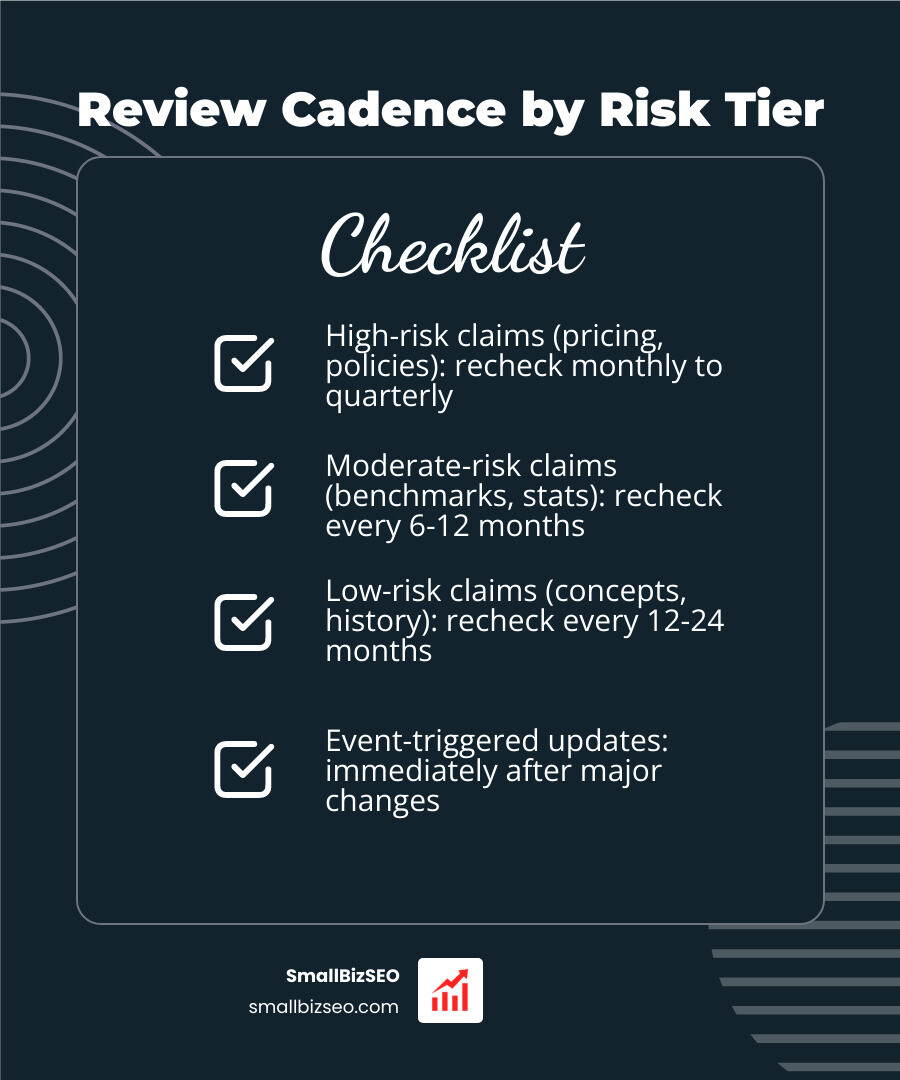
- High Change Risk (Monthly to Quarterly): Software pricing tables, SaaS feature matrices, tax brackets, and platform policies. Reverify these items before major promotions and during all about performing a content audit.
- Moderate Change Risk (Every 6 to 12 Months): Industry benchmarks, survey statistics, platform workflows, and recommended tool stacks.
- Low Change Risk (Every 12 to 24 Months): Foundational business concepts, mathematical formulas, broad definitions, and historical context.
- Event-Triggered Reviews (Immediate): Immediate reviews triggered by vendor product updates, regulatory changes, or search engine core algorithm releases, regardless of calendar timing.
What Steps Help Teams Schedule and Document Fact Checks?
Teams should schedule and document fact checks by maintaining a centralized claim ledger, validating every claim against an evidence content brief, and preserving a transparent changelog.
A claim-level ledger separates focused checks from full rewrites. A price update may need only a source check and a few corrections, while a changed policy may require a broader review. Assign an owner and enough time for the actual risk rather than a fixed minutes-per-page target.
Your claim ledger should include the following tracking columns:
- Target URL and Primary Heading
- Specific Factual Claim
- Original Source URL and Publication Date
- Last Verification Date
- Assigned Change Risk Tier
- Next Scheduled Review Date
- Specific Event Triggers
- Verification Status (Verified, Review Due, Change Detected, Retired)
When updating content on the page, update your visible modified date only when making substantive factual additions. Avoid purely cosmetic date bumps, as search engines evaluate actual page modifications.
How Can You Check Sources for Scientific and Civil Society Claims?
Check sources by enforcing a strict hierarchy of evidence: rely on peer-reviewed research and official regulatory portals for scientific data, and use nonpartisan public databases for civic or industry claims.
For a claim about research, read the original study and check its date, sample, methods, limitations, and any corrections or retractions. For a rule or product feature, use the responsible authority or current official documentation. A source’s institutional status alone does not prove every claim it makes.
When verifying evergreen content, apply a tiered verification standard:
- Tier 1 (Authoritative Primary Sources): Peer-reviewed journal studies, official government bodies, statutory legal documents, and official technical documentation.
- Tier 2 (Established Research Databases): Nonpartisan trackers, academic libraries, and vetted research repositories.
- Tier 3 (Direct Subject Matter Verification): Direct developer release notes, certified public corporate disclosures, and direct expert consultations.
Always trace cited claims back to their original methodology rather than quoting secondary blog commentary.
How Can You Correct Errors and Maintain Authority?
To maintain brand authority when correcting errors, clearly state what information was adjusted, elaborate on the factual evidence supporting the change, and provide clear citations for readers and search crawlers.

Updating an outdated claim is an opportunity to showcase expertise. When executing a comprehensive evergreen content strategy, high-ranking pages must deliver verified answers that reflect the latest industry landscape.
When a material error could affect a reader’s decision, add a short correction note explaining what changed and why. Link the evidence and give the correction date. Routine typo fixes need not become a lengthy announcement; focus transparency on consequential changes.
How Can Visuals Help Correct Recycled Misinformation?
Visuals correct recycled misinformation by breaking down complex data into simple comparison charts, reducing the cognitive effort required to process accurate facts.
Use a visual only when it makes the correction easier to understand. For example, show an old price beside the current price and identify the source and effective date. Do not reproduce an inaccurate chart without a prominent correction.
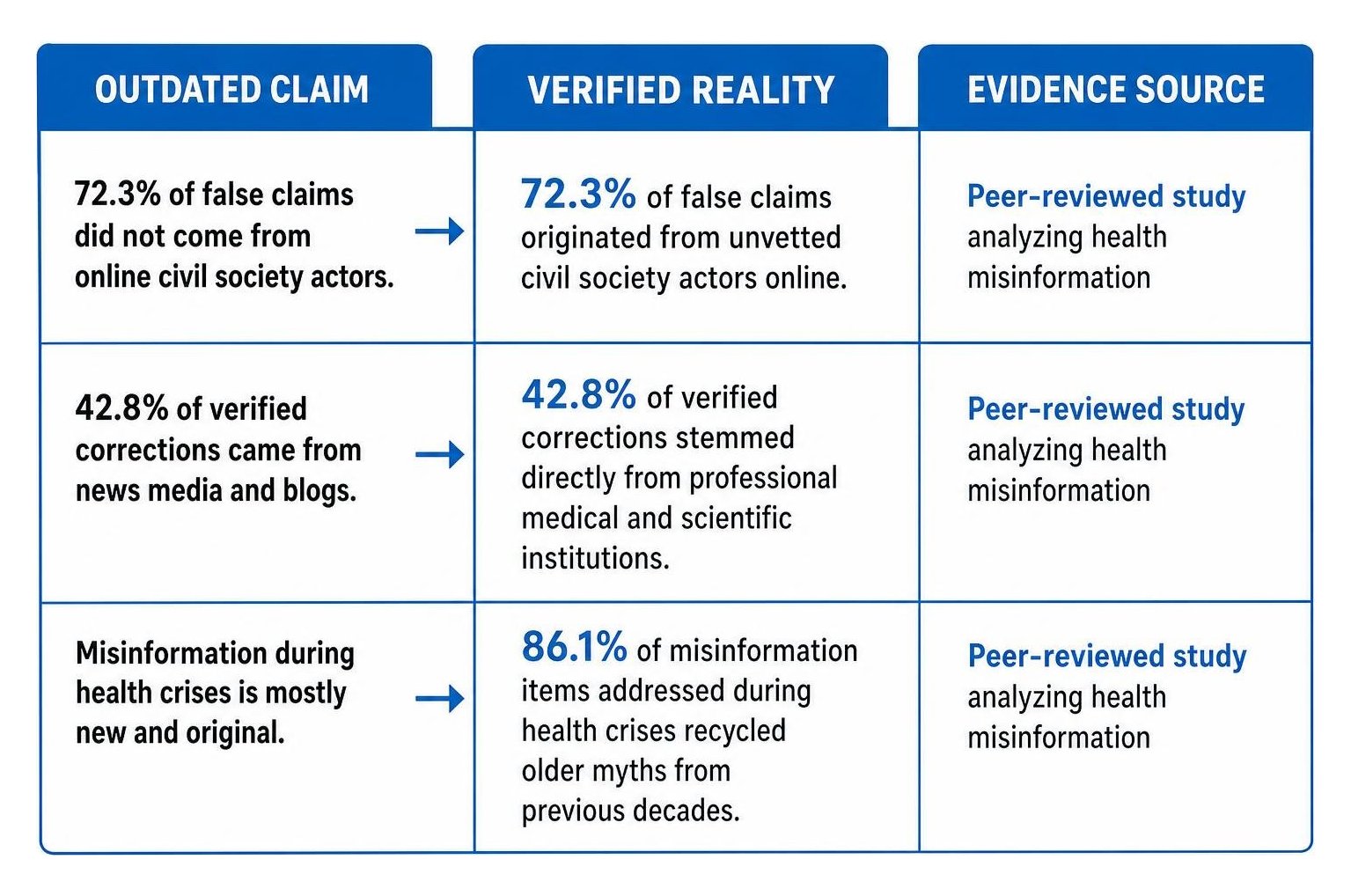
To counter this natural complexity gap, content teams should build a library of visual assets:
- Side-by-Side Comparison Tables: Place outdated assumptions next to current standards.
- Data Flow Charts: Illustrate how verified mechanisms operate step by step.
- Visual Callout Cards: Highlight key numbers with explicit source badges.
Label charts clearly, provide accessible text, and check the graphic against the corrected source. A polished illustration is not evidence and cannot replace an accurate explanation.
How Can You Track Content Health and Make Ethical Corrections?
Track content health through scheduled audits, monitor referral traffic and search positions, and make ethical corrections using objective, neutral language that avoids emotional exaggeration.
Maintaining content health requires transparent operational standards:
Maintain tone neutrality: present facts and evidence without sensationalism. Document meaningful revisions: use clear notes when changing important recommendations or recalculating a dataset. Validate technical signals: keep visible dates and structured data consistent, and request recrawling only when appropriate; requests do not guarantee indexing or timing. Preserve evidence: retain source URLs, review dates, and the responsible editor so later checks can be repeated.
Building a Sustainable Fact-Checking Schedule
Start with ten important pages and list their changeable claims. Assign an owner, a source, and a next-review date for each one. Review the ledger monthly, correct consequential errors promptly, and record what changed. This process supports accurate content and reader trust; it does not guarantee rankings.