All About Performing a Content Audit
How to Prepare and Run Your Performance Evaluation
A content audit is a systematic review of your published material to assess performance, relevance, and accuracy. To perform one, define your core goals, crawl your website URLs, pull performance data from analytics platforms, and assemble the findings into a master analysis spreadsheet. This process ensures your published material supports business goals, strengthens user trust, and builds sustainable organic visibility. In practical industry case studies, executing a thorough content review boosted search engine traffic by 33.88%. By evaluating your site against clear qualitative criteria and Experience, Expertise, Authoritativeness, and Trustworthiness (E-E-A-T) signals, you turn passive digital pages into active revenue drivers.
What Is the Difference Between a Content Inventory and a Content Audit?
A content inventory is a quantitative catalog that lists every URL, file, and asset on your site to answer "What is there?", while a content audit is a qualitative analysis that assesses performance, relevance, and accuracy to answer "Is it any good?"
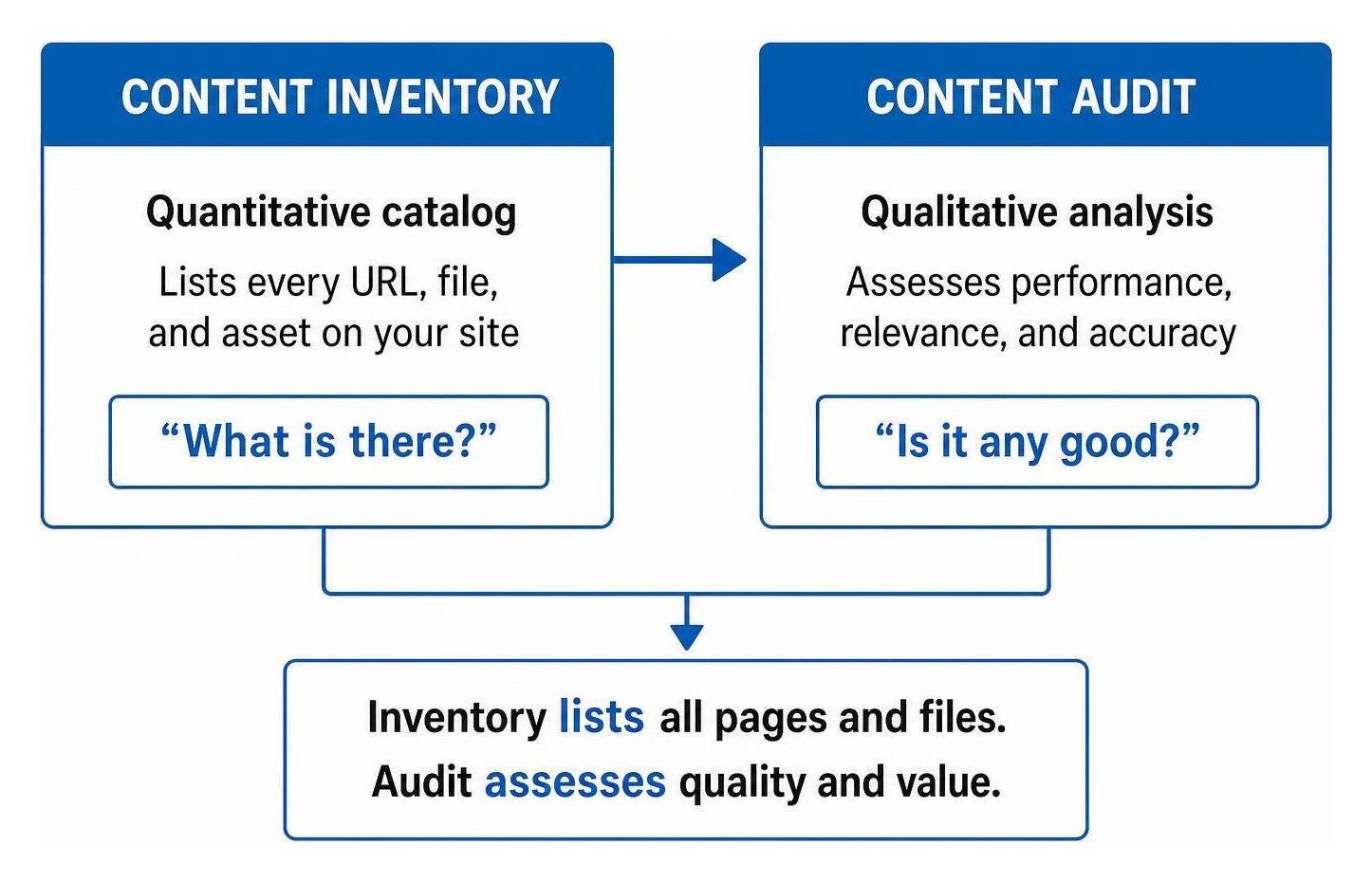
Both components work together inside a mature content planning process. As detailed in foundational usability research on Content Inventory and Auditing 101 - NN/G, compiling raw URLs establishes baseline visibility, but critical human evaluation is required to identify Redundant, Outdated, and Trivial (ROT) material.
| Feature | Content Inventory | Content Audit |
|---|---|---|
| Primary Question | "What assets currently exist on the site?" | "How well do these assets perform and help users?" |
| Core Method | Automated crawling and sitemap exporting | Qualitative assessment and metric scoring |
| Tracked Metrics | URL, title tag, page type, publish date, author | Organic clicks, bounce rates, conversions, intent match |
| Output Deliverable | Raw data spreadsheet of digital assets | Action plan (keep, update, consolidate, or remove) |
Why Does Auditing Matter for SEO and AI Visibility?
Auditing matters because search engines and artificial intelligence engines prioritize fresh, accurate, and comprehensive sources while demoting neglected websites that accumulate errors.
Publishing fresh material is not enough on its own. When pages lose organic traction due to content decay, refreshing and reposting an improved version on the exact same URL can boost traffic by 14.8%.
Regular audits also safeguard valuable digital assets; for instance, a single comprehensive industry research study can accumulate over 3,700 backlinks over time. Running a structured SEO visibility audit helps identify those high-equity URLs so you do not accidentally damage them. Maintaining healthy evergreen content ensures large language models (LLMs) and answer engines continue to cite your brand as an authoritative reference across modern search platforms.
To run a performance evaluation, define your core goals, crawl your website URLs, pull performance data from analytics platforms, and assemble the findings into a master analysis spreadsheet.
Begin by setting a clear boundary for your audit. You can examine your entire digital footprint or scope the review to specific directories like /blog/ or top user journeys. Use crawler software or XML sitemaps to capture all live pages, and ensure you run a technical site audit to verify indexation status before evaluating editorial factors. This technical baseline ensures you build a strong foundation for high-performing content SEO.
Who Should Be Involved in the Content Audit Team?
A successful audit team involves cross-functional contributors, including content creators, SEO strategists, subject matter experts (SMEs), and compliance or legal reviewers.
As documented in organizational studies on the formal Content audit, treating governance as a solo task often causes bottlenecks. Clear task ownership across roles accelerates your content velocity while keeping updates accurate:
- SEO Strategists: Extract ranking data, check search intent, and manage redirect planning.
- Content Writers and Editors: Revise outdated copy, structure text for scannability, and optimize headings.
- Subject Matter Experts: Verify technical accuracy and industry facts.
- Compliance and Legal Reviewers: Ensure public statements adhere to industry-specific regulatory standards.
Which Metrics and Tools Are Essential for Evaluation?
Essential evaluation tools include Google Search Console for search clicks and rankings, Google Analytics 4 for user engagement and conversions, and site crawlers for link architecture.
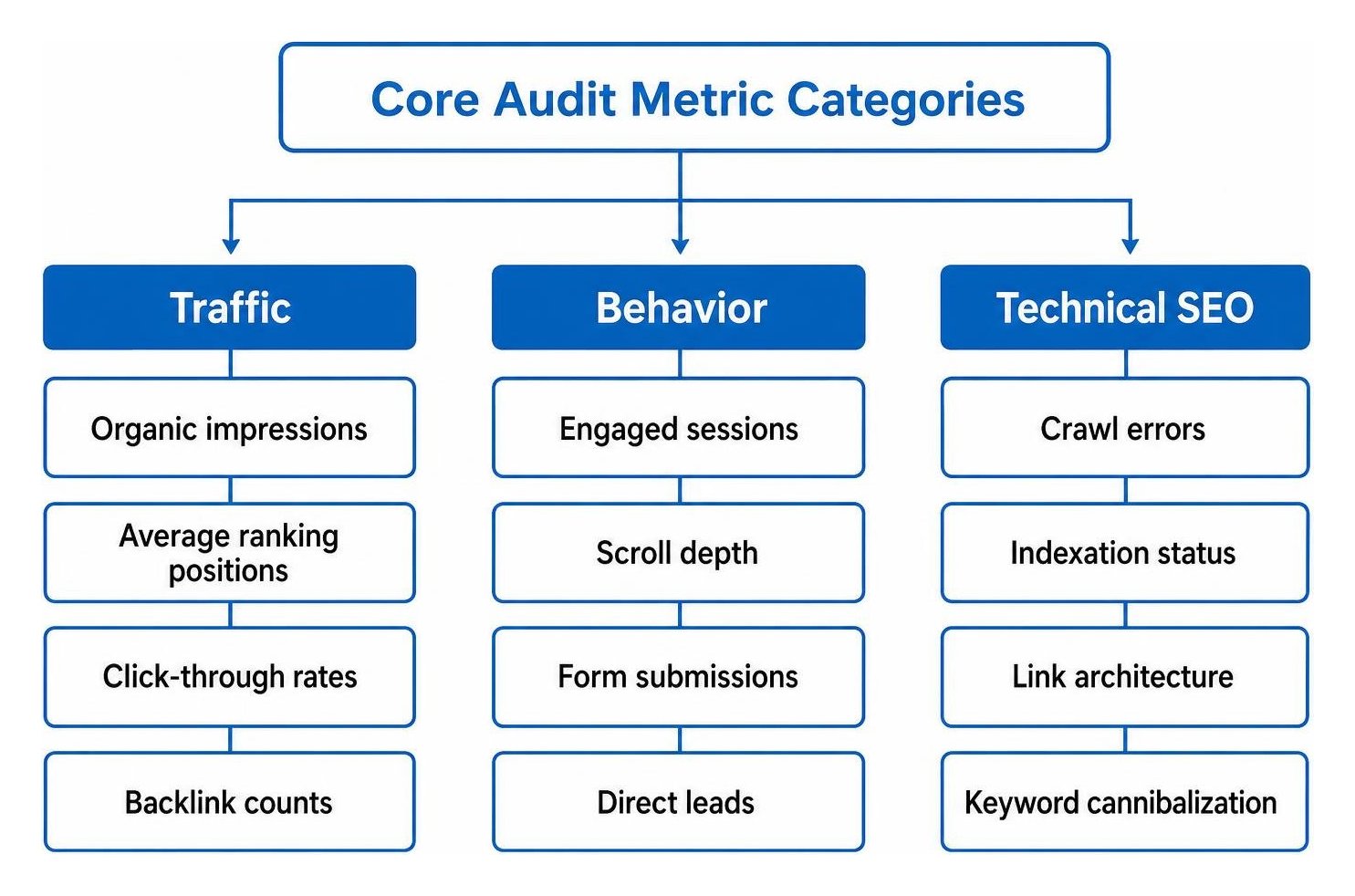
When analyzing your inventory, balance quantitative numbers with qualitative readability:
- Search and Visibility Metrics: Organic impressions, average ranking positions, click-through rates, and backlink counts.
- Engagement and Conversion Metrics: Engaged sessions, scroll depth, form submissions, and direct leads.
- Technical and Structural Health: Detecting crawl errors and understanding the keyword cannibalization definition to stop overlapping URLs from hurting rankings.
- Editorial Quality: Reviewing content readability and using the best thin content checker tools to spot shallow pages that fail user search intent.
Post-Audit Action Frameworks and Measuring Results
To execute post-audit actions, categorize every audited URL into a defined disposition bucket, assign responsible owners, implement structural changes, and track performance changes over set intervals.

When modifying URLs, protect your search equity. Use 301 redirects when merging older articles to preserve incoming links, implement canonical tags where needed, and apply noindex directives directly within HTML meta tags rather than within robots.txt files. Review our detailed guide on how to run a visibility audit to safeguard your rankings during restructuring. Looking beyond content optimization helps connect structural improvements directly to overall revenue.
How Do You Decide Whether to Keep, Update, Consolidate, or Delete?
You decide whether to keep, update, consolidate, or delete a page by evaluating its traffic trends, backlink value, search intent alignment, and conversion contribution.
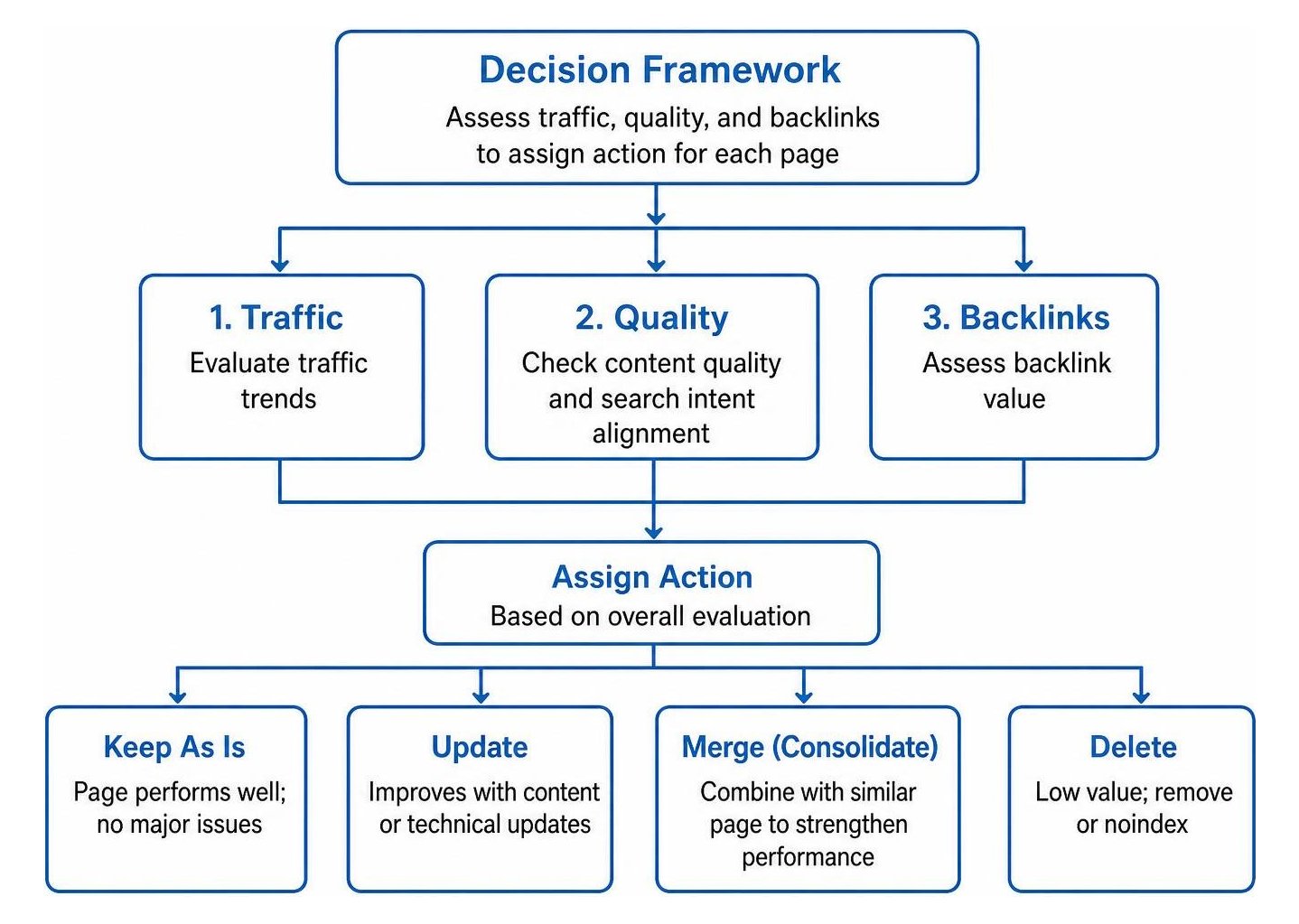
Applying systematic content audit decision frameworks removes emotional attachment from the review process.
| Action Status | When to Choose This Action | Strategic Remediation Step |
|---|---|---|
| Keep As Is | Page generates steady organic traffic, conversions, and high engagement. | Leave live; review internal links to pass equity to other pages. |
| Update / Refresh | Page has declining traffic, ranking positions 10–30, or outdated facts. | Perform a structured content refresh by expanding depth and fixing media. |
| Consolidate | Multiple URLs compete for identical terms with overlapping thin content. | Consolidate thin pages into a single pillar page and 301 redirect the rest. |
| Delete / Prune | Page has zero traffic, zero backlinks, and no business utility. | Execute systematic content pruning and serve a clean 410 or 404 response code. |
How Often Should an Organization Review and Refresh Content?
Organizations should conduct a full review at least once a year, while publishing teams benefit from running rolling reviews on a quarterly or bi-annual schedule.
Industry survey data reveals that one-third of marketers conduct content audits twice a year. High-publishing sites require frequent rolling reviews to prevent site drift, whereas smaller sites can manage with scheduled annual reviews.
Regular reviews help you spot every critical content gap left open by your competitors. Organizing your updated URLs into a structured content hub establishes strong topic authority across your target market.
Elevate Your Search Performance With Smarter Strategy
Keeping your website healthy requires regular evaluation, clean technical architecture, and a commitment to quality. Rather than letting outdated pages drag down your search performance, auditing gives your business a clear roadmap to higher rankings and stronger customer trust.
At SmallBizSEO, we help small businesses build sustainable organic growth through data-driven technical optimization, content strategy, and link building. If you are ready to evaluate your existing digital assets and build a clear plan for higher rankings, explore our specialized content audit services today to turn your website into a reliable engine for new business.