Stop Deleting Random Posts and Choose Smarter SEO Consolidation Instead

Should You Merge Outdated Blog Posts or Retire Them?
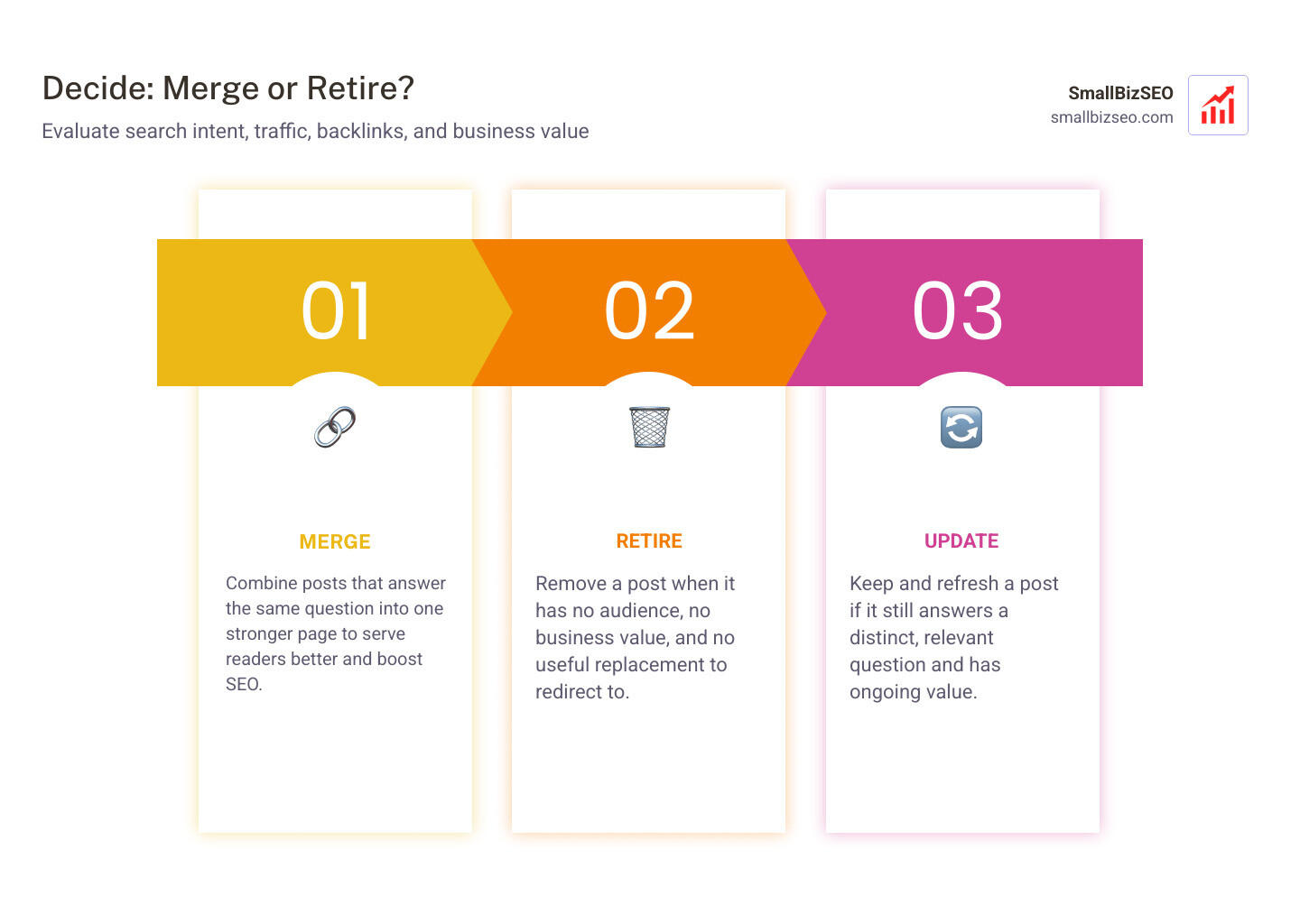
Here’s how to decide whether to merge outdated blog posts or retire them: merge posts that answer the same question when one updated page can serve readers better. Retire a post when it no longer serves your audience or business and has no close replacement. Before either choice, check its search queries, traffic, backlinks, and internal links. If it still answers a distinct question, keep it and update it instead.
I’m Clayton Johnson, founder of SmallBizSEO, where I help small businesses connect content and SEO with qualified leads. I use that experience to explain how to decide whether to merge outdated blog posts or retire them without overlooking a page that still has value.
How Do You Decide Whether to Merge Outdated Blog Posts or Retire Them?
Compare search intent, business relevance, audience need, traffic trends, and backlinks. Merge overlapping posts when combining them creates a more useful page; retire posts that no longer serve a relevant need.
When we evaluate aging content archives, we look closely at evaluating content decay rate to see whether a drop in visibility stems from stale facts or overlapping search intent. A page with declining traffic is not automatically a removal candidate, just as a page with strong traffic is not automatically worth keeping unchanged. A 3,000-word guide someone agonized over feels important even if it drew very few visits all year, but a structured inventory strips that emotional bias out.
Industry studies show that updating existing content is one of the highest-leverage actions available. Research from HubSpot found that 76% of blog views and 92% of leads came from older posts, with deliberate refreshes driving an average 106% traffic increase. Furthermore, 51% of companies noted that updating their existing library of content was their most efficient marketing tactic.
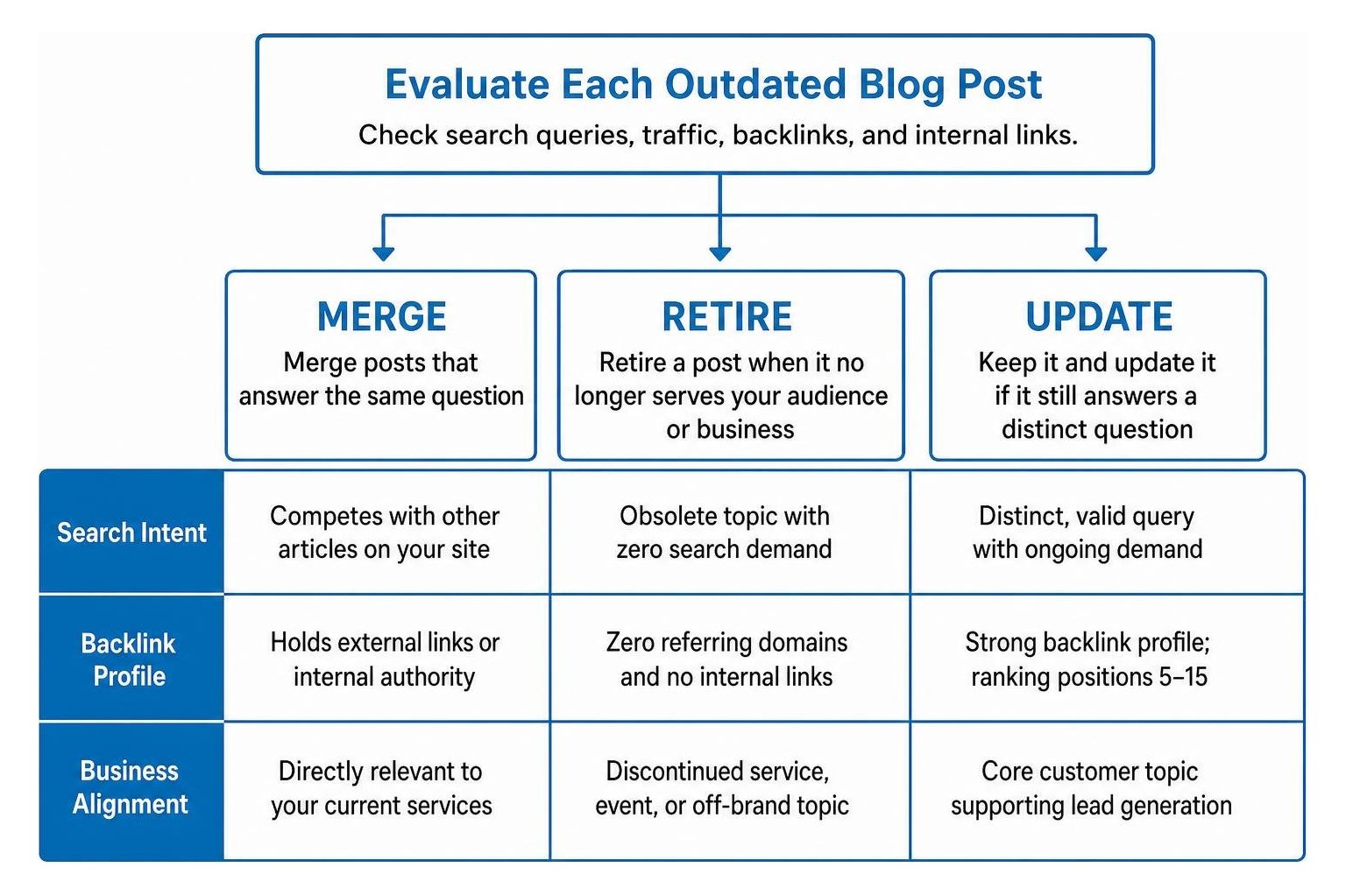
| Decision Factor | Merge into Survivor Page | Retire / Remove from Index | Keep & Update in Place |
|---|---|---|---|
| Search Intent | Competes with other articles on your site | Obsolete topic with zero search demand | Distinct, valid query with ongoing demand |
| Backlink Profile | Holds external links or internal authority | Zero referring domains and no internal links | Strong backlink profile; ranking positions 5–15 |
| Business Alignment | Directly relevant to your current services | Discontinued service, event, or off-brand topic | Core customer topic supporting lead generation |
| Action Taken | Consolidate content; implement 301 redirect | Return 410 / 404 response or apply noindex | Rewrite sections, add fresh data, retain URL |
How Can You Spot Keyword Cannibalization Before Deciding Whether to Merge or Retire Posts?
If multiple URLs receive impressions for the same queries and intent, compare them to see whether one consolidated page would better satisfy searchers.
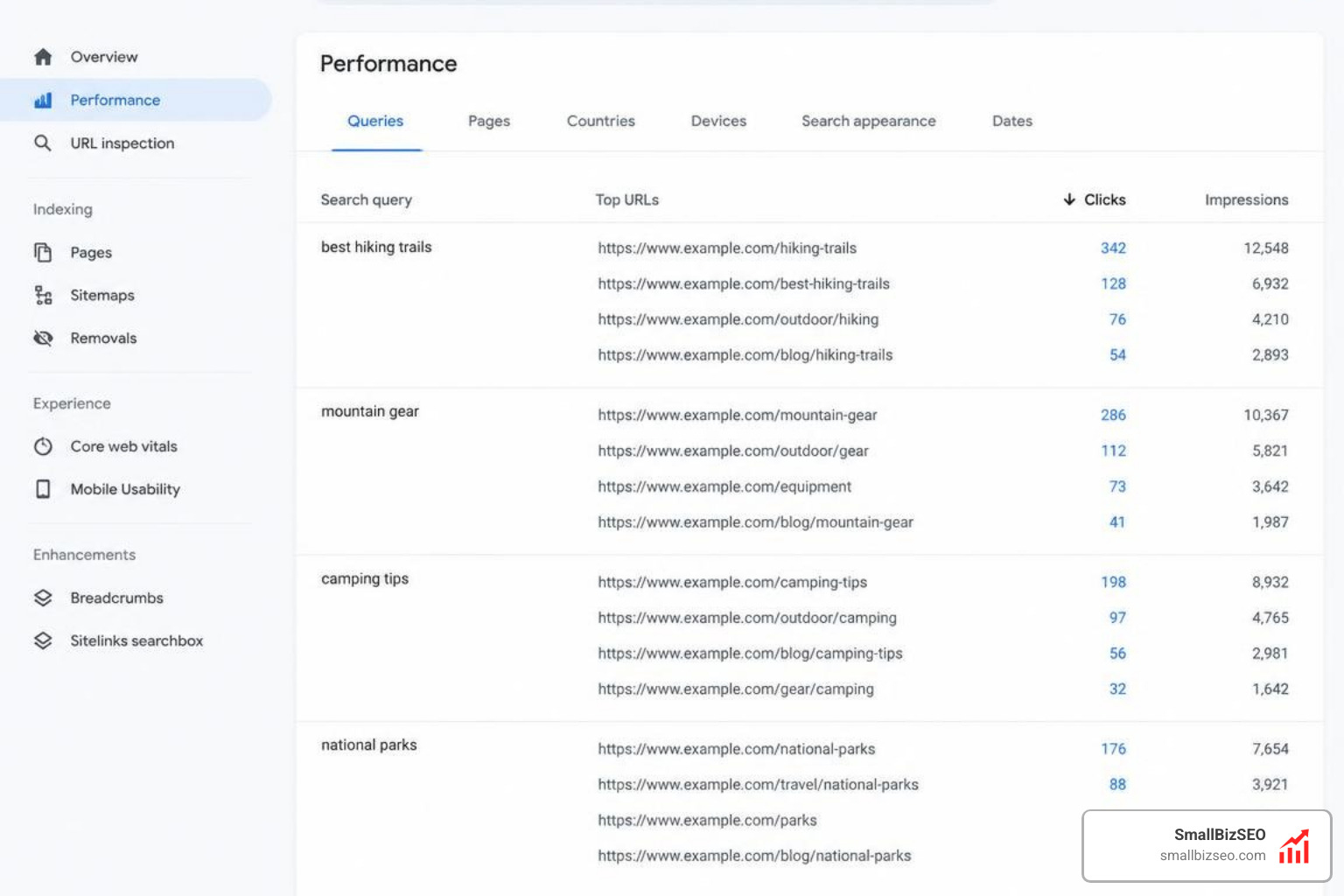
When two or more articles target identical search terms, they split clicks and ranking authority. To diagnose this, filter your queries in Google Search Console and inspect the Pages tab. If two URLs alternate positions or both linger on page two for the exact same target phrase, resolving keyword cannibalization by combining them is usually the fastest fix.
Merging eliminates thin content by combining short, fragmented insights into a comprehensive resource. Following a structured content cleanup guide helps prevent search engines from having to guess which URL is the best answer.
Should You Retire a Low-Traffic Post or Keep It Because Its Topic Still Matters?
Low traffic alone is not a reason to retire a post. Check whether it has useful backlinks, supports sales, or covers a topic that remains relevant to your audience.

An article might receive only a handful of organic visits each month while acting as a critical asset for sales enablement or customer onboarding. Before removing any page, audit its link profile. External backlinks provide domain authority across your entire site. As outlined in an editorial lifecycle audit methodology, if an old article has earned referring domains from reputable publications, it must never be deleted outright without a proper redirect strategy.
Retire a post only when the subject matter is permanently obsolete (such as past software release notes or discontinued product lines), has no inbound links, and cannot be responsibly redirected to an equivalent topic.
What Data Sources and Signals Should You Use?
Compare search performance, site analytics, and backlinks over time to understand whether a post has lost value or still helps readers and your business.
We evaluate candidates using three primary data sources:
- Google Search Console: Analyze clicks, impressions, average positions, and click-through rates. Look for pages ranking in positions 5–15 that show declining impressions, which indicates high-ROI refresh or merge potential.
- Website Analytics Platforms: Track organic entrances, user engagement duration, and goal completions to see if visitors take action after reading.
- Backlink Analysis Tools: Count unique referring domains and check whether inbound equity exists on the URL before modifying its status.
Reviewing these signals also helps uncover any content gap where user intent has shifted, allowing you to incorporate missing subtopics during consolidation.
How Do You Implement Merges, Redirects, and Pruning Safely?
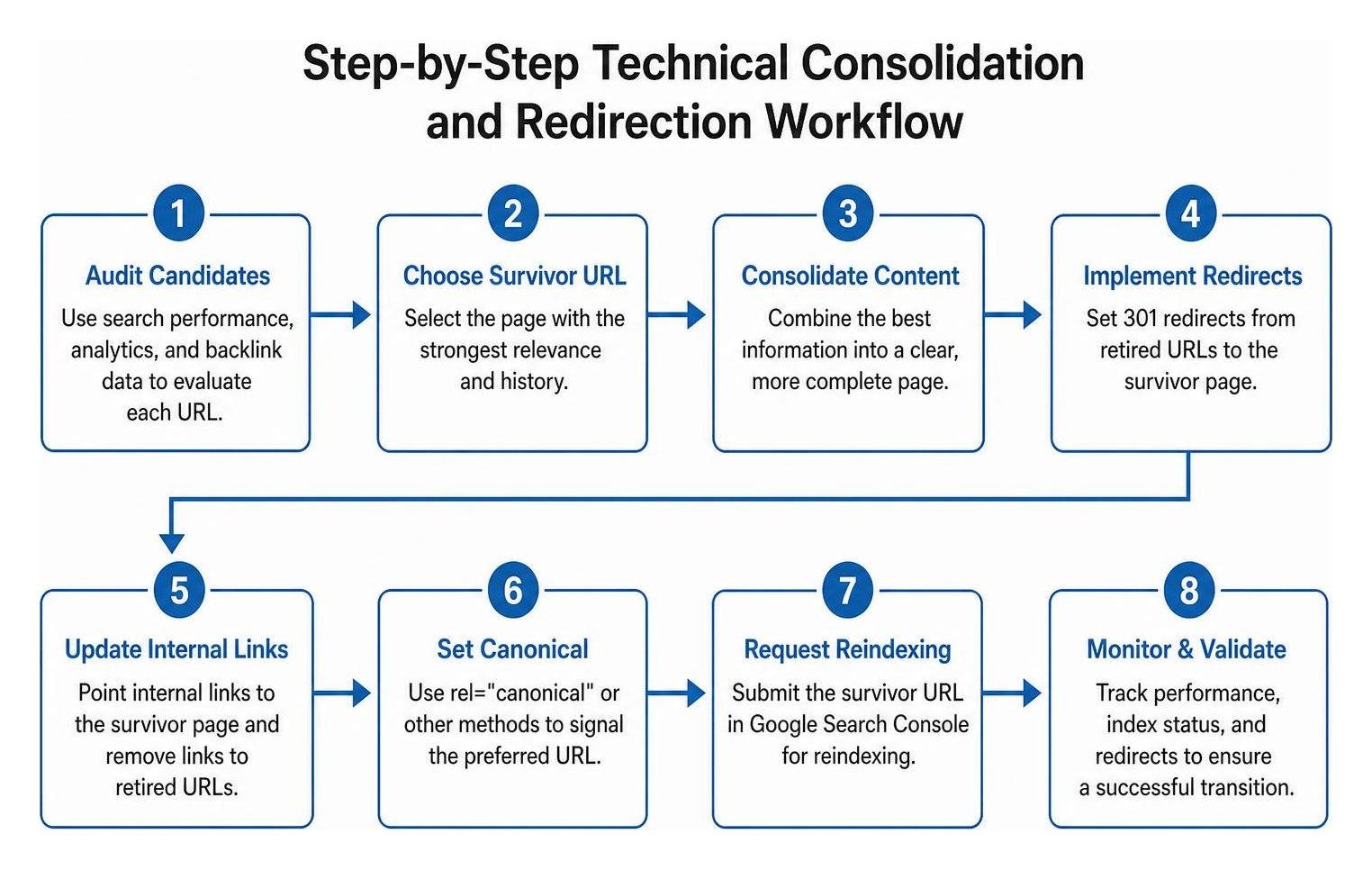
Keep the strongest relevant URL, consolidate useful content, and use the right status code and internal links to guide visitors and search engines.
Consolidating pages correctly preserves authority and ensures that search bots index the right URL. Google’s canonical documentation explains how to specify a canonical with rel="canonical" and other methods, emphasizing that permanent server-side redirects serve as clear signals for combining ranking equity.
How Do You Choose the Survivor URL and Consolidate Content?
Choose the URL with the strongest relevance and history, then combine the best information into a clear, more complete page.
When merging multiple articles, select the destination URL (the "survivor" or "hero" page) based on three objective criteria:
- Backlink Authority: The page with the highest number of quality referring domains.
- Historical Performance: The URL that has earned the most lifetime clicks and impressions.
- URL Structure: A clean, evergreen slug that does not contain specific dates or narrow phrasing.
Once the survivor is chosen, synthesize the content. Pull unique statistics, clear definitions, practical examples, or expert steps from the retiring page and merge them logically into the survivor page. Avoid simply pasting text at the bottom; rewrite sections so the combined article flows naturally.
How Should You Handle Redirects, Status Codes, and Internal Links?
Use a permanent 301 redirect when a page has a relevant replacement; use 404 or 410 when it has no suitable replacement, and update internal links to point to the right destination.
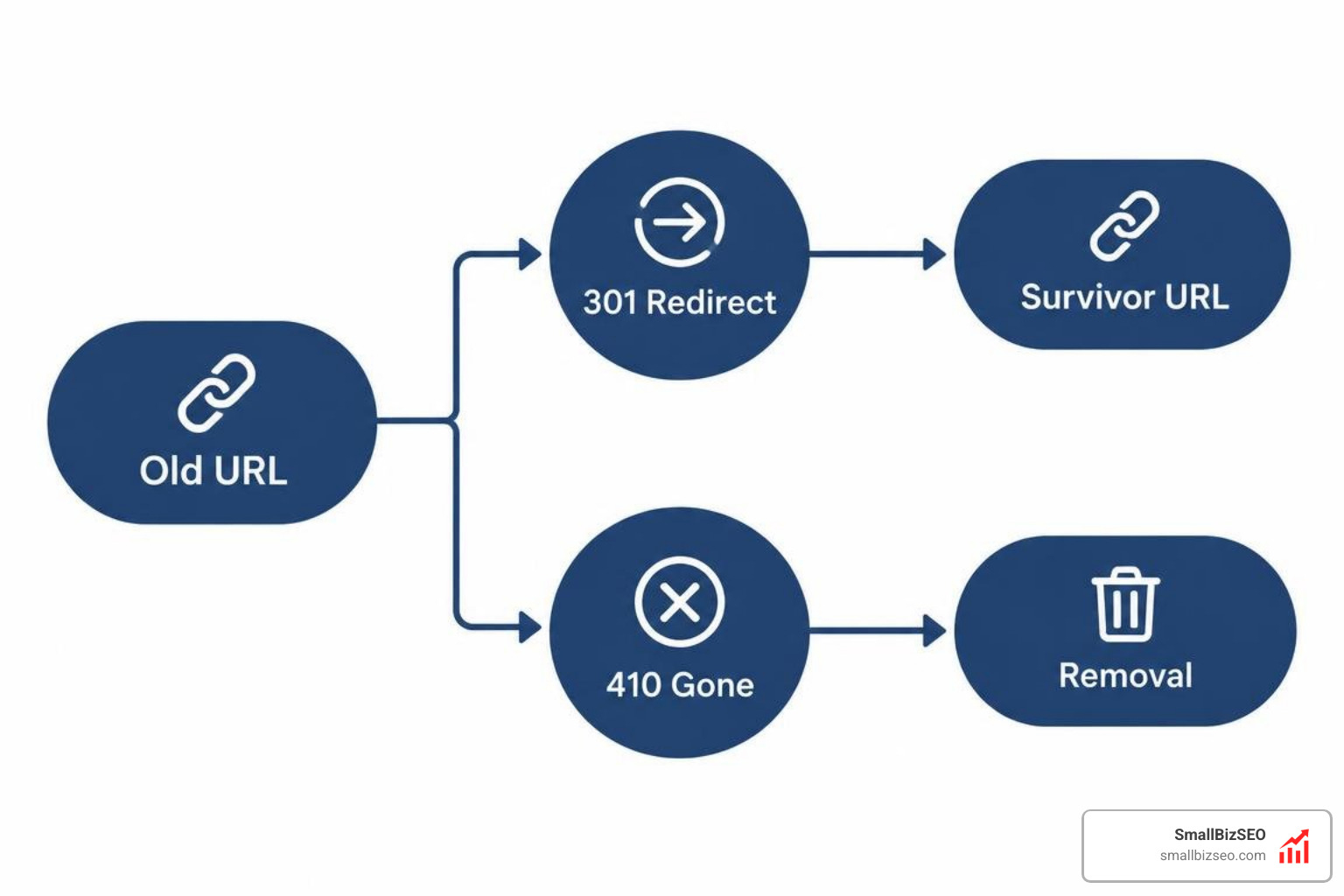
When consolidating articles, set up a server-side permanent 301 redirect from the old URL to the survivor URL. This transfers ranking signals and ensures readers encounter the right material. If an outdated post has no relevant match on your site, do not redirect it to your homepage, as search engines treat unrelated redirects as soft 404 errors. Instead, consider serving an HTTP 410 status code or standard 404 to tell crawlers the page has been permanently removed.
Follow these technical verification steps when executing a merge or retirement:
- Map every old URL to its exact, relevant replacement URL before applying server rules.
- Update every internal link across your site that pointed to the old URL so links point directly to the survivor page.
- Verify that the redirected URL is removed from your active XML sitemap.
- Check server response codes in a crawler to confirm no redirect chains exist.
How Often Should You Audit Content and Measure Long-Term Performance?
Review content at least quarterly, compare results with a baseline, and track whether updates improve performance over time.
A regular two-hour quarterly review keeps your library focused without overwhelming your team. By running a proven content audit process to revive dead traffic, you can maintain a lean site where every page serves a purpose.
Measure performance over a 4 to 8 week window post-merge by tracking impressions, organic clicks, average ranking position, and appearance in AI summaries. If managing legacy archives and technical cleanups exceeds your team's bandwidth, our team at SmallBizSEO provides data-driven professional content pruning and technical optimization to help your content compound value over time.
Turn Your Blog Archive into a Predictable Growth Asset
Managing an aging blog library requires treating every URL as an active business investment. By systematically auditing performance, merging overlapping pages into authoritative hubs, and retiring truly obsolete posts with clean status codes, you protect your backlink equity and make it easy for search engines to rank your best answers.
Set aside time each quarter to review your traffic data, eliminate keyword cannibalization, and consolidate thin content. A lean, up-to-date site consistently outperforms a bloated library of forgotten posts.