The Practical Guide to Content Audit Decision Frameworks

Introduction: Content Audit Decision Criteria for Keep, Update, Merge, or Remove
The content audit decision criteria for keeping, updating, merging, or removing pages come down to four tests: keep pages that are accurate, distinct, and useful; update pages that are strategically valuable but factually stale or underperforming; merge pages that compete with each other for the same search intent and dilute your topical authority; and remove pages that are obsolete, have no meaningful traffic or conversions, and hold no link equity worth preserving. Applying this framework keeps your site aligned with search intent while controlling content debt.
Building an extensive archive of articles, case studies, and service pages is an effective way to grow organic visibility, but unmanaged growth eventually creates significant content debt. Over time, search engines penalize sites with decaying, conflicting, or low-quality URLs, leading to lost rankings and wasted crawl budget. According to research across 14 billion web pages by Ahrefs, 96.55% of pages receive zero organic traffic from Google. Furthermore, SparkToro data shows that fewer than one in three Google searches result in a click to the open web. When digital landscapes shift toward conversational search and generative answers, keeping every page you have ever published without an active governance plan quietly undermines your website's topical authority.
A systematic review of your URLs separates high-performing assets from those that drain your domain's organic performance. As outlined in the foundational methodology of Content Inventory and Auditing 101 - NN/G, establishing a continuous diagnostic workflow allows marketing teams to evaluate historical content against clear editorial and technical benchmarks. We run content audits to identify keyword cannibalization, prune obsolete material, protect earned link equity, and align our sites with modern search intent.
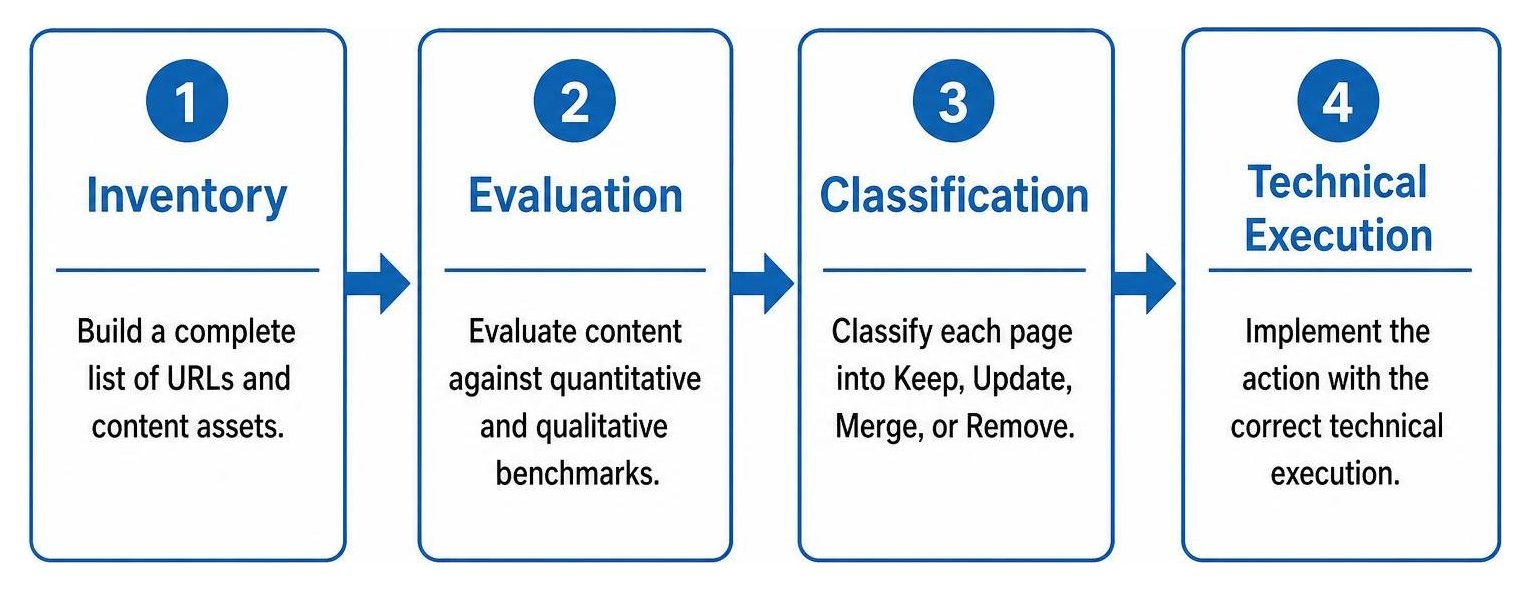
Evaluating Pages: The 4-Action Content Decision Matrix
A successful content audit balances quantitative metrics (organic traffic, conversions, backlinks) with qualitative evaluation (factual accuracy, messaging alignment, brand utility). Relying exclusively on traffic filters can lead teams to accidentally delete critical utility pages, legal notices, or high-converting bottom-of-funnel assets that simply target low-volume keywords.
To classify every page into one of four distinct actions, we evaluate URLs across search performance, business value, and topical overlap.
| Action | Primary Decision Criteria | Typical Traffic & Search Signals | Business & Value Alignment | Technical & Redirection Handling |
|---|---|---|---|---|
| Keep | Accurate, distinct, technically sound, and fully aligned with current search intent. | Stable or growing impressions, top-10 rankings, healthy engagement time. | Direct lead generation, assisted conversions, essential utility, or customer support. | Retain as is; log a future scheduled review date. |
| Update | Core topic remains strategically valuable, but details, media, structure, or rankings are decaying. | Declining impressions, ranking on page two or three, high bounce rate. | Strong conversion potential that is currently limited by stale or incomplete information. | Update on the existing URL to preserve backlink equity and historical indexation. |
| Merge | Two or more pages target substantially the same search intent, splitting organic equity. | Shared or cannibalizing keyword impressions, low click-through rates across multiple URLs. | Overlapping topics that create user confusion and dilute organic authority. | Consolidate top assets into the strongest URL; 301 redirect all subordinate URLs. |
| Remove | Completely obsolete, low quality, zero conversions, and holds no valuable external backlinks. | Zero organic search impressions and zero referral traffic over trailing 12 months. | Outdated service offerings, past events, or broken concepts with no current utility. | Serve an HTTP 410 Gone header or 301 redirect if an equivalent parent category exists. |
What Are the Core Content Audit Decision Criteria for Keeping or Updating Content?
To decide whether a page should be kept or updated, determine if the topic has ongoing business value and whether the existing content fulfills its promise to the reader.

1. Keep Criteria
A page should remain active without substantial edits when:
- The content is factually accurate, well-structured, and easy for search engines and answer engines to parse.
- It targets a dedicated primary keyword with clear search intent, ranking reliably in top positions.
- It provides a distinct conversion path, such as driving demo requests, newsletter signups, or phone inquiries.
- It fulfills a necessary operational, legal, or brand function (e.g., privacy policies, pricing sheets, terms of service).
2. Update Triggers
A page requires an editorial refresh when:
- Search Decay: Organic impressions or rankings have steadily slipped over consecutive quarters.
- Intent Mismatch: The page ranks for relevant queries but suffers from low click-through rates and high bounce rates because search engines have shifted how they interpret user intent. You can resolve this by aligning pages with true search intent.
- Factual Inaccuracy: The core premise is sound, but screenshots, pricing figures, tool recommendations, or industry regulations have changed.
- Content Gaps: Competitor pages cover essential sub-topics, structured FAQs, or technical specifications that your asset currently lacks.
When you discover decaying high-impact pages, prioritize them immediately. Marketing teams often see major ranking recoveries within 30 to 45 days simply by reviving dead traffic through a content audit and updating information directly on the existing URL.
What Are the Content Audit Decision Criteria for Merging or Removing Pages?
When multiple pages target the same topic or provide negligible value, keeping them separate degrades site-wide authority. Modern search algorithms evaluate overall domain quality; retaining hundreds of low-value, thin articles pulls down your organic visibility across the board.
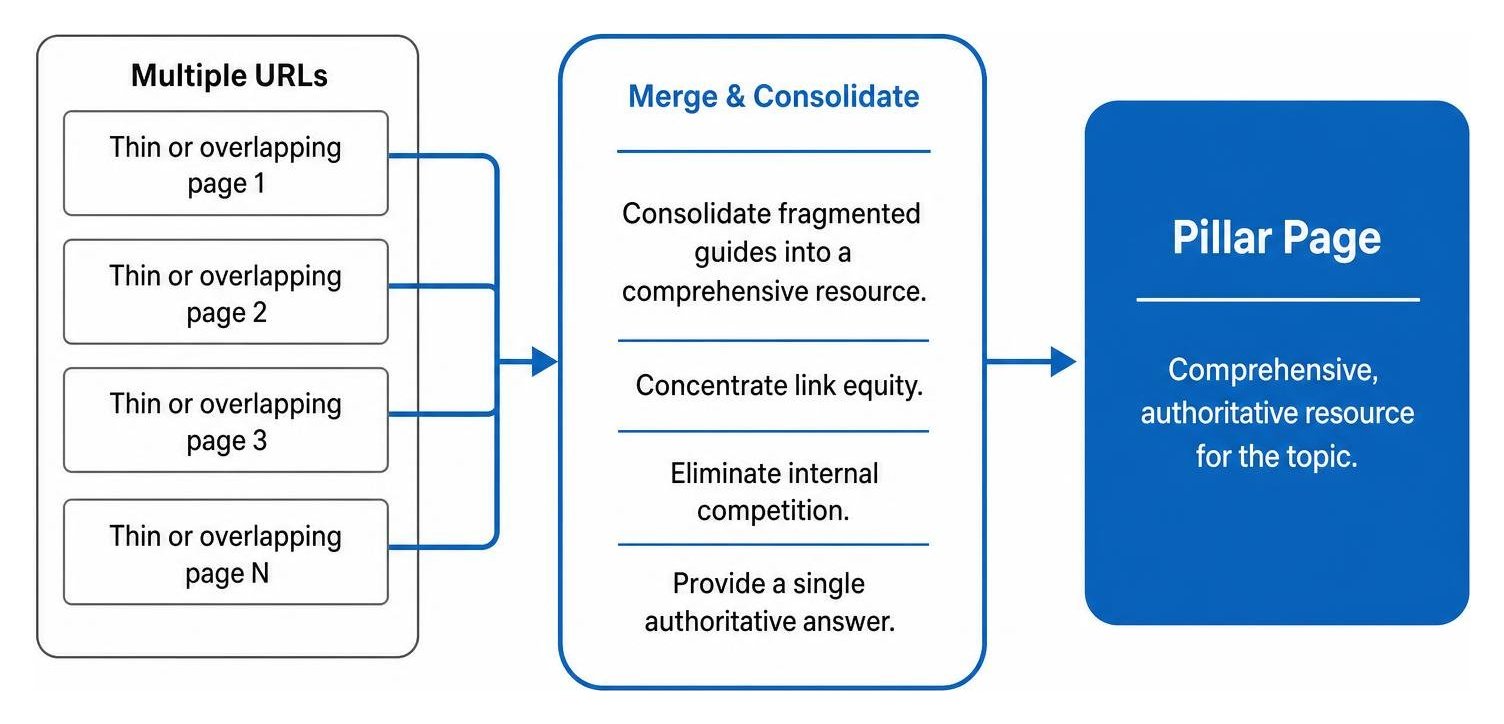
1. Merge Criteria
Merge pages when you have several thin or overlapping URLs competing for the same search query. Consolidating fragmented guides into a comprehensive resource allows you to concentrate link equity, eliminate internal competition, and provide a single authoritative answer. A structured audit that identifies and resolves thin content helps concentrate your topical authority. Following a systematic approach like the one in Content inventory: Your complete website audit playbook ensures no orphan URLs are overlooked during this consolidation phase.
2. Clear Signals Content Should Be Retired
A page should be permanently removed rather than updated or merged when it meets the following criteria:
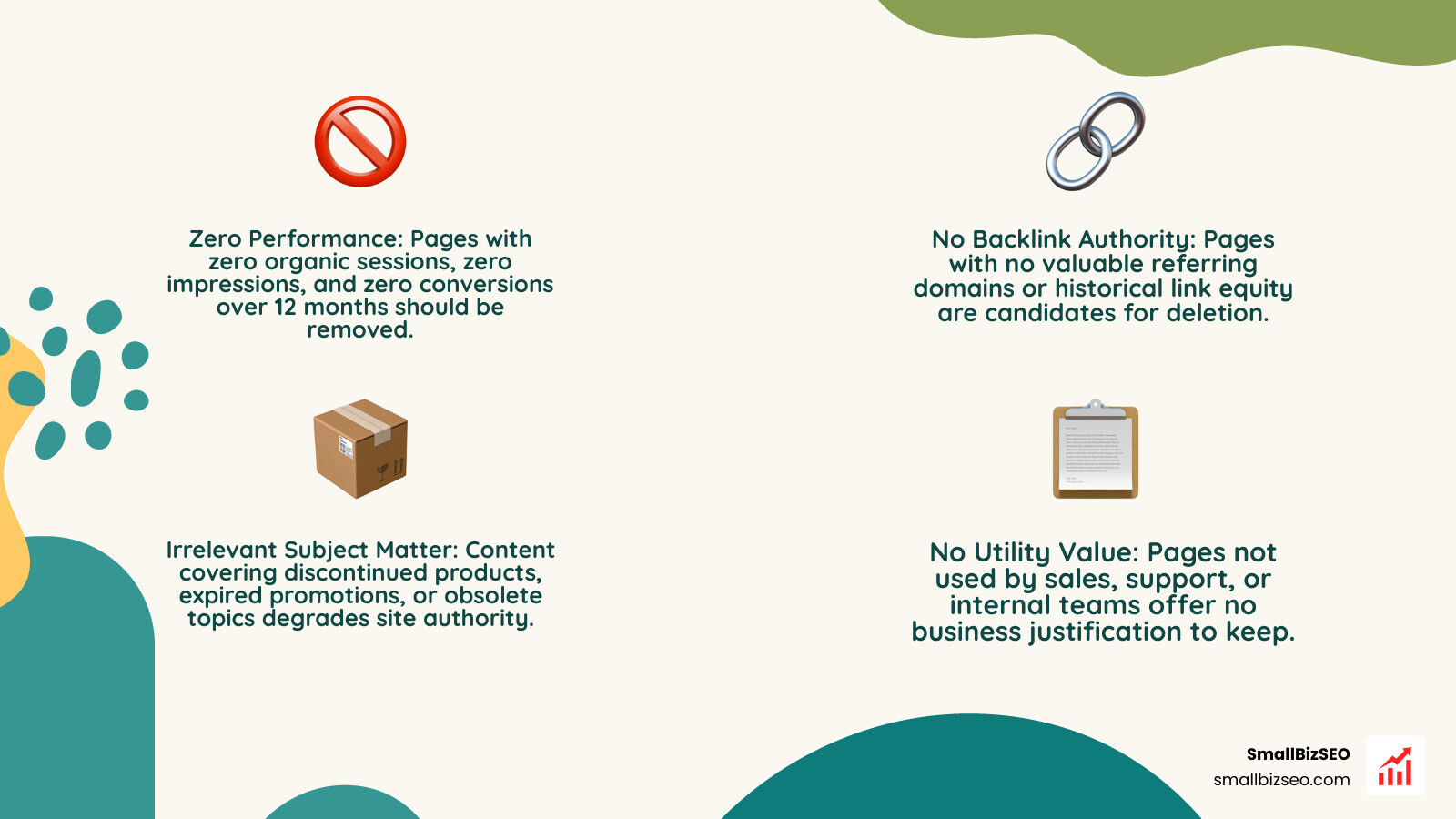
- Zero Performance: It has earned zero organic sessions, zero search impressions, and zero conversions over the past 12 months.
- No Referral or Utility Value: It is not used by sales teams, customer support, or internal staff.
- Irrelevant Subject Matter: It covers discontinued products, expired promotional campaigns, or legacy topics completely detached from your current business positioning.
- Zero Backlink Authority: It has no valuable referring domains or historical authority worth transferring to another URL.
How Does AI Search Visibility and the Replaceability Test Change Page Evaluation?
Evaluating content today requires looking beyond traditional search engine ranking pages. Modern answer engines, including ChatGPT, Perplexity, and Google AI Overviews, directly extract structured answers to satisfy user queries without sending a click to the source website. Data from Ahrefs shows that AI Overviews appear on over 20% of searches, cutting click-through rates on top organic results by up to 58%.
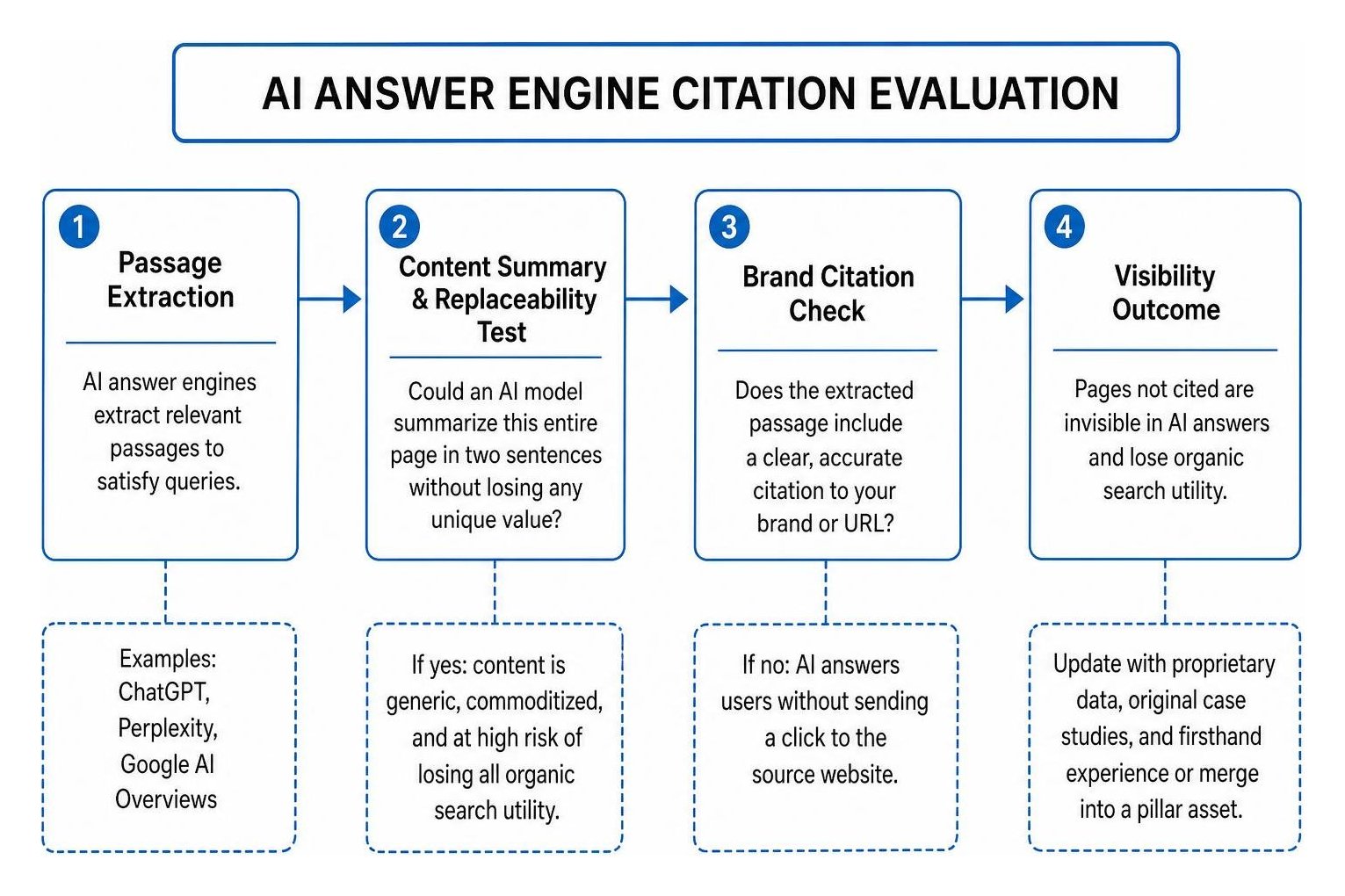
To adapt, content audits must incorporate Generative Engine Optimization (GEO) criteria:
1. The Replaceability Test
Ask this fundamental question during manual page reviews: Could an AI model summarize this entire page in two sentences without losing any unique value?
- If the answer is yes, the content is generic, commoditized, and at high risk of losing all organic search utility. It must either be updated with proprietary data, original case studies, and experience, or merged into a broader pillar asset.
- If the answer is no because the page contains unique proprietary data, distinct visual frameworks, expert commentary, or interactive tools, the asset passes the test and should be kept.
2. Content Freshness and LLM Citations
Research examining approximately 17 million citations across major AI search platforms indicates that content cited by AI systems runs approximately 25.7% fresher than pages ranking in traditional organic top-ten results. Stale definitions and unmaintained statistics cause AI engines to bypass your domain in favor of regularly updated publications.
3. Answer Extractability
To maximize citation rates, audit your heading hierarchies and paragraph structures. High-performing pages position direct answers within the first one to two sentences of each major section (under 80 words), followed by structured data tables, clear entity relationships, and bulleted lists.
Execution Protocols: Consolidating, Redirecting, and Governance
Making audit decisions in a spreadsheet is only half the battle. Executing those decisions cleanly without creating broken links, indexing loops, or 404 errors is what protects and grows organic traffic.
How Do You Identify Keyword Cannibalization and Retain Backlink Equity?
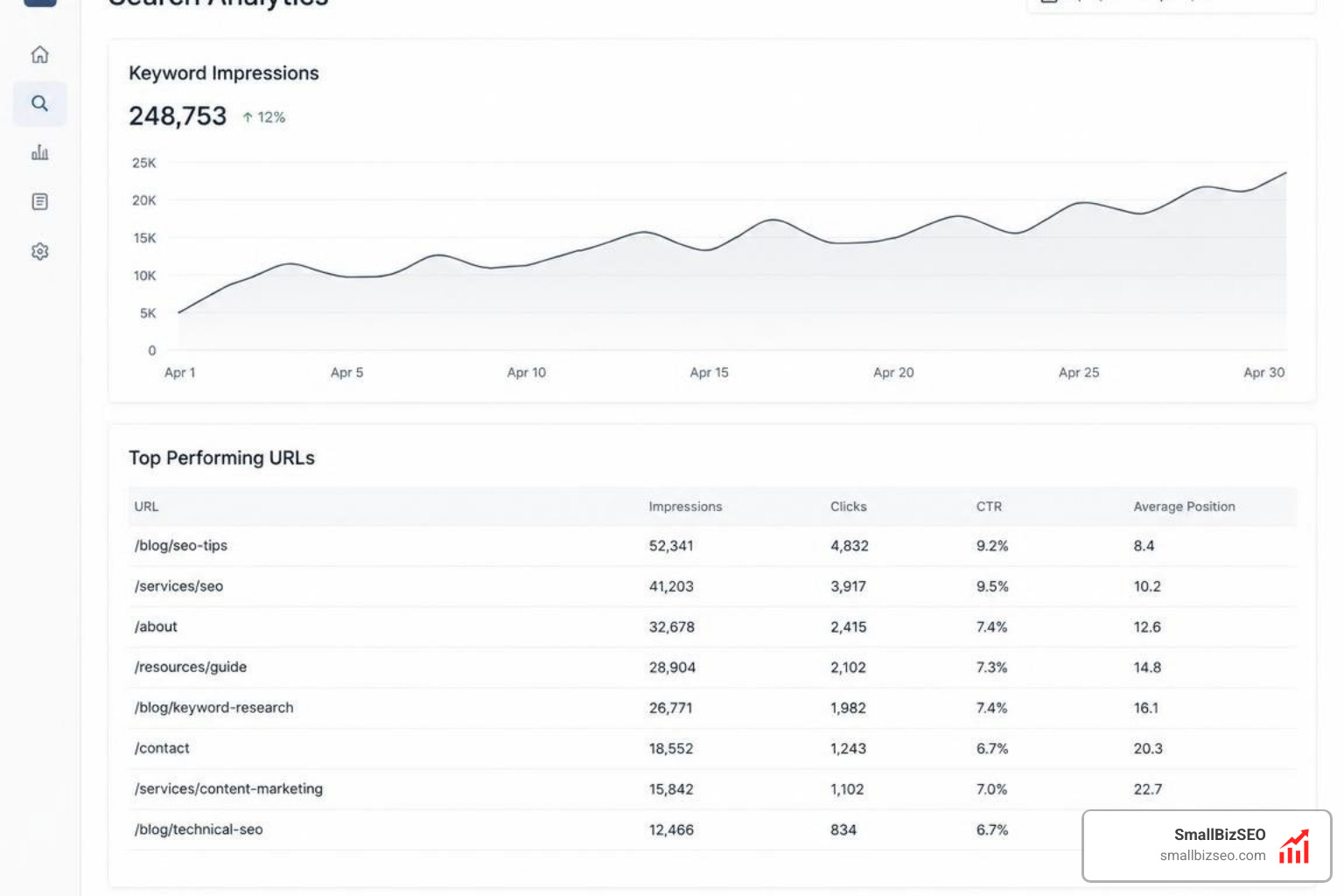
Keyword cannibalization occurs when multiple URLs on your domain target identical search intent, forcing Google to alternate which page it indexes. This splits impressions, dilutes click-through rates, and keeps all competing URLs from reaching their full ranking potential.
To identify cannibalization:
- Export Google Search Console query performance reports over a trailing 6-month window.
- Filter by high-impression commercial queries and inspect the Pages tab.
- If two or more URLs receive similar impressions and clicks for the exact same query, cannibalization is occurring.
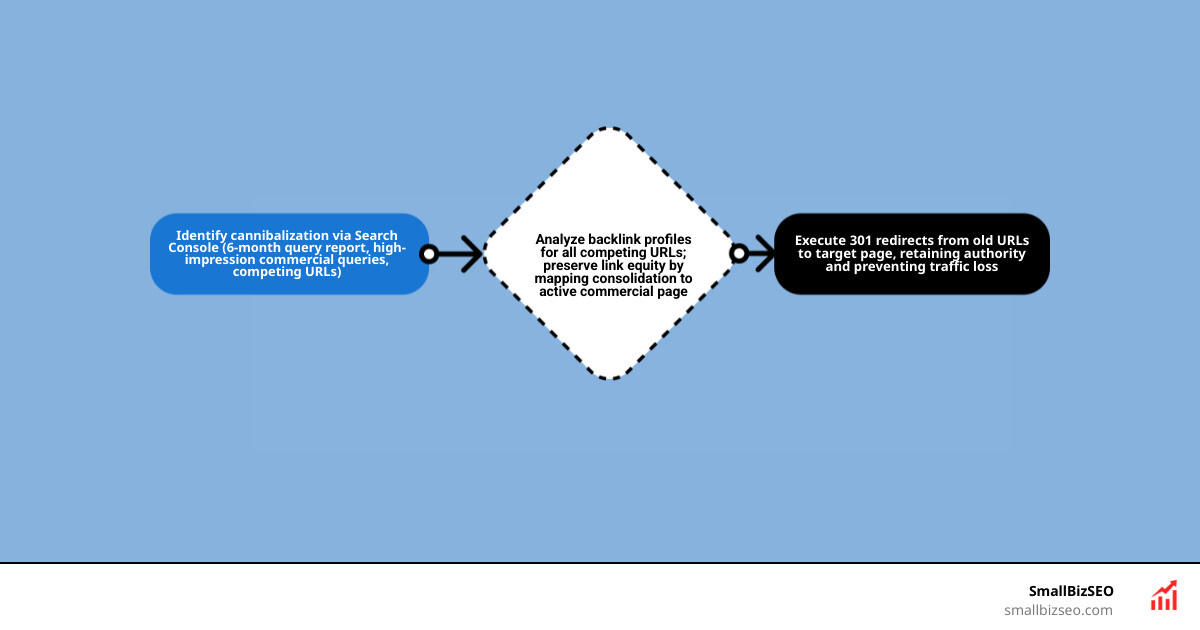
Before modifying or deleting any URL, inspect its backlink profile using a backlink analysis tool. Even if an older blog post generates zero organic traffic today, it may hold 10 or 15 high-authority referring domains. Deleting that URL destroys the accumulated link equity. Instead, map that page for a consolidation or redirect so that authority flows directly into an active, relevant commercial URL.
How Should You Execute Merges and 301 Redirects Without Traffic Loss?
When merging multiple overlapping articles into a single primary URL, execute the following technical workflow:
- Select the Primary Destination URL: Choose the page with the highest historical authority, strongest backlink profile, or cleanest URL structure.
- Consolidate Editorial Value: Migrate unique case studies, data points, quotes, and actionable sections from the subordinate URLs into the primary page.
- Map 301 Redirects: Implement server-side permanent 301 redirects pointing each retired URL directly to the expanded primary page. You can follow our detailed redirect mapping process to avoid redirect chains.
- Update Internal Links: Crawl your site to identify internal links pointing to the old URLs and update them to point directly to the new primary destination.
- Request Indexing: Submit the updated primary page via Google Search Console to prompt search crawlers to re-evaluate the consolidated asset.
Well-executed content merges regularly produce a 40% to 80% ranking lift on target keywords within 60 days because the combined page satisfies user intent more thoroughly than disjointed URLs.
When Is HTTP 410 Removal the Right Choice Over Redirection?
A common SEO mistake is bulk-redirecting every low-performing, dead URL to the homepage or an unrelated category page. Google treats these as soft 404 errors, which wastes server resources and passes no link equity.
When removing content that has no relevant thematic replacement and zero inbound backlinks, serving HTTP 410 Gone headers is the correct protocol. An HTTP 410 status code informs search crawlers that the page has been permanently removed intentionally, accelerating de-indexation and freeing up crawl budget far faster than standard 404 errors.
Streamlining Your Content Strategy for Sustainable Growth
A content audit is not a one-time clean-up task; it is an ongoing governance mechanism that protects domain authority, clarifies search signals, and improves user experience. Rather than continuously publishing new articles onto an unmanaged website, auditing your library ensures every URL on your site serves a clear business purpose.
By applying objective criteria to keep, update, merge, or remove assets, you eliminate low-value noise and strengthen your site's organic rankings. If you need professional support auditing an extensive content library, analyzing AI citation visibility, or resolving complex cannibalization issues, explore our specialized SmallBizSEO content audit services to optimize your content inventory for sustainable growth.