The Ultimate Content Audit Process to Revive Dead Traffic

The Ultimate Content Audit Process to Revive Dead Traffic
Why Your Existing Content Is Costing You Traffic Right Now
An SEO content audit is the process of systematically analyzing every page on your website to measure how well it performs in search, then deciding whether to keep, update, consolidate, or delete it.
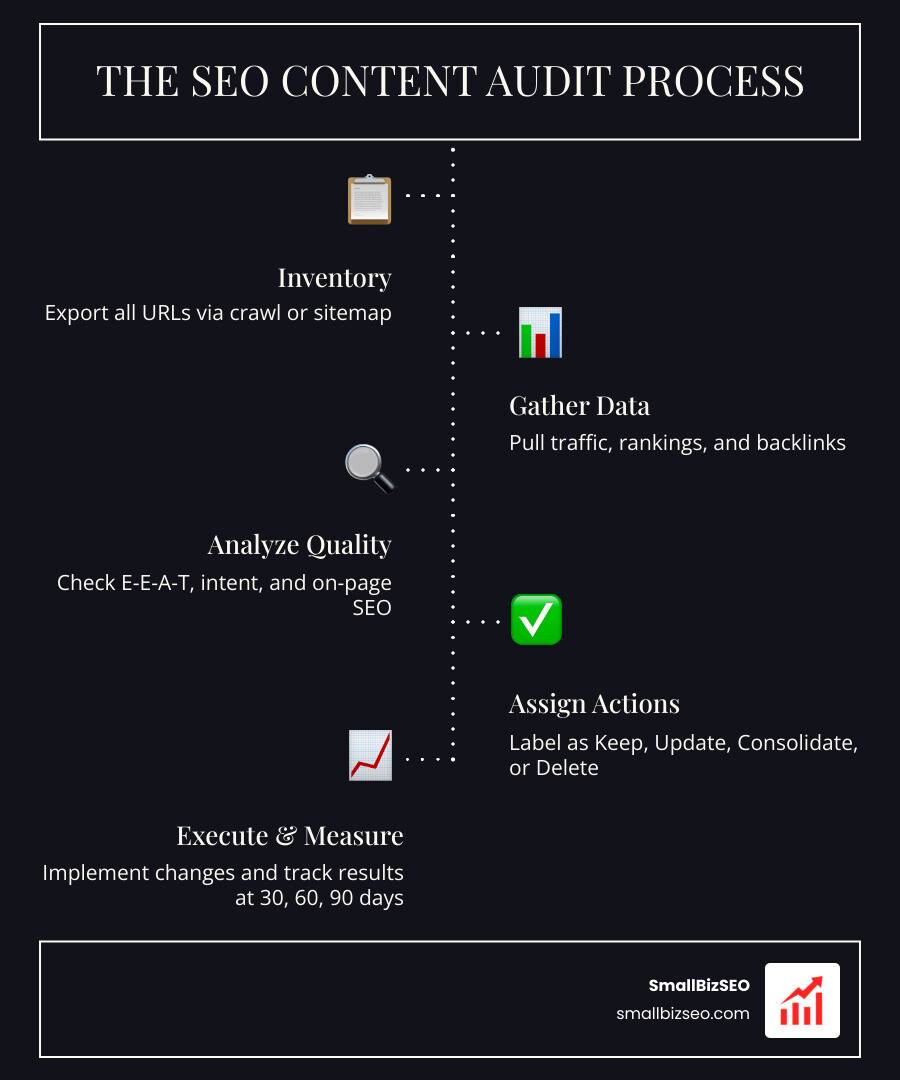
Here is a quick overview of what the process involves:
- Inventory your content - Export all URLs using a crawl tool or your sitemap
- Gather performance data - Pull organic traffic, keyword rankings, and backlinks
- Analyze content quality - Check E-E-A-T signals, search intent match, and on-page elements
- Identify problems - Flag keyword cannibalization, thin content, and technical issues
- Assign actions - Label each page as Keep, Update, Consolidate, or Delete
- Execute and measure - Implement changes and track results at 30, 60, and 90 days
Most small business owners focus almost entirely on publishing new content. But here is the uncomfortable truth: the pages you already have are quietly decaying. Rankings slip. Traffic drops. And because nothing breaks visibly, it goes unnoticed for months.
One sharp observation captures this perfectly — marketing teams often get caught in a cycle of creating and publishing content just because, without ever knowing what is actually working.
That cycle is expensive. And an SEO content audit is how you break it.
I'm Clayton Johnson, a digital PR and SEO specialist who has helped businesses recover lost search visibility through structured SEO content audits and data-driven content strategies. In the sections below, I'll walk you through the exact process we use to turn underperforming pages into traffic assets.
Related content about SEO Content Audit:
What is an SEO Content Audit and Why Does It Matter?
An SEO content audit is not just a spreadsheet of links; it is a diagnostic health check for your digital presence. When we build out a comprehensive content inventory, we look beyond simple page titles. We analyze how every single piece of content contributes to your overall search visibility.
Over time, websites experience what we call traffic decay. Older pages lose their relevance, search intent shifts, and search engine algorithm updates change how content is prioritized. If you leave these decaying pages untouched, they act like anchor weights pulling down your entire domain's authority. By identifying underperforming pages, we can systematically refresh them to align with modern search behaviors. To evaluate where your site stands, you can Learn more about our SEO visibility audit.
How It Differs From a General Website Audit
While a general website audit looks at broad issues like general user experience and branding, an SEO content audit focuses specifically on organic search performance.
A technical crawlability check ensures search engine bots can access your pages, but the content audit goes deeper. We examine search intent alignment, exact keyword rankings, and user engagement metrics. A page might load perfectly and look beautiful, but if it targets the wrong keywords or fails to answer the user's query, it will never rank. For a complete look at your site's health, you can Discover our detailed SEO analysis services.
The Business Value of Auditing Existing Assets
Optimizing what you already own yields a much higher ROI than starting from scratch. Producing a brand-new article requires hours of research, writing, and waiting weeks for indexation. Conversely, updating an existing page that already has established link equity and historical trust can yield massive traffic boosts in a fraction of the time.
Additionally, cleaning up your site prevents content bloat. Too many low-quality pages dilute your crawl budget—the limited number of pages a search engine crawler will review on your site during a given period. By pruning the dead weight, you ensure search engines focus on your high-converting, high-value pages. To understand how this fits into your broader growth strategy, Explore our guide on SEO content marketing.
Step-by-Step Guide to Conducting a Successful Audit
Conducting an audit does not have to be an overwhelming chore. By setting up a clear, structured framework, you can systematically analyze thousands of pages without losing your mind.

Phase 1: Compiling Your Content Inventory
The first step is to gather every single live URL on your domain. We use crawl tools like Screaming Frog to crawl the site, supplemented by exporting your XML sitemaps.
During this URL extraction phase, we pay close attention to HTML status codes. We want to make sure we are only auditing live pages returning a successful status code, while flagging broken pages that need immediate attention. For a structured approach to this phase, Read about the 15-point SEO content audit checklist.
Phase 2: Gathering Performance and LLM Metrics
Once we have our list of URLs, we connect our data sources to populate our master spreadsheet. We pull organic clicks, impressions, and click-through rates directly from Google Search Console, alongside session data from Google Analytics 4.
In the modern search landscape, we must also track AI search visibility and LLM citations. AI search engines and answer engines pull information from authoritative, structured content. We look for referral traffic from AI platforms to see how well our brand is being cited in conversational search results. To see how we turn these raw numbers into growth, check out how to Turn your data into traffic.
Phase 3: Analyzing Content Quality and E-E-A-T
Search engines place immense value on trust. During our qualitative review, we evaluate every page for E-E-A-T (Experience, Expertise, Authoritativeness, and Trustworthiness) signals.
We check if the content showcases verifiable first-hand experience and includes clear author credentials, such as a biography linking to professional achievements. We also assess content completeness to ensure we are answering the user's primary question and addressing common follow-up queries. For a deep dive into building search trust, read our guide on How to optimize your content for E-E-A-T.
Resolving Keyword Cannibalization and Link Equity Issues
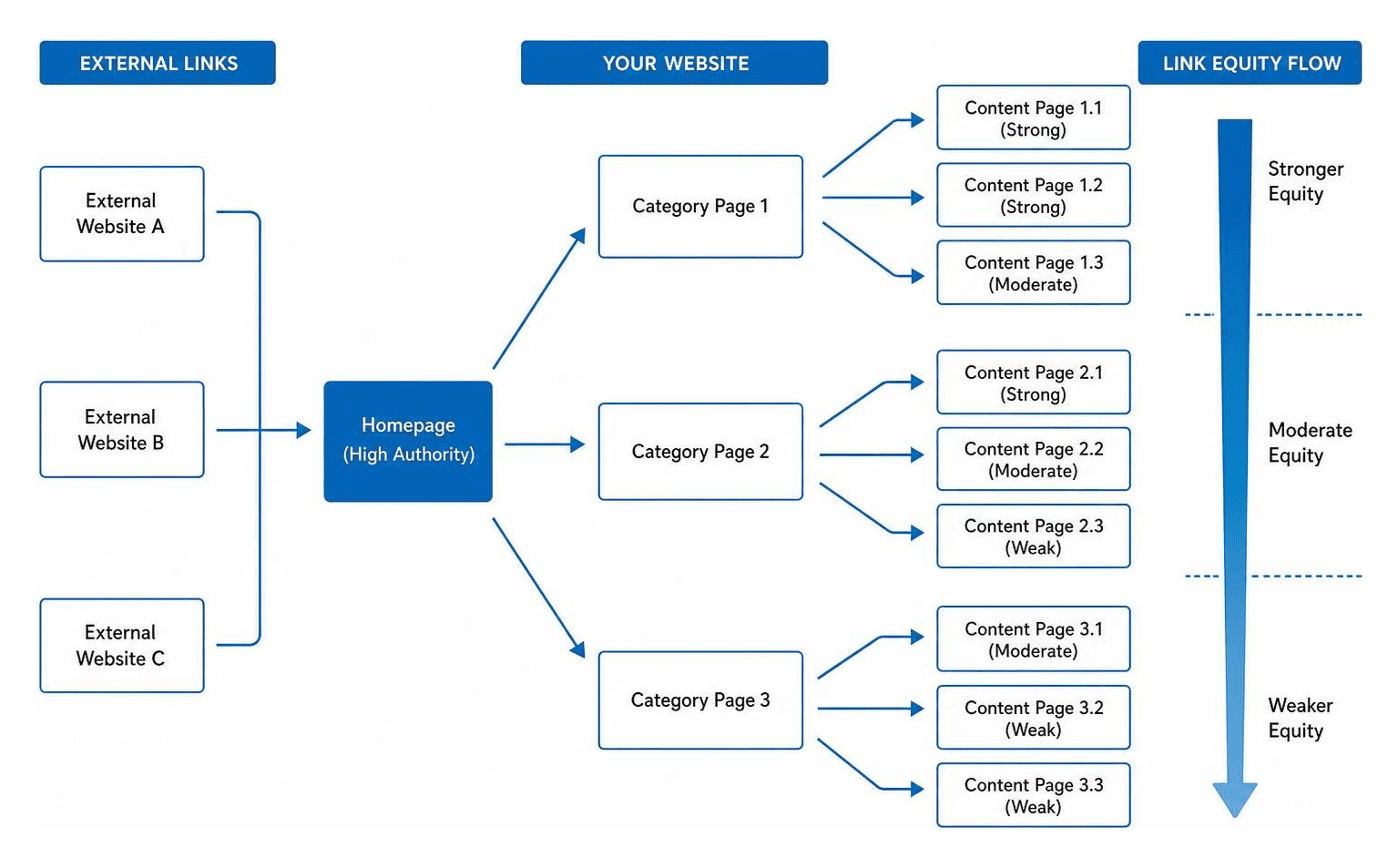
A common reason high-quality pages fail to rank is internal competition. When multiple pages on your site target the exact same keyword, they end up fighting each other for search engine results pages supremacy.
Identifying and Fixing Keyword Cannibalization
Keyword cannibalization occurs when search engines cannot determine which of your pages is the best match for a query. This search intent mismatch splits your rankings and dilutes your organic visibility.
To resolve this, we search for overlapping keywords across our content inventory. If we find three different blog posts trying to rank for the same term, we merge their unique insights into one comprehensive "power page." We then implement 301 redirects from the old URLs to the new primary page to consolidate their ranking power. To learn how to spot and fix these overlaps, Understand keyword cannibalization and how to fix it.
Optimizing Internal Links and Backlink Distribution
Internal links act as pathways for both users and search crawlers, distributing link equity throughout your site. During an audit, we frequently find orphan pages—valuable content assets that have zero internal links pointing to them.
By building a logical internal linking structure with descriptive anchor text, we signal to search engines which pages are our most important pillars. Additionally, we analyze our backlink profile to ensure external validation is flowing naturally to our high-priority commercial pages. If your content is great but still struggling to rank, Learn why your rankings are still stuck.
Evaluating On-Page Elements and Technical Foundations
Even the most brilliant writing will fail to rank if its technical foundation is unstable or its on-page meta elements are poorly optimized. We use a structured approach to evaluate these elements systematically.
| On-Page Element | SEO Impact | Optimization Goal |
|---|---|---|
| Title Tags | Critical | Keep between 50-60 characters; place primary keyword in the first half. |
| Meta Descriptions | High (CTR) | Write compelling value propositions within 150-155 characters. |
| Header Tags (H1-H3) | High | Use semantic hierarchy; incorporate keyword synonyms naturally. |
| Core Web Vitals | Medium-High | Ensure fast loading speeds and smooth visual stability. |
To ensure your pages meet these structural benchmarks, you can Get professional on-page SEO support.
Optimizing On-Page Architecture for Search Engines
Your page's on-page architecture must make it incredibly easy for both search engines and human readers to scan and understand the topic. We organize content using semantic headings, ensuring H2 and H3 tags use keyword synonyms rather than repeating the same exact-match phrases.
Additionally, we optimize title tags and meta descriptions to improve organic click-through rates. Adding specific numbers or years to your titles can boost click-through rates significantly. To improve your overall content standards, Read about our SEO friendly content writing.
Technical SEO Checks for Content Visibility
A technical content audit ensures that search engines can actually crawl and index your pages. We check for accidental noindex tags or restrictive robots.txt directives that might be blocking search crawlers.
We also evaluate user experience metrics like Core Web Vitals. Specifically, we look at Largest Contentful Paint (how fast the main content loads) and Interaction to Next Paint (how quickly the page responds to user inputs). A sluggish page frustrates users and search engines alike, leading to lower rankings.
Prioritizing Actions: Keep, Update, Consolidate, or Delete
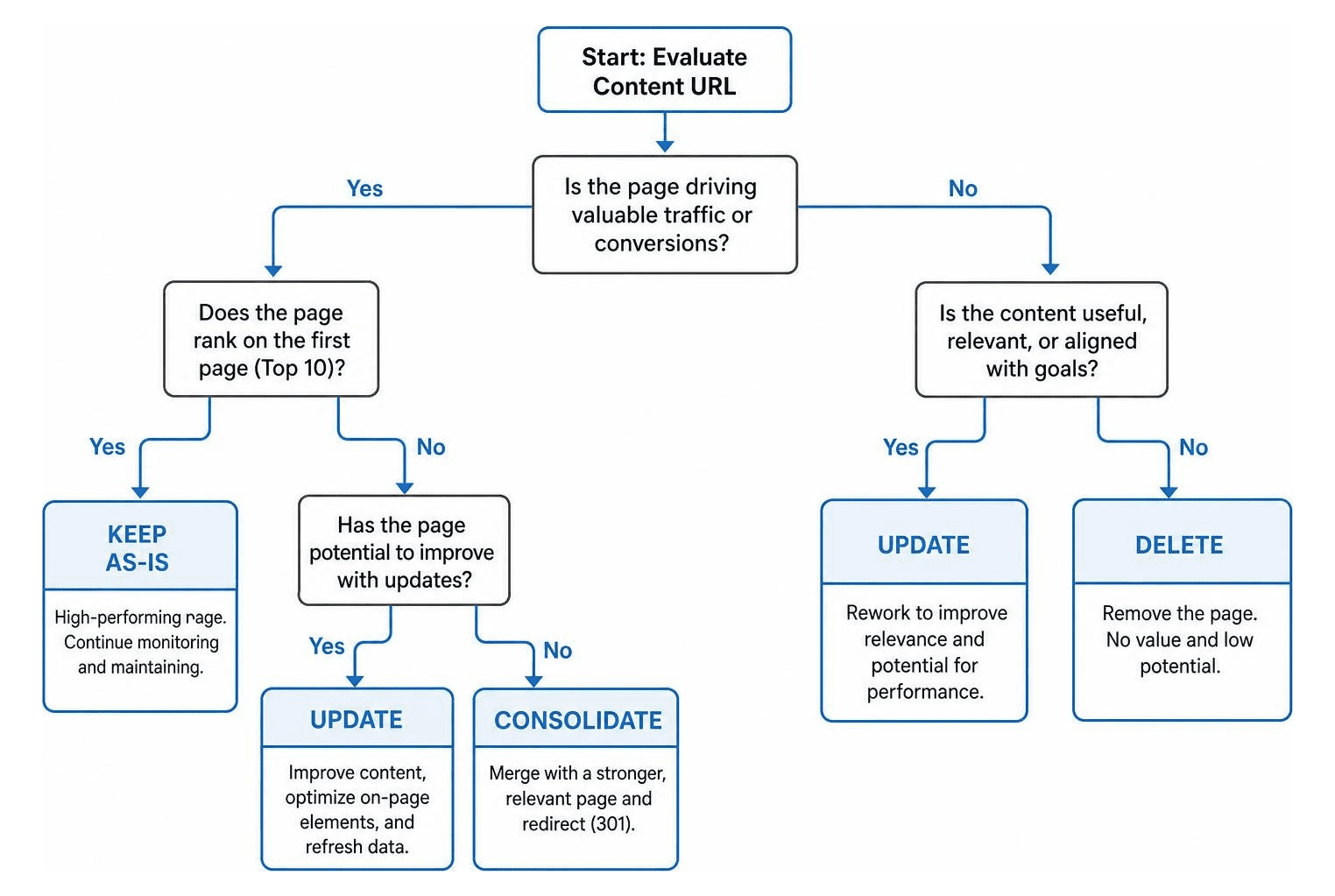
Once your data is compiled, it is time to make decisions. To avoid spreadsheet paralysis, we use a simple decision-making framework to assign a clear action to every single URL.
To explore how these decisions fit into a broader growth plan, Find out how to go beyond content optimization.
Executing the Keep and Update Decisions
- Keep As-Is: Reserved for high-performing pages that currently rank on the first page of search results and drive consistent conversions.
- Update: Best for "striking distance" keywords—pages currently ranking in positions 11 through 25.
When updating, we focus on content freshness. We do not just add fluff; we make additive updates by introducing fresh statistics, original data, or answering helpful user questions. To build a repeatable system for these updates, Improve your content planning process.
Managing Consolidations and Deletions Safely
- Consolidate: If you have multiple thin, underperforming pages covering the exact same topic, merge them. Always redirect the weaker URLs to the primary survivor page to preserve historical link equity.
- Delete: If a page has zero traffic, zero backlinks, and holds no business value, it is ROT content (Redundant, Outdated, or Trivial). We can safely delete it. Just be sure to set up a 301 redirect to the most relevant active page to avoid creating broken 404 errors.
To identify what content is missing from your library during this pruning phase, you can Conduct a keyword gap analysis.
Establishing Your Long-Term Content Governance Strategy
An SEO content audit is not a one-time project; it is an ongoing business habit. To keep your search visibility compounding over time, you need a structured content governance strategy.
How Often Should You Run an SEO Content Audit?
We recommend a tiered audit cadence to keep your site in peak condition:
- Quarterly: Conduct a quick striking distance review of your top-performing pages to capitalize on quick wins.
- Semi-Annually: Run a site-wide quality review to catch content decay and adjust for recent algorithm updates.
- Annually: Execute a comprehensive, full-scale SEO content audit to clean up legacy pages and re-align your overall content strategy.
For continuous optimization insights, you can Check out our blog for more SEO tips.
Choosing the Right Tools for an SEO Content Audit
To streamline your auditing workflow, you can leverage a mix of powerful industry tools:
- Screaming Frog: Excellent for compiling your initial content inventory and checking technical health.
- Google Search Console & GA4: Essential for pulling accurate, first-party traffic and indexation data.
- Semrush or Ahrefs: Great for monitoring competitor keyword gaps, backlink profiles, and tracking overall search visibility.
If you prefer a completely hands-off, expert approach, you can partner with a professional agency to manage your audits and ongoing strategies.
Frequently Asked Questions About Content Performance
Will deleting old content hurt my website's SEO?
Only if you do it incorrectly. Deleting a page without setting up a proper 301 redirect destroys link equity and creates broken links, which harms user experience. However, deleting thin, outdated content that has no traffic or backlinks actually improves your site's overall quality score and optimizes your crawl budget.
How long does it take to see results after an audit?
Once you implement your audit recommendations—such as updating on-page metadata, consolidating thin content, or fixing technical indexation issues—it typically takes 4 to 8 weeks for search engine crawlers to re-index your pages and for ranking adjustments to reflect in your search console.
Can AI tools automate the entire content auditing process?
AI tools are fantastic for summarizing long pages, identifying topic gaps, and speeding up data analysis. However, they cannot replace human oversight. Strategic decision-making, brand alignment, and evaluating E-E-A-T signals still require a human touch to ensure true content quality.
Revitalize Your Search Performance Today
At SmallBizSEO, we help small businesses stop wasting resources on ineffective content. Our proprietary "Velocity" framework delivers rapid ranking growth and E-E-A-T-compliant optimization through transparent, automated reporting.
We are here to help you turn dead weight pages into high-performing customer acquisition assets.
Ready to clean up your site and revive your organic traffic? Partner with us for professional SEO content services.