Stop Publishing Fluff by Aligning Startup SEO Content with Real Search Intent

Why Early-Stage Content Fails Without Intent-Driven SEO
A startup SEO content strategy starts with the searches your potential customers make, not a list of blog ideas. To build one:
- Choose a customer problem your product or service solves.
- Find specific searches tied to that problem and check what people expect to see.
- Create useful pages that answer those searches, link related pages, and give readers a clear next step.
- Track qualified inquiries and sales, not just visits.
This keeps a small team from spending time on content that attracts readers who are unlikely to become customers.
I'm Clayton Johnson, founder of SmallBizSEO. My work connects SEO, content, and digital PR to help businesses build visibility and earn qualified leads; in this guide, I'll show you how to put that approach into a startup SEO content strategy.
Simple guide to startup SEO content strategy:
- data driven SEO small business
- transparent SEO reporting small business
- startup SEO reporting transparent
Early-stage companies often fall into the trap of writing about company updates or high-volume keywords with zero commercial value. While a generic post might pull hundreds of curious readers, it rarely lowers your customer acquisition cost (CAC). Search intent misalignment wastes precious runway because it pulls in visitors who will never buy. By shifting to intent-driven topics, we align every published page directly with practical business goals.
What makes a startup SEO content strategy different from traditional content marketing?
A startup SEO content strategy focuses on search demand validation and direct revenue impact rather than broad brand awareness. Traditional content marketing often produces top-of-funnel opinion pieces, while a startup framework maps directly to the customer journey to capture high-intent buyers.
Startups cannot afford to wait years for vague brand recognition to turn into revenue. Building a defensive moat SEO strategy means targeting terms where prospects actively seek solutions to their immediate problems. When founders stop guessing and start developing a small business content strategy, organic search turns into a compounding acquisition channel that lowers long-term customer acquisition costs.
How to Build a Winning Startup SEO Content Strategy in 5 Steps
To build a high-performing engine, follow a clear, repeatable process that combines technical excellence with helpful answers:
- Map Search Intent to Conversion: Categorize keywords by stage of awareness.
- Construct Topical Clusters: Connect deep supporting articles to central pillars.
- Establish Technical Foundations: Optimize site speed, mobile experience, and metadata according to Google's official Search Engine Optimization SEO Starter Guide.
- Deploy Efficient Creation Workflows: Use briefs and subject-matter expert interviews to create original, high-E-E-A-T guides.
- Measure Direct Pipeline: Attribute leads and closed deals directly to organic URLs.
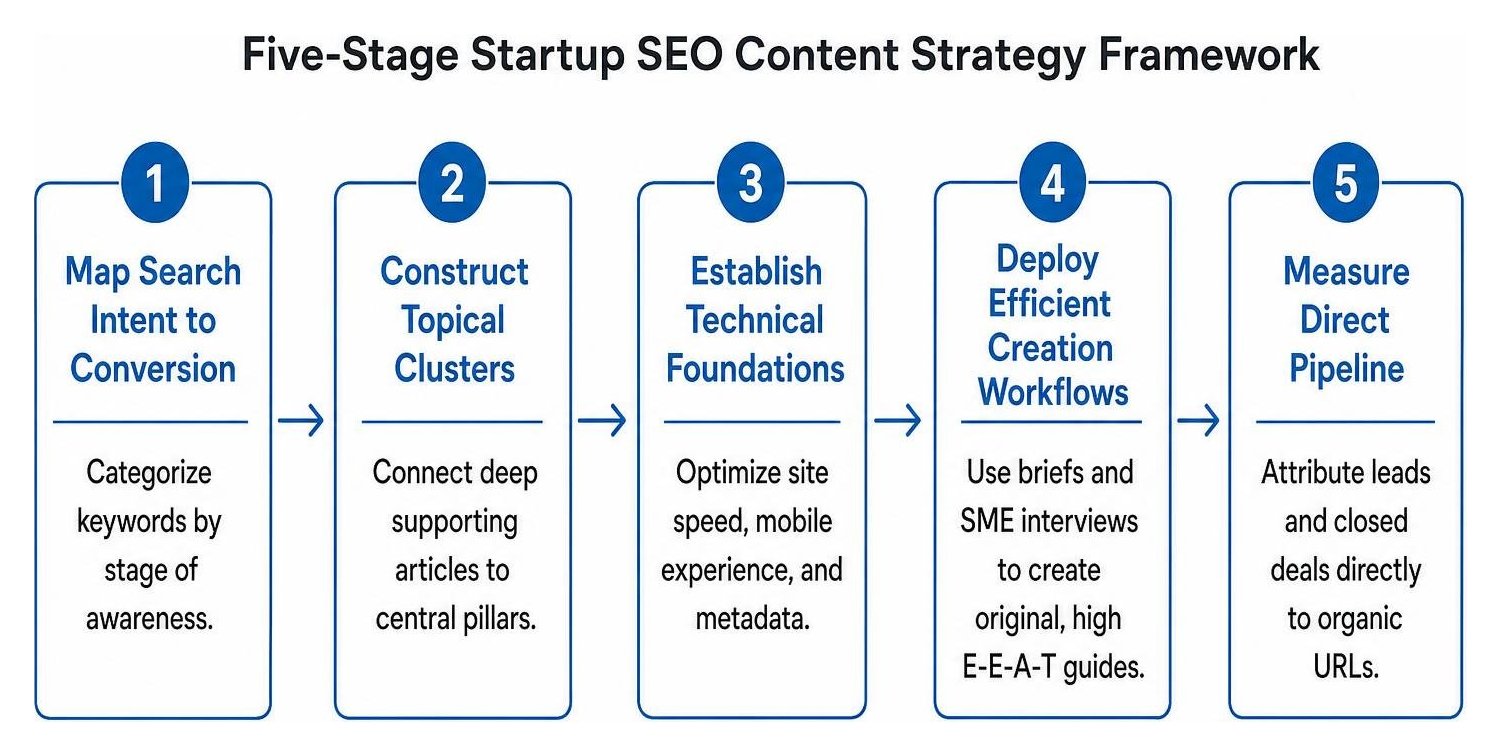
Our Velocity framework applies these steps to deliver fast, transparent organic growth while maintaining strict quality standards.
How should early-stage teams prioritize keywords by business impact and search intent?
Startups should prioritize low-competition, high-intent keywords over high-volume vanity terms. Chasing broad queries with tens of thousands of monthly searches puts you against massive industry incumbents with years of backlink equity. Instead, focus on specific commercial investigation and transactional terms.
Targeting bottom-of-funnel queries allows new websites to capture qualified prospects quickly. In fact, a documented bootstrapped SEO case study proved that targeting low-difficulty, long-tail search queries can drive over 60,000 active users from scratch on a bootstrap budget.
| Intent Type | Example Startup Search Query | Ranking Timeline | Conversion Potential |
|---|---|---|---|
| Informational | What is automated workflow software? | 60–90 Days | Low to Moderate (Lead Magnet) |
| Commercial Investigation | Best project management tool for remote teams | 3–6 Months | High (Product Demos & Trials) |
| Transactional | Buy field service management software | 6–12 Months | Highest (Direct Signups / Sales) |
How do topic clusters build topical authority against established competitors?
Topic clusters demonstrate topical authority by organizing content into a central pillar page surrounded by tightly related, interlinked spoke articles. Search engines crawl this organized structure to understand your depth of expertise in a specific niche.
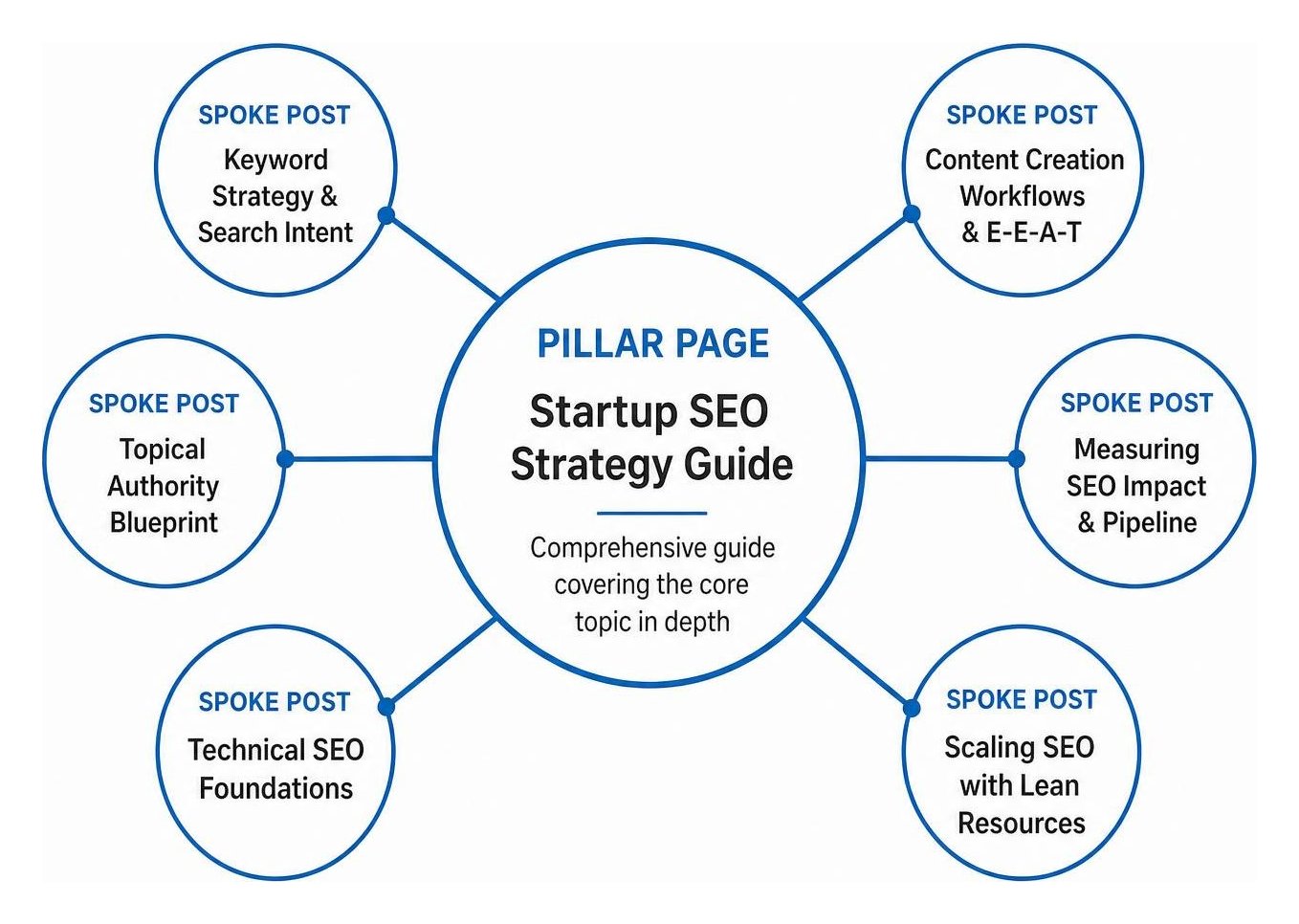
When creating your clusters, pages with 2% or more of their internal links pointing toward relevant content sections perform significantly better in search rankings. To establish market leadership, follow our complete blueprint for building topical authority.
How can you scale your startup SEO content strategy with lean internal resources?
Lean teams can scale production without lowering quality by using structured content briefs and batch-writing systems. Trying to write individual articles from scratch each week creates context switching and inconsistent messaging.

Begin by creating standardized SEO briefs that define the exact search intent, required subheadings, target keywords, and internal links. Internal founders or subject matter experts can record short audio notes or bullet points answering key questions, which are then shaped into full drafts. This keeps your company's unique voice and experience intact while maintaining an active publishing calendar.
Scaling Content Operations and Measuring Direct Revenue Impact
Publishing content consistently builds an organic moat, but you need clear operations to manage that growth. As your library expands past 50 published pieces, compounding traffic begins to take off.

Connecting your website analytics to your CRM ensures you evaluate each URL based on revenue impact rather than simple pageviews. First-party data assets drive 83% more traffic value and 34% more backlinks across the web, making original research and direct case studies your most valuable assets.
What are the realistic SEO timelines and milestones for early-stage companies?
For new websites, low-competition, long-tail queries typically begin ranking within 60 to 90 days. Meaningful organic traffic and consistent lead generation generally reach an inflection point between 6 and 12 months.
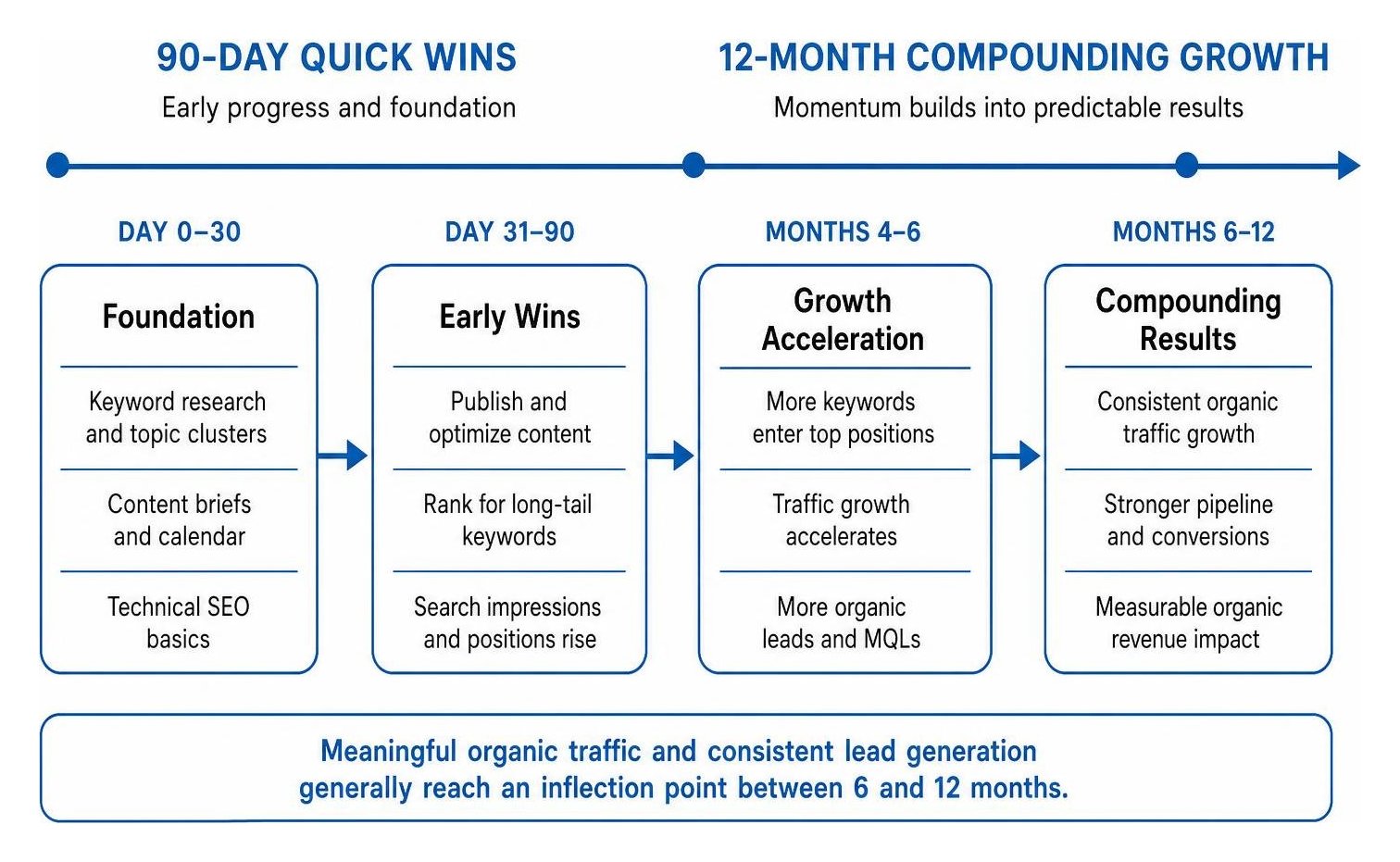
Early milestones include search impression growth and improved positions for core product queries in Google Search Console. As you hit these goals, stay focused by tracking monthly SEO metrics to spot quick-win opportunities on page two.
How do you measure organic revenue attribution instead of vanity metrics?
You can measure true SEO return on investment by tracking organic marketing-qualified leads (MQLs), pipeline velocity, and closed-won revenue tied to organic landing pages. Relying solely on raw traffic counts gives a false sense of success if those visits never turn into paying customers.
Implement multi-touch attribution models inside your CRM to track which blog articles prospects visited before scheduling a demo or making a purchase. Sticky top navigation alone can boost conversions by 39%, ensuring your captured organic traffic always has a straightforward path to convert. If you want to accelerate your pipeline with a proven framework, consider partnering with a dedicated SEO service provider to scale your organic lead engine.
Turn Your Startup Search Visibility into a Predictable Growth Engine
Executing an intent-driven SEO strategy takes the guesswork out of early-stage growth. Instead of publishing random articles hoping for traffic, build a structured library of topic clusters that solve real problems for real buyers. By tracking revenue-focused metrics, maintaining strong technical optimization, and answering search queries clearly, your organic content becomes a reliable, compounding customer acquisition channel.