Stop Posting and Start Ranking with This Small Business Content Strategy

Stop Posting and Start Ranking with This Small Business Content Strategy
Why Most Small Businesses Stay Invisible Online (And How a Content Strategy Changes That)
A solid content strategy for small businesses is the difference between shouting into the void and actually growing your brand online. If you've been posting on social media, sending the occasional email, and wondering why nothing is moving — you're not alone.
Here's what a content strategy for small businesses looks like in practice:
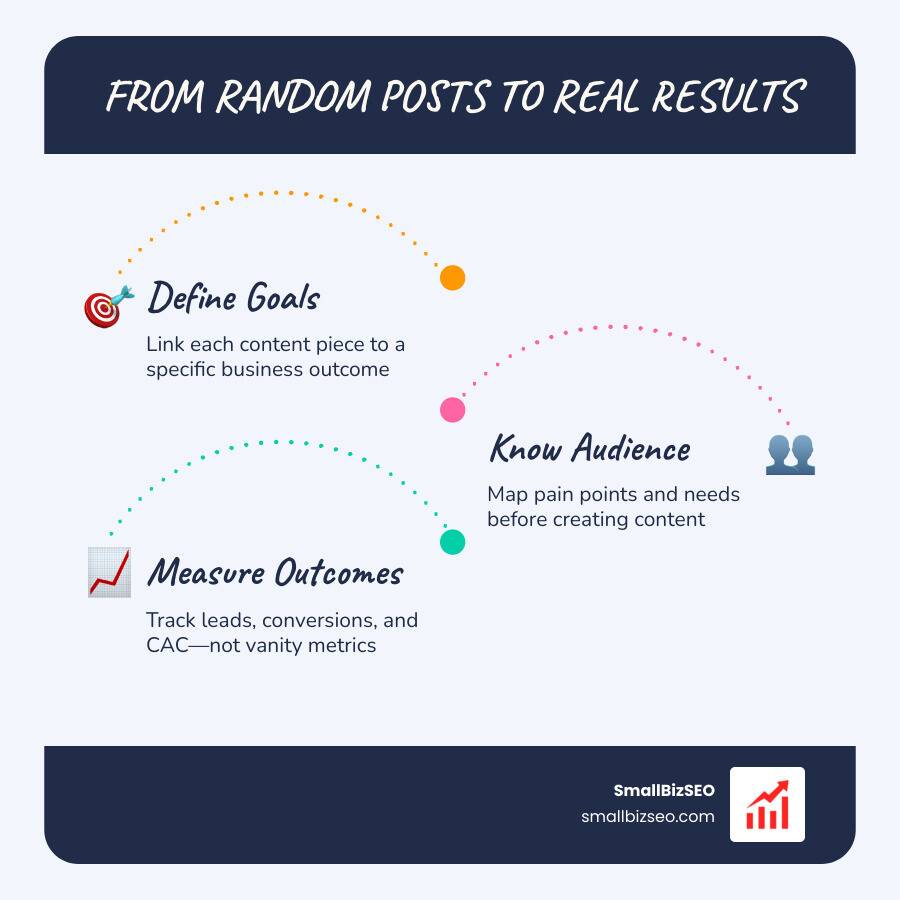
- Define your goals — tie every piece of content to a specific business outcome
- Know your audience — identify their pain points and what they need to see right now
- Choose your content mix — pick 2-3 formats and channels you can sustain
- Build a content calendar — plan themes, cadence, and seasonal shifts in advance
- Distribute strategically — go where your audience already spends time
- Repurpose and streamline — turn one piece of content into many
- Measure what matters — track leads and conversions, not just likes
The hard truth? Fewer than 20% of small business owners create and publish traffic-generating content consistently. Meanwhile, 80% of the most successful companies in content marketing have a documented strategy driving their efforts. The gap isn't talent or budget — it's the lack of a repeatable system.
Random posting creates random results. A content strategy replaces that chaos with a plan that compounds over time, bringing in leads long after a piece is published — unlike paid ads that stop the moment you turn them off.
I'm Clayton Johnson, a digital PR and SEO specialist who has spent years building impactful content marketing campaigns that help businesses earn real search visibility and audience trust. My work directly informs the content strategy for small businesses framework you'll find throughout this guide — so let's get into it.
What is a Content Strategy for Small Businesses and Why Do You Need It?
A content strategy for small businesses is a repeatable business system that coordinates your publishing efforts with your commercial goals. Without a strategy, content creation is just a series of random daily tasks that lead to team burnout. With a strategy, every blog post, email, and social update becomes a permanent asset that works to grow your brand.
By treating content as an investment rather than an expense, we can systematically lower our customer acquisition cost (CAC) over time. While paid ads get more expensive every year, an evergreen article continues to attract high-intent leads years after publication.
Consistently publishing authoritative content also builds brand authority and fosters trust. When prospects repeatedly find answers to their hardest questions on your website, they stop comparing you to competitors on price alone. They choose you because you have already proven your expertise.
The Difference Between Content Marketing and a Content Strategy for Small Businesses
It is common to use these terms interchangeably, but they are fundamentally different:
- Content Strategy is the strategic planning phase. It determines why you are creating content, who it is for, how it will be positioned against competitors, and what boundaries you will set to avoid wasting resources.
- Content Marketing is the execution phase. It is the tactical process of writing, designing, publishing, and promoting those assets.
Before you write a single word, you need absolute positioning clarity and a defined brand voice. To build this foundation, you can learn How to Develop a Small Business Content Strategy | CO to map your unique value proposition to your audience's expectations.
How to Build Your Commercial-First Content Plan
Most small businesses make the mistake of writing broad, informational articles that attract readers who will never buy from them. We advocate for a commercial-first approach. This means we build content around commercial intent and map each topic to specific stages of the buyer journey.
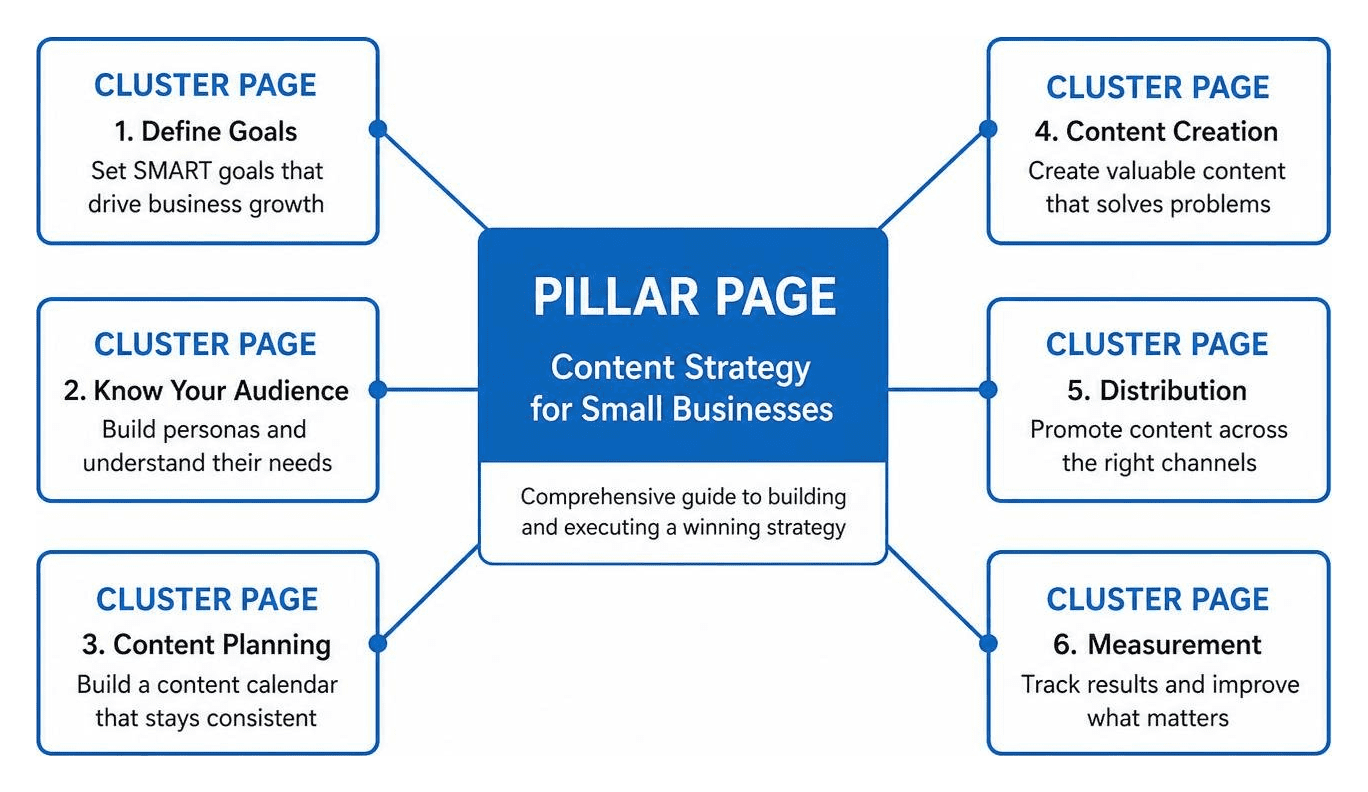
To do this efficiently, we use the topic cluster model. Instead of publishing disconnected articles, we build a central pillar page focused on a core service, surrounded by tightly related subtopic pages that answer specific buyer questions.
Aligning Business Goals with a Content Strategy for Small Businesses
To keep your content focused, every campaign must align with SMART goals (Specific, Measurable, Achievable, Realistic, and Time-bound). Rather than aiming to "get more traffic," aim to "generate twenty new email sign-ups per month through our educational guides."
Next, build detailed customer personas. Go beyond basic demographics to uncover their exact pain points, daily challenges, and purchasing objections.
Because search engines prioritize reliable information, we must design our content around search engine guidelines for Experience, Expertise, Authoritativeness, and Trustworthiness. To ensure your site meets these strict standards, read our guide on How to Optimize Your Content for E-E-A-T and Build Real Search Trust.
Choosing Your Content Mix and Brand Pillars
To keep your production manageable, we recommend organizing your ideas into 3-4 brand pillars. These are the core themes your business wants to be known for.
We also suggest following the 70/30 content rule:
- 70% Commercial Content: Focus on bottom-of-funnel assets like detailed service pages, product comparisons, transparent pricing guides, and case studies.
- 30% Authority-Building Content: Focus on educational guides, industry storytelling, and answers to common customer questions.
| Content Type | Primary Goal | Funnel Stage | Example |
|---|---|---|---|
| Commercial Content | Drive direct inquiries & sales | Bottom-of-Funnel (BOFU) | Service pricing guides, product comparisons |
| Authority & Storytelling | Build trust & brand loyalty | Middle-of-Funnel (MOFU) | Founder stories, step-by-step problem-solving guides |
Planning Your Content Calendar and Distribution Channels
Consistency always beats intensity. A thoughtful, weekly publishing cadence is far better than publishing ten articles in a single week followed by months of silence.
To keep your team organized, you must maintain a centralized content calendar.
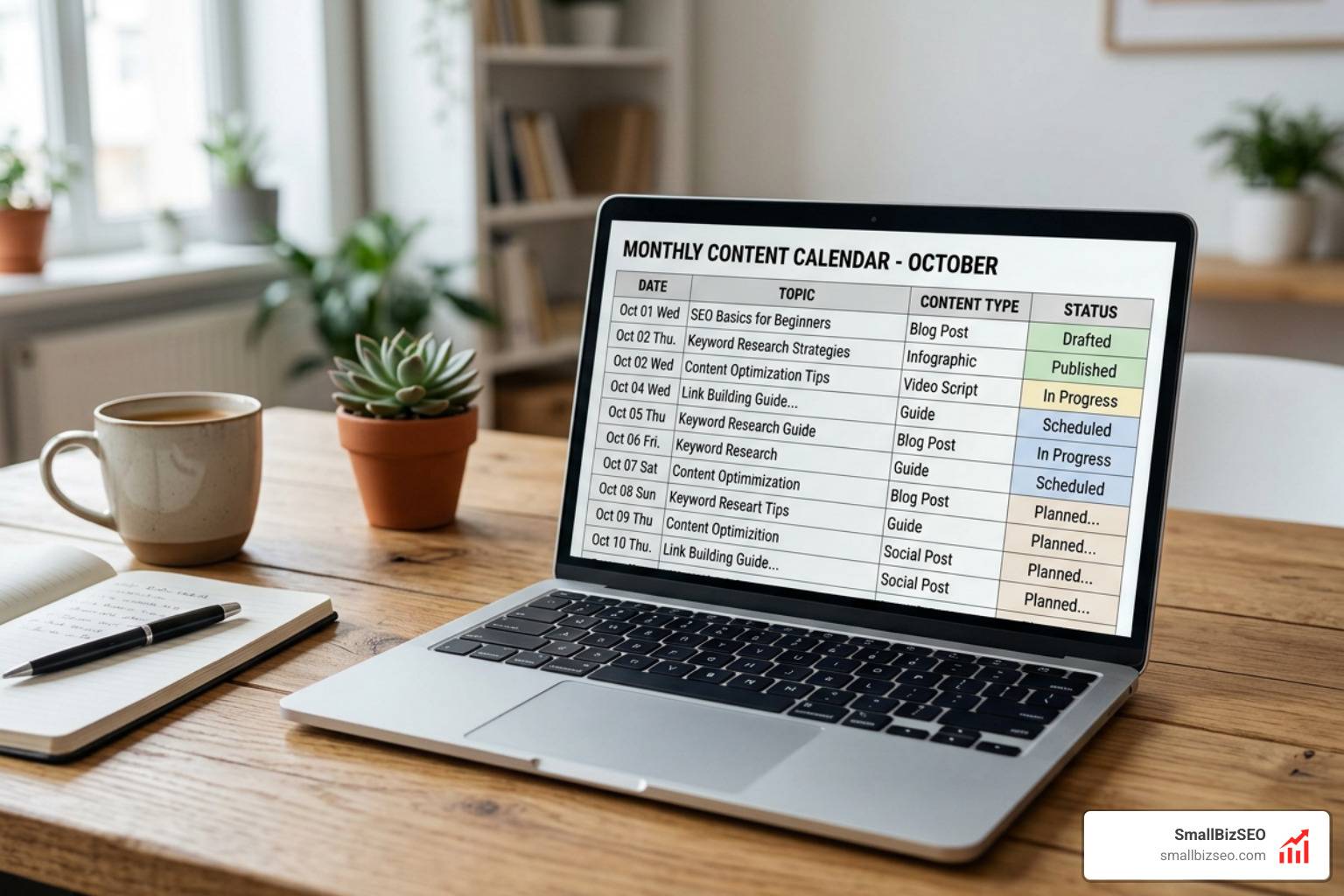
When planning your calendar, account for seasonality and natural business cycles. We recommend dividing your year into distinct seasons:
- Nurture Seasons: Focus on educational content and building relationships with your existing audience.
- Reach Seasons: Focus on highly shareable content and partnerships to expand your visibility.
- Launch Seasons: Focus heavily on commercial content, promotional offers, and direct sales.
Selecting the Right Distribution Channels
You do not need to be on every social media platform. In fact, spreading yourself too thin is a fast track to mediocre results. Use an audience-first approach to select only 1-2 primary distribution channels where your ideal customers already spend their time.
For most small businesses, the highest-ROI distribution channels are:
- Search Engine Optimization (SEO): To capture prospects who are actively searching for solutions to their problems.
- Email Marketing: To nurture leads who have already expressed interest in your brand.
- Social Media: To humanize your brand and engage with your local community.
To help you determine which channels will yield the fastest rankings and organic growth, explore our comprehensive SEO Services Guide.
Amplifying Reach Through Partnerships and Collaborations
You do not have to build an audience entirely from scratch. You can amplify your reach by partnering with complementary, non-competing businesses, local creators, or micro-influencers who share your target market.
Consider co-creating content, hosting joint webinars, guest blogging, or pitching your expertise as a background source for journalists and podcasters. To learn how to cut through the digital noise and build these relationships, review Content Strategy for Small Businesses: The Complete Guide to Stop the Noise and Start Driving Results.
Streamlining Workflow, AI Integration, and Content Repurposing
Creating high-quality content takes time, but you can streamline your workflow by batch-creating your assets. Instead of writing sporadically, set aside dedicated blocks of time to plan, write, and edit your content a month in advance.
We also highly recommend the 1:7 content repurposing rule. Under this framework, you create one comprehensive, long-form anchor piece (such as an in-depth blog post) and turn it into seven smaller, platform-specific assets:
- An email newsletter summary
- Three short social media text posts
- An infographic for visual platforms
- A brief video script for social media reels
- An updated FAQ section on your service page
By systematically repurposing your best work, you maximize your visibility while keeping your production costs low. If you need help building this pipeline, our team offers professional SEO Content Services tailored to small teams.
Leveraging AI Safely in Your Content Production
Generative AI tools are excellent assistants for brainstorming topics, structuring detailed outlines, and proofreading drafts. However, relying on raw, unedited AI output carries significant risks.
AI-generated content often lacks original insights, personal voice, and real-world experience. Furthermore, search engines actively demote thin, generic content. Always maintain strict human oversight. Use AI as a speed layer to accelerate your drafting process, but ensure every published piece is thoroughly reviewed, fact-checked, and infused with your unique business expertise.
Measuring Success and Avoiding Vanity Metrics
The ultimate goal of a content strategy for small businesses is to drive profitable customer action. To understand if your strategy is working, you must look past surface-level numbers and track metrics that directly impact your bottom line.

Using tools like Google Analytics and Google Search Console, you can monitor how users discover your website, how long they stay, and what actions they take before leaving.
Prioritizing Engagement and Conversion Over Vanity Metrics
It is easy to get excited about a post that gets thousands of views or likes, but these are often vanity metrics. High traffic means very little if none of those visitors convert into paying customers.
Instead, prioritize metrics that reflect real commercial engagement:
- Conversion Rates: The percentage of visitors who complete a contact form, sign up for your newsletter, or request a quote.
- Email List Growth: The rate at which high-intent prospects join your private database.
- Referral Traffic: Visitors coming to your site from high-authority partner websites and media placements.
- Customer Acquisition Cost (CAC): The overall efficiency of your marketing spend.
To find the right tools and templates for tracking these key performance indicators, explore our curated digital marketing Resources.
Frequently Asked Questions About Small Business Content
How long does it take to see results from a content strategy?
While paid ads offer instant visibility, content strategy is a long-term compound investment. Most small businesses begin to see initial improvements in search engine impressions and keyword rankings within two to three months. Measurable lead generation and organic conversions typically take four to six months of consistent publishing to build momentum.
Do small businesses need a blog to succeed?
While a traditional "diary-style" blog is not required, having a dedicated section on your website for long-form anchor content is highly recommended. Search engines rely on text to index your site and understand your services. Furthermore, modern AI-powered search engines frequently cite comprehensive, well-structured blog articles when answering user queries.
How much should a small business spend on content marketing?
Your budget depends on your internal resources and growth goals. Solo operators can start for free by investing their own time into writing and basic optimization. However, to scale your growth without burning out, outsourcing to specialized agencies typically costs between $2,000 and $5,000 per month.
Conclusion
Building a successful content strategy for small businesses is not about publishing more content — it is about publishing smarter, commercially aligned content. By setting clear goals, focusing on commercial-intent search terms, and maintaining a consistent calendar, you can build a marketing engine that continuously generates qualified leads.
At SmallBizSEO, we help small businesses fast-track this process. Our proprietary "Velocity" framework delivers rapid search engine rankings and E-E-A-T-compliant growth. We back our content strategy, technical SEO, and link-building services with transparent, automated reporting so you always know exactly how your investment is performing.
To stay updated on the latest search trends, browse our Blog. If you are ready to stop posting into the void and start ranking on search engines, Grow Your Brand with Professional SEO Services today.