A Practical Guide to Thin Content in Modern SEO

What Is Thin Content, and Why Does It Matter for SEO?
Thin content is a page that gives visitors too little useful information to meet their needs. It is not defined by word count: a short answer can be helpful, while a long page can still be thin if it repeats generic advice or fails to answer the question that brought someone there.
For a small business, the practical test is simple: Does this page help a potential customer take the next step? If not, it may need a clearer answer, original details, or a different purpose. This guide covers how to spot those pages and decide what to improve, combine, or remove.
I'm Clayton Johnson, founder of SmallBizSEO, where I develop SEO and content strategies that help small businesses turn their expertise into useful resources. In my work, answering what is thin content starts with understanding the customer's question, not counting words.
What Is Thin Content and Why Does Google Penalize It?
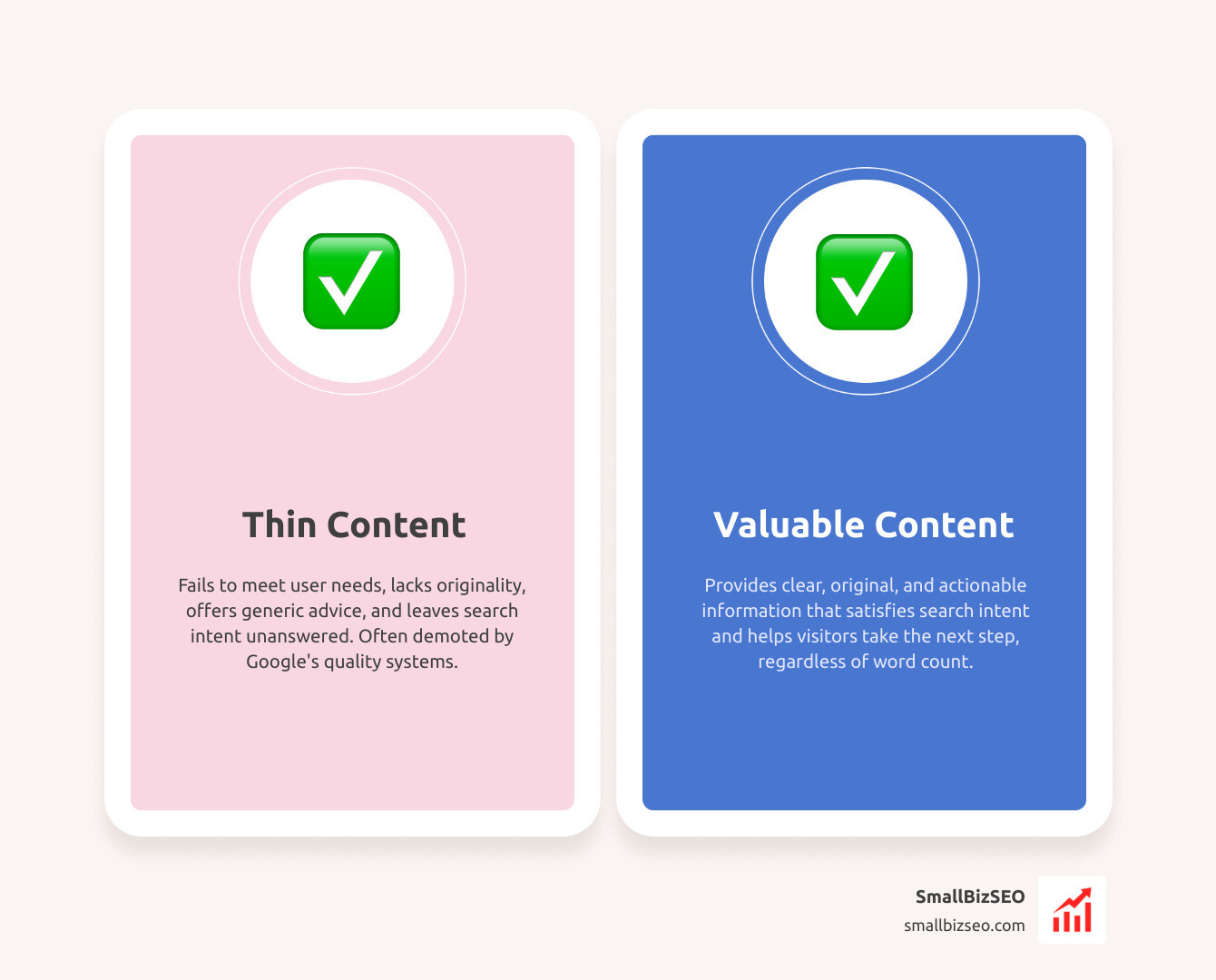
Thin content is any web page that fails to provide meaningful value, lacks originality, or leaves a searcher's core query unanswered. Google penalizes or demotes these pages because its automated systems prioritize satisfying search intent and delivering strong user experiences.
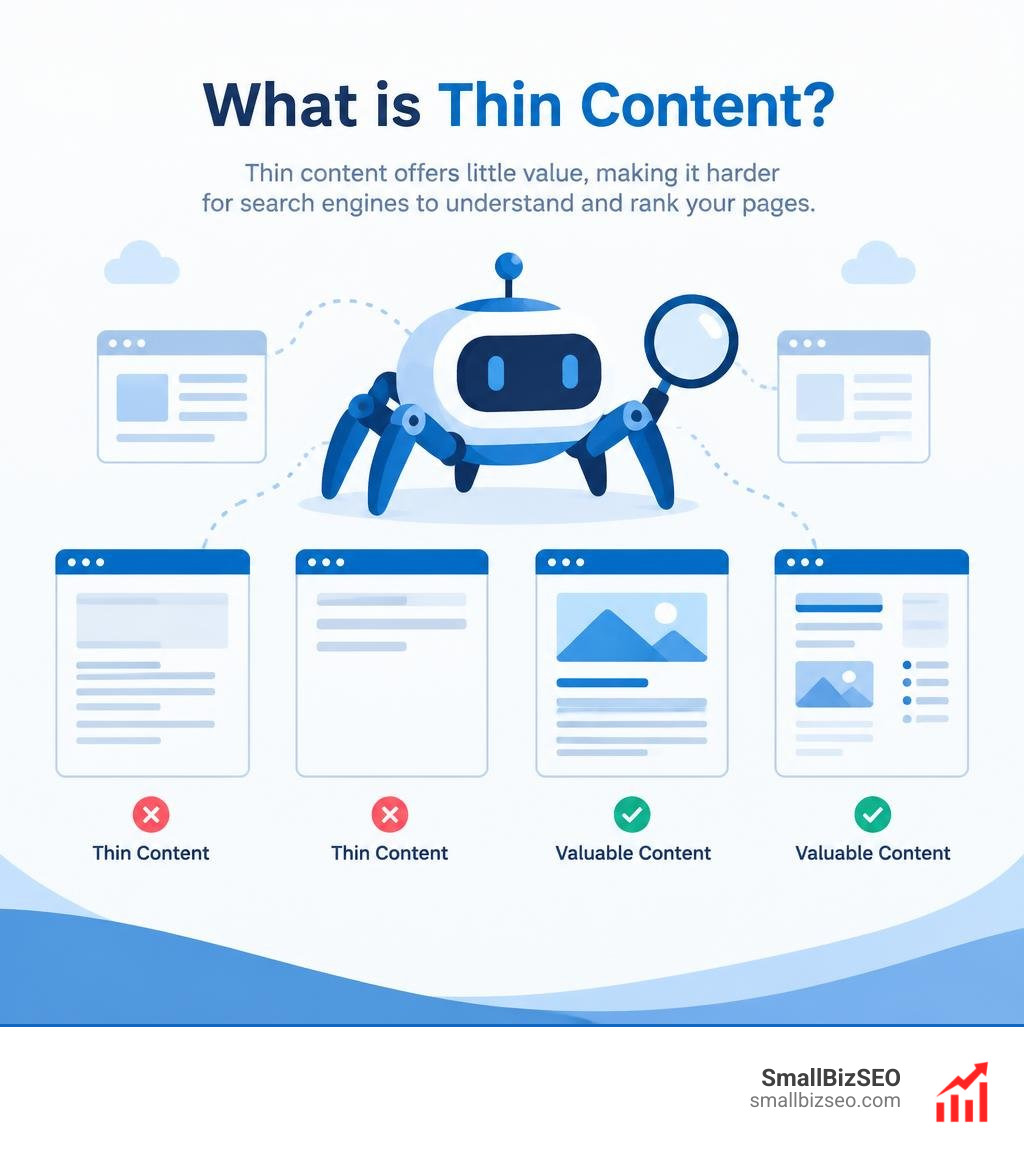
When search engines crawl a website overloaded with low-substance pages, they consume crawl budget on URLs that will never satisfy a user. This causes index bloat and dilutes your site's overall topical authority. According to Google's perspective on content depth, search systems evaluate substance and usefulness rather than word count. Pages must demonstrate clear experience, expertise, authoritativeness, and trust (E-E-A-T) to perform consistently in organic search.
What Is Thin Content vs Short Content?
The difference between thin content and short content comes down to user intent fulfillment:
- Short Content: A 150-word page that directly answers a specific question (such as business hours, a quick definition, or an FAQ response) provides high value and satisfies the searcher completely.
- Thin Content: A 2,000-word article filled with keyword stuffing, vague generalizations, and repetitive filler fails to answer the user's question, making it thin despite its length.
| Metric / Dimension | Short, High-Value Content | Thin Content |
|---|---|---|
| Search Intent Match | Fully resolves specific query | Fails to answer core question |
| User Engagement | High satisfaction, quick conversion | High bounce rates, low dwell time |
| Word Count | Typically brief (100–400 words) | Can be short or excessively long |
| Originality | Direct, expert-led answer | Repetitive fluff or scraped text |
| SEO Risk | Low to none | High risk of ranking drops |
Search representatives have noted that splitting long articles vs thin pages does not automatically trigger quality issues, provided each resulting page delivers distinct, standalone value for users.
What Are Common Types of Low-Value Pages and Scaled Content?
Low-value pages generally fall into several common categories across commercial websites:
- Scraped and Lightly Rewritten Copy: Content copied from third-party sites or republished without adding original commentary, analysis, or proprietary data.
- Low-Value Affiliate Pages: Product roundups that copy manufacturer descriptions without original product testing, custom photography, or distinct pricing insights.
- Doorway Pages: Low-quality pages targeting slight location or keyword variations designed solely to funnel searchers to a single contact form.
- Mass-Produced Automation: Engaging in scaled content abuse by publishing thousands of unreviewed AI pages creates systemic quality issues.
- Deceptive Content Elements: Attempting keyword manipulation via hidden text abuse violates core search guidelines.
- Technical URL Duplication: Unintended thin pages generated by parameter strings, internal search results, or duplicate HTTP/HTTPS protocols.
How Do Algorithmic Quality Systems and Manual Actions Impact Rankings?
Search engines evaluate low-quality pages through both automated algorithmic systems and human-led manual reviews. Automated quality algorithms evaluate website helpfulness continuously. When a site contains a high proportion of low-utility URLs, automated systems can reduce visibility across the entire domain.
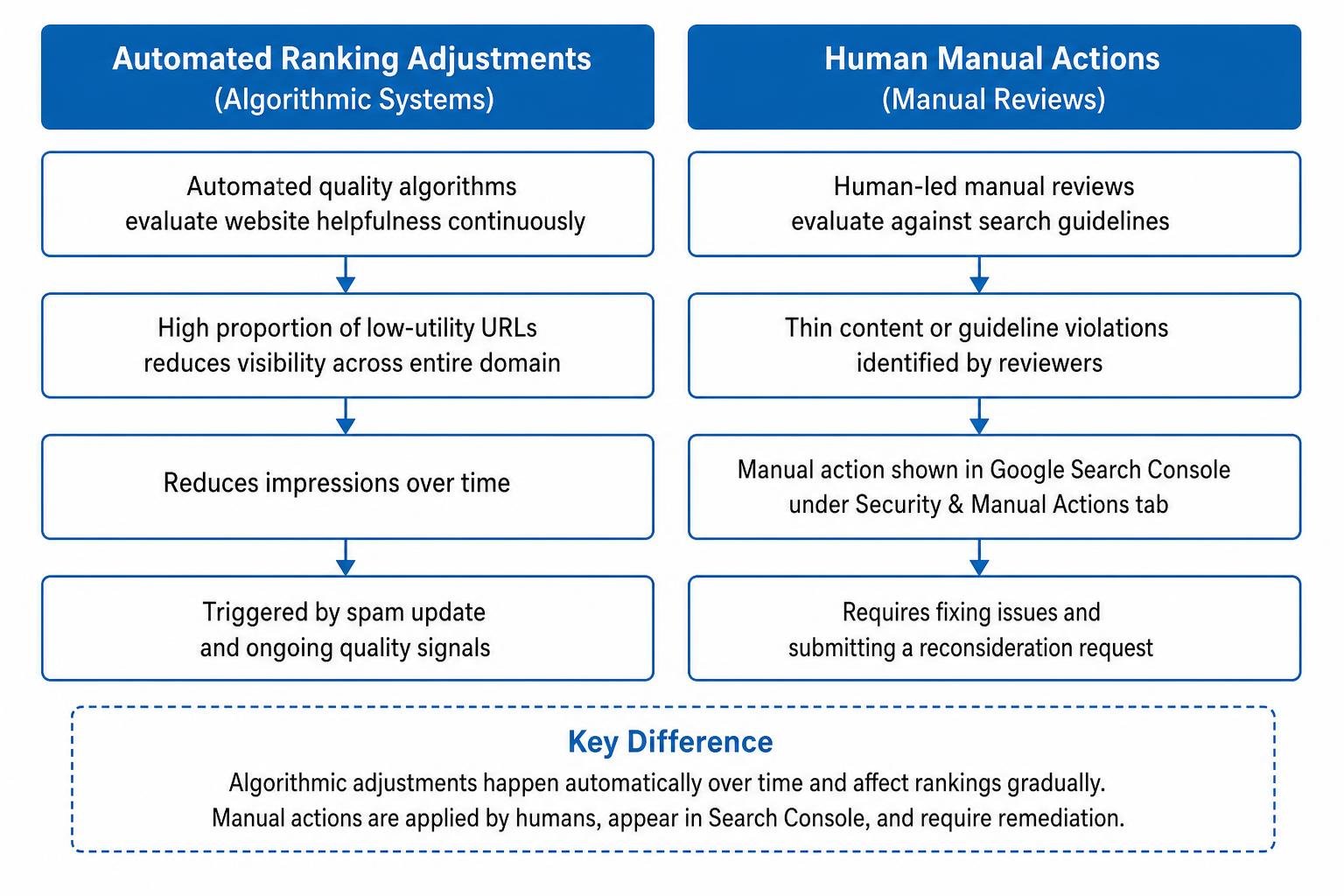
It is crucial to distinguish between algorithmic penalties vs technical indexing failures when diagnosing lost traffic. An algorithmic adjustment reduces impressions over time, while a manual action for thin content appears directly inside Google Search Console under the Security & Manual Actions tab. Following a search engine spam update, sites that proactively audit and avoid Google penalty risks are far better positioned to maintain consistent traffic.
How Can You Identify, Audit, and Fix Low-Value Pages on Your Website?
You can identify and fix low-value pages by compiling an inventory of all indexed URLs, analyzing organic search performance, evaluating user engagement, and applying a structured decision framework to prune, redirect, or improve each page.
Understanding modern depth and SEO insights allows website owners to focus on depth of insight rather than padding articles with irrelevant words.
What Is Thin Content Detection During a Site Audit?
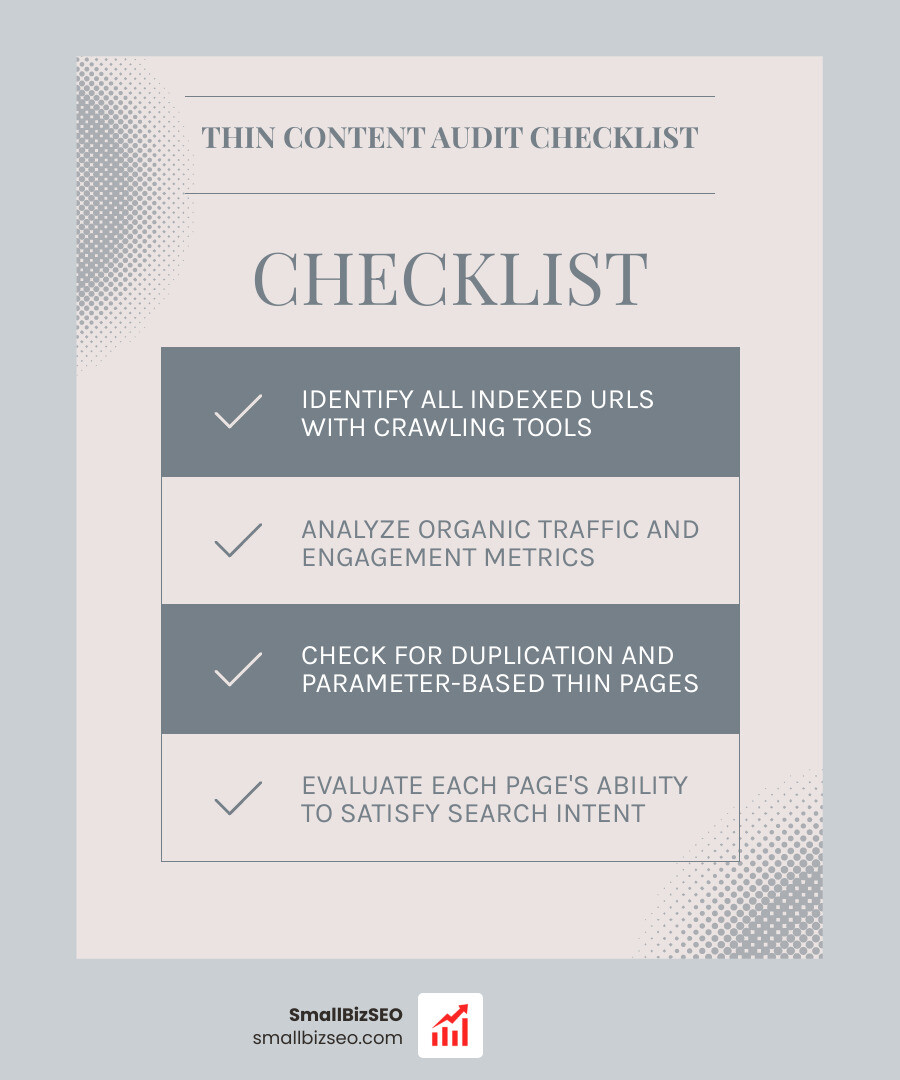
Finding low-quality URLs requires combining data from technical crawling software and analytics platforms. During a comprehensive content audit, perform a detailed SEO analysis to evaluate every URL across several performance criteria:
- Check Indexation Status: Use a crawling tool during your regular site audit to identify every indexed URL on your domain.
- Identify Zero-Traffic URLs: Filter analytics and Google Search Console data for pages that have generated zero clicks and minimal impressions over the past several months.
- Analyze User Engagement: Flag URLs with abnormally high bounce rates or short session durations, which signal a mismatch with search intent.
- Identify Duplicate Intent: Look for clusters of pages targeting identical or near-identical keyword variations.
- Evaluate Manual Content Depth: Manually inspect flagged pages to determine if they answer the visitor's core problem clearly and authoritatively.
How Should You Consolidate, Refresh, or Prune Low-Value Content?
Once you have identified low-value URLs, evaluate them through a clear remediation framework rather than blindly deleting files. Choosing smarter SEO consolidation allows you to preserve accumulated backlink authority while eliminating index bloat.
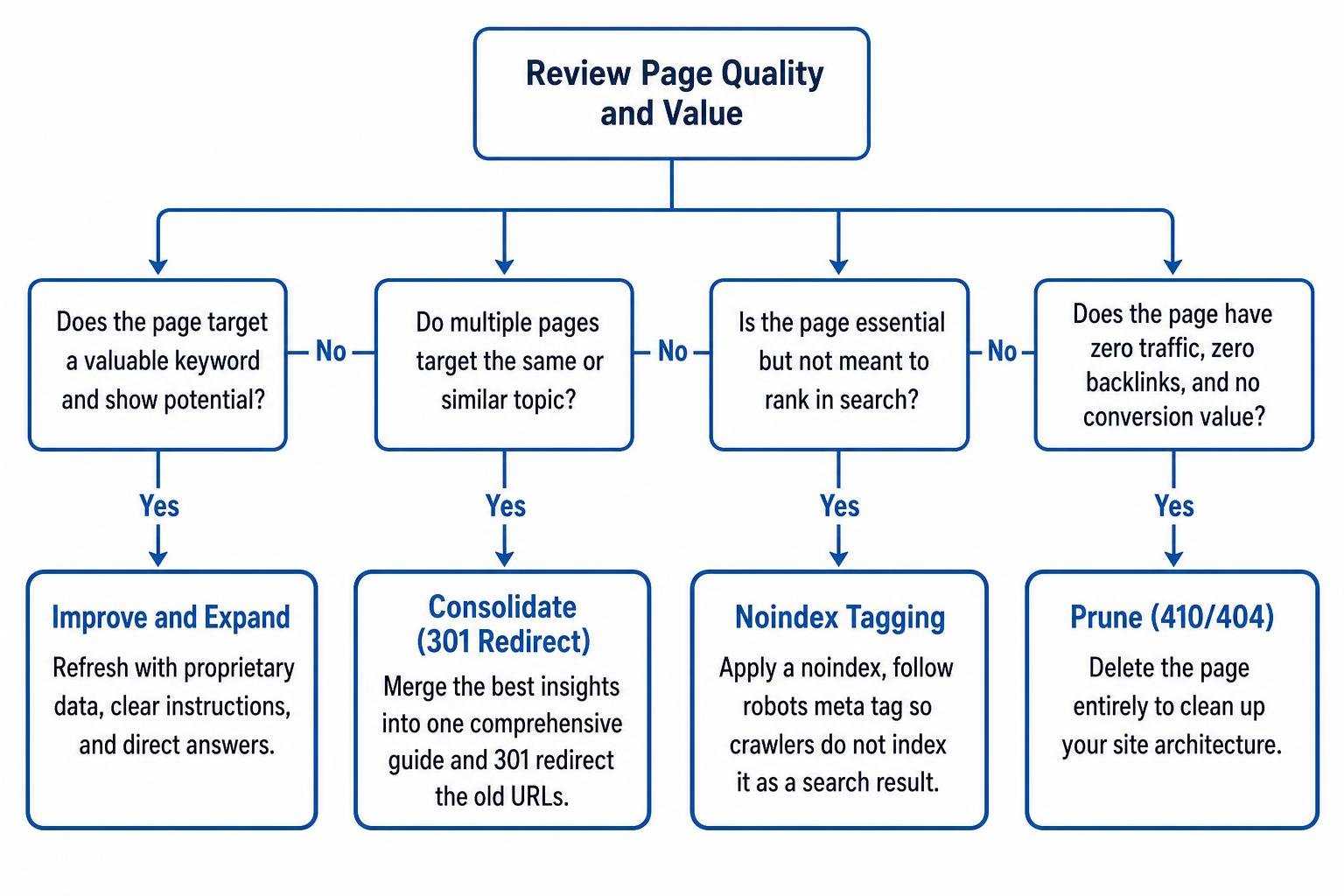
- Improve and Expand: If a page targets a valuable keyword but suffers from content decay, refresh it with proprietary data, clear step-by-step instructions, and direct answers.
- Consolidate (301 Redirect): When multiple weak pages compete for the same topic, merge their best insights into a single comprehensive guide and implement 301 redirects from the old URLs.
- Noindex Tagging: For essential utility pages (such as internal search archives, login portals, or thank-you pages), apply a
noindex, followrobots meta tag so crawlers do not index them as thin search results. - Prune (410/404): If a page has zero backlinks, zero organic traffic, and no conversion value, delete the page entirely to clean up your site architecture.
How Can You Restore Visibility and Build Sustainable Authority?
Restoring search visibility after cleaning up low-value content requires deliberate technical follow-through. Once you have consolidated or removed thin pages, update your internal links to point exclusively to canonical, high-value destinations. Refresh your XML sitemap and submit your primary URLs for re-indexing inside Google Search Console.
When publishing new material, prioritize depth and authentic expertise. Following our guide to grounding AI drafts with original data ensures that every article incorporates unique perspectives, real-world case studies, and practical workflows.
Elevate Your Site Architecture with High-Value Content
Eliminating low-quality pages is an essential step in building a resilient digital presence. At SmallBizSEO, our data-driven Velocity framework helps growing businesses pinpoint technical vulnerabilities, resolve index bloat, and produce authoritative content that satisfies search intent.
If you are ready to identify low-performing assets and turn your website into a high-converting resource, explore our specialized Thin Content solutions or schedule an audit with our team today.