Modern Techniques for Web Content Optimization
Modern Techniques for Web Content Optimization
Why Web Page Optimization Is the Growth Lever Most Small Businesses Overlook
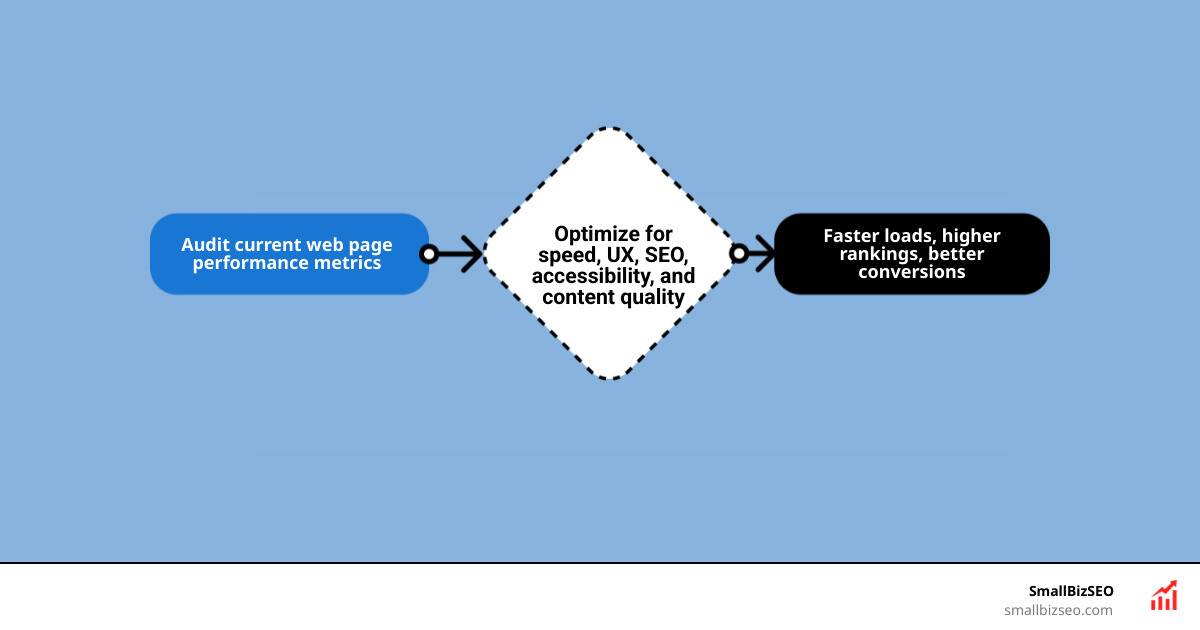
Web page optimization is the ongoing process of improving your website so it loads faster, ranks higher, converts more visitors, and delivers a better experience across every device.
Here's a quick breakdown of what it covers:
- Speed — Pages that load in under 2.5 seconds keep visitors engaged and rank better on Google
- SEO — Structured content, clean URLs, and strong on-page signals help search engines find and rank your pages
- User experience (UX) — Clear navigation, readable layouts, and intuitive design reduce bounce rates
- Conversions — Optimized calls-to-action, landing pages, and forms turn visitors into leads or customers
- Accessibility — Pages built for all users, including those using screen readers or assistive tech
- Content quality — Relevant, authoritative content that matches what your audience is actually searching for
The stakes are real. 88% of people are less likely to return to a website after a bad first experience. And a B2B site that loads in one second converts visitors at three times the rate of a site that takes five seconds. That's not a small gap — that's the difference between a website that works for your business and one that quietly costs you customers every single day.
Most small business owners know their website could be doing more. The problem is knowing where to start — and that's exactly what this guide is for.
I'm Clayton Johnson, a digital PR and SEO specialist focused on building search visibility and driving meaningful engagement for businesses like yours — and web page optimization sits at the core of everything I do. Let's walk through the modern techniques that actually move the needle.
What is Web Page Optimization and Why Does It Matter?
At its core, web page optimization is the practice of fine-tuning your digital storefront to ensure it performs at peak efficiency. It is the intersection of technology, psychology, and creative writing. When we talk about optimizing a web page, we are not just talking about pleasing search engine crawlers—we are talking about creating a frictionless pathway for real human beings.

If your website is slow, confusing, or difficult to navigate, visitors will leave. In fact, the average page load time for websites globally is 2.5 seconds, but the top-ranking sites on the first page of Google boast an average load speed of just 1.65 seconds.
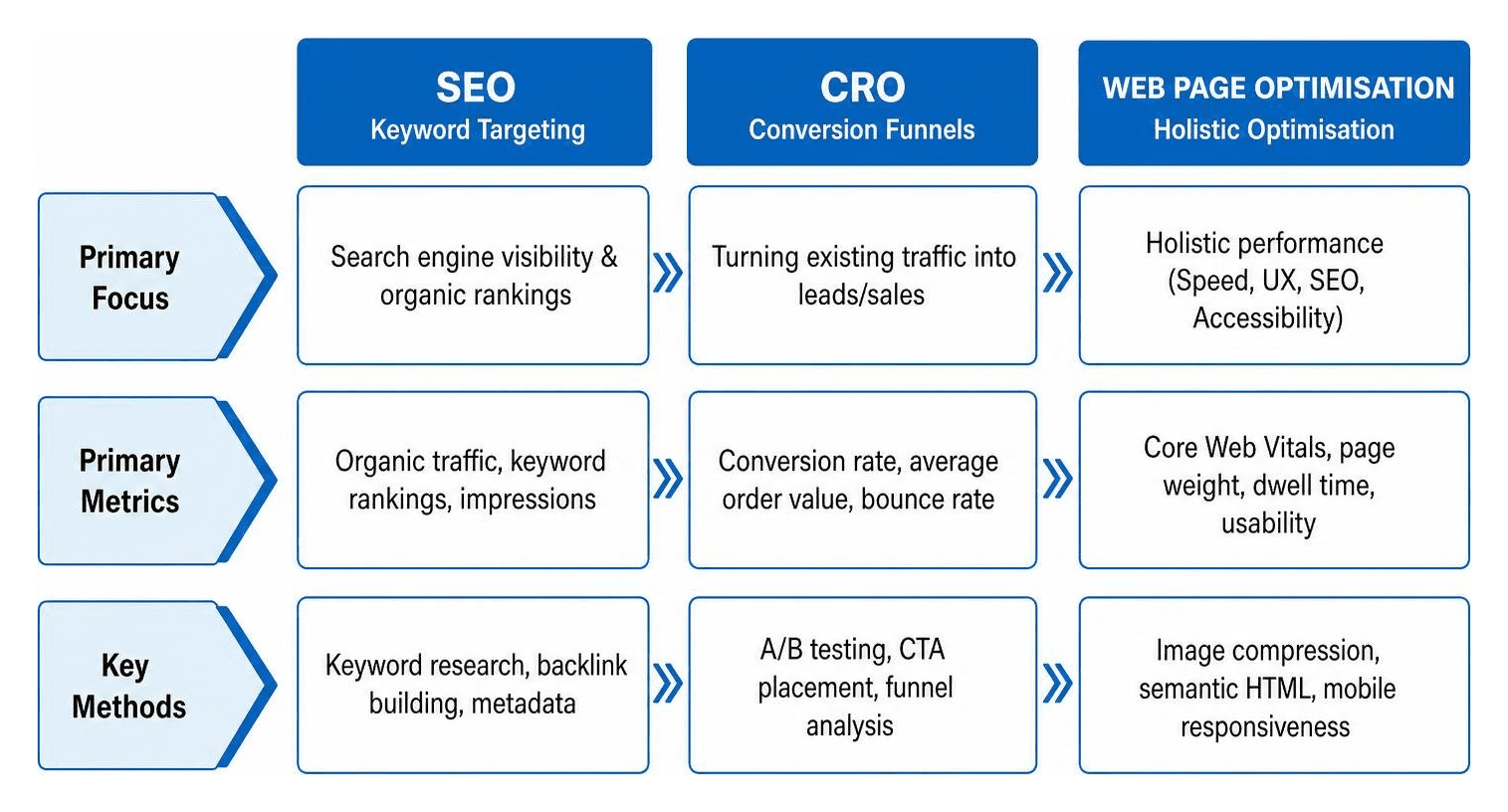
Optimizing your web pages directly impacts your bottom line by improving brand reputation, increasing user retention, and maximizing the return on your marketing spend. To understand how this fits into your broader digital strategy, it helps to see how optimization spans multiple disciplines.
| Feature | Search Engine Optimization (SEO) | Conversion Rate Optimization (CRO) | Web Page Optimization |
|---|---|---|---|
| Primary Focus | Search engine visibility & organic rankings | Turning existing traffic into leads/sales | Holistic performance (Speed, UX, SEO, Accessibility) |
| Primary Metrics | Organic traffic, keyword rankings, impressions | Conversion rate, average order value, bounce rate | Core Web Vitals, page weight, dwell time, usability |
| Key Methods | Keyword research, backlink building, metadata | A/B testing, CTA placement, funnel analysis | Image compression, semantic HTML, mobile responsiveness |
The Core Benefits of Optimizing Your Web Pages
When we systematically improve our web pages, we unlock several distinct advantages:
- Compounded Organic Traffic: Search engines reward fast, well-structured pages with better visibility, driving more qualified visitors to your site.
- Higher Conversion Rates: Removing friction from your checkout or sign-up process means more of your hard-earned traffic actually takes action.
- Lower Bounce Rates: Engaging layouts and rapid load speeds keep users browsing instead of clicking the "back" button.
- Reduced Customer Acquisition Cost (CAC): By converting a higher percentage of your organic traffic, you decrease your reliance on expensive paid ads.
How Web Page Optimization Differs from Traditional SEO and CRO
While traditional SEO focuses heavily on ranking factors like keywords and links, and CRO focuses primarily on user behavior and conversion funnels, web page optimization acts as the foundation supporting both.
You cannot have a highly successful CRO campaign if your landing page takes eight seconds to load on a mobile device. Similarly, your SEO efforts will fall flat if Google detects that users immediately bounce due to a chaotic layout.
Modern optimization relies on understanding search intent and running controlled experiments to see what resonates with your audience. To build a solid foundation, we always recommend following proven On-Page SEO strategies to ensure your technical structures align with your conversion goals.
The Three Pillars of Modern Web Page Optimization
To keep your optimization efforts organized and effective, we group them into three primary pillars: Experience, Growth, and Protection. This framework ensures you never sacrifice user satisfaction in the pursuit of traffic. To dive deeper into these core standards, you can explore the official Web performance standards maintained by industry experts.
Content Strategy and Web Page Optimization for E-E-A-T
Content is the voice of your brand. However, search engines have evolved beyond simple keyword matching. Today, algorithms analyze semantic context and search trust using the E-E-A-T framework (Experience, Expertise, Authoritativeness, and Trustworthiness).
To optimize your content for both search engines and human readers:
- Align with Search Intent: Ensure your content directly answers the specific query your visitor typed.
- Build Topical Authority: Group related pages into directories and use internal links to show depth of knowledge.
- Demonstrate First-Hand Experience: Use clear author bios, cite reputable sources, and share unique insights. Learn more about this by reading our guide on How to optimize content for E-E-A-T and Build Real Search Trust.
User Experience (UX) and Conversion Rate Optimization
Great UX is invisible. When a page is designed well, the user moves naturally from the headline to the call-to-action (CTA). To achieve this flow, we analyze user behavior using modern tools:
- Heatmaps: These visual maps show exactly where users click, scroll, and linger, helping you place high-value CTAs where eyes naturally land.
- Session Recordings: Watching real, anonymous user sessions allows us to spot "rage clicks" and identify confusing navigation paths.
- Simplified Navigation: Keep your menus clean and logical, ensuring users can find what they need in three clicks or less.
Web Accessibility and Compliance
Web accessibility is no longer optional. In the United States, there has been a 23% increase in lawsuits related to the Americans with Disabilities Act (ADA) targeting non-compliant websites.
Optimizing for accessibility means ensuring your site is fully usable for individuals who rely on screen readers or keyboard navigation. This includes using strong color contrast, adding descriptive alt text to all images, and maintaining a logical header hierarchy (H1, H2, H3). Inclusive design is not just legally smart—it expands your market reach to all potential customers.
Advanced Technical and Performance Optimization Techniques
To truly outpace your competitors, you must venture under the hood of your website. High-performing sites require clean code, smart asset delivery, and a deep understanding of modern speed metrics.
Google measures real-world user experience through Core Web Vitals. These metrics focus on three main areas:
- Largest Contentful Paint (LCP): Measures loading performance. Your page's main content should load within 2.5 seconds.
- Interaction to Next Paint (INP): Measures visual responsiveness. Your site should respond to clicks and keypresses in under 200 milliseconds.
- Cumulative Layout Shift (CLS): Measures visual stability. Elements should not jump around as the page loads (target score under 0.1).
Technical SEO and Web Page Optimization Best Practices
A solid technical architecture ensures search engine crawlers can easily index your site. This involves creating a clean XML sitemap, utilizing descriptive URLs with hyphens, and establishing strong internal linking pathways.
For developers looking to maximize speed through clean markup, the HTML performance optimization guide offers invaluable code-level techniques. If you are planning a larger site overhaul, be sure to reference our comprehensive Website redesign checklist to avoid losing your hard-earned organic visibility.
Speed and Performance Optimization
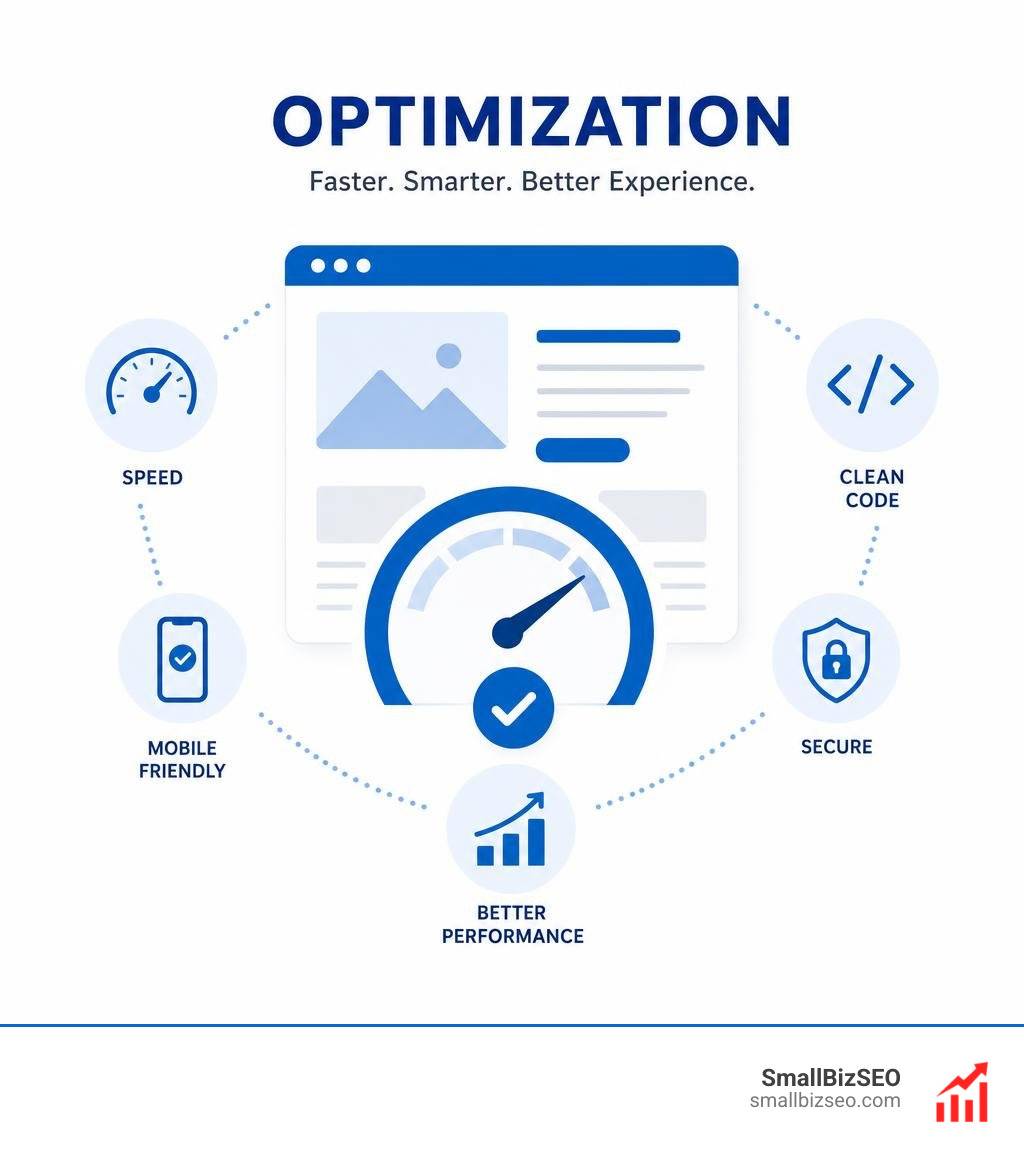
Images account for 50% to 70% of a typical web page's total weight. Optimizing your visual assets is the fastest way to slash your load times.
We recommend converting standard JPEGs or PNGs to modern formats like WebP or AVIF, which are significantly smaller without sacrificing quality. Additionally, implementing browser caching and deploying a Content Delivery Network (CDN) ensures your site's static files are served from servers physically closest to your visitors.
- Lazy Loading: Instruct the browser to only load images and videos as they scroll into the viewport, saving immense bandwidth.
- Minify Resources: Strip out unnecessary spaces, comments, and formatting from your CSS, JavaScript, and HTML files.
- Prioritize Critical Resources: Preload your LCP images and critical fonts so they render immediately upon the first visit.
Frequently Asked Questions About Page Performance
How do you measure the success of web page optimization?
We measure success by tracking both technical performance and user behavior metrics. Using tools like Google Search Console and PageSpeed Insights, we monitor Core Web Vitals, organic impressions, and click-through rates. The true measure of success is an upward trend in conversion rates and a reduction in bounce rates over a three-to-six-month period.
What are the most common pitfalls in website optimization?
The most frequent mistakes include:
- Ignoring Mobile Users: Given that 59.5% of all web traffic comes from mobile devices, optimizing for desktop-only is a critical error.
- Keyword Stuffing: Writing for algorithms instead of humans leads to poor readability and search penalties.
- Broken Links and Redirect Loops: These frustrate users and waste search engine crawl budgets.
- Too Many Third-Party Scripts: Installing excessive tracking pixels and plugins heavily degrades page speed.
How often should you audit and optimize your web pages?
Web optimization is not a one-time project; it is a continuous loop. We recommend conducting a comprehensive technical audit every six months. However, you should continuously monitor user feedback, review heatmaps, and analyze performance weekly to spot and fix minor issues before they impact your rankings.
Conclusion
Web page optimization is the single most powerful investment you can make to secure long-term digital growth. By focusing on speed, clear user pathways, and high-quality content, you turn your website into a reliable, round-the-clock sales tool.
At SmallBizSEO, we help small businesses navigate this complex landscape through our proprietary "Velocity" framework. We deliver data-driven, E-E-A-T-compliant optimization strategies backed by transparent, automated reporting—giving you clear visibility into your growth.
Ready to transform your digital presence and turn searchers into loyal customers? Partner with our SEO content services today, and let us build a faster, higher-converting website for your business.