Transform Your Team’s Quotes into High-Authority Media Coverage
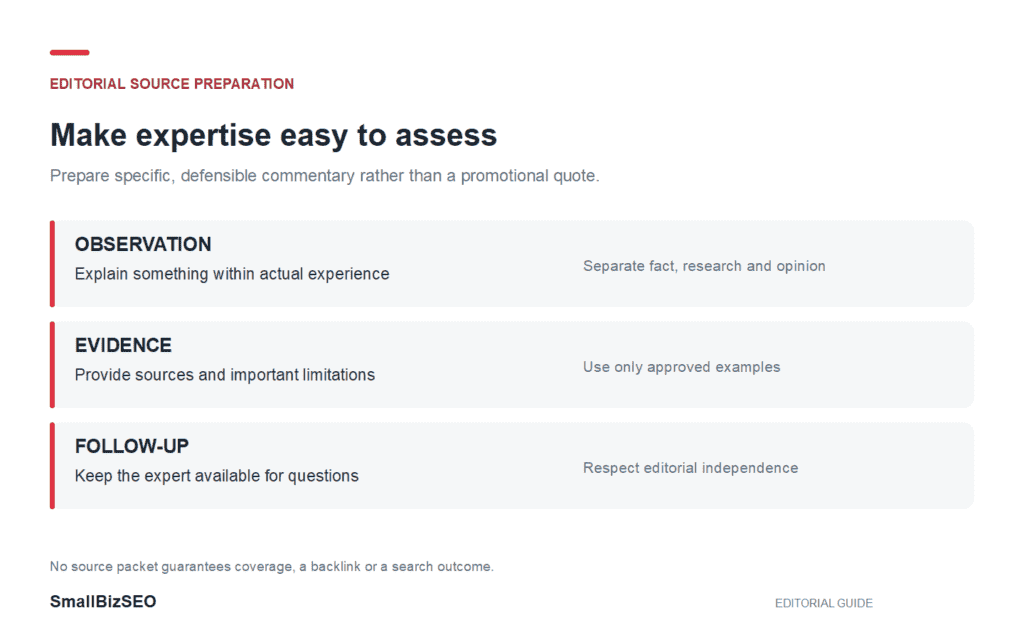
Make your expertise usable before pitching it
Expert commentary can contribute to editorial coverage when it helps a journalist explain something accurately. A promotional quote is not enough. Prepare a compact source packet with a specific observation, supporting evidence, the limits of the expert's knowledge, and a clear way to follow up.
No packet guarantees coverage, a backlink, or a particular search outcome. The journalist decides whether the contribution belongs in the story. Your job is to make the useful information easy to assess without overstating it.
Choose an observation the expert can defend
Start with a question within the person's actual experience. What recurring problem have they directly seen? What common interpretation is misleading? What practical consequence can they explain that a reader might otherwise miss?
Separate firsthand observation, published research, and opinion. Someone who implemented a process can explain the implementation, but that does not make them an authority on every market-wide trend. Avoid turning a few client experiences into a claim about an entire industry.
Write the proposed angle in one sentence. If the angle still reads like “our company provides excellent service,” it is probably an advertisement rather than useful commentary.
Build the source packet
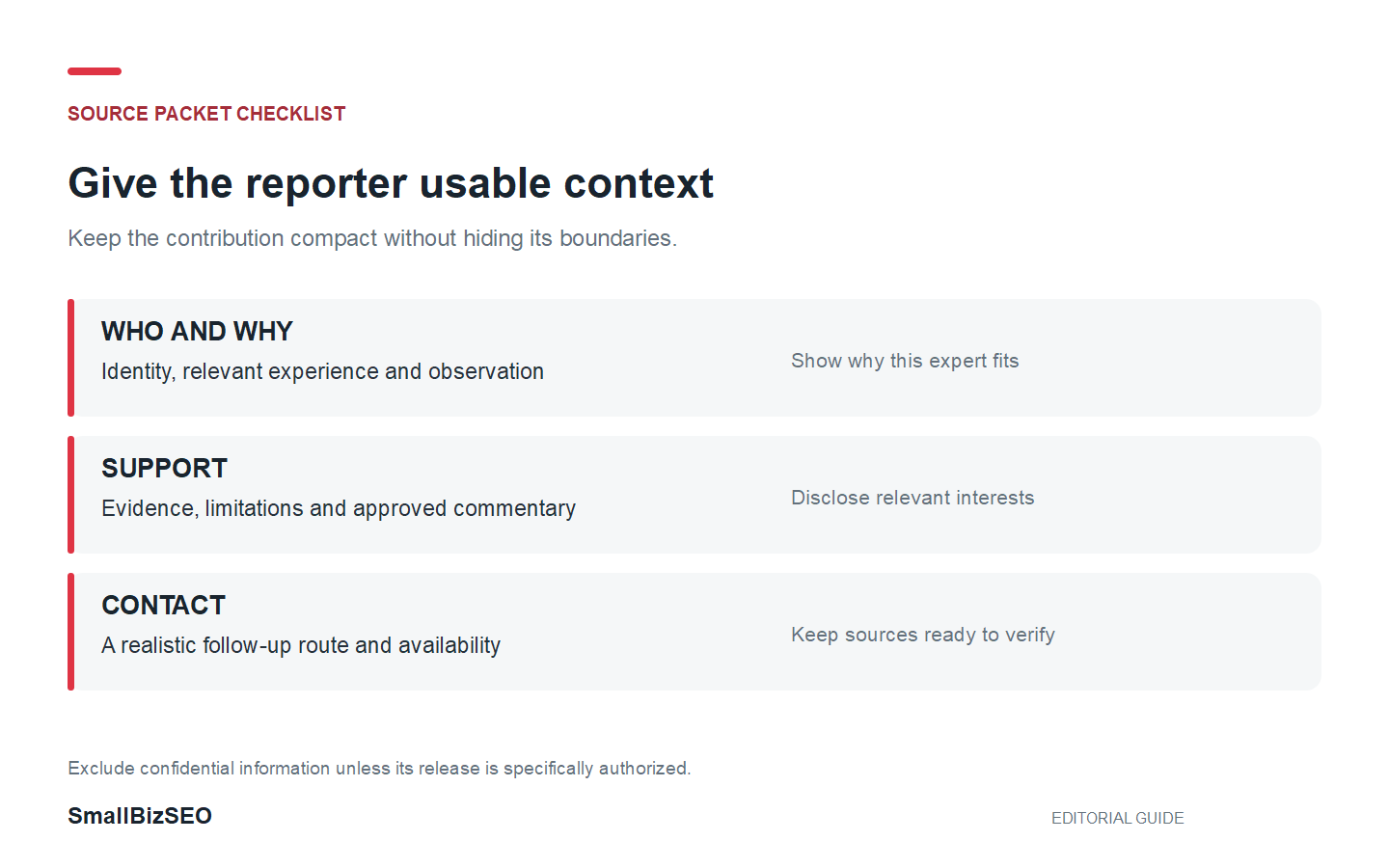
- Expert identity: name, current role, relevant experience, and a public biography that supports the credentials.
- Main observation: a concise explanation of the issue and why it matters to the publication's audience.
- Evidence: original source links, documented methodology, or approved examples supporting factual claims.
- Boundaries: date range, sample limitations, geography, and what the evidence does not establish.
- Commentary: the expert's own approved wording, clearly distinguished from background notes.
- Interests: relevant employment, client, financial, or other relationships that could affect interpretation.
- Availability: a realistic contact route and interview window.
Keep confidential client information out of the packet unless its release has been specifically authorized. An anonymized example must not expose identifying details indirectly. When permission or evidence is unavailable, use a general explanation rather than inventing a case study.
Preserve the expert's meaning
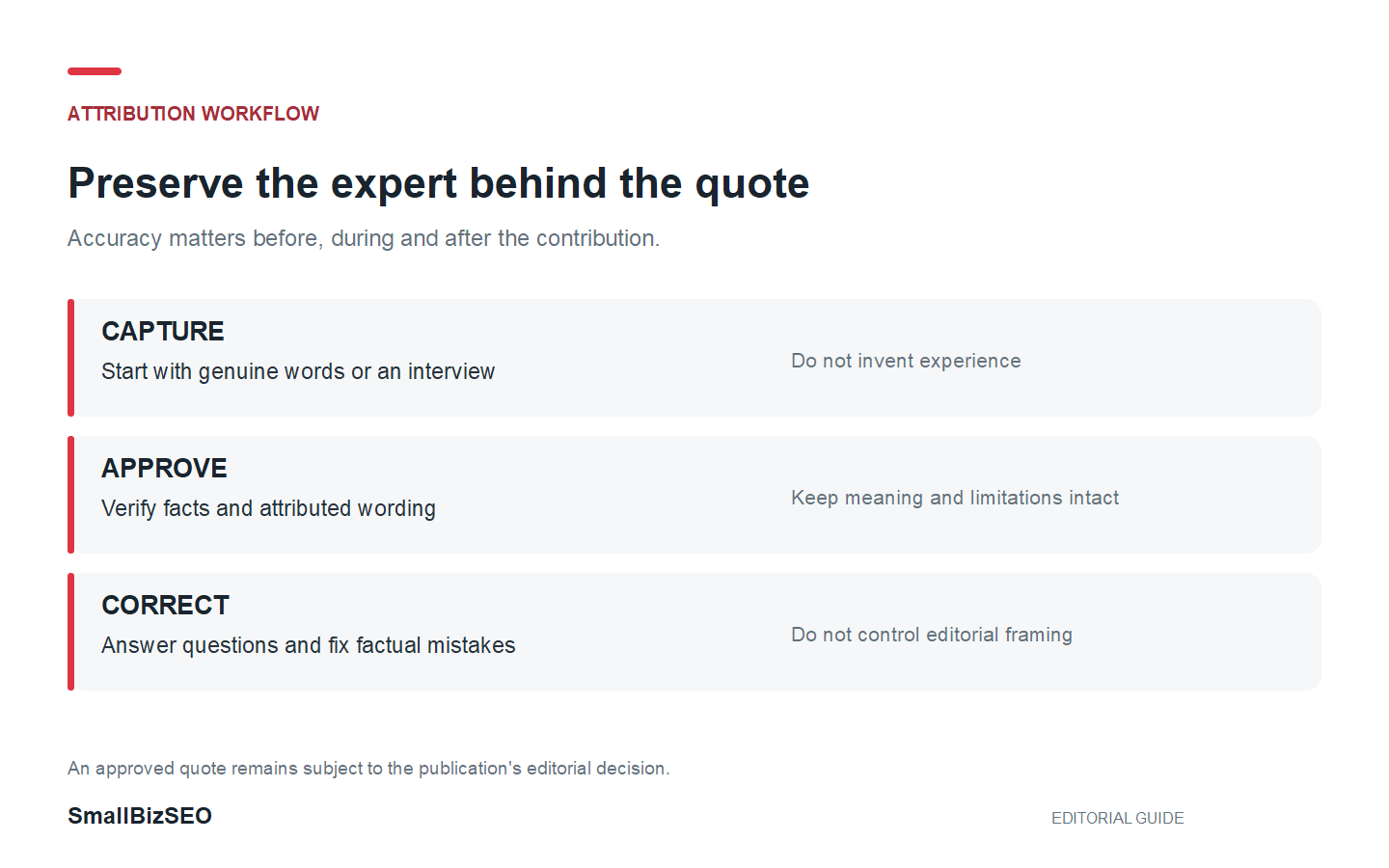
Interview the expert or work from their genuine written response. Editors can improve clarity, but the expert should approve the final attributed wording and verify the supporting facts. Do not manufacture a quotation, credential, project result, or personal experience.
If a draft was prepared with AI assistance, verify every factual statement and let the named expert take responsibility for the final response. A plausible-sounding paragraph is not evidence of expertise.
The Associated Press's standards explain that release material is evaluated and supplemented rather than simply reproduced. Its guidance also protects quotation accuracy and calls for clear interview ground rules. Expect a reporter to verify your material and ask questions, not accept a packet as finished journalism.
Match the contribution to a real editorial need
Read the journalist's recent work or the actual source request. Identify the audience, question, requested expertise, format, and deadline. Respond only when the expert fits. There is no universal response-time window that guarantees selection.
A concise introduction can explain the relevant credential, the specific contribution, and where the evidence is documented. Avoid long biographies, unrelated attachments, keyword-heavy anchor requests, and a demand for coverage in exchange for helping.
Before an interview, agree on any requested restrictions and what they mean to the journalist. Do not assume that adding “off the record” afterward changes an earlier conversation. If sensitive material cannot be shared under acceptable terms, leave it out.
Handle follow-up and corrections responsibly
Keep the packet's sources and approved wording available so the expert can answer follow-up questions. If a detail is uncertain, say that you need to check rather than improvising a statistic.
Distinguish correcting a factual error from trying to control an editor's framing. If you discover a mistake in information you supplied, explain it promptly and provide the correct evidence. Do not pressure the journalist to remove a legitimate criticism or rewrite an accurate quote for promotional effect.
Measure contribution quality, not just links
Record the topic, outlet, response, evidence used, and whether the published story represents the contribution accurately. Where coverage appears, note relevant referral traffic or inquiries without attributing every later business result to the placement.
A story may include the expert without linking to the business. An editorial mention is not a paid deliverable, and a link is not a guaranteed ranking improvement. Evaluate whether the contribution reached an appropriate audience and built a credible record of expertise.
Keep the reusable evidence and retire stale claims through an evergreen fact-check process. A reliable expert source becomes useful by being specific, accurate, and available, not by promising a larger number of placements.
For help aligning expert material with your site's editorial plan, review our content research and writing services. Editorial coverage remains the publication's decision.