Filter Out Noisy Brand References to Uncover High-Value Visibility

Core Criteria: How to Distinguish Meaningful Brand Mentions from Passing References
A meaningful brand mention is an online reference that actively influences customer perception, drives organic search equity, or informs AI-generated recommendations. A passing reference is simply a casual name-drop, an ambiguous keyword match, or a generic listing that carries no commercial intent or editorial weight. Learning how to distinguish meaningful brand mentions from passing references helps your team avoid chasing low-value alerts and focus on signals that actually move the needle.
When evaluating incoming signals, we measure each mention against four core pillars: context, audience reach, source authority, and sentiment. Checking whether a publication has genuine trust helps determine whether your brand is actually authoritative in the eyes of search engines and prospective buyers.
The Mention Quality framework breaks this down into four weighted dimensions:
- Position and Prominence: Where does the reference appear? A brand featured in the opening paragraph as the primary solution carries far more weight than one buried in an appendix.
- Framing Context: Is your product framed as the category leader, a specialized solution, or merely an afterthought?
- Embedding-Source Authority: How credible is the publishing platform within your specific niche?
- Sentiment and Characterization: Does the surrounding text praise your strengths, critique shortcomings, or remain completely neutral?
| Dimension | Meaningful Brand Mention | Passing Reference |
|---|---|---|
| Context | Editorial focus, detailed product review, problem-solving feature | Side-note list item, brief name-drop, offhand example |
| Placement | Headline, introductory summary, primary recommendation | Footnote, author bio, buried directory row |
| Buyer Intent | High commercial or comparative consideration | Incidental topical association |
| Search & AI Value | Direct entity reinforcement, high-value citation | Low-weight semantic co-occurrence |
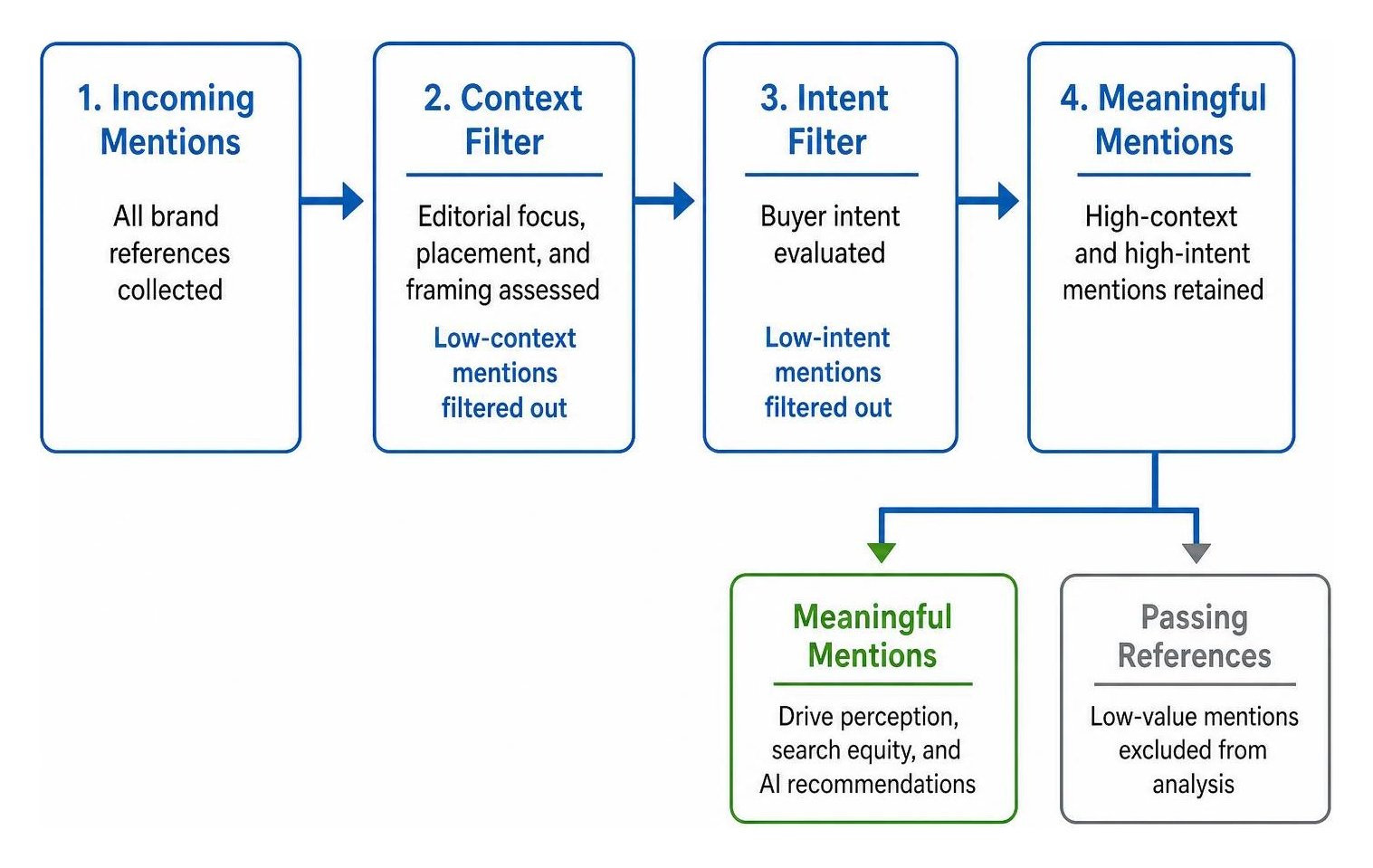
What Determines Context, Intent, and Entity Salience in Brand Mentions?
Entity salience measures how central your business is to the main topic of an article. When a search engine or language model processes a document, it evaluates whether your business acts as a primary subject or background filler.
A high-salience mention typically takes the form of an explicit brand recommendation, where the author outlines why your product solves a specific business problem. These references directly influence buyers actively evaluating solutions.
In contrast, low-salience mentions happen when an author mentions your name in a list of fifty generic tools without descriptive context. To search engines building a profile around your brand entity, isolated list items offer weak topical signals. Filtering out these false positives keeps your team focused on references that actually drive revenue and authority.
Web vs. AI: How to Distinguish Meaningful Brand Mentions from Passing References Across Search Surfaces

Evaluating visibility in AI answer engines requires a different mindset than tracking traditional web pages. In platforms like ChatGPT, Perplexity, and Google AI Overviews, answers are generated probabilistically based on retrieval-augmented generation and underlying model training.
Understanding the difference between a brand mention and a brand citation in LLM outputs is essential for accurate reporting. A mention occurs when the engine names your company in its generated response text, shaping user perception directly. A citation occurs when the system provides a linked reference card pointing back to your URL as evidence.
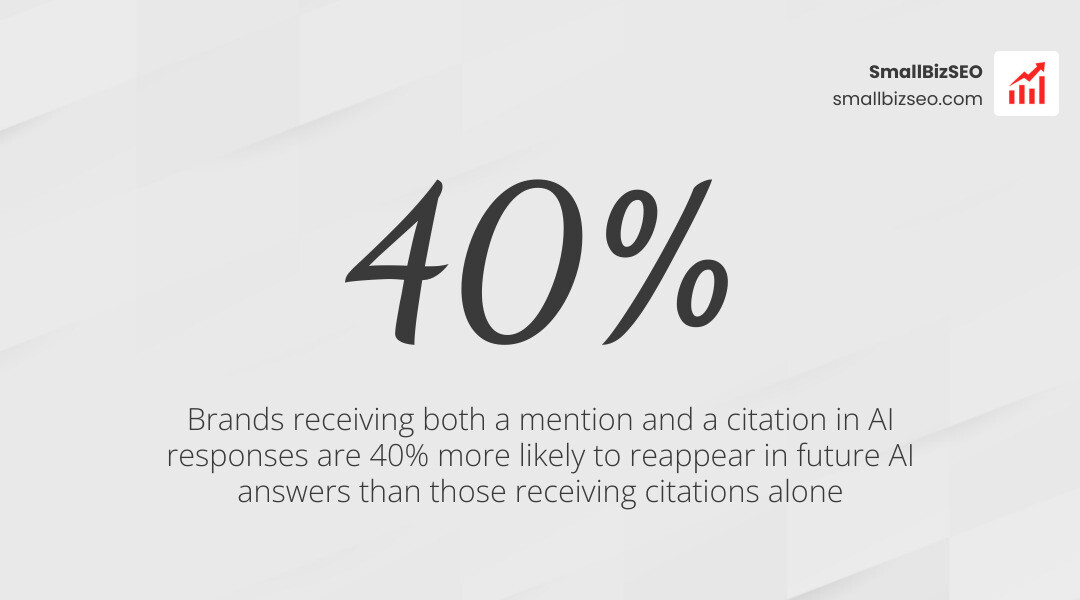
Research indicates that 62% of AI citations link to a site without ever naming the brand in the answer text. Furthermore, studies show that brands receiving both a citation and a mention are 40% more likely to reappear in future AI responses than those receiving citations alone. The ultimate goal is building AI brand influence and semantic framing, ensuring that generative models adopt your terminology, core features, and positioning rather than merely listing your name.
| Visibility Type | Generation Origin | User Impact | SEO & Authority Value |
|---|---|---|---|
| AI Text Mention | Model training data or retrieved context | Shapes brand perception directly in conversational copy | Strengthens entity associations across generative engines |
| Source Citation | Live search retrieval module | Generates high-intent referral traffic and verifies factual claims | Validates technical authority and domain relevance |
| Ghost Citation | Algorithmic indexing without explicit display | Low immediate user visibility | Contributes to underlying knowledge graph synthesis |
How to Evaluate Unlinked Mentions, Backlinks, and Visual Brand Exposure
Every brand mention carries strategic value, but the approach changes depending on whether the reference includes an active link. An unlinked mention occurs when an author discusses your business without linking to your domain.
Search engines treat unlinked references as implied links, associating your business with relevant industry keywords. However, converting these assets into active backlinks through targeted link reclamation secures direct link equity and referral channels. Prioritize outreach for unlinked mentions that meet three conditions:
- The publishing domain possesses strong authority and topic relevance.
- The context is positive or educational.
- A link naturally aids the reader's journey by leading to a specific study, guide, or tool.
Visual exposure also plays an expanding role. When your logo appears in an industry video, infographic, or customer unboxing clip, it builds recognition that text scrapers miss. Modern social listening platforms use AI-powered image recognition to flag these visual assets, allowing your marketing team to amplify user-generated content and track multimedia impact.
Step-by-Step Framework to Triage, Measure, and Act on Meaningful Mentions
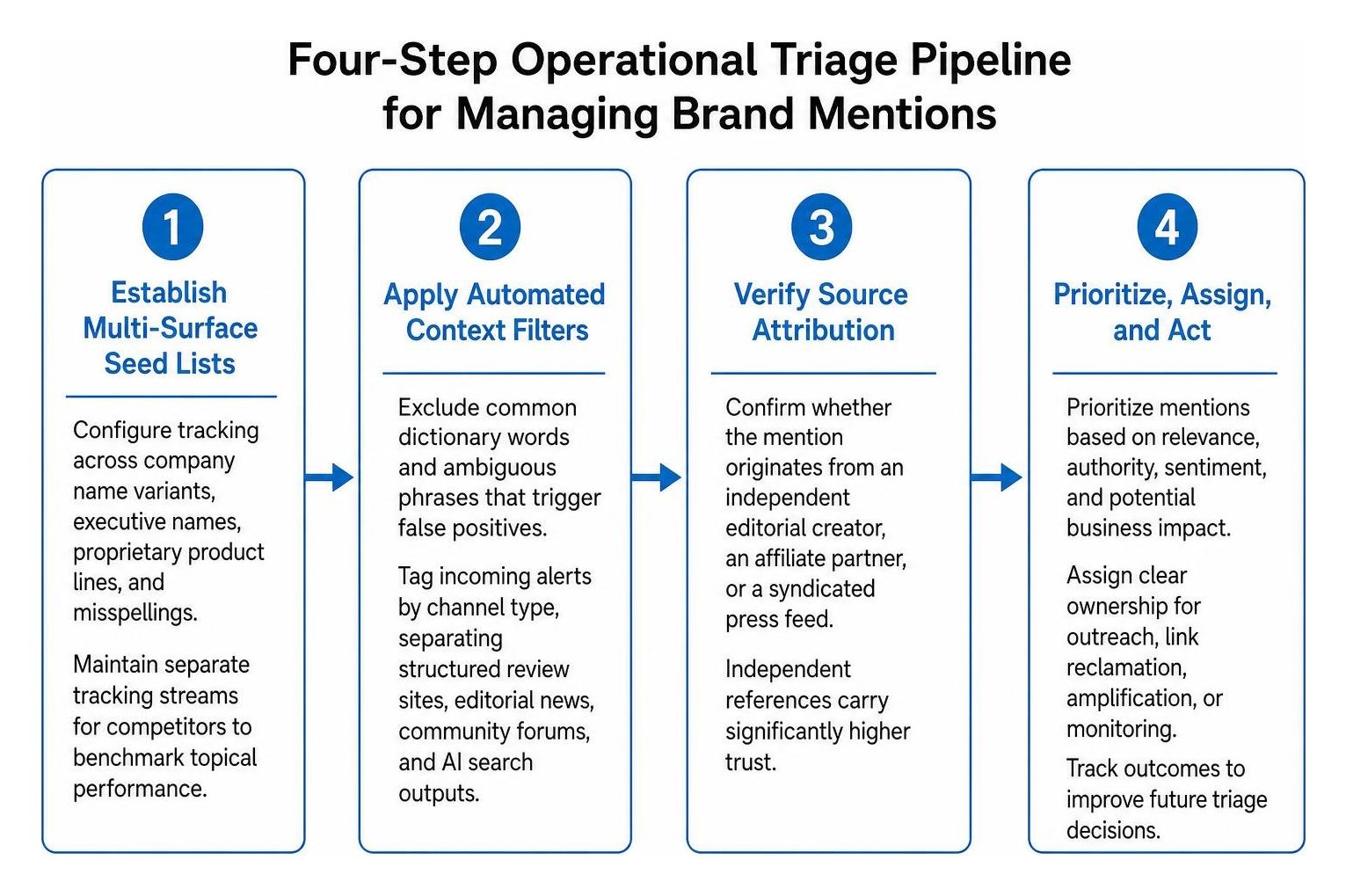
To avoid getting buried in automated notifications, your team needs an operational triage system. The goal is to filter incoming alerts quickly, assign clear ownership, and focus resources on mentions that generate concrete business outcomes.
- Establish Multi-Surface Seed Lists: Configure tracking across company name variants, executive names, proprietary product lines, and misspellings. Maintain separate tracking streams for competitors to benchmark topical performance.
- Apply Automated Context Filters: Exclude common dictionary words and ambiguous phrases that trigger false positives. Tag incoming alerts by channel type, separating structured review sites, editorial news, community forums, and AI search outputs.
- Verify Source Attribution: Confirm whether the mention originates from an independent editorial creator, an affiliate partner, or a syndicated press feed. Independent references carry significantly higher trust.
- Conduct Scheduled Audits: Pair automated tools with manual reviews. Run regular prompt sets across AI search engines to monitor how generative models describe your business over time.
Operational Triage: How to Distinguish Meaningful Brand Mentions from Passing References in Daily Workflows
A consistent triage matrix prevents team overlap and ensures critical mentions receive timely attention based on predefined severity levels.
- Priority 1: High-Risk Sentiment & PR Emergencies (SLA: Under 2 Hours)
- Triggers: Severe customer complaints on high-traffic forums, viral social threads, or factual errors in major news publications.
- Owner: PR, Legal, or Senior Customer Support.
- Action: Direct outreach, official clarification, or proactive dispute resolution.
- Priority 2: High-Intent SEO & Link Opportunities (SLA: Within 24 to 48 Hours)
- Triggers: Unlinked editorial mentions on authoritative niche publications, category roundups, and podcast show notes.
- Owner: Link Building and SEO Outreach Teams.
- Action: Personalized outreach thanking the editor and suggesting a relevant source asset.
- Priority 3: Brand Advocacy & Social Proof (SLA: Within 24 Hours)
- Triggers: Authentic customer praise, unprompted recommendations, or video testimonials.
- Owner: Social Media and Content Marketing.
- Action: Public engagement, reposting, and archiving quotes for marketing collateral (ensuring proper disclosure standards).
- Priority 4: Neutral Mentions & Background Chatter (SLA: No Direct Response Required)
- Triggers: Passing references, generic directory listings, or low-reach automated data feeds.
- Owner: Automated Dashboard Logging.
- Action: Aggregate data for share-of-voice reporting; no direct outreach needed.
How to Measure Share of Voice, Citation Rate, and Long-Term Brand Momentum
Tracking raw mention counts alone often creates a misleading picture of marketing success. A sudden volume spike might simply reflect an irrelevant news cycle rather than lasting market authority. Instead, track metrics that measure depth, sentiment, and conversion impact:
To establish dependable benchmarks:
- Track the Sentiment Mix: Segment mentions into positive, neutral, and critical buckets. A healthy profile maintains a steady baseline of authentic positive recommendations across independent channels.
- Run Fixed Prompt Panels: Test a consistent set of customer evaluation queries across major AI platforms every month. This isolates genuine visibility gains from temporary algorithmic fluctuations.
- Measure Referral Conversions: Use web analytics to track traffic, dwell time, and goal completions originating from earned editorial links and AI citation cards.
Turn Your Earned Visibility into Measurable Growth
Separating meaningful brand mentions from background chatter allows your team to protect its brand reputation, capture high-value backlinks, and optimize for the future of search. When you focus on context, authority, and buyer intent, every alert turns into an actionable growth opportunity.
At SmallBizSEO, our data-driven "Velocity" framework combines technical SEO, targeted content strategy, and authoritative link building to help growing companies expand their digital footprint. If you want to refine your search strategy and strengthen your online authority, schedule an SEO visibility audit with our team today.