The Ultimate Guide to Organic Traffic Growth in 2026

The Ultimate Guide to Organic Traffic Growth in 2026
Why Most Small Businesses Are Leaving Organic Traffic Growth on the Table
Organic traffic growth is one of the most powerful — and most misunderstood — levers available to small business owners trying to build a sustainable online presence.
Here is a quick answer if you need it now:
How to grow organic traffic:
- Fix technical SEO issues (crawl errors, page speed, indexing)
- Target high-intent keywords your buyers actually search for
- Create and consistently publish quality, search-optimized content
- Build authoritative backlinks from relevant sites
- Optimize on-page elements (titles, meta descriptions, headings)
- Track conversions and revenue — not just visits
68% of all online experiences start with a search engine. Yet many small business owners either ignore organic search entirely or chase the wrong metrics — fixating on raw traffic numbers while missing the leads and revenue hiding inside a smarter strategy.
Here is the hard truth: organic traffic is declining across the web. SERP features like AI Overviews, People Also Ask boxes, and video carousels are absorbing more clicks than ever before. But that does not mean SEO is dead. It means the old playbook is dead.
The businesses winning right now are not the ones with the most traffic. They are the ones attracting the right traffic — visitors with real buying intent — and converting it efficiently.
One data point makes this clear: in a study of 200 companies, revenue grew from 0% to 7.2% over the course of a year while organic traffic stayed nearly flat. More traffic did not drive more revenue. Better traffic did.
This guide walks you through exactly how to build that kind of organic engine — from fixing your technical foundation to targeting the queries that actually move the needle for your business.
I'm Clayton Johnson, and I've spent my career leveraging digital PR and SEO to help brands build real search visibility and drive meaningful growth — including hands-on work with organic traffic growth strategies across competitive markets. Let's break down what actually works.
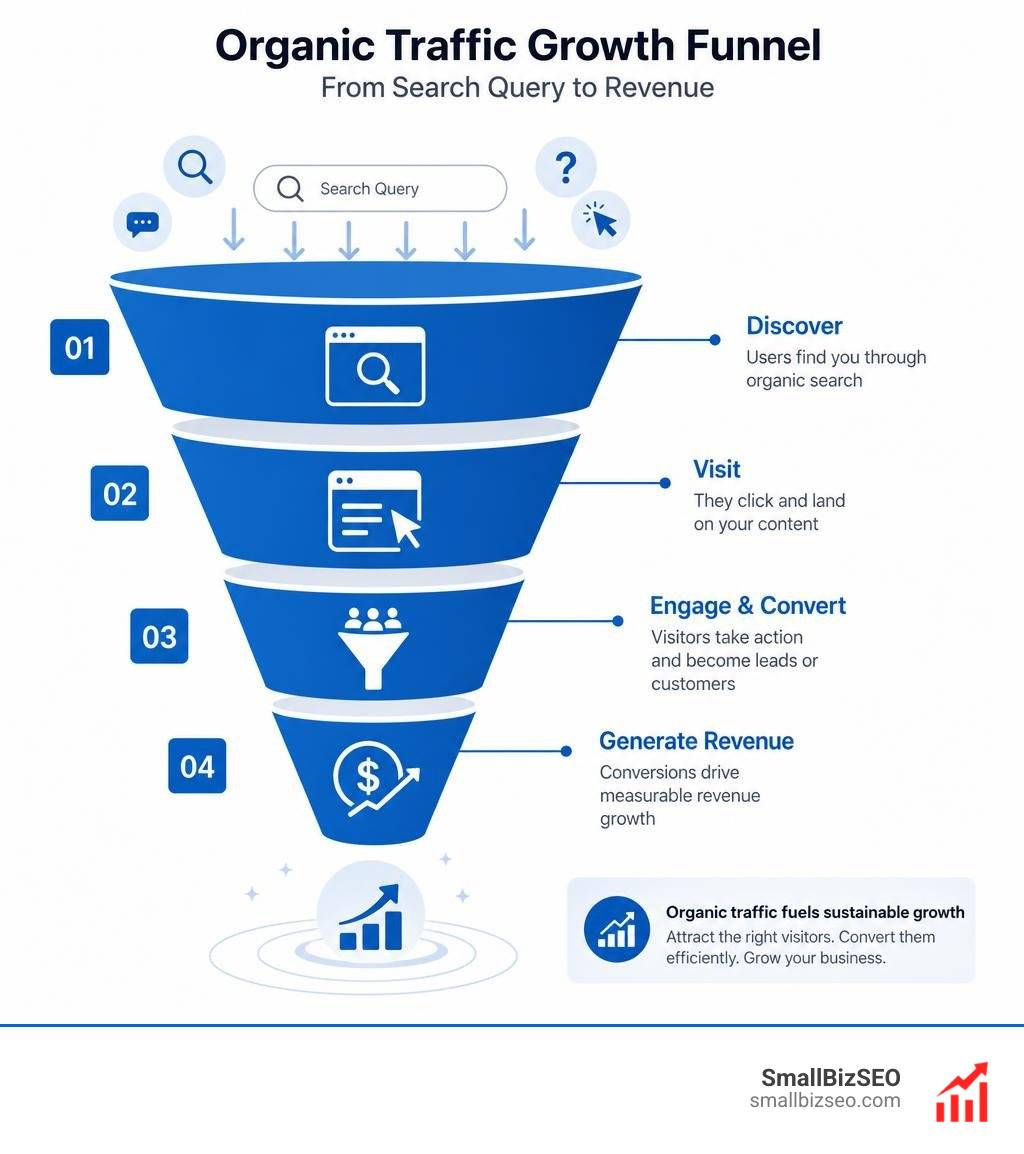
Understanding Organic Traffic Growth and Its Long-Term Value
When we talk about organic search, we are referring to the visitors who land on your website through unpaid search engine results. Unlike paid traffic, where every single click drains your marketing budget, organic clicks are entirely free.
To understand where your current search presence stands and identify areas for improvement, a proper Organic Search Traffic Analysis Guide can help you evaluate how visitors interact with your site.
Why Organic Traffic Outperforms Paid Ads for Sustainable Growth
Paid advertising is like a faucet: the moment you turn off the budget, the traffic stops instantly. Organic traffic, however, acts as a sustainable asset that continues to drive value long after your initial optimization work is done.
Consider what happens when companies pause their paid advertising. In a real-world test where a brand completely shut down its paid search spend ($0 budget), the site maintained its sales performance. Because of a strong organic SEO foundation:
- Total sessions increased by 5.09%
- Engaged sessions rose by 5.88%
- Organic sessions climbed by 34.04%
- Direct sessions increased by 66.73%
This demonstrates that a robust organic funnel acts as a protective shield, keeping your pipeline full even when ad spend is eliminated. To build this type of safety net, our comprehensive SEO Services Guide outlines the essential steps to transition away from heavy ad reliance.
The Compounding ROI of Long-Term Organic Traffic Growth
Organic SEO is a compounding game. It requires patience, but the long-term math is incredibly in your favor.
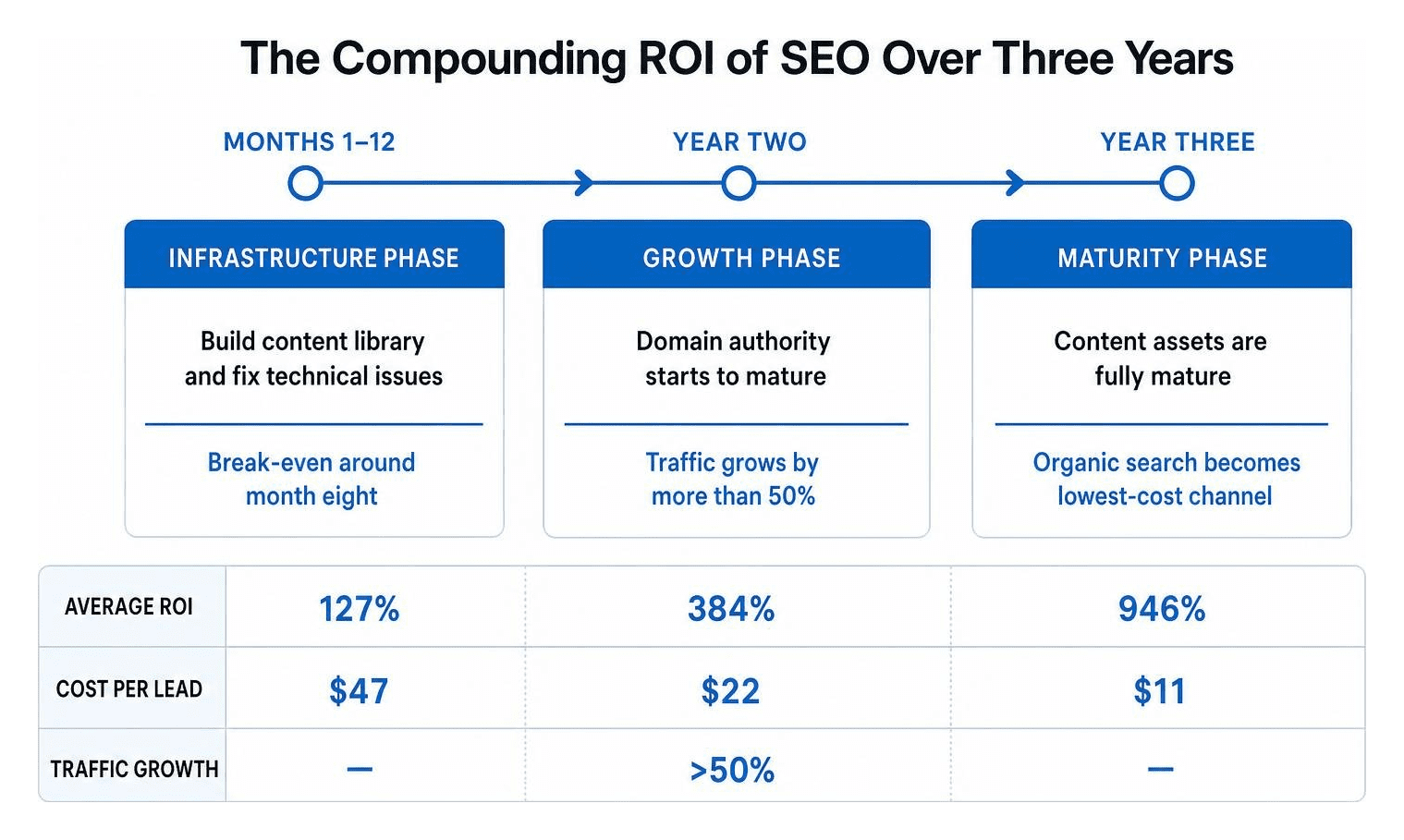
Unlike paid campaigns where customer acquisition costs (CAC) remain relatively flat, organic search costs drop dramatically over time. Here is how the compounding curve typically looks across tracked businesses:
- Months 1 to 12: The infrastructure phase. You build your content library and fix technical issues. Average ROI sits around 127%, with a cost per lead of roughly $47. Break-even typically occurs around month eight.
- Year Two: Your domain authority starts to mature. Traffic grows by more than 50% on average, ROI climbs to 384%, and cost per lead drops to $22.
- Year Three: Your content assets are fully mature. Organic search becomes your lowest-cost channel. ROI averages a massive 946%, and cost per lead plummets to just $11.
To master this compounding effect and see how consistent content volume builds topical authority, you can read more about How to Grow Organic Traffic, The Compound Playbook.
Navigating the Modern Search Landscape: AI Overviews and Declining Click-Through Rates
The search engine results page (SERP) is no longer a simple list of ten blue links. If you have noticed your organic click-through rates dipping, you are not alone.

How AI Overviews and SERP Features Impact Organic Clicks
Search layouts are increasingly dominated by AI Overviews, People Also Ask boxes, and featured snippets. These features satisfy informational queries directly on the search page, resulting in "zero-click searches."
While this makes winning traditional clicks harder, it opens up new opportunities for Answer Engine Optimization (AEO). To find out how visible your brand is in this new landscape, performing an SEO Visibility Audit is a crucial first step.
Shifting Strategy from Informational Queries to Visit-Website Intent
Because AI tools answer simple informational queries instantly on the SERP, we must shift our focus to "visit-website intent" queries. These are searches where the user must click through to a website to get what they need—such as comparing specific products, reading deep case studies, or booking services.
To find where your competitors are winning these high-intent clicks, you can run a Keyword Gap Analysis: What It Is and How to Do It Right to pivot your targeting toward commercial terms.
Maximizing Revenue with Flat Traffic: High-Intent vs. Informational Queries
Chasing raw traffic volume is a vanity play. If you bring ten thousand visitors to a blog post about a broad topic and zero of them buy, your traffic report looks great, but your bank account remains empty.
| Feature | Informational Intent | Commercial/Buying Intent |
|---|---|---|
| Search Example | "What is organic traffic" | "Best technical SEO services" |
| CTR on SERP | Low (often answered by AI) | High (requires site visit) |
| Conversion Rate | Very low (<0.5%) | High (typically 3% to 10%+) |
| Revenue Impact | Indirect / Brand awareness | Direct sales pipeline |
Commercial vs. Informational Search Intent Outcomes
By targeting commercial-intent keywords, you align your content with users who are actively carrying a credit card in their hand. This is why a small US e-commerce brand was able to grow its organic revenue by 21.7% with only a minor increase in overall traffic—they simply ranked higher for the specific keywords that buyers use.
Our team specializes in mapping out these commercial clusters through our targeted SEO Content Services.
Driving Revenue Growth Through Conversion Rate Optimization
Once high-intent traffic lands on your site, you have an average of only 3 seconds to convince them to stay. If your bounce rate is over 70%, it indicates issues with your design, layout, or call to action.
By running a Detailed SEO Analysis, you can identify which pages are attracting users but failing to convert them, allowing you to optimize your layouts and maximize revenue per visitor.
Core Pillars of a High-Yield SEO Strategy
To achieve sustainable organic traffic growth, you must build a balanced strategy across three core pillars: technical, on-page, and off-page SEO.
Technical SEO and On-Page Optimization Foundations
A beautiful website is useless if search engines cannot crawl or index it. Technical fixes, like compressing large images and removing unused code, can improve page load speeds dramatically (e.g., from over 6 seconds down to under 2 seconds), which directly boosts rankings and user retention.
To ensure your technical foundation is flawless, we recommend learning How to Pass Google's Own SEO Analysis Audits and mastering the fundamentals of On-Page SEO.
Building Trust with E-E-A-T, Backlinks, and User-Generated Content
Google prioritizes content that demonstrates Experience, Expertise, Authoritativeness, and Trustworthiness (E-E-A-T). You can build this trust by securing contextual backlinks from highly reputable industry websites and showcasing authentic user-generated content (UGC).
Explore our guide on How to Optimize Your Content for E-E-A-T and Build Real Search Trust and leverage our professional Link Building Services to safely elevate your domain authority.
E-commerce Strategies for Accelerating Organic Traffic Growth
E-commerce stores face unique search challenges, such as managing thousands of product variations without creating duplicate content or thin, low-quality pages.

For a deep dive into e-commerce search strategies, check out Organic Traffic Growth 101.
Optimizing Category and Product Pages for High-Intent Clicks
Category pages often rank for broader, high-volume search terms, while product pages capture highly specific long-tail queries. Adding descriptive, unique text and structured product schema to these pages helps search engines understand exactly what you sell.
To scale this optimization across your online store, our specialized SEO Services can help you clean up duplicate pages and maximize category visibility.
Leveraging Product Reviews and UGC to Double Conversions
Did you know that having just 100 reviews on a product page can more than double its conversion rate? Authentic customer reviews provide search engines with fresh, keyword-rich content while acting as powerful trust signals for shoppers. Furthermore, adding review snippets to your search listings can increase click-through rates by up to 24%.
Measuring Success: Key Performance Indicators Beyond Total Visits
To run a truly data-driven business, you must look past vanity traffic charts and focus on metrics that directly impact your bottom line.
Essential Metrics for Tracking Organic Traffic Growth
While total visits are good to know, you should prioritize tracking:
- Organic Sessions: Unpaid visits to your money pages.
- Keyword Rankings: Movements of commercial-intent terms into the top positions.
- Referring Domains: The quantity and quality of sites linking to you.
To simplify this process, our core SEO strategies include transparent, automated reporting that connects search visibility directly to lead generation.
Analyzing User Engagement and Bounce Rates in GA4
Using Google Analytics (GA4), monitor your engaged sessions and average session duration. If visitors spend less than a minute on your key landing pages or bounce immediately, your content may not be matching their search intent, or your page layout might need a refresh.
Frequently Asked Questions About Organic Traffic
Why is my organic traffic declining despite good rankings?
Your rankings might remain high, but search engine results pages now feature AI Overviews, People Also Ask boxes, and featured snippets that answer user queries immediately. This keeps searchers on Google instead of clicking through to your website, making "visit-intent" keyword targeting more critical than ever.
How long does it take to see results from SEO?
SEO is a compounding asset. While minor technical fixes can yield quick boosts within weeks, significant growth on competitive commercial terms typically takes six to twelve months. By year three, it often becomes your lowest-cost, highest-ROI marketing channel.
Can AI-generated content rank on search engines?
Yes. Google's guidelines clarify that high-quality content is rewarded regardless of how it is created. However, search engines heavily penalize thin, repetitive, or unoriginal content designed purely to manipulate rankings. Every piece of content must offer real value, unique insights, and clear E-E-A-T signals.
Conclusion
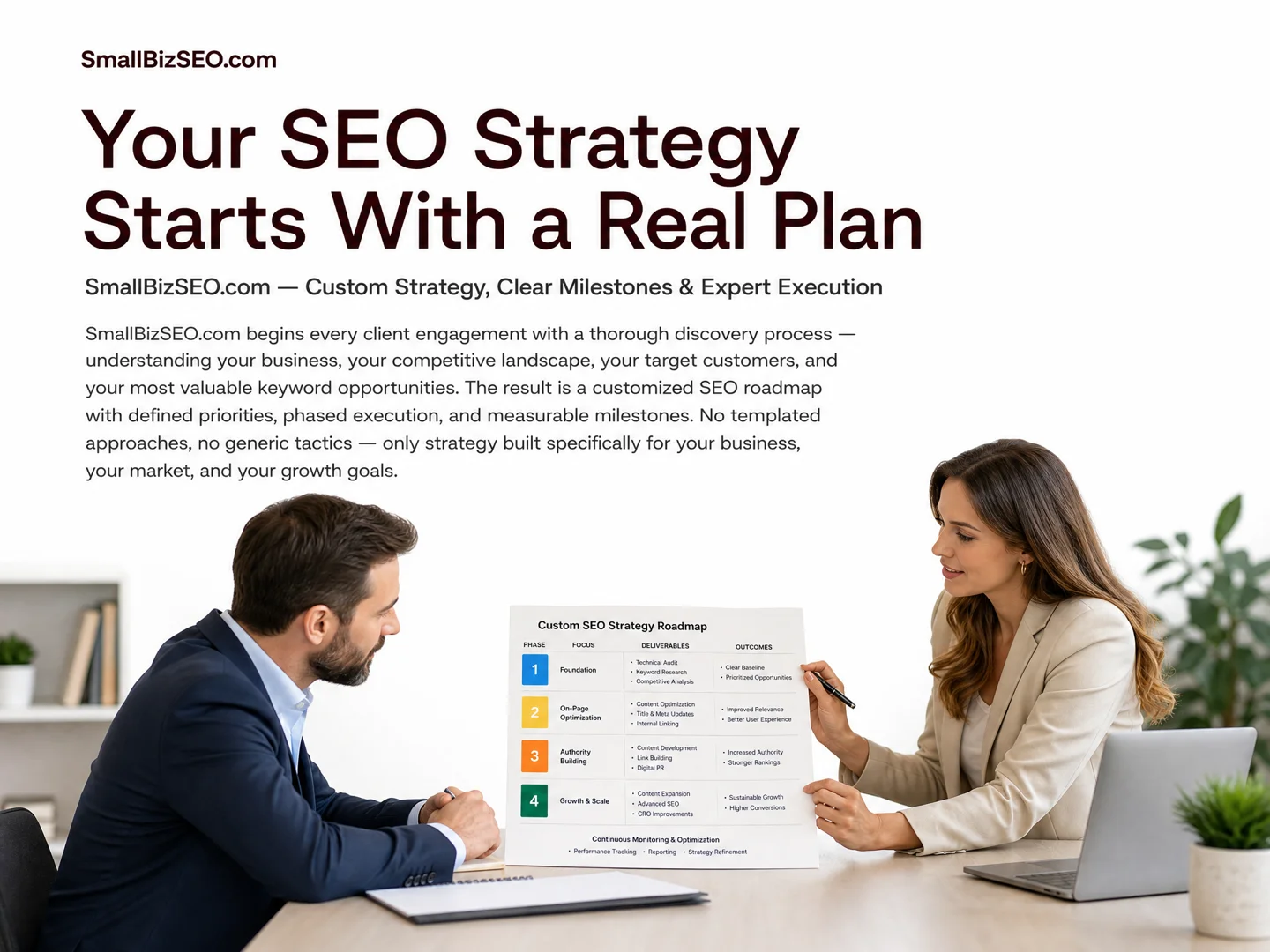
Achieving sustainable organic traffic growth is not about chasing loopholes or trying to trick search algorithms. It is about building a clean technical foundation, targeting the high-intent keywords your buyers actually use, and delivering an exceptional user experience that converts clicks into revenue.
At SmallBizSEO, we help small businesses scale their search presence using our data-driven "Velocity" framework. We combine technical SEO, content strategy, and trustworthy link-building to deliver transparent, automated results that grow your bottom line.
Ready to turn your website into a high-yield organic engine? Explore our tailored SmallBizSEO Packages today and let's build your growth roadmap together.