Keep Your Business Citations Clean and Organized While Changing Names

How Do You Keep Business Citations Accurate During a Rebrand?
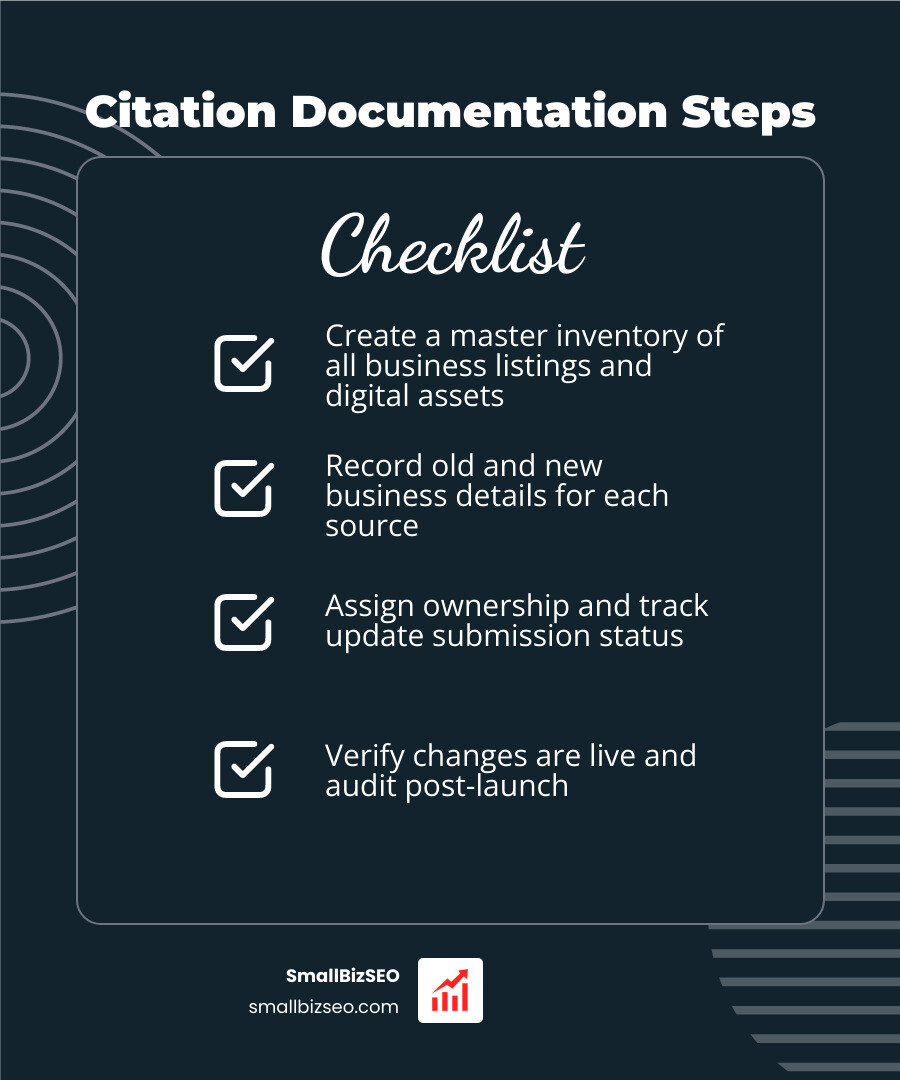
Here's how to document citation sources during a business rebrand: make one list of every place your business name and contact details appear. For each source, record the old details, the verified new details, who owns the update, when it was submitted, and whether the change is live.
Start with the listings and pages customers are most likely to find. Keep the record after launch so you can catch old names, broken links, and conflicting details before they cause confusion.
I'm Clayton Johnson, founder of SmallBizSEO. My work connecting SEO, content, and digital PR informs my guidance on how to document citation sources during a business rebrand: keep the evidence organized, check each update, and make the new identity easy to recognize.
How Can You Document Citation Sources During a Business Rebrand?
To document citation sources effectively, create a centralized master inventory that tracks every platform, directory, legal filing, and digital asset mentioning your business. Assign clear ownership, link direct source URLs, log old versus new information, and update verification statuses in real time.

A rebrand is far more than designing a new logo or writing a fresh tagline. A new visual identity on an outdated operational foundation only makes the gap between promise and customer experience more obvious. When you change names, search algorithms, artificial intelligence discovery models, and customers all rely on your historical footprint to determine whether your business is legitimate. Without structured documentation, legacy references fragment your online presence, creating search visibility loss and customer doubt.
Why Does Documenting Citation Sources During a Business Rebrand Matter?
Documenting your sources preserves search equity, protects algorithm trust, and prevents fragmented public records from diluting your brand authority.
When search engines and answer engines scan the web, they search for consistent patterns. If third-party databases, business directories, and review platforms display conflicting names or outdated contact information, search systems struggle to reconcile your business entity. Maintaining authoritative credibility requires precise reference logging, as detailed in academic frameworks like Documenting Sources in Business Communication.
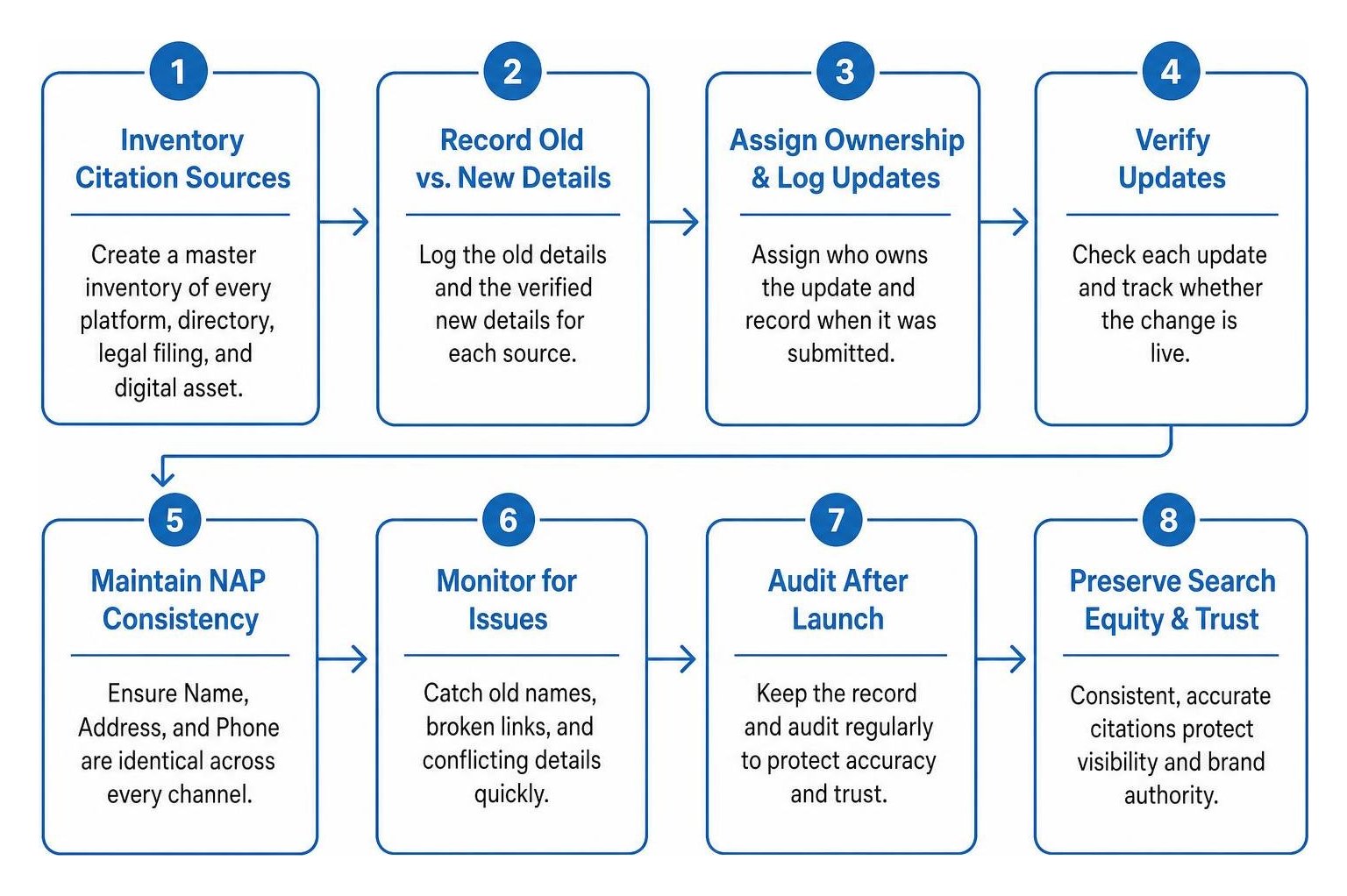
Clear documentation simplifies maintaining strict NAP consistency—ensuring your Name, Address, and Phone number remain identical across every digital channel. When external records disagree, your local search rankings drop, knowledge panels split, and AI assistants provide outdated information to prospective clients.
How Do You Audit Legacy Brand Assets and Data Sources?
Begin your audit by cataloging every owned, earned, and third-party platform that displays your business identity into a master tracking sheet.
Divide your audit into two operational categories: internal brand assets and external citation sources. For internal records, follow established corporate standards like academic business research guidelines to document historical evidence, whitepapers, proposals, and case studies. For external citations, identify every directory, social profile, industry registry, and partner site contributing to building an authoritative brand entity.
| Citation Source Type | Examples & Scope | Primary Risk if Overlooked | Documentation Priority |
|---|---|---|---|
| Primary Digital Profiles | Google Business Profile, Apple Business Connect, Bing Places | Immediate loss of local map rankings and customer calls | High (Pre-Launch & Day 1) |
| Core Web Directories | Yelp, YellowPages, Better Business Bureau, Chamber of Commerce | Conflicting signals that confuse search crawlers | High (Phase 1 Rollout) |
| Industry & Niche Platforms | Trade associations, professional registries, supplier databases | Inaccurate B2B referrals and lost niche authority | Medium (Phase 2 Rollout) |
| Internal Business Assets | Master contracts, proposals, invoices, pitch decks | Legal non-compliance and customer confusion | High (Internal Prep) |
| Earned & Unstructured Mentions | Press releases, partner websites, digital PR features | Split brand entities in AI answer engines | Ongoing (Post-Launch) |
Every entry in your audit sheet must include the direct URL, current login credentials or verification method, the exact name variant displayed, the designated internal owner, and a priority tier based on referral traffic and domain authority.
How Do You Document Citation Updates Across Directories?
Document directory updates by logging each platform's submission requirements, tracking verification timelines, and recording confirmation statuses sequentially.
Updating directories is not an instantaneous, single-day task. Platforms process edits on different schedules—some update within minutes, while others take weeks or require manual phone verification. Implementing a structured, modern web directory strategy ensures that high-impact databases pass authority to your new brand first.
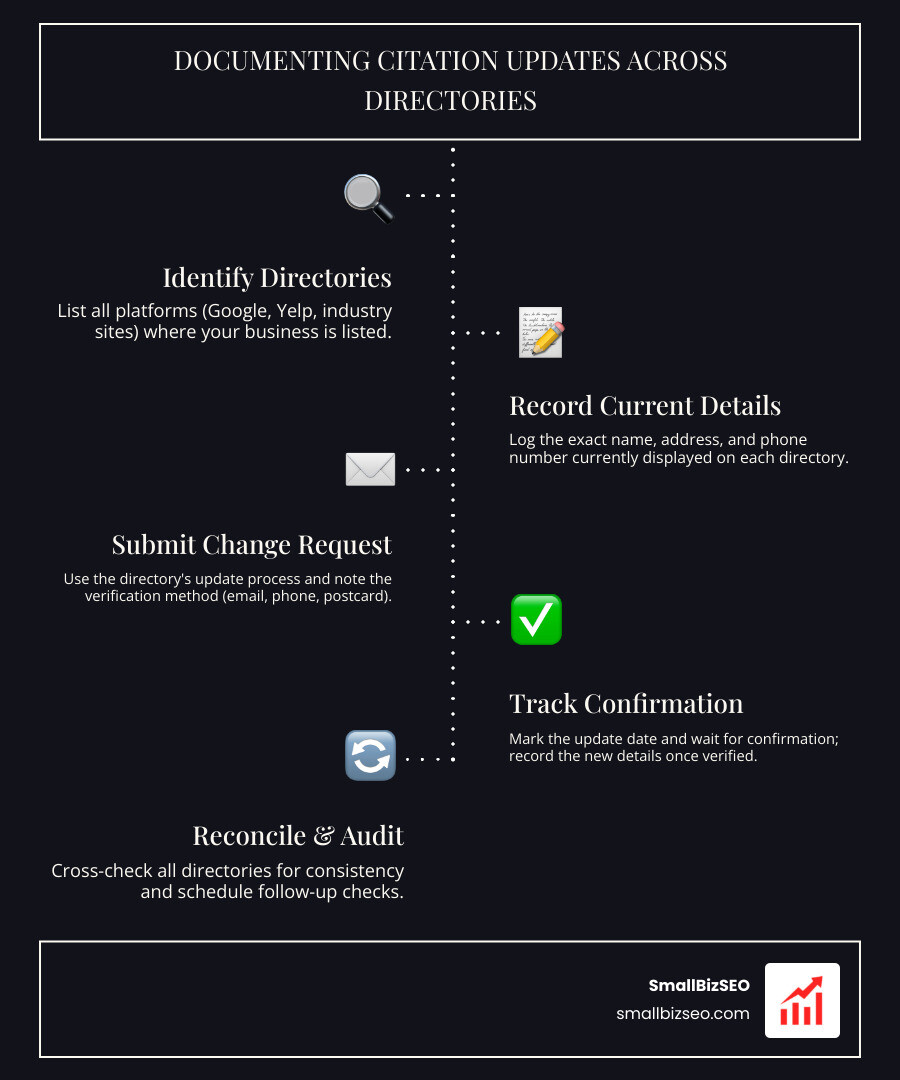
When updating each local citation, log these data points in your master spreadsheet:
- Directory Name and Live URL: The exact link to your public profile.
- Submission Date: The date your team requested the name and detail change.
- Verification Method Used: Email pin, phone call, business documentation upload, or postcard.
- Legacy Name Displayed: The old name variant to ensure complete entity migration.
- Canonical New Details: The verified name, updated description, and website URL.
- Current Status: Marked as Pending, Under Review, Live/Verified, or Action Required.
How Do You Maintain Brand Trust and Citation Accuracy After Launch?
Maintain post-launch accuracy by establishing an official public source of truth, implementing technical redirects, and running scheduled audits to resolve leftover discrepancies.
A rebrand succeeds when both human audiences and search engines can navigate the new identity without friction. If an old directory listing still surfaces in search results, users may assume the company closed or merged unexpectedly. Ongoing monitoring bridges the gap between your legacy equity and your new brand identity.
How Do You Establish a Central Brand Source of Truth?
Publish a dedicated corporate identity or rebrand announcement page on your primary website that serves as the undisputed canonical reference for your business details.
Search algorithms and AI retrieval models require an authoritative destination to verify that your new brand is the legitimate continuation of your previous business. Creating a dedicated page based on the source of truth page framework provides machine-readable confirmation of your name change, former DBAs, leadership team, and active services.
When documenting external research, market statistics, or legal changes, follow clear formats such as APA business citation standards so internal teams format proposals and public statements consistently.
To prevent confusion during the transition, use bridging language across your digital footprint:
- Include a visible "formerly known as" tag in your website header, footer, and social media bios for several months.
- Publish a transparent rebrand brief explaining why the company changed names, focusing on expanded services or strategic growth.
- Link all press releases and directory updates back to your central source of truth page.
How Do You Handle Technical Migration and Post-Rebrand Audits?
Protect your accumulated search equity by executing a page-by-page URL redirect plan, updating structured schema markup, and auditing citation networks on a recurring schedule.
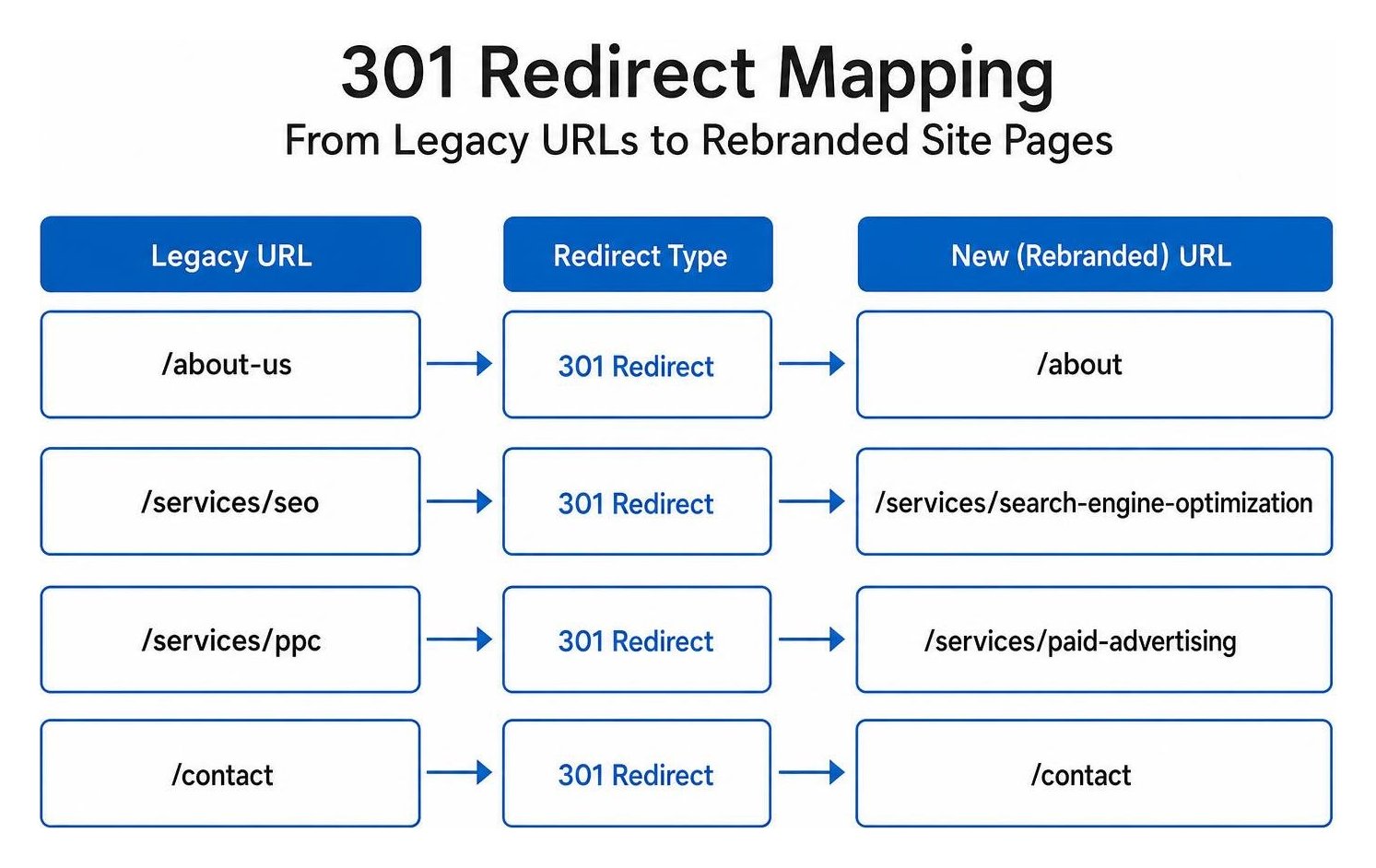
Changing your business name often involves moving to a new domain name or restructuring service URLs. Never rely on broad, homepage-only redirects. Follow a detailed step-by-step redirect mapping guide to pair each legacy page with its exact equivalent on your new website using permanent 301 server redirects.
On your website, update your Organization schema markup to include the alternateName and sameAs properties. These technical signals explicitly tell search crawlers that the old business entity and the new brand name represent the exact same company.
Schedule post-rebrand citation reviews at standard intervals:
- Week 1 Audit: Check primary digital listings and verify that permanent redirects resolve without redirect loops.
- Day 30 Audit: Review tier-two web directories and scan Search Console for broken links or indexing errors.
- Day 90 Review: Audit high-authority backlinks, unlinked brand mentions, and third-party registries.
- Quarterly Check: Run automated citation scans to catch directories that may have reverted to old scraped data.
Streamline Your Brand Transition with Confident Execution
Rebranding your business should mark an exciting period of growth, not a chaotic battle with broken citations and lost search rankings. By systematically tracking legacy assets, prioritizing high-authority directories, and maintaining a clear source of truth, you protect the authority you spent years building.
If managing multi-platform directories, technical URL migrations, and entity reconciliation feels overwhelming, partnering with experienced professionals keeps your rollout smooth and precise. Explore how professional business citation management from SmallBizSEO keeps your business information organized, accurate, and fully aligned across the web.