Knowledge Graphs Explained for Curious Data Teams
What Is a Knowledge Graph, and Why Does It Matter?
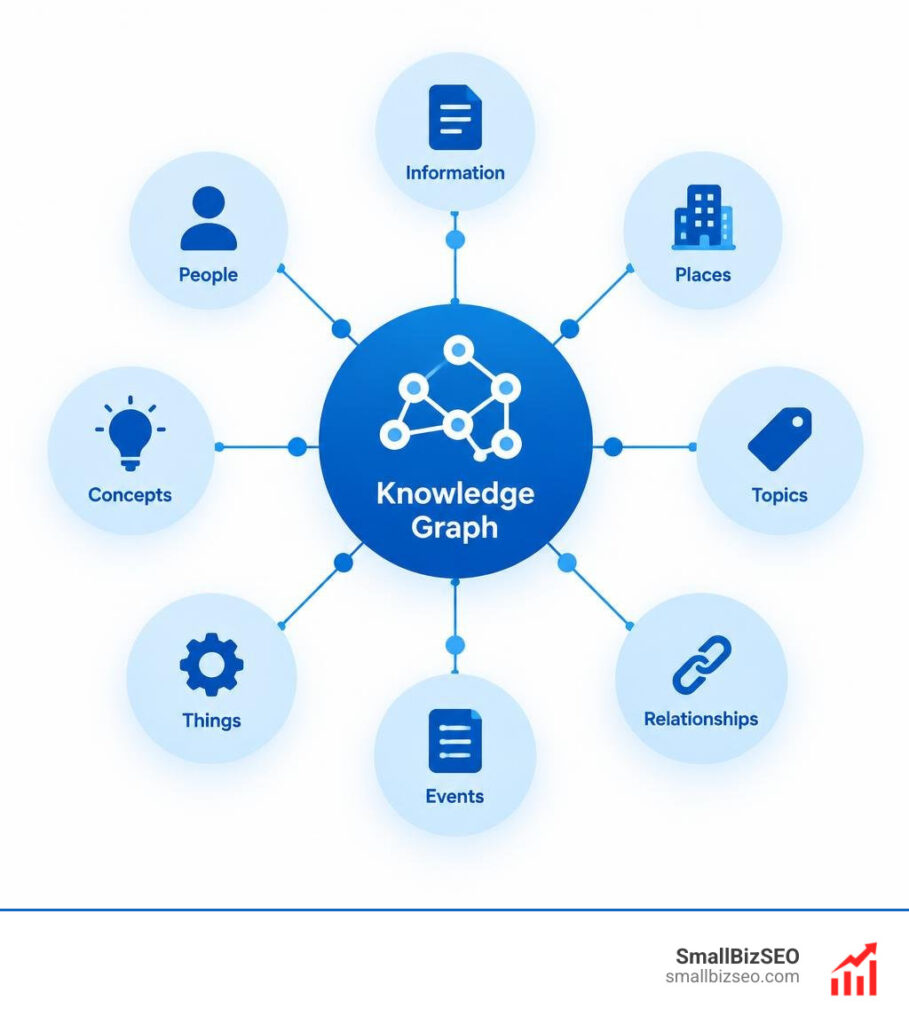
A knowledge graph is a network of connected facts about people, places, things, and how they relate. It gives each thing a clear identity and links it to other things, so a search tool can understand context rather than match words alone.
For example, a graph can connect a product to its maker, category, and customer reviews. Those links help a search tool tell apart two products with similar names. This guide explains how those connections work and when they are useful.
I’m Clayton Johnson, founder of SmallBizSEO, where I help businesses turn complex search topics into clear, useful content. Questions like “what is knowledge graph” fit that work: understanding how information connects can help teams make it easier to find and use.
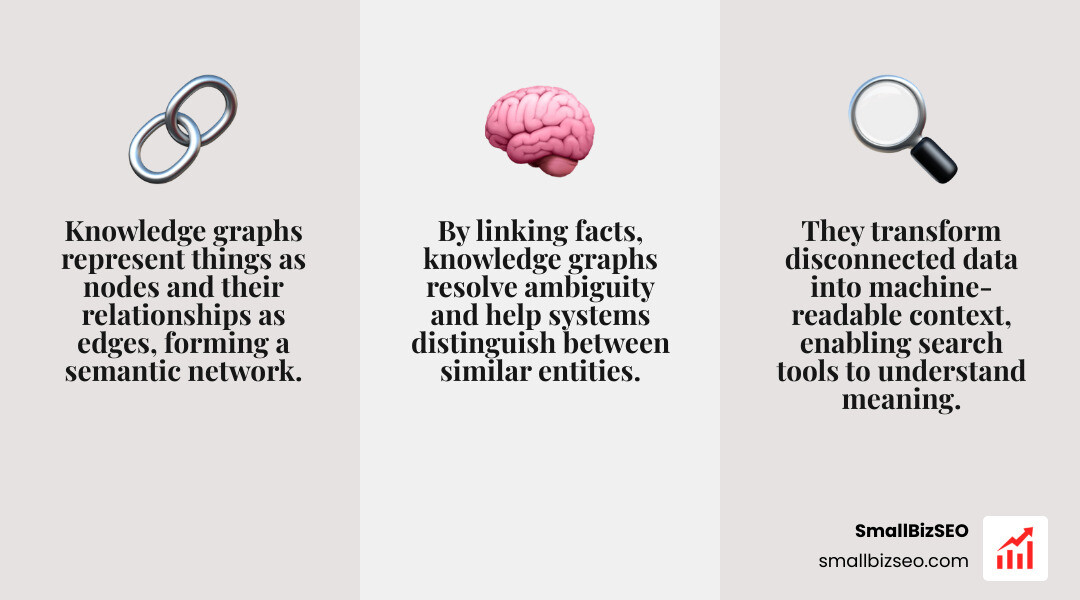
At its heart, a knowledge graph functions as a semantic network. It turns raw, disconnected information into machine-readable context. Instead of leaving data trapped inside disconnected software systems, a graph binds disparate data points together. This interconnected structure enables search engines and internal tools to resolve ambiguity, accurately tell concepts apart, and uncover deep relationships across massive datasets.
What Is a Knowledge Graph Made Of: Nodes, Edges, and Properties?
A knowledge graph is built from three core components: nodes represent things, edges show how they relate, and properties describe their specific details.
- Nodes (Entities): Nodes represent distinct concepts or objects. Through real-world entity mapping, a node can represent a physical object like a machine part, an abstract idea, a person, or an organization.
- Edges (Relationships): Edges are directed connections between nodes that define how those entities interact, such as "authoredby," "locatedin," or "manufactured_by."
- Properties (Attributes): Properties are key-value pairs attached to nodes or edges that provide descriptive context, such as a timestamp, price, or geographic coordinate.
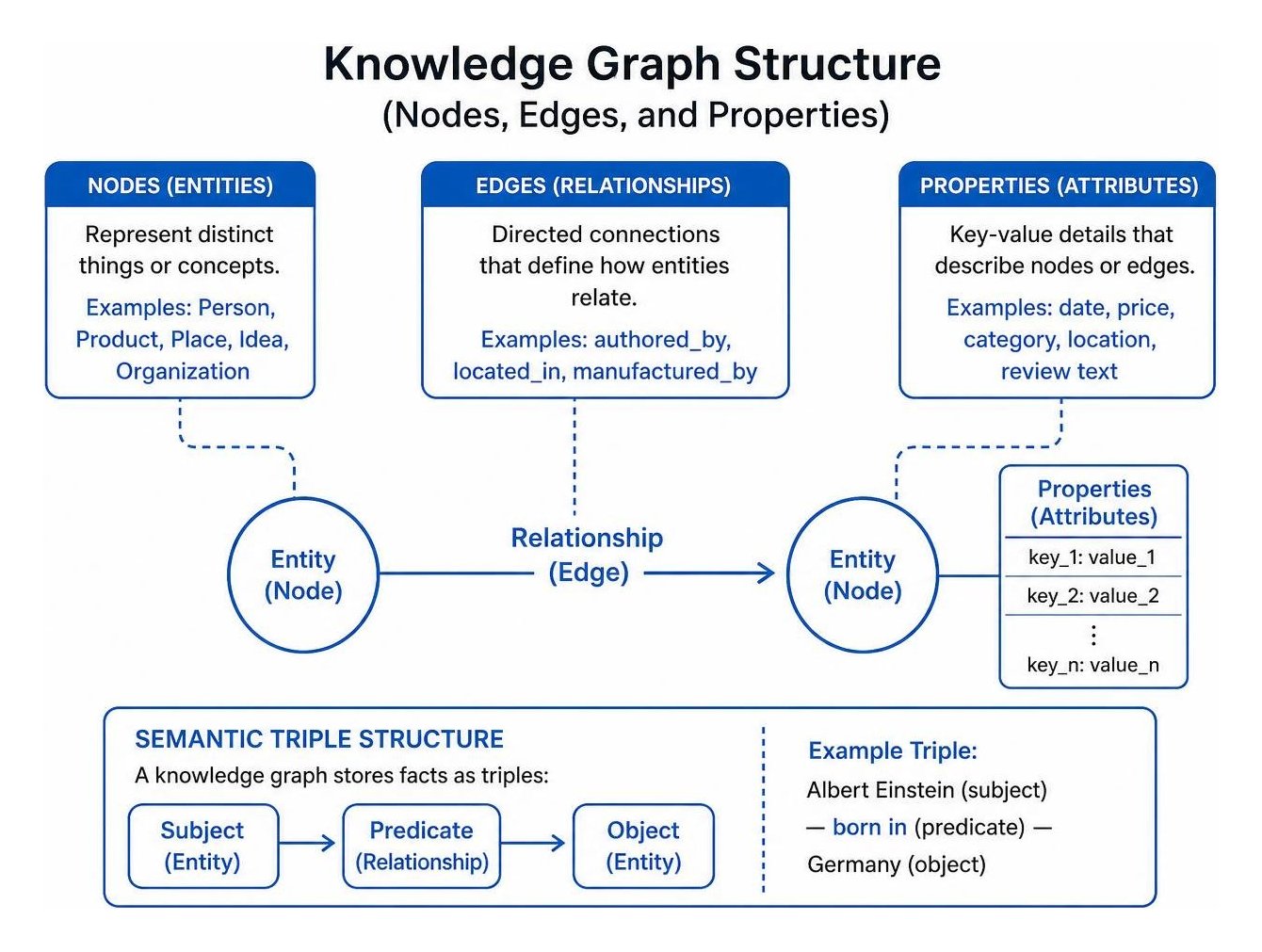
Together, these elements form structured statements known as semantic triple structures. A triple follows a simple subject-predicate-object statement, such as "Albert Einstein (subject) — born in (predicate) — Germany (object)."
By linking millions of these triples together, organizations create an expressive web of knowledge. Leading research on knowledge graphs highlights that storing facts as explicit triplets enables software systems to traverse connections effortlessly and discover indirect facts that traditional systems miss.
What Is a Knowledge Graph Schema and Ontology?
A schema sets the structural rules for a graph, while an ontology defines the formal concepts, categories, and relationship logic within a specific domain.
While a taxonomy arranges terms into a hierarchical tree (such as classifying a canine as a mammal), an ontology acts as a comprehensive contract. It specifies the allowed relationship types, defines domain constraints, and provides rules for automated inference. For instance, an ontology can state that if Person A is the "parent of" Person B, then Person B is the "child of" Person A.
On the web, teams apply these structural definitions using standardized vocabularies. Implementing schema markup integration allows search engines to read website entities with clarity. In enterprise environments, formal ontologies ensure clean entity alignment across departments, establishing a shared language based on trusted semantic standards, as outlined in IBM knowledge graph foundations.
How Does Graph Data Differ From Relational Models?
Relational database management systems organize data into rigid tables made of rows and columns, whereas graph databases connect data directly using nodes and edges, making complex relationships easier to navigate.
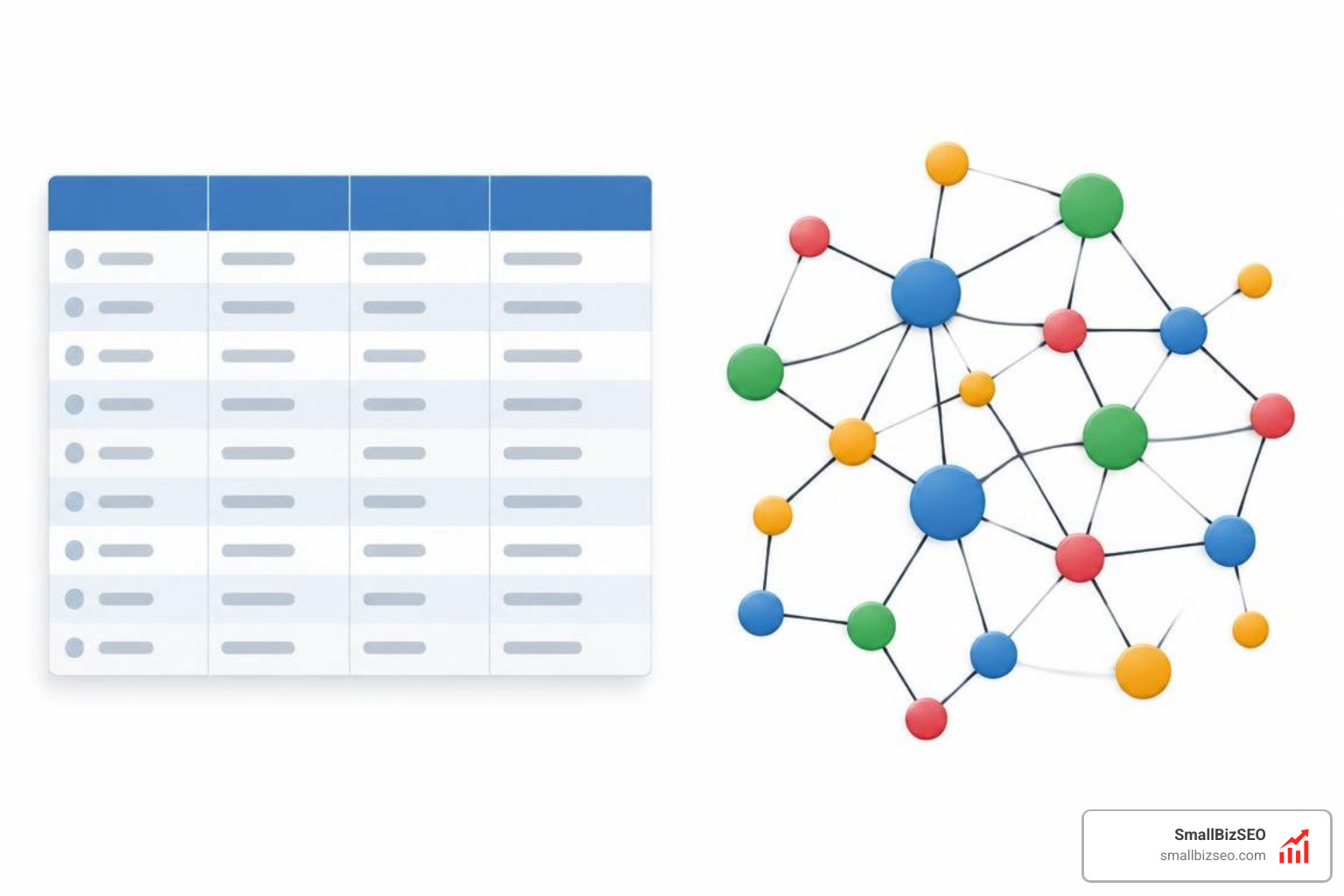
When organizations ingest multi-source data from customer relationship management platforms, enterprise resource planning systems, and web analytics, relational models struggle to adapt. Modifying table structures requires schema migrations, database downtime, and complex foreign key management.
In contrast, knowledge graphs offer flexible schema evolution. New entities, properties, and relationship types can be added without breaking existing queries. Graph databases utilize index-free adjacency, meaning each node directly holds physical pointers to its adjacent neighbors. Instead of computing expensive index lookups across multiple tables during query execution, graph engines traverse relationships along direct memory pointers, dramatically speeding up multi-hop graph analytics.
Property Graphs vs. RDF Triple Stores: Which Architecture Fits Your Data?
The two primary architectures for knowledge graphs are Labeled Property Graphs (LPGs) and Resource Description Framework (RDF) triple stores.
- Labeled Property Graphs (LPGs): LPGs allow developers to attach rich key-value attributes directly to both nodes and edges. They are queried using languages like Cypher and are optimized for high-performance path traversal, internal enterprise data fabrics, and operational graph analytics.
- RDF Triple Stores: RDF systems treat every fact as a strict subject-predicate-object triple, relying on uniform resource identifiers (URIs) for global interoperability. They are queried using SPARQL and excel at academic research, open data sharing, and complex deductive reasoning based on open knowledge graph standards. Adding metadata directly to an RDF edge requires an extra modeling step known as reification.
| Feature | Labeled Property Graphs (LPG) | RDF Triple Stores |
|---|---|---|
| Core Structure | Nodes and edges with key-value properties | Subject-predicate-object triples |
| Primary Query Language | Cypher, GSQL | SPARQL |
| Edge Properties | Native support on all relationships | Requires reification or RDF-star |
| Standardization | De facto industry graph standards | W3C open standards |
| Best Used For | Real-time analytics, traversals, operational AI | Global data interchange, formal ontologies |
How Do Graph Databases Compare With Relational Tables for Following Relationships?
Graph databases follow connected relationships directly along memory pointers, while relational databases rely on multi-table JOIN operations that quickly degrade performance as relationship depth increases.
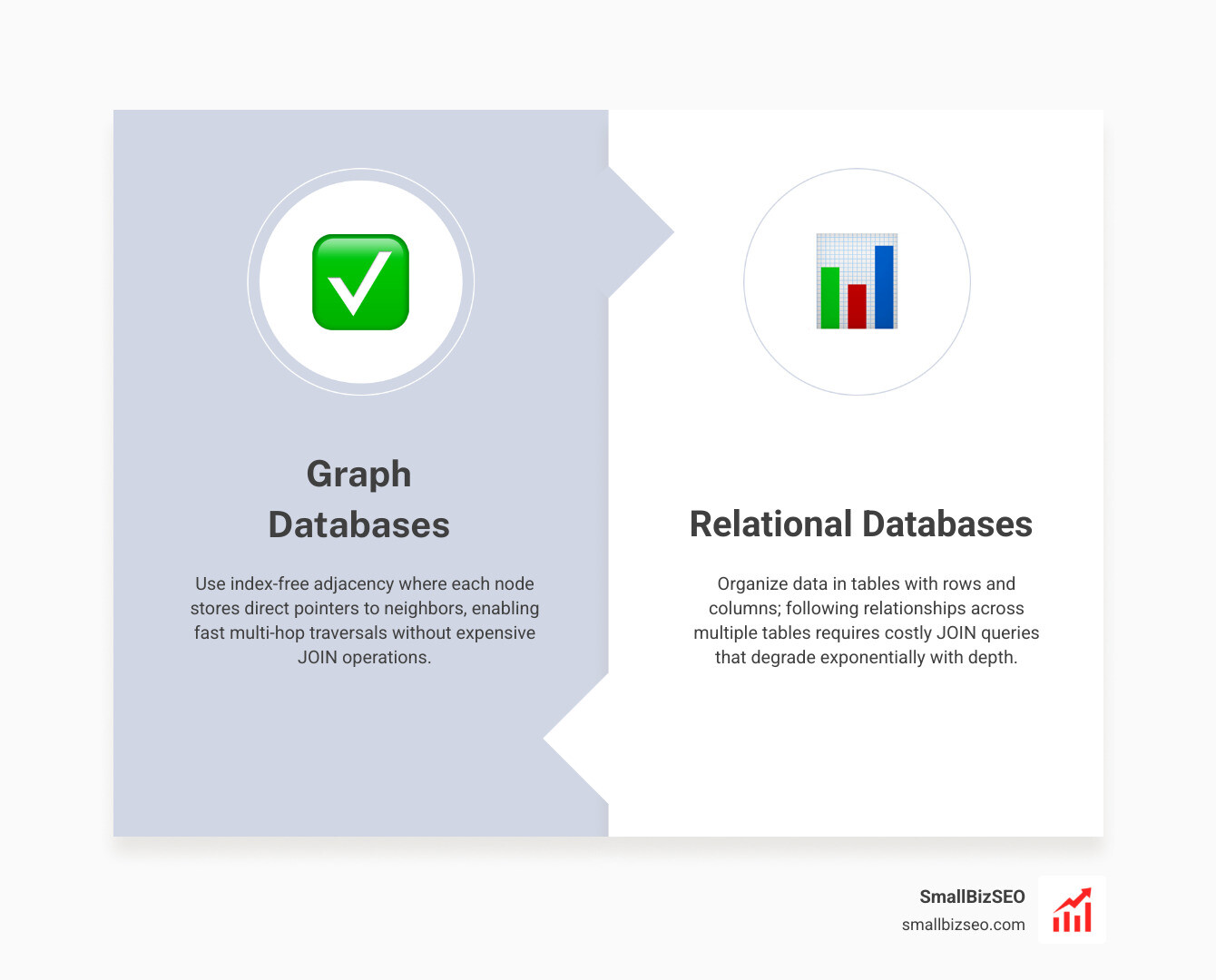
In a relational database, finding connections across five degrees of separation requires joining five large tables. Each JOIN operation multiplies computational overhead, causing severe query latency and relational bottlenecks.
Graph architectures eliminate this friction. Because relationships exist as first-class citizens in the storage engine, querying deep paths—such as tracing a financial transaction through ten intermediary accounts—takes milliseconds rather than hours. This capability allows organizations to unite structured databases with unstructured text, providing connected intelligence that uncovers contextual relevance across complex enterprise ecosystems.
How Do Knowledge Graphs Help With AI Search and Enterprise Discovery?
Knowledge graphs connect disparate business information so search tools and human operators can find facts within their complete operational context.
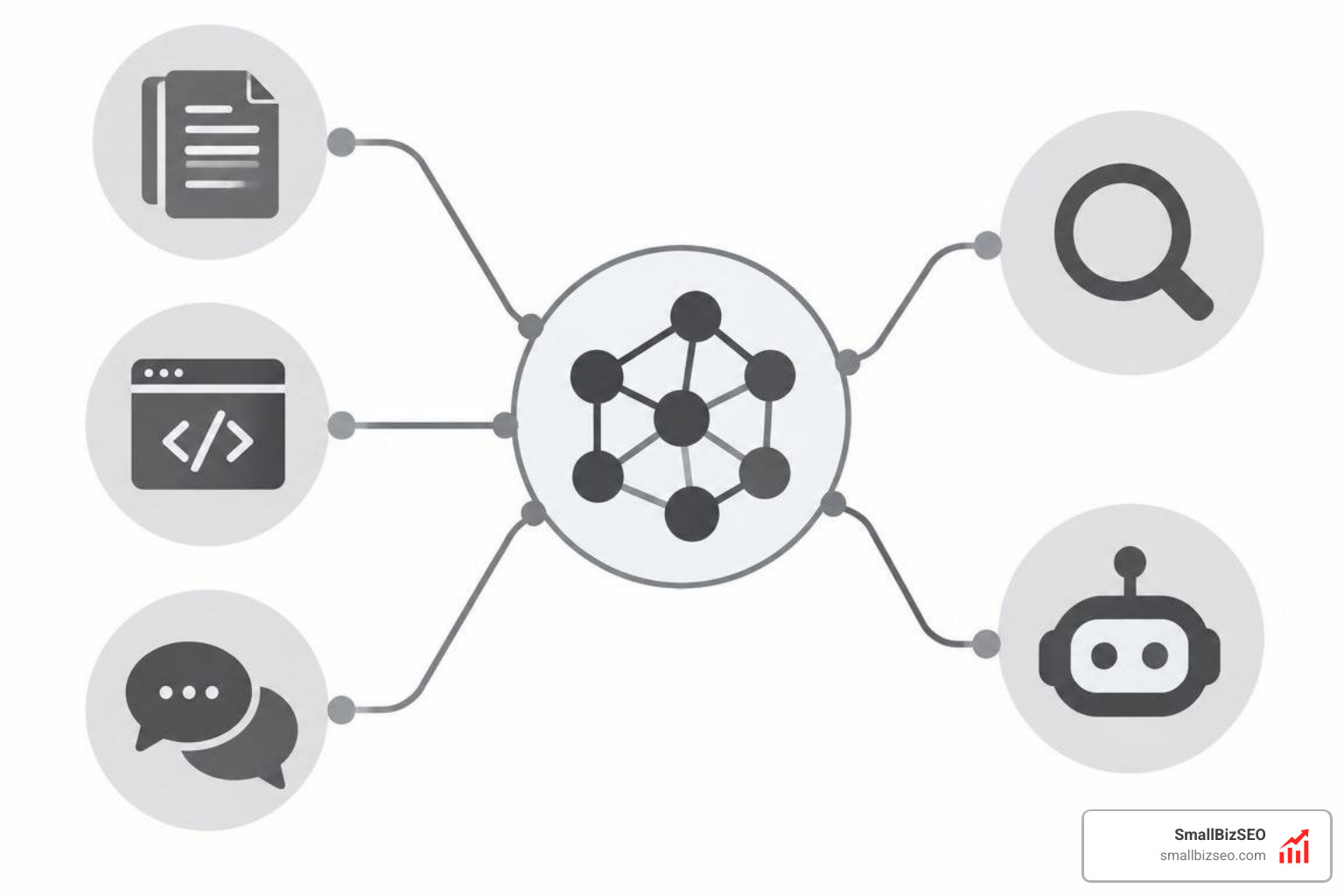
Across modern enterprises, knowledge graphs power several critical workflows:
- Enterprise Search: Graph platforms unify scattered documentation, code repositories, and communication channels into a unified knowledge fabric.
- Fraud Detection: Financial networks map accounts, shared phone numbers, IP addresses, and transaction histories to flag suspicious patterns in real time.
- Master Data Management: Graph modeling constructs unified "Customer 360" profiles by consolidating scattered records without destructive schema merges.
- Supply Chain Mapping: Companies trace dependencies across multi-tier supplier networks to evaluate disruption risks instantly.
- Clinical Decision Support: Healthcare systems link patient histories, clinical trial outcomes, and pharmaceutical databases to aid medical diagnoses.
How Can Knowledge Graphs Add Grounded Context to AI Search and RAG?
A knowledge graph provides artificial intelligence systems with explicit, verifiable facts to query alongside unstructured text, enabling reliable retrieval and reducing hallucinations.
In standard retrieval-augmented generation (RAG), systems convert documents into vector embeddings and search for textual similarity. However, vector search alone can struggle with structured reasoning, multi-hop logic, and global summarization.
By integrating graph indexes with modern AI Search engines, teams build advanced GraphRAG pipelines. When a user submits a query, the system extracts the core entities, traverses the graph to retrieve connected facts, and feeds that structured context into the language model.
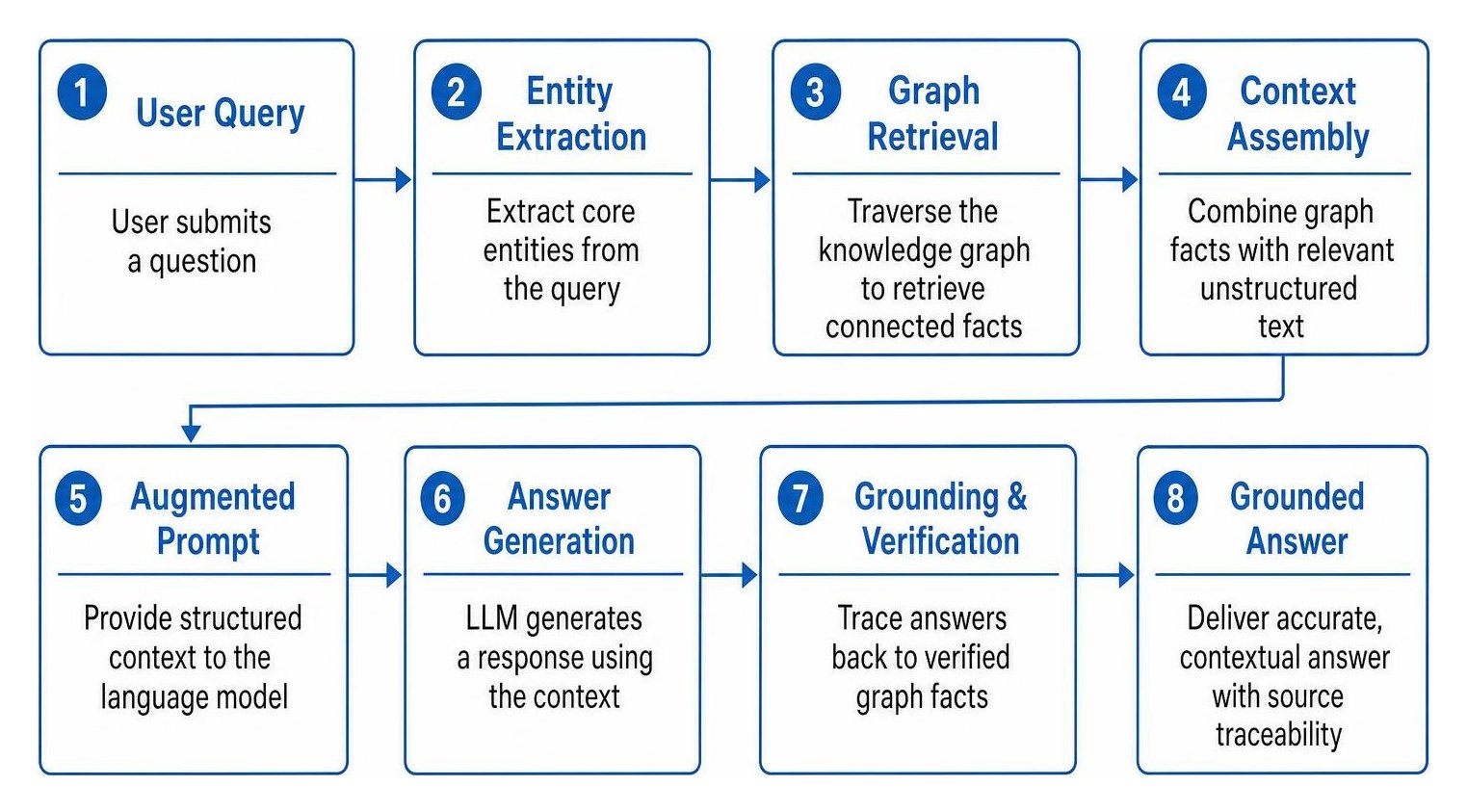
This hybrid architecture empowers retrieval-augmented generation workflows to excel at graph neural network reasoning while delivering grounded answers that trace directly back to verified data points.
What Are Common Knowledge Graph Use Cases, and How Can Teams Get Started?
Organizations apply knowledge graphs across diverse industries, from powering personalized e-commerce recommendation engines to accelerating biomedical drug discovery and generating public SERP knowledge panel generation entries that verify brand authority.
To establish a resilient knowledge graph program, data teams should follow these implementation best practices:
- Start with a Scoped Problem: Avoid boiling the ocean. Select one measurable business question—such as resolving customer duplicates or tracking critical supplier components.
- Establish Data Quality Governance: Profile source datasets for accuracy, remove conflicting duplicates, and define clear entity resolution protocols.
- Draft a Lightweight Schema: Model core business entities and their primary connections first, expanding relationship types as new data sources come online.
- Choose the Right Tooling: Select an RDF store for open standards and reasoning, or a property graph database for operational traversals and machine learning pipelines.
- Iterate and Expand: Connect downstream applications incrementally, measuring query latency and user retrieval precision at every release.
Unlocking Connected Data for Long-Term Growth
Knowledge graphs transform isolated data points into an interconnected network of actionable facts. By giving entities clear identities and explicit relationships, graphs eliminate data silos, accelerate complex queries, and supply artificial intelligence platforms with the structured context needed for reliable reasoning.
At SmallBizSEO, we build data-driven organic strategies that help businesses establish technical authority, clarify their digital footprint, and grow search visibility. As search platforms and internal discovery tools evolve toward semantic intelligence, structuring your data clearly is essential for sustainable growth. To discover how our team helps businesses build authority through advanced technical SEO and content optimization, explore SmallBizSEO knowledge graph solutions today.