Stop Guessing and Start Auditing: A Beginner’s Guide to Web Page SEO
Stop Guessing and Start Auditing: A Beginner's Guide to Web Page SEO
Is Your Website Invisible Online? Here's What an SEO Web Page Analysis Reveals
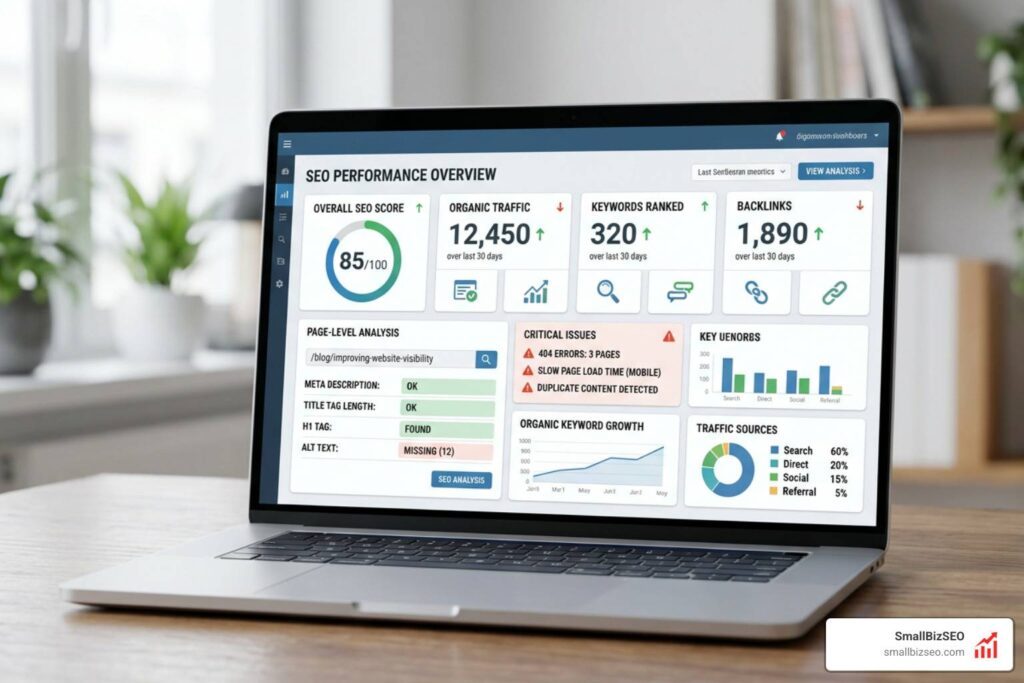
SEO web page analysis is the process of evaluating a web page across dozens of technical, content, and performance factors to understand why it ranks — or why it doesn't.
Here's what a basic web page SEO analysis covers:
- Meta tags — Are your title and description optimized and the right length?
- Content quality — Is your content relevant, deep enough, and trustworthy?
- Page speed — Does your page load fast enough to keep visitors from bouncing?
- Mobile usability — Does the page work properly on phones and tablets?
- Technical health — Are there broken links, indexing blocks, or security issues?
- Structured data — Is schema markup in place to help search engines understand your content?
- AI visibility — Can large language models (LLMs) like ChatGPT or Perplexity find and cite your page?
Most small business owners skip this step entirely — and that's exactly why their traffic stalls.
Think about it this way: you could have a great product and solid content, but if your page has a broken canonical tag, a slow load time, or no structured data, search engines may simply pass you over. One agency reportedly fixed 47 technical issues on a client's site and saw organic traffic jump 34% within a month. These aren't rare flukes — they're what happens when you stop guessing and start auditing.
Here's the bigger picture: search isn't just Google anymore. Around 40% of searches now happen inside AI engines like ChatGPT, Gemini, and Perplexity. A page that ranks #1 on Google can still score zero for AI readiness. That means your SEO analysis needs to cover both traditional rankings and LLM visibility.
I'm Clayton Johnson, a digital PR and SEO strategist who has spent years running SEO web page analysis audits to help businesses close the gap between great content and actual search visibility. In the sections below, I'll walk you through every layer of a modern web page audit — from the basics to AI optimization — so you can take real action, even without a technical background.
What is an SEO Web Page Analysis and Why Does It Matter?
At its core, a Detailed SEO Analysis is like a comprehensive medical checkup for your website. Instead of guessing why your site is sluggish or why your competitors are outperforming you, an audit provides hard data on exactly what is holding your pages back. If you have ever wondered Why Your Rankings Are Still Stuck, the answer almost always lies in the technical and structural details of your pages.
An effective analysis looks at your website through two distinct lenses: how easily search engine bots can read your pages, and how satisfying the actual experience is for human visitors.
Why Traditional Search Engines Require SEO Web Page Analysis
Traditional search engines rely on automated software called crawlers (or spiders) to discover and evaluate content. Googlebot, for example, systematically parses your website's code, follows links, and indexes the content it finds.
If your page code is cluttered, or if your heading structure is out of order, crawlers struggle to understand what your page is actually about. A proper On-Page SEO audit ensures that crawlers can easily access, read, and categorize your pages. When search engines can clearly understand your structure and content, they can confidently match your page to relevant search queries.
The Shift Toward AI Search and LLM Visibility
The search landscape is changing rapidly. With a massive chunk of search queries moving to AI-powered search engines, traditional keyword matching is no longer enough. AI engines do not just display a list of links; they synthesize answers and cite their sources.
To stay visible, your website needs to pass an SEO Visibility Audit that measures your brand's AI readiness. This means evaluating how easily large language models (LLMs) can parse your text, extract facts, and pull your brand into their cited summaries. If AI bots cannot crawl your site or understand your data structure, your business becomes completely invisible to users searching through AI platforms.
The Core Pillars of a Modern SEO Web Page Analysis
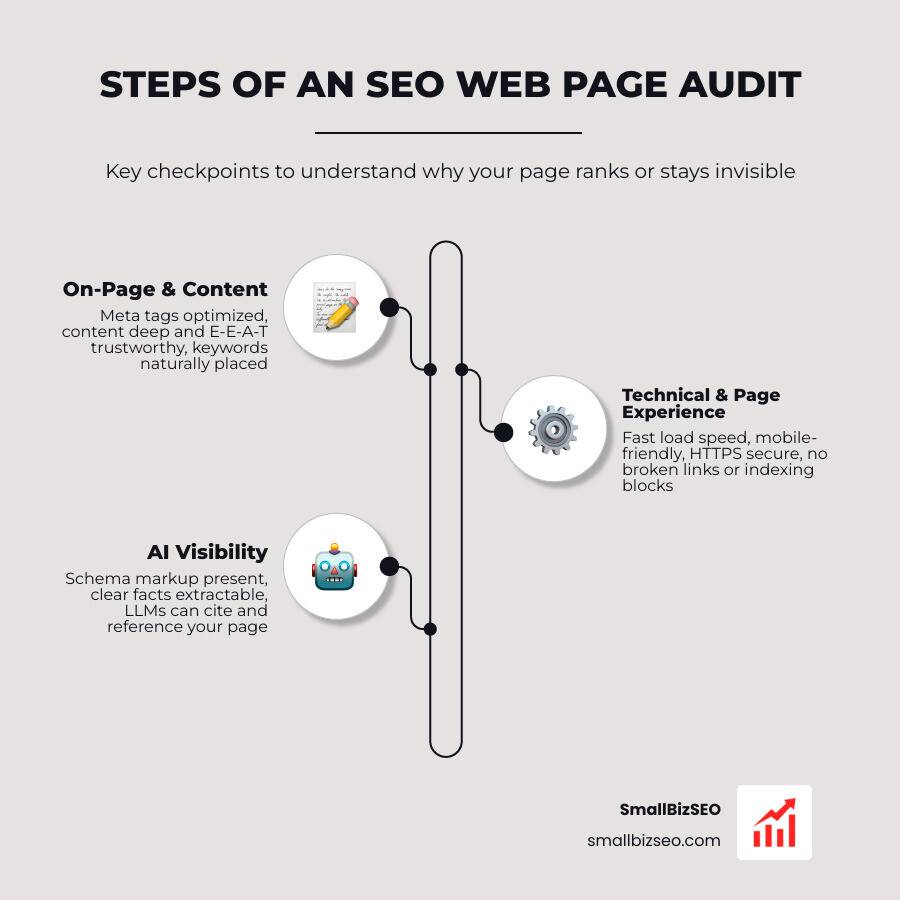
A modern audit must balance traditional search criteria with the technical requirements of the AI era. We can organize these requirements into three core pillars:
| Pillar | Focus Areas | Primary Goal |
|---|---|---|
| On-Page Content | Title tags, headings, keyword density, E-E-A-T signals | Human engagement and topical relevance |
| Technical Experience | Core Web Vitals, page speed, HTTPS, mobile responsiveness | Seamless rendering and security |
| AI & Schema | Structured data, llms.txt, citation signals | LLM readability and automated citations |
Critical On-Page and Content Quality Factors
The actual words on your page are the foundation of your search presence. When we analyze a page, we look closely at how keywords are balanced against natural language. Industry studies show that pages optimized for specific, highly relevant terms rank 67% higher than generic pages. Furthermore, proper on-page optimization can improve rankings by 25% to 50%, driving a massive surge in organic traffic.
However, modern search engines look far beyond simple keyword density. They prioritize Experience, Expertise, Authoritativeness, and Trustworthiness (E-E-A-T). To build this trust, you must learn How to Optimize Your Content for E-E-A-T and Build Real Search Trust by showcasing clear author credentials, citing reliable sources, and keeping your content deeply informative and original.
Technical SEO and Page Experience Signals
A beautifully written page is useless if it takes ten seconds to load. Search engines prioritize fast-loading websites because site speed directly correlates with user satisfaction metrics that Google uses as ranking factors.
Studies show that sites with loading times under a few seconds maintain much higher user engagement rates, while pages taking longer to load experience immediate spikes in bounce rates. Regular performance auditing identifies technical issues that reduce search visibility and discovers optimization opportunities that improve user experience and rankings simultaneously.
To ensure your technical foundation is flawless, you must know How to Pass Google's Own SEO Analysis Audits by resolving mobile responsiveness issues, securing your site with HTTPS, fixing broken links, and optimizing your Core Web Vitals.
Traditional SEO vs. Generative Engine Optimization (GEO)
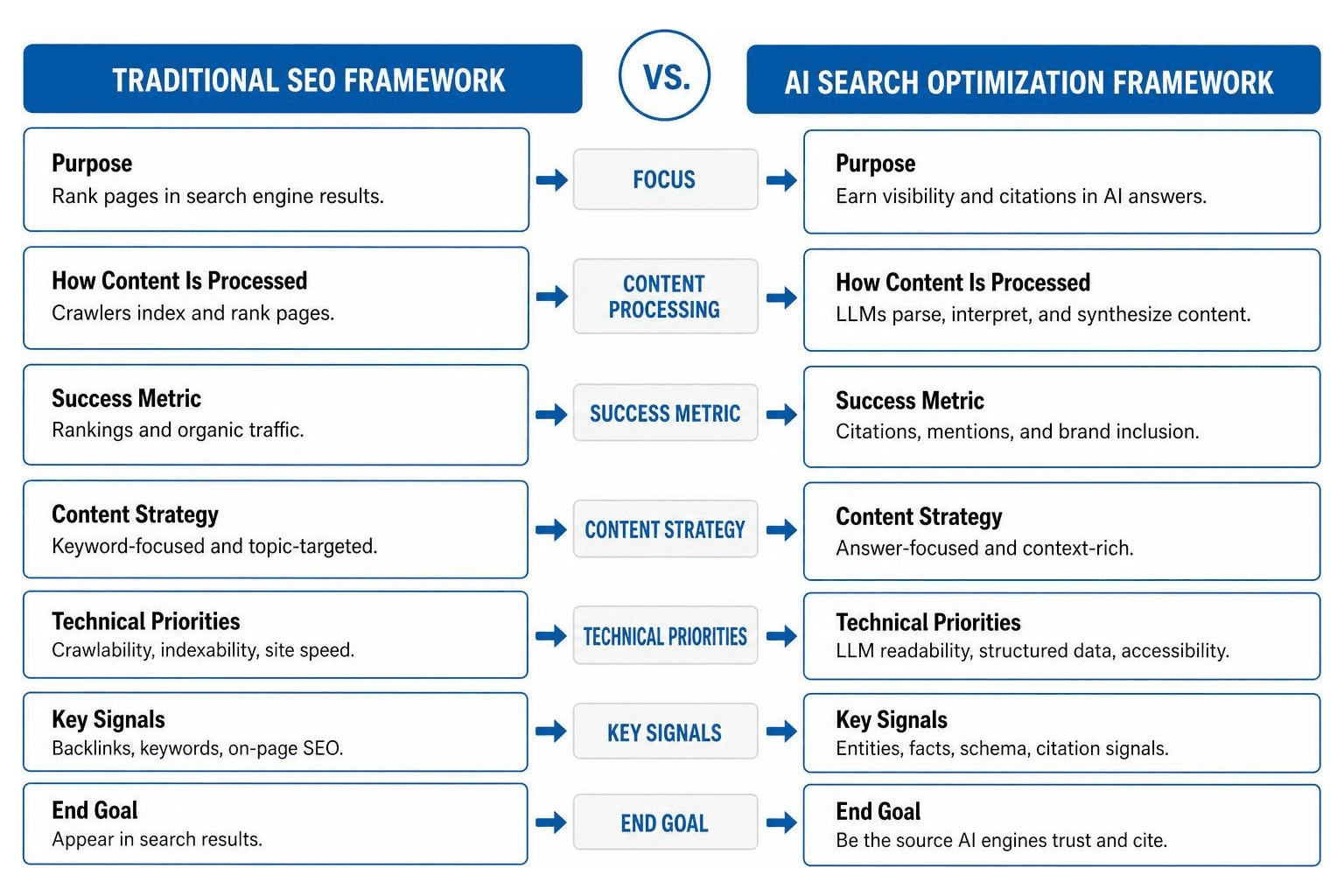
As search behavior shifts, a new discipline has emerged: Generative Engine Optimization (GEO). While traditional SEO focuses on climbing the ranks of standard search results pages, GEO focuses on securing citations within AI-generated answers.
This evolution means we must look Beyond Content Optimization and think about how information is structured for machine consumption. AI engines do not just look for matching keywords; they seek authoritative, structured, and factual data that they can confidently present as absolute truth to their users.
Optimizing for AI Answer Engines (AEO)
Answer Engine Optimization (AEO) is a subset of GEO that focuses specifically on conversational search queries. When a user asks an AI assistant a direct question, the assistant pulls from highly structured data sources.
To optimize for these environments, we must Optimize E-E-A-T Signals Today. This includes implementing robust Schema.org markup, keeping facts clear and unambiguous, and even utilizing files like llms.txt (a text file at the root of your site that summarizes your content specifically for AI bots).
How AI-Powered Analyzers Prioritize Actionable Recommendations
Older auditing tools would simply dump a list of hundreds of errors on your lap, leaving you overwhelmed. Modern, AI-powered analyzers are much smarter. They categorize issues by severity:
- Critical Errors (Red Flags) — Indexing blocks, broken canonical tags, or major speed bottlenecks that require immediate attention.
- Warnings (Orange Flags) — Missing meta descriptions, unoptimized heading structures, or missing alt text on key images.
- Notices (Blue Flags) — Minor improvements, such as adding schema properties or tweaking keyword variations.
This automated prioritization helps you focus on the highest impact-to-effort fixes first.
Choosing the Right Tools for Your Audit
Choosing the right tool depends on your technical comfort level and the size of your website. You can find excellent options for both quick, single-page checks and deep, site-wide analysis. A comprehensive toolset will also help you perform a Keyword Gap Analysis: What It Is and How to Do It Right to spot high-value terms your competitors are ranking for.
How to Perform a Free SEO Web Page Analysis
If you are just getting started, you do not need to invest in expensive enterprise software. There are several highly capable, free tools that can analyze a single URL in seconds:
- To analyze on-page semantic structures and keyword density, you can try the SEO Analysis - Free tool by Alyze.
- For a quick, 44-point check of your content and meta tags directly through an AI-friendly interface, check out the Free SEO Content Analyzer | 44-Point Audit in Seconds | Ooty.
- If you want to check your HTML head tag ordering and eliminate deprecated tags that slow down browser rendering, use the SEO Analyzer - Audit SEO & Head Tags | RJL.io.
These free tools are perfect for running quick, client-side snapshots to identify immediate technical errors.
When to Upgrade to Paid or Enterprise Audit Suites
While free tools are fantastic for a quick check of a single page, they fall short when you need to audit a massive website with hundreds of pages.
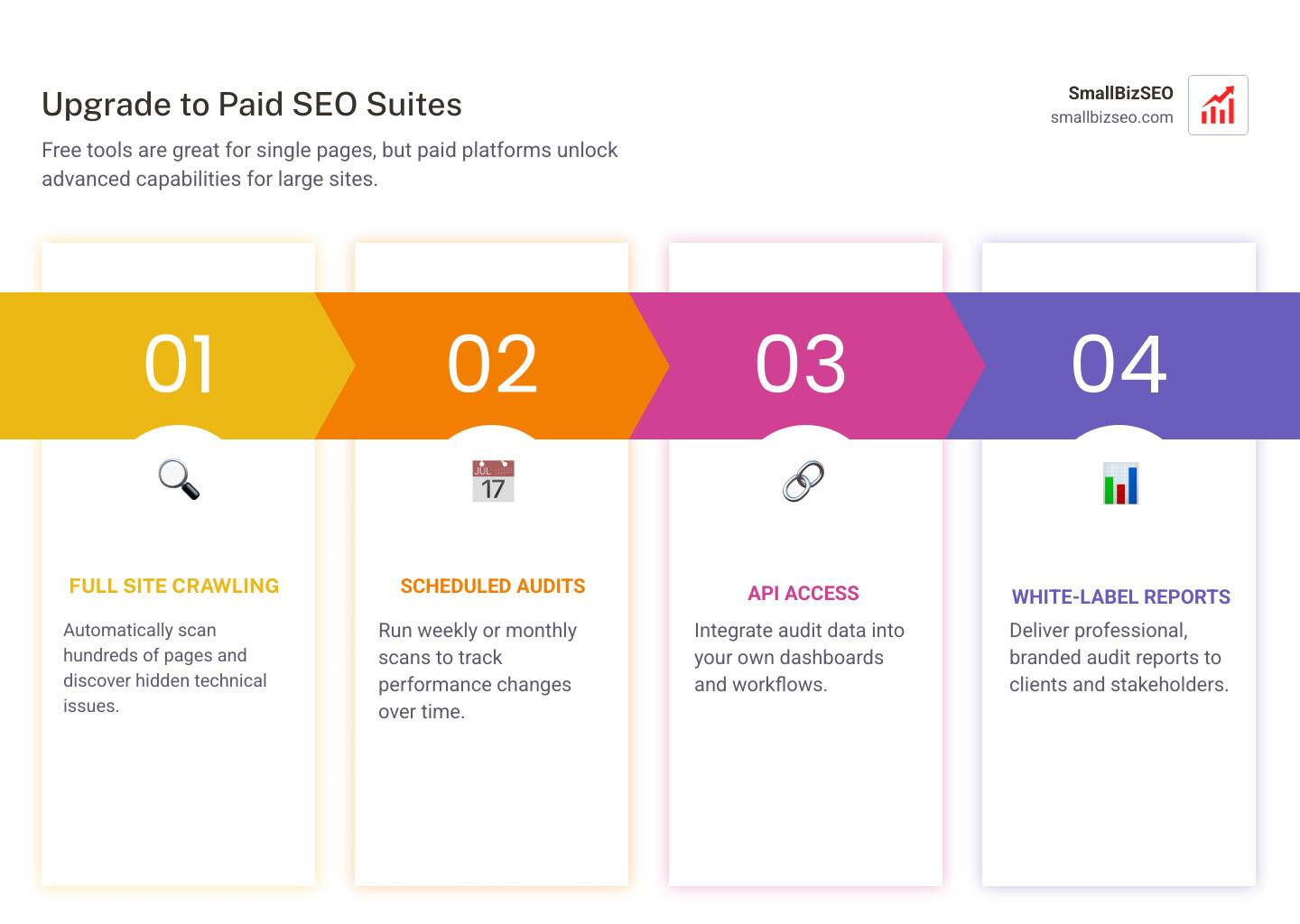
Upgrading to a professional platform like the On-Page SEO Checker: Get Your Page Optimization Score allows you to crawl your entire site automatically. Paid suites offer automated weekly scheduling, deep backlink monitoring, API access, and white-label reports that are perfect for agencies.
Software can show you what is wrong, but strategy still matters. The best approach is to pair audit data with a clear action plan that prioritizes technical fixes, content improvements, and authority-building work based on the impact each change can have on your search visibility.
Frequently Asked Questions About Web Page Audits
How often should I run an SEO web page analysis?
We recommend running a basic page analysis at least once a month, or immediately after making major content updates. Search engine algorithms change constantly, and regular audits help you catch minor technical glitches before they hurt your organic traffic. Regular monitoring is also your best defense against unexpected drops in traffic, showing you exactly How to Recover from a Google Algorithm Penalty if your site is ever negatively impacted by a core update.
Will running a website audit affect my search rankings?
No. Running an SEO audit tool does not hurt your search rankings. Most single-page analyzers run entirely client-side or make a single, standard request to your page, which has zero impact on your server load or crawl budget.
Can a web page analyzer help with local SEO visibility?
Yes! A good analyzer will check for local schema markup (like LocalBusiness schema) and verify that your contact information is structured correctly. To avoid common pitfalls that keep you from appearing in local map packs, review our guide on 5 Local SEO Mistakes Killing Your Visibility and dive into our complete Local SEO Guide to dominate your local search market.
Conclusion
Stop guessing why your website isn't growing. A systematic SEO web page analysis takes the mystery out of search rankings, giving you a clear, prioritized checklist of exactly what to fix.
At SmallBizSEO, we help small businesses cut through the technical noise. Our data-driven "Velocity" framework is designed to deliver fast rankings and E-E-A-T-compliant growth through transparent, automated reporting. We handle the heavy lifting — from deep technical SEO audits to content strategy and high-authority link building — so you can focus on running your business.
Ready to take your search visibility to the next level? Explore our comprehensive SEO Services Guide or reach out to us today to Get professional SEO services tailored to your business goals.