The Step-by-Step Guide to SEO Analysis for Competitors

The Step-by-Step Guide to SEO Analysis for Competitors
What Is SEO Analysis for Competitors (And Why It Changes Everything)
SEO analysis for competitors is the process of studying the websites that outrank you in Google search results — examining their keywords, content, backlinks, and technical setup — so you can understand exactly why they rank and what it takes to beat them.
Here's a quick breakdown of how it works:
- Identify your SEO competitors — the websites ranking for your target keywords (not just your business rivals)
- Find keyword gaps — keywords they rank for that you don't
- Analyze their content — what topics they cover, how deep they go, and what format they use
- Compare backlinks — how many referring domains they have and where those links come from
- Check technical SEO — page speed, mobile-friendliness, and site structure
This isn't about copying what competitors do. It's about understanding what Google is rewarding — then doing it better.
Here's a sobering stat: 90% of web pages get zero traffic from Google. The #1 organic result captures 27.6% of all clicks, while two-thirds of all clicks go to just the first five results. If you're not in that top five, most searchers never see you.
That's exactly why running an SEO analysis of your competitors isn't optional — it's the fastest way to find out what's keeping you off that first page.
I'm Clayton Johnson, a digital PR and SEO strategist who has spent years using SEO analysis of competitors to help businesses close the visibility gap between where they are and where they need to be. In the sections below, I'll walk you through a clear, repeatable process you can start using today.
Discover more about SEO analysis competitors:
Why Traditional Business Rivals Aren't Your SEO Analysis Competitors
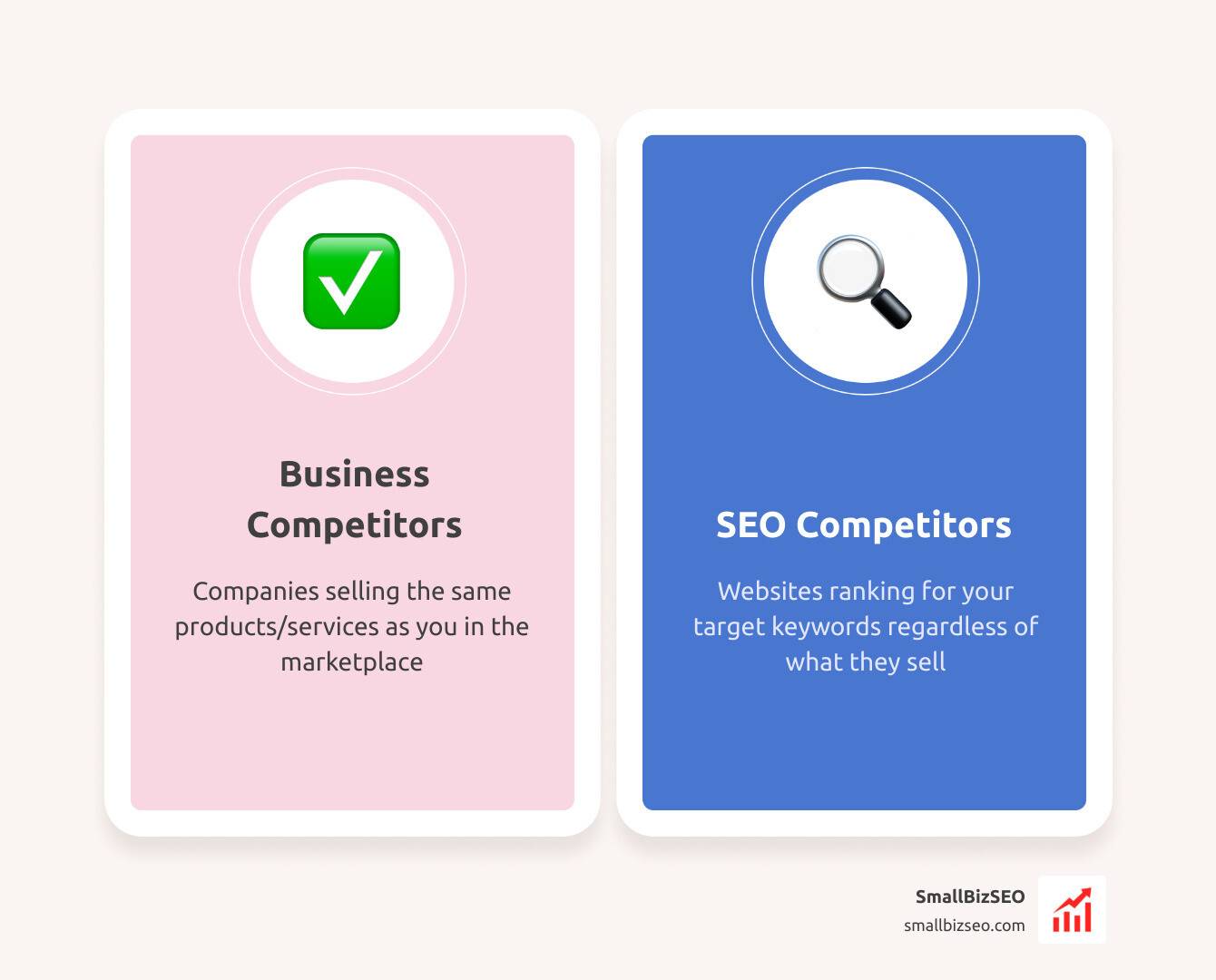
When business owners sit down to list their competitors, they usually think of the shop down the street or the direct commercial rival offering the same service. However, in the search engine results pages (SERPs), your SEO analysis competitors are often completely different.
An SEO competitor is any website that ranks for the search queries you target, regardless of their business model. For example, if you sell handmade kitchen knives, your direct business competitors are other artisanal knife makers. But your SEO competitors might include:
- Recipe blogs writing about "how to carve a turkey."
- Review sites like Wirecutter ranking for "best chef knives."
- Online forums like Reddit where users discuss kitchen gear.
- Major e-commerce platforms like Amazon.
If a site captures the search intent of your target audience and steals your organic search traffic, it is your SEO competitor.
Ignoring these non-traditional competitors is a major mistake. If you only look at your brick-and-mortar rivals, you miss the broader search landscape and fail to understand what content Google actually wants to rank. This is why we always start with a Detailed SEO Analysis to map out who actually owns the digital real estate in your niche.
The 5-Step Framework to Analyze Competitor SEO Strategies
To make this process manageable, we break down our SEO analysis competitors workflow into five core pillars. This structured approach ensures we look at every angle—from keywords to technical health—without getting overwhelmed by raw data.
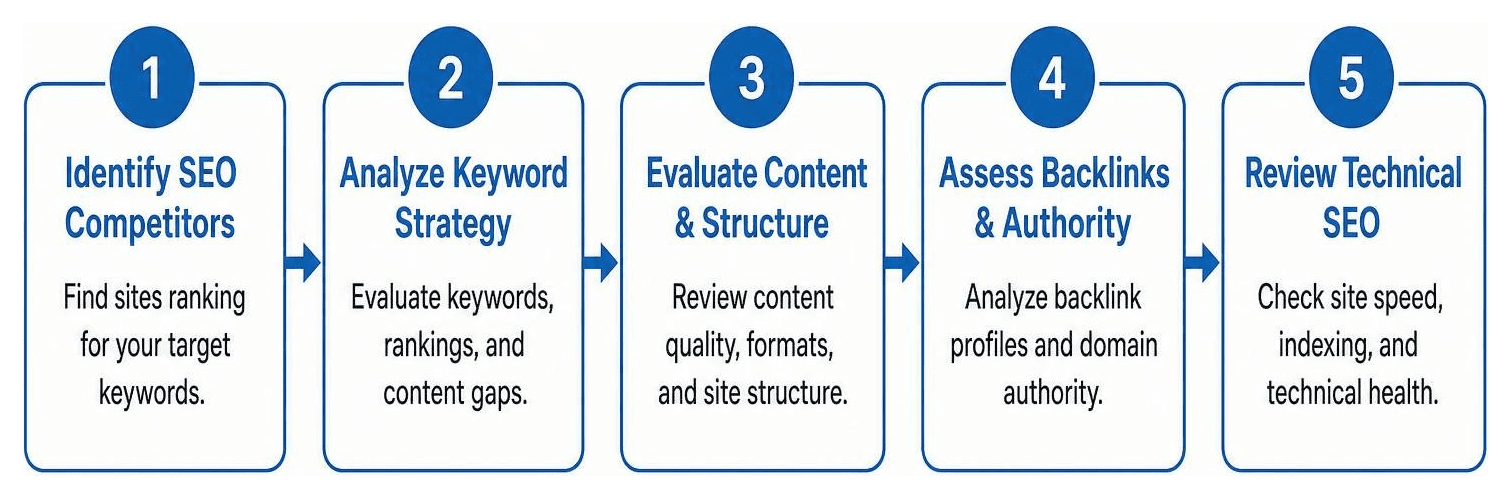
Before diving into the steps, let's look at the key metrics we need to track across our competitive landscape:
| Metric Category | What We Measure | Why It Matters |
|---|---|---|
| Keyword Gap | Overlapping vs. unique keywords | Finds immediate content opportunities |
| Backlink Gap | Referring domains & link quality | Measures authority and trust signals |
| Technical SEO | Page speed & Core Web Vitals | Ensures the site is crawlable and user-friendly |
Step 1: Identify Your SEO Analysis Competitors
We begin by finding the domains that consistently show up for your target search queries. Instead of guessing, we use data-driven SERP analysis.
Start by searching your top five to ten core business keywords in an incognito browser window. Note which domains appear on page one. You will quickly notice that some sites keep popping up across different terms.
To speed up this process and gather clean data, we can use automated tools. For instance, the Free Competitor Analysis Tool Online | Thunderbit allows us to quickly pull tech stacks and metadata from a list of URLs to see who we are truly up against. We recommend narrowing your focus to three to five primary SEO competitors to keep your research highly actionable.
Step 2: Run a Keyword Gap Analysis
Once we have our list of competitors, we want to find their keyword footprint. A keyword gap analysis reveals the terms your competitors rank for, but your website does not.
Look for high-volume keywords where multiple competitors rank in the top ten while your site is completely absent or stuck on page two. These represent massive, pre-validated content opportunities.
To execute this properly, you must filter these gaps by search intent. It does no good to target a high-volume keyword if the searcher is looking for something completely unrelated to your business. For a deep dive on how to execute this step, check out our comprehensive guide on Keyword Gap Analysis: What It Is and How to Do It Right.
Step 3: Evaluate Content Quality and Search Intent
Now that we know which keywords to target, we must reverse-engineer the pages that currently win those rankings. Google rewards pages that offer the best user experience and most thoroughly satisfy search intent.
Analyze the top-ranking competitor pages for:
- Content Depth: Are they writing 1,500-word guides or short, 500-word answers? (Studies show page-one Google results contain an average of 1,447 words).
- Heading Structure: How do they organize information using H2 and H3 tags?
- Media and Formatting: Do they use original images, bullet points, tables of contents, or interactive tools?

If multiple competitors structure their pages similarly, it is a clear sign that Google's algorithm prefers that format. Your goal is to create something even more comprehensive—a technique often called the "Skyscraper" method.
Step 4: Perform a Competitor Backlink Analysis
Backlinks remain a top three ranking factor for Google. If a competitor has high organic visibility, they likely have a strong backlink profile.
We look at two main factors:
- Referring Domains: The number of unique websites linking to them. Top-ranking pages have an average of 3.8 times more backlinks than pages in positions two through ten.
- Link Quality: Are these links coming from authoritative, niche-relevant sites, or low-quality directories?
By running a backlink gap analysis, we can identify websites that link to multiple competitors but not to us. These are prime targets for our own link-building campaigns. To uncover these authority gaps, we rely on specialized tools like the SEO Competitor Analysis Tool: Uncover Gaps & Win Rankings to map out exactly where our rivals are earning their digital authority.
Step 5: Audit Technical SEO and Core Web Vitals
A beautiful page with great links will still fail to rank if its technical foundation is broken. We must benchmark our site against our competitors' technical setups.
We look closely at PageSpeed and Core Web Vitals. Visitors expect pages to load quickly—47% of users expect a web page to load in two seconds or less. Additionally, with more than 58% of Google searches occurring on mobile devices, mobile-friendliness is non-negotiable.
We also check if competitors use schema markup to win rich snippets in the SERPs, and we review their internal linking structure to see how they distribute page authority. To make sure your site meets these strict standards, you can learn How to Pass Google's Own SEO Analysis Audits to clean up crawl errors and boost your rankings.
How to Turn Competitor Insights into an Actionable Strategy
Gathering data is only half the battle. The real magic happens when we turn those insights into a prioritized, real-world roadmap.

We categorize our findings into three buckets:
- Quick Wins: Optimizing existing pages where we already rank in positions 11-20, or fixing simple technical errors.
- Medium-Term Plays: Creating new content to fill high-priority keyword gaps where the keyword difficulty is low to moderate.
- Long-Term Investments: Launching link-building campaigns to match the domain authority of our strongest competitors.
By organizing these tasks into an active content calendar, we ensure our team is always working on the initiatives that will drive the fastest return on investment. If you need a partner to help build and execute this roadmap, our SEO Services Guide outlines how we use our signature framework to scale organic growth.
For businesses operating in highly competitive markets like New York, NY, working with local experts who understand regional search behavior is crucial. Having a localized strategy is key to standing out in crowded search landscapes and outranking local rivals.
Essential Tools for Tracking SEO Analysis Competitors
You do not need an enterprise budget to track your competitors effectively. A solid stack of tools can automate the heavy lifting for you. We recommend using:
- Ahrefs or Semrush for keyword gap analysis and backlink tracking.
- Google PageSpeed Insights for technical benchmarking.
- Google Search Console to monitor your own organic footprint.
By setting up automated weekly or monthly reports, you can keep a close eye on rank changes, new backlinks your competitors earn, and emerging search trends without spending hours on manual research.
Frequently Asked Questions about Competitor SEO
How often should you conduct an SEO competitor analysis?
We recommend conducting a comprehensive review quarterly. However, you should run a quick, targeted analysis immediately if you experience a sudden drop in rankings, or before launching a major new product or content campaign.
What is the difference between direct and indirect SEO competitors?
Direct SEO competitors are businesses that sell the exact same products or services as you and compete for the same transactional keywords. Indirect SEO competitors are blogs, publishers, or directories that do not sell what you sell but rank for informational keywords your target audience searches for.
Can social media presence affect SEO competitor rankings?
Social media presence is not a direct ranking factor for Google. However, a strong social media presence builds brand awareness, drives direct search traffic, and increases the likelihood of other webmasters finding and linking to your content—which does directly improve your SEO.
Conclusion
At SmallBizSEO, we know that trying to rank without looking at your competitors is like running a race with a blindfold on. Every ranking position you want is already held by someone else. The fastest way to claim it is to understand exactly why they have it, and then build a better, more authoritative page.
Through our data-driven "Velocity" framework, we help small businesses in New York, NY, and across the country strip away the guesswork. We deliver transparent, automated reporting and E-E-A-T-compliant content strategies designed to get you fast rankings that last.
Ready to see how you stack up against the competition? Get Your Free SEO Visibility Audit today, and let's start building your roadmap to the first page.