Why Your New Law Firm is Struggling to Rank (And How to Fix It)

Why Your New Law Firm is Struggling to Rank (And How to Fix It)
Why Your New Law Firm Can't Get Found Online (And What to Do About It)
A law firm SEO audit is a structured review of your website's technical health, content quality, local presence, and backlink authority — designed to find exactly what's stopping you from ranking in search results.
Here's what a basic audit covers:
- Technical health — page speed, mobile usability, crawl errors, indexation issues
- On-page content — practice area pages, keyword targeting, thin or duplicate content
- Local SEO — Google Business Profile completeness, NAP consistency, map pack visibility
- Backlink profile — domain authority, link quality, toxic or spammy links
- E-E-A-T signals — attorney bios, credentials, reviews, editorial transparency
You built your law firm. You launched a website. And then... nothing.
No calls from Google. No contact form submissions. Just a site sitting quietly on page three while potential clients click on your competitors.
Here's the hard truth: 96% of people seeking legal advice start with a search engine. And most never scroll past the first page of results. If your firm isn't showing up there, those leads are gone before you ever had a chance.
The problem usually isn't one big mistake. It's a combination of small, invisible issues — a slow-loading homepage, a missing Google Business Profile, practice area pages with too little content, or attorney bios that don't signal credibility to Google. These issues stack up quietly and kill your rankings without any warning.
That's exactly what a law firm SEO audit is designed to uncover.
I'm Clayton Johnson, a digital PR and SEO specialist who has worked on search visibility campaigns across competitive professional service niches — including conducting law firm SEO audits that reveal the technical, content, and authority gaps holding practices back from page one. In this guide, I'll walk you through every layer of the audit process so you know exactly where to look and what to fix first.
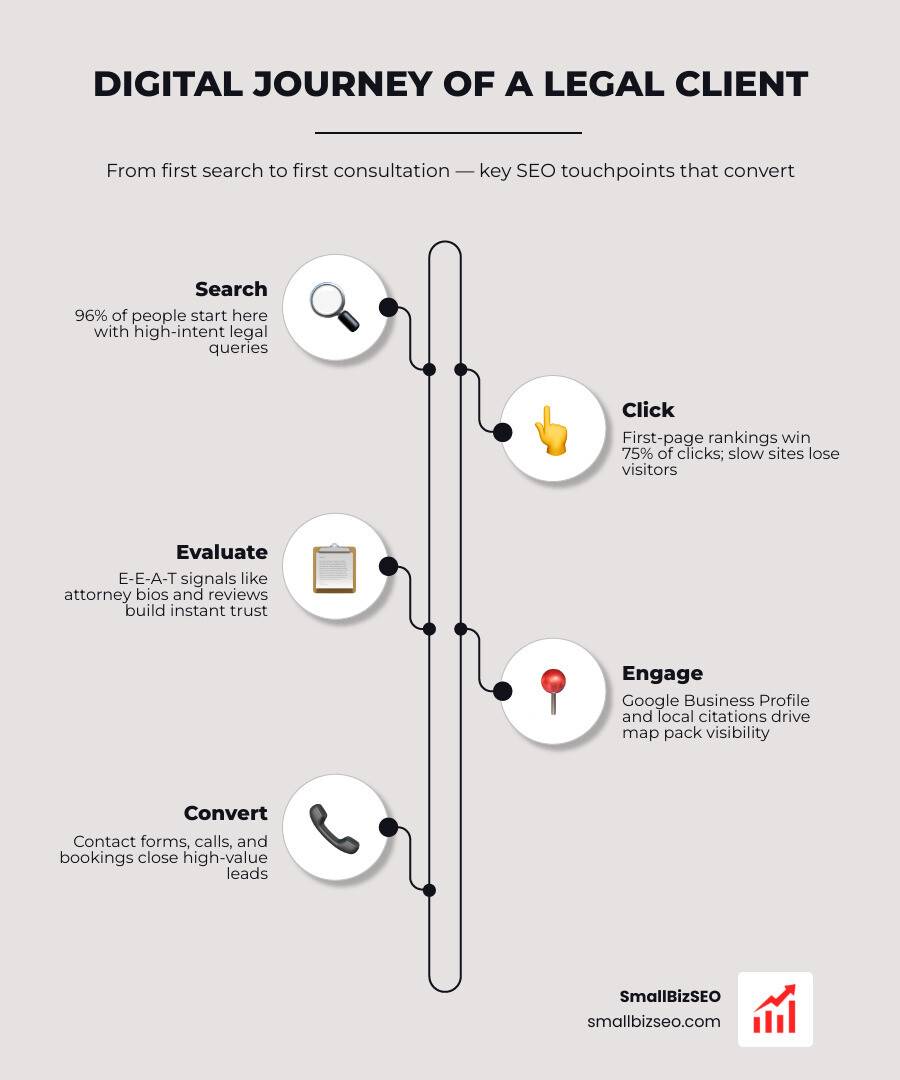
Learn more about law firm SEO audit:
What Is a Law Firm SEO Audit and Why Your Practice Needs It
At its core, a law firm SEO audit is a complete health check for your firm’s website. It evaluates your search visibility, identifies why you might be losing potential clients to competing practices, and establishes an action plan for better client acquisition.
Unlike general websites, Google holds legal websites to incredibly high standards. Legal content falls under the "Your Money or Your Life" (YMYL) category because inaccurate legal information can cause real-world financial or personal harm. Therefore, Google requires legal websites to demonstrate a high degree of trust and authority.
Additionally, legal practices must navigate strict state bar association rules and advertising regulations. An audit ensures your content remains fully compliant while still aggressively targeting high-value search terms. Partnering with a specialized team ensures your site balances these compliance guidelines with modern search tactics.
The Unique Challenges of Legal Search
Legal search is one of the most competitive spaces on the internet. Because a single case can be worth thousands—or even millions—of dollars, the competitive intensity is extreme.
- High-Intent Queries: Users looking for legal representation are rarely "just browsing." They are looking for immediate help, often in a high-stress situation.
- Extreme Cost-Per-Click (CPC): In paid search, legal keywords can easily exceed $100 to $700 per click. This makes organic search the most cost-effective channel for sustainable growth.
- Hyper-Local Competition: Most legal clients look for representation in their immediate vicinity, making local visibility crucial.
To cut through this noise, many firms work with a dedicated SEO agency to systematically identify and close competitive gaps.
Why General Website Audits Fall Short for Attorneys
A generic website audit might tell you that your images are too large or your meta descriptions are missing, but it won’t understand the nuances of a legal practice.
General audits miss legal-specific directory listings, state bar compliance issues, and the proper structure of practice area pages. They don't analyze whether your content speaks to a person in crisis or if it uses too much confusing legalese. To get real results, you need a specialized approach that reviews how your practice areas are organized and how your digital footprint looks to legal search engines. If you want to see how a professional team handles these complex layers, explore our specialized SEO Services.
The Core Pillars of a Comprehensive Law Firm SEO Audit
To get a complete picture of your website’s performance, we break the audit down into four distinct layers. If you ignore even one of these pillars, your rankings will suffer.
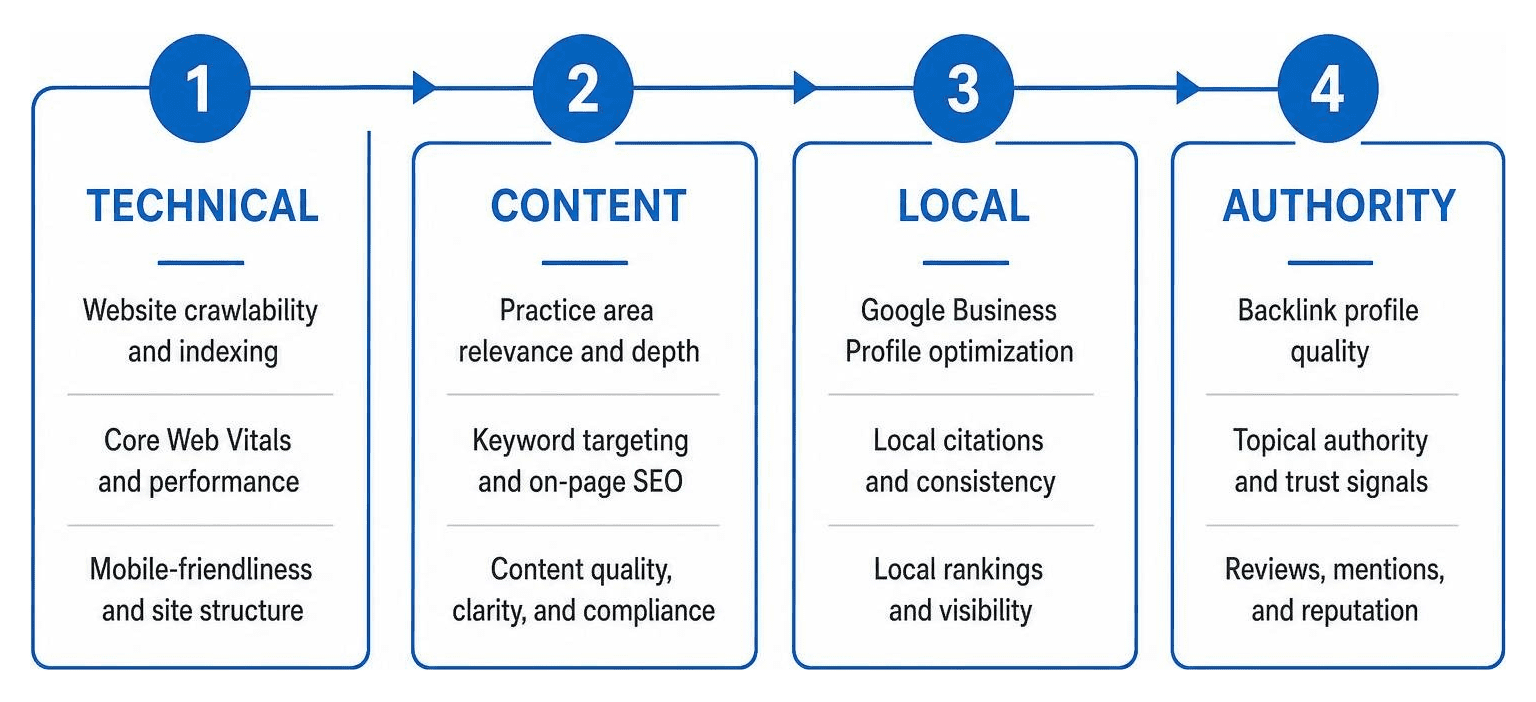
Before you begin writing new blog posts or launching ad campaigns, we recommend starting with a Detailed SEO Analysis to establish your baseline.
Technical Infrastructure and Core Web Vitals
Technical debt is the silent killer of legal SEO. If your website takes too long to load, potential clients will click away before they even see your phone number. In fact, 88% of users are unlikely to return to a website after a bad user experience.
During this phase, we look closely at Google's Core Web Vitals:
- Largest Contentful Paint (LCP): How fast does the main content load? (Aim for under 2.5 seconds).
- Interaction to Next Paint (INP): How responsive is your site when a user clicks a button? (Aim for under 200 milliseconds).
- Cumulative Layout Shift (CLS): Does your page layout jump around as elements load? (Aim for under 0.1).
With over 60% of legal searches happening on mobile devices, mobile-first indexing is no longer optional. Your site must render perfectly on smartphones. To see if your technical foundation is up to par, read our guide on How to Pass Google's Own SEO Analysis Audits.
On-Page Optimization and Content Depth
Every practice area you serve needs its own dedicated, high-quality page. A common mistake is grouping all services onto a single "Practice Areas" page.
We audit your site for:
- Thin Content: Pages with fewer than 500 words rarely rank for competitive legal terms.
- Keyword Cannibalization: Having multiple pages targeting the exact same keyword confuses search engines.
- Readability: Legal concepts should be explained in plain English, not complex legal jargon.
Our approach to On-Page SEO focuses on creating comprehensive resources that answer your clients' most pressing questions while maintaining clear internal links to your attorney bios and contact pages.
Local SEO and Google Business Profile Health
For lawyers, local search is where the magic happens. About 85% of people use online maps to locate local services. If your firm isn't showing up in the local map pack, you are missing out on the majority of your potential leads.
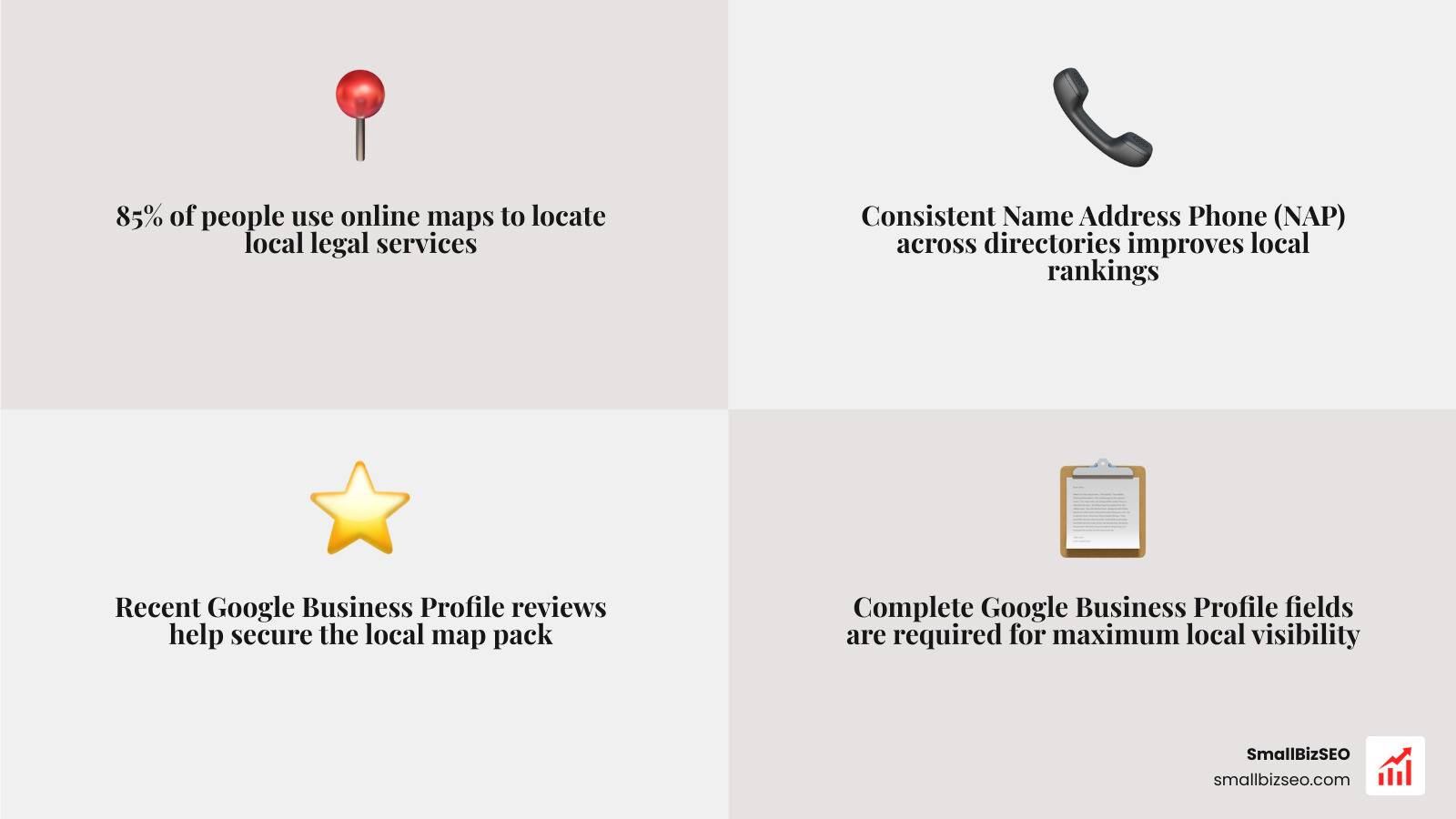
An audit checks for Name, Address, and Phone (NAP) consistency across all online directories, review recency, and the completeness of your Google Business Profile.
Step-by-Step Guide to Executing Your Law Firm SEO Audit
Now that you understand the pillars, let’s look at how to run the diagnostic framework yourself.

To see a live demonstration of these principles in action, you can watch this helpful SEO Audit for Law Firms walkthrough.
Phase 1: Crawlability and Indexation Diagnostics
First, we must make sure Google can actually find and read your pages. Log into Google Search Console (GSC) and check the "Pages" report. Are there critical practice area pages listed under "Excluded"?
- XML Sitemaps: Ensure your sitemap is submitted and contains only live, high-quality pages.
- Robots.txt: Make sure you aren't accidentally blocking search engines from crawling your primary service pages.
- Index Bloat: Check for unnecessary tag pages, search results, or duplicate landing pages that dilute your crawl budget.
If you've noticed a sudden drop in traffic, it could be a sign of deeper search issues. Learn How to Recover from a Google Algorithm Penalty to get your site back on track.
Phase 2: Keyword and Content Gap Analysis
Next, compare your content against your top-performing local competitors. Are they ranking for high-value transactional keywords like "car accident lawyer in New York" while you only rank for informational blog topics?
To systematically identify these opportunities, we use a structured spreadsheet to map out where your competitors have content that you lack. Check out our guide on Keyword Gap Analysis: What It Is and How to Do It Right to build your own target list.
Phase 3: Backlink Profile and Authority Assessment
Backlinks act as votes of confidence. In the legal niche, a few high-quality links from trusted legal directories and local publications are worth far more than hundreds of low-quality, spammy links.
We analyze:
- Domain Authority: How strong is your site compared to competitors?
- Legal Directory Presence: Are you listed on authoritative sites like Avvo, Justia, and Martindale-Hubbell?
- Toxic Links: Do you have unnatural backlinks that could trigger Google Penalties?
Leveraging E-E-A-T and Local SEO to Drive High-Value Leads
Google uses the E-E-A-T framework (Experience, Expertise, Authoritativeness, Trustworthiness) to evaluate the quality of YMYL websites. For law firms, this means your digital presence must prove you are a licensed, credible professional.

For a complete approach to building this trust, consider our Legal Professional Services SEO Packages.
Optimizing Your Google Business Profile for the Map Pack
To dominate the local map pack in New York, NY, your Google Business Profile must be meticulously optimized.
- Primary Category: Ensure your primary category matches your most profitable practice area (e.g., "Personal injury attorney" rather than just "Attorney").
- Review Strategy: Implement a system to collect fresh reviews weekly. Respond to all reviews—both positive and negative—promptly and professionally.
- Local Citations: Ensure your business name, address, and phone number are identical across the web.
For localized expertise, working with an experienced SEO agency or checking directory structures can help align your local footprint with New York's competitive landscape.
Building Trust with YMYL-Compliant Content
To satisfy Google's E-E-A-T guidelines, your content should feature:
- Attorney Bylines: Every legal article should be authored or reviewed by a licensed attorney, with a link to their professional bio page.
- Credentials and Badges: Showcase bar admissions, legal awards, and professional memberships clearly on your site.
- Real Case Results: Include anonymized case studies or client testimonials to prove your real-world experience.
We design our SEO Packages to build this digital trust while keeping your content fully compliant with advertising rules.
Frequently Asked Questions About a Law Firm SEO Audit
How often should my practice perform a law firm SEO audit?
We recommend running a technical mini-audit monthly to catch crawl errors or broken links, and a comprehensive strategic audit quarterly. This ensures your site adapts to search algorithm updates and competitive shifts in your local market.
What are the most common technical errors found during a law firm SEO audit?
The most common issues we find are slow page speeds caused by unoptimized chat widgets, broken internal redirect chains, and missing schema markup (such as LegalService or FAQPage schema) that helps search engines understand your practice areas.
Can I perform a legal SEO audit myself or do I need a specialist?
You can easily perform basic diagnostics using free tools like Google Search Console and PageSpeed Insights. However, fixing deep technical debt, implementing advanced schema, and building an authoritative backlink profile typically require the help of a legal SEO specialist.
Conclusion: Prioritizing Your Audit Findings for Maximum ROI
An SEO audit is only as good as the action plan it produces. Once you have your findings, prioritize them by business impact and implementation effort. Fix critical technical errors first, then move on to expanding your practice area pages and optimizing your local map presence.
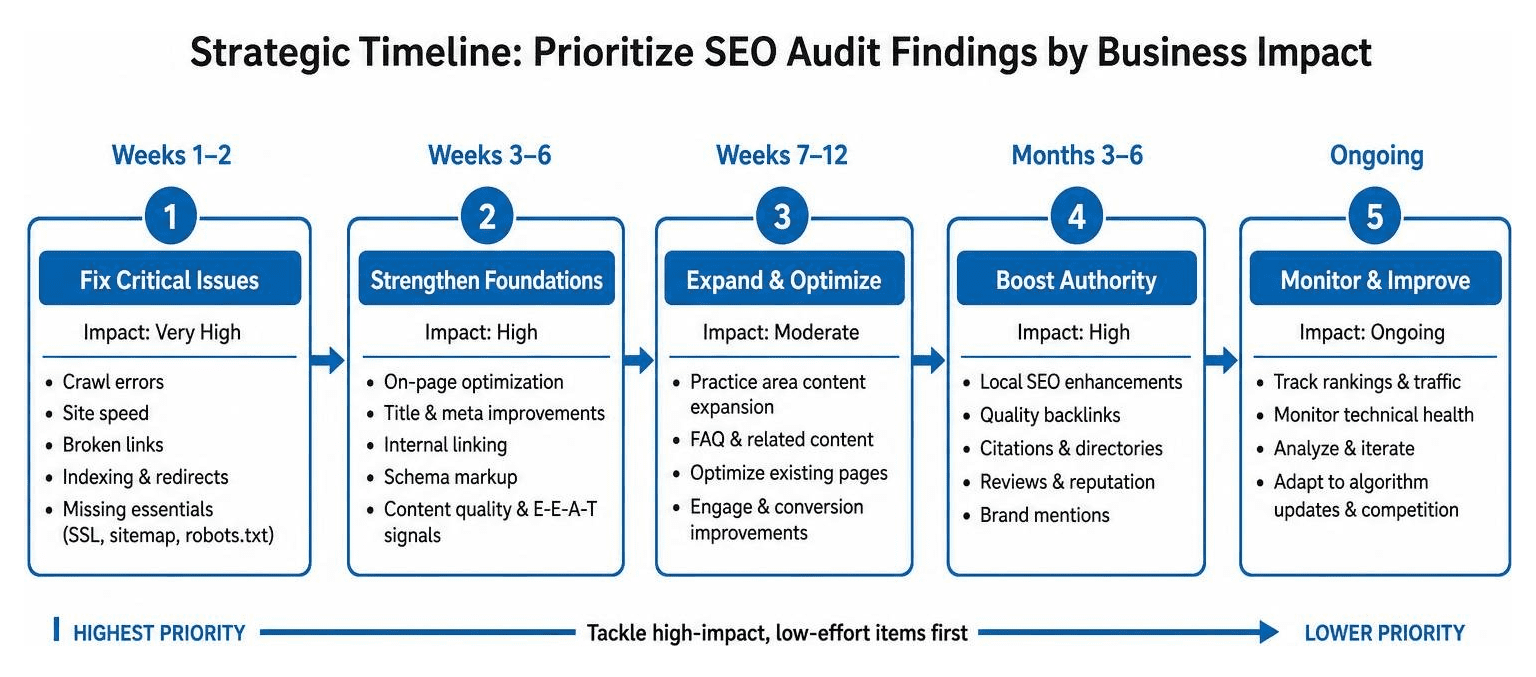
At SmallBizSEO, we help law firms cut through the confusion of search marketing. Using our data-driven "Velocity" framework, we deliver fast, sustainable rankings and E-E-A-T-compliant growth through transparent, automated reporting.
Don't let your competitors capture the leads that belong to your practice. Take the first step toward dominating your local market today by requesting our SEO Visibility Audit.