How to Conduct a Truly Detailed SEO Analysis

Why a Detailed SEO Audit is the Starting Point for Real Search Growth
A detailed SEO audit is the single most important step you can take before spending another dollar on content, links, or ads. Without it, you're guessing — and guessing is expensive.
What is a detailed SEO audit?
A detailed SEO audit is a systematic, top-to-bottom review of every factor that affects how search engines find, crawl, index, and rank your website. It covers:
- Technical SEO — crawlability, indexation, site speed, Core Web Vitals, mobile usability
- On-Page SEO — title tags, meta descriptions, heading structure, internal links
- Content quality — thin content, duplicate content, keyword cannibalization, E-E-A-T signals
- Backlink profile — link quality, toxic links, anchor text distribution
- AI search readiness — schema markup, entity signals, AI crawler access
The findings tell you exactly what is holding your rankings back — and in what order to fix it.
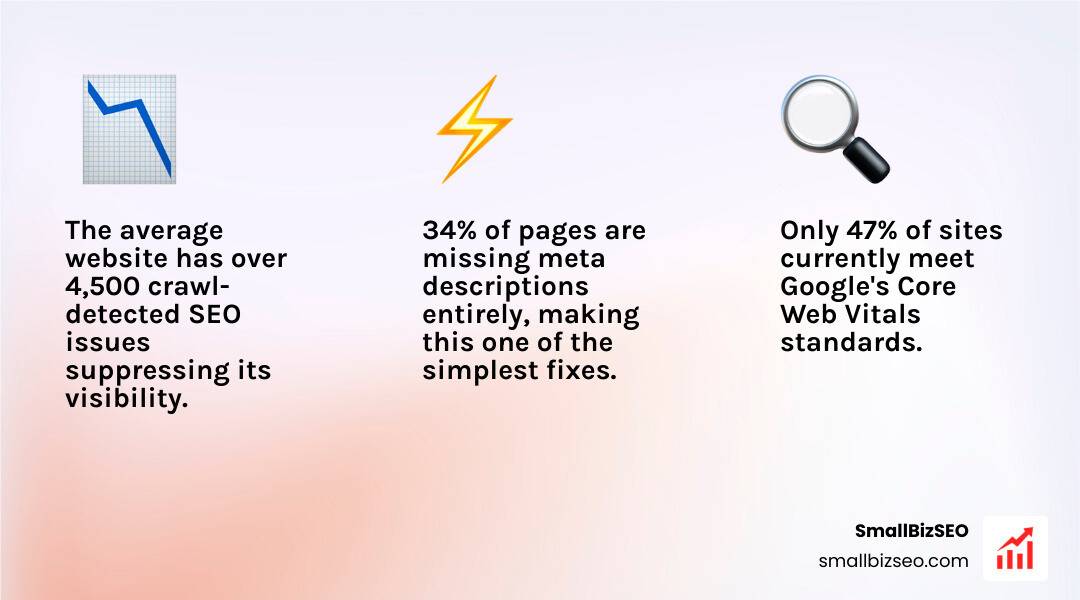
Here's why this matters for small business owners specifically: the average website has over 4,500 crawl-detected SEO issues suppressing its visibility. Only 47% of sites currently meet Google's Core Web Vitals standards. And 34% of pages are missing meta descriptions entirely — one of the simplest fixes in SEO.
The good news? A thorough audit typically delivers a 25–40% traffic uplift within four to six weeks of implementing fixes. You cannot fix what you have not diagnosed.
I'm Clayton Johnson, a digital marketing and SEO specialist focused on using strategies like digital PR and technical optimization to help businesses grow their search presence — and conducting a detailed SEO audit is always the first step in every engagement I lead. In this guide, I'll walk you through the exact framework we use so you can apply it to your own site.
What is a Detailed SEO Audit and Why It Matters
Many business owners run a free, automated tool, fix three broken links, and think they have completed an audit. But a surface-level scan is not a detailed SEO audit.
An automated tool might tell you that your home page is missing an alt tag on an image. A detailed audit, however, will tell you that a faceted navigation crawl trap is eating up 60% of your crawl budget, leaving your highest-revenue category pages completely undiscovered by search engine crawlers.
Crawl budget refers to the number of pages a search engine bot will crawl on your site during a given timeframe. When your site is bogged down by duplicate parameter URLs, search engines waste time on low-value pages. This directly suppresses your overall search visibility.
By identifying these critical structural issues through an SEO Visibility Audit, you can clear the path for search bots to find and index your money-making pages. This foundational work is what drives the rapid 25–40% traffic uplift that businesses experience after implementing our recommendations.
| Audit Element | Basic SEO Audit | Detailed SEO Audit |
|---|---|---|
| Crawl & Indexation | Checks robots.txt exists and counts sitemap links. | Analyzes server logs, parameter traps, and raw vs. rendered HTML. |
| Performance | Measures Lighthouse lab scores on the desktop homepage. | Evaluates real-user Core Web Vitals field data (CrUX) across templates. |
| On-Page Signals | Flags missing title tags and meta descriptions. | Maps internal link equity, heading hierarchies, and search intent. |
| Content Quality | Counts word length and checks for basic keyword density. | Evaluates E-E-A-T signals, keyword cannibalization, and thin content. |
| AI Search Readiness | None. | Audits schema coverage, entity signals, and AI engine crawler permissions. |
Step-by-Step Framework for a Detailed SEO Audit
To prevent wasted effort, we execute audits in a strict dependency-ordered sequence. For example, spending thousands of dollars optimizing Core Web Vitals on a template that has a "noindex" tag injected into the code is a complete waste of capital. We always audit from the bottom up: discovery, then indexing, then rendering, then on-page relevance, and finally, authority and AI readiness.
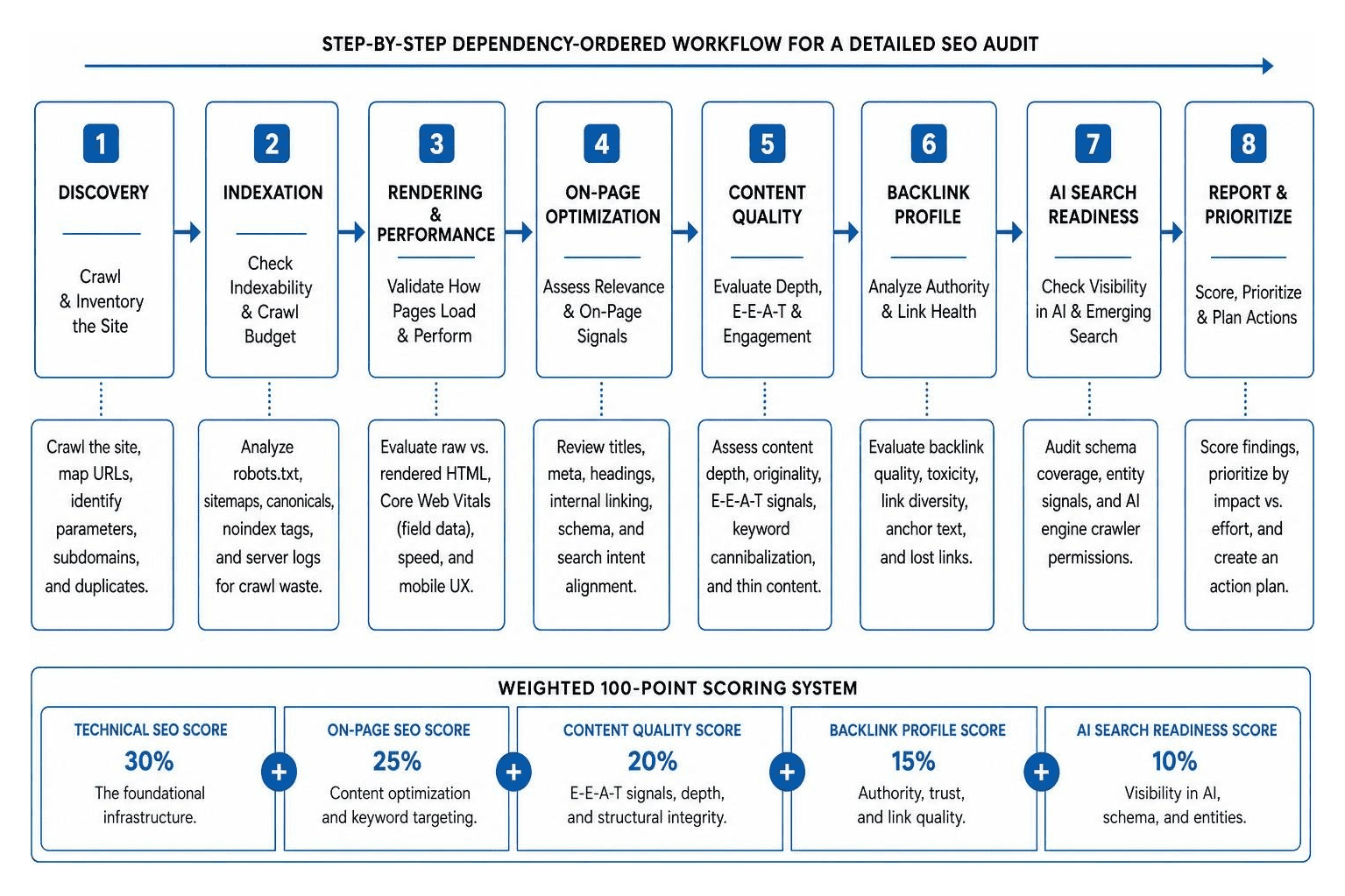
To make these findings highly actionable, we use a weighted 100-point scoring system. This framework breaks down your site's health into measurable metrics:
- Technical SEO Score (30%) — The foundational infrastructure.
- On-Page SEO Score (25%) — Content optimization and keyword targeting.
- Content Quality Score (20%) — E-E-A-T signals, depth, and structural integrity.
- Backlink Profile Score (15%) — Authority, trust, and link quality.
- Competitor Gap Score (7%) — Share of voice and structural opportunities.
- Local SEO Score (3%) — Citation accuracy and local map presence.
A quarterly 5-to-10-point improvement in this overall score is a realistic and highly rewarding trajectory for most growing businesses.
Technical SEO: Crawlability, Indexation, and Performance
Technical SEO is the physical foundation of your website. If your infrastructure is broken, even the most brilliant content will fail to rank.
First, we audit crawlability. Your robots.txt file must be permissive and reachable. If it returns a server error, search bots will pause crawling entirely. Next, we verify your XML sitemaps. A common mistake is using sitemaps as a dump for every URL your content management system generates. Your sitemap must only contain canonical, indexable, 200-status URLs.
Once search engines can crawl your site, they must be able to load it quickly. Google ranks sites based on real-user field data from the Chrome User Experience Report (CrUX), not theoretical lab scores. We focus on the three Core Web Vitals:
- Largest Contentful Paint (LCP) — Measures loading speed. The main content of your page must load in under 2.5 seconds.
- Interaction to Next Paint (INP) — Measures page responsiveness. Interactive elements should respond in under 200 milliseconds.
- Cumulative Layout Shift (CLS) — Measures visual stability. Elements should not jump around as the page loads; target a score under 0.1.

To optimize these metrics, we ensure all images have explicit width and height dimensions, preload hero images, and defer non-essential third-party scripts. For a deeper dive into technical execution, check out this Advanced Technical SEO Audit Checklist Guide.
Crawlability and Indexation Signals
Beyond site speed, we must audit the explicit directives we send to search engines:
- Canonical Tags: Every indexable page must have a clean, self-referencing canonical tag to prevent duplicate content issues.
- Redirect Chains: We target a maximum of two redirect hops. A third hop can trigger search console warnings and waste valuable crawl budget.
- Hreflang Annotations: If your site serves multiple languages, hreflang tags must be reciprocal and use exact ISO codes to prevent targeting errors.
- JavaScript Rendering: Many modern sites render content on the client side using JavaScript. We compare raw HTML against rendered HTML to ensure search bots can read your primary text and links.
- Orphan Pages: We scan for pages with zero internal links. These "orphans" receive no link equity and are rarely crawled.
On-Page, Off-Page, and AI Search Readiness
With a strong technical foundation, we transition to optimizing what is actually on your pages. Our On-Page SEO audit focuses on aligning your page elements with search intent.

We evaluate title tags, ensuring they are unique, descriptive, and under 60 characters with your primary keyword positioned near the beginning. Meta descriptions should sit between 120 and 160 characters to avoid truncation.
Finally, we audit heading hierarchy. Every page must have exactly one H1 tag that aligns with the title tag, followed by logically nested H2 and H3 tags.
Content Quality and E-E-A-T Signals
High rankings require high-quality content. During our content audit, we address several common issues:
- Thin & Duplicate Content: Roughly 29% of websites struggle with duplicate content. We identify thin pages and use a content consolidation strategy, merging them into comprehensive resources rather than deleting them, to preserve existing link equity.
- Keyword Cannibalization: This occurs when multiple pages target the same search intent. We resolve this by consolidating pages or redirecting weaker content to a primary target page.
- E-E-A-T Signals: Search engines look for Experience, Expertise, Authoritativeness, and Trustworthiness. We ensure your content features clear author bios, editorial standards, and accurate source citations. Failing to maintain these signals can leave your site vulnerable to Google Penalties. If you've recently lost traffic, you may need a recovery plan to address How to Recover from a Google Algorithm Penalty.
Recommended Tools for a Detailed SEO Audit
Conducting a professional audit requires a robust tool stack. We recommend the following resources:
- Crawlers: Screaming Frog or Lumar for deep technical crawls.
- Browser Extensions: The Detailed SEO Extension - Chrome Web Store for instant, one-click on-page analysis.
- Specialized Software: SEO Audit Software for continuous, automated monitoring.
- Personalized Audits: If you prefer over-the-shoulder expert feedback, you can review SEO Audits Recorded on Video for tailored insights.
- Backlink Checkers: Ahrefs or Semrush to audit referring domains and anchor text distribution.

A healthy backlink profile should show a natural anchor text distribution (branded and natural phrases) with commercial exact-match anchors kept below 5%.
For local businesses, we also integrate local citation checks and Google Business Profile optimization. You can read our complete Local SEO Guide to learn how to keep your name, address, and phone number consistent across the web.
Frequently Asked Questions about Detailed SEO Audits
How often should you conduct a detailed SEO audit?
For most businesses, we recommend a comprehensive, full-site audit annually, with lighter quarterly reviews. However, you should trigger an immediate audit following any major site migration, platform redesign, CMS update, or unexplained drop in search traffic.
What is the difference between a technical SEO audit and a full SEO audit?
A technical SEO audit focuses strictly on the infrastructure layer — ensuring search engines can find, crawl, render, and index your site. A full SEO audit is much broader; it includes the technical audit plus an exhaustive review of content quality, on-page optimization, backlink health, competitor gaps, and AI search readiness.
How do AI search engines affect modern SEO audits?
Modern audits must evaluate your site's AI retrievability. This means ensuring your robots.txt file explicitly permits or blocks specific AI crawlers (like GPTBot or ClaudeBot) based on your business goals. It also involves checking your schema markup and entity signals to ensure AI search engines can easily parse and cite your brand as a trusted source.
Conclusion
A detailed SEO audit is not a passive PDF of warnings; it is an active blueprint for growth. By diagnosing your technical bottlenecks, optimizing your on-page elements, and preparing your site for modern AI search engines, you pave the way for sustainable search visibility.
At SmallBizSEO, based at 99 Wall Street NY in New York NY, we help small businesses eliminate the guesswork. Our data-driven "Velocity" framework is designed to deliver fast rankings and transparent, automated reporting.
We prioritize your fixes by impact and effort, resolving critical errors first so your marketing dollars drive real revenue. Ready to stop guessing and start growing? Claim your SEO Visibility Audit today, and let us build your roadmap to search dominance.