7 Steps to a High-Converting B2B SEO Strategy

7 Steps to a High-Converting B2B SEO Strategy
How Does a B2B SEO Strategy Build Pipeline?
A B2B SEO strategy should help the right companies find you, evaluate you, and take the next step. Start with the questions buyers ask before a purchase. Build clear service pages and useful answers around those questions, make the site easy to use, and track which visits lead to qualified sales conversations.
That matters even more as buyers research through Google, AI answers, and other sources before they contact sales. Traffic alone will not tell you whether your SEO is working; lead quality and pipeline will.
I’m Clayton Johnson, founder of SmallBizSEO. My work in B2B SEO strategy connects technical SEO, content, and digital PR to help businesses earn trust and attract qualified leads.
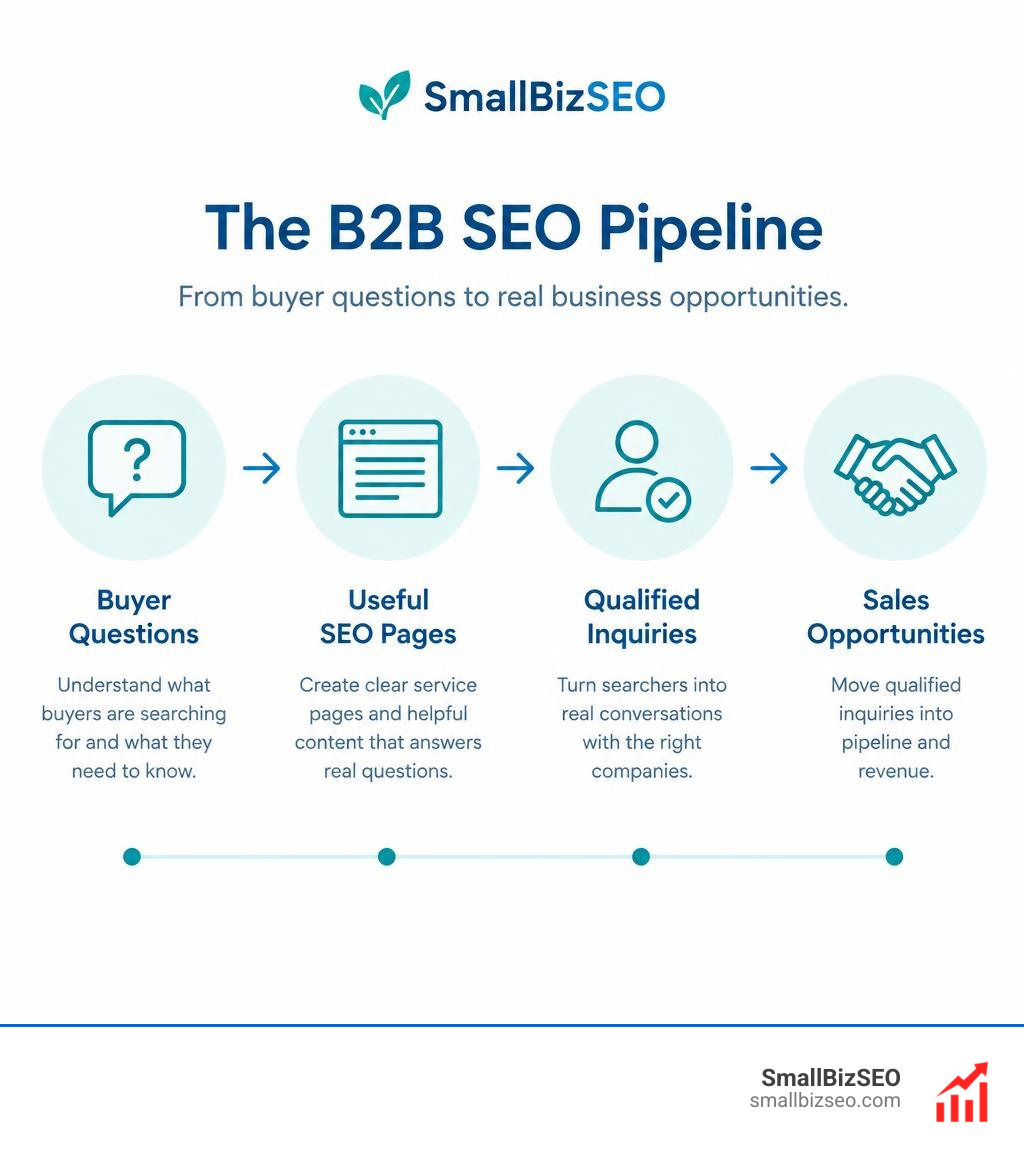
B2B SEO strategy vocabulary:
Introduction: The New Realities of Enterprise Search
A modern B2B SEO strategy helps buyers find and evaluate vendors during their independent research, then connects that search activity to pipeline outcomes.
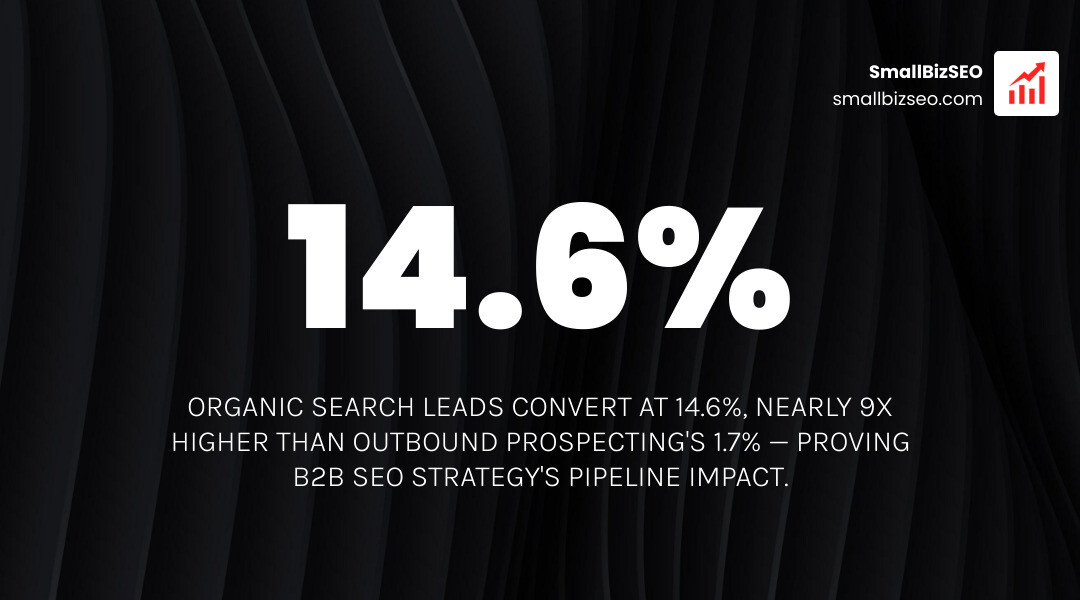
Organic search leads convert at roughly 14.6%, compared to just 1.7% for outbound prospecting. Yet the way business professionals discover solutions has shifted. Today, 83% of buyers define purchase requirements before speaking with sales, conducting deep autonomous research across search engines, review hubs, and AI tools. At the same time, position-1 click-through rates have fallen by as much as 58% on queries with AI Overviews.
To succeed, search optimization cannot stop at capturing traffic. It must guide self-directed buyers directly into your sales motion.
How Can a Revenue-First Framework Improve a B2B SEO Strategy?
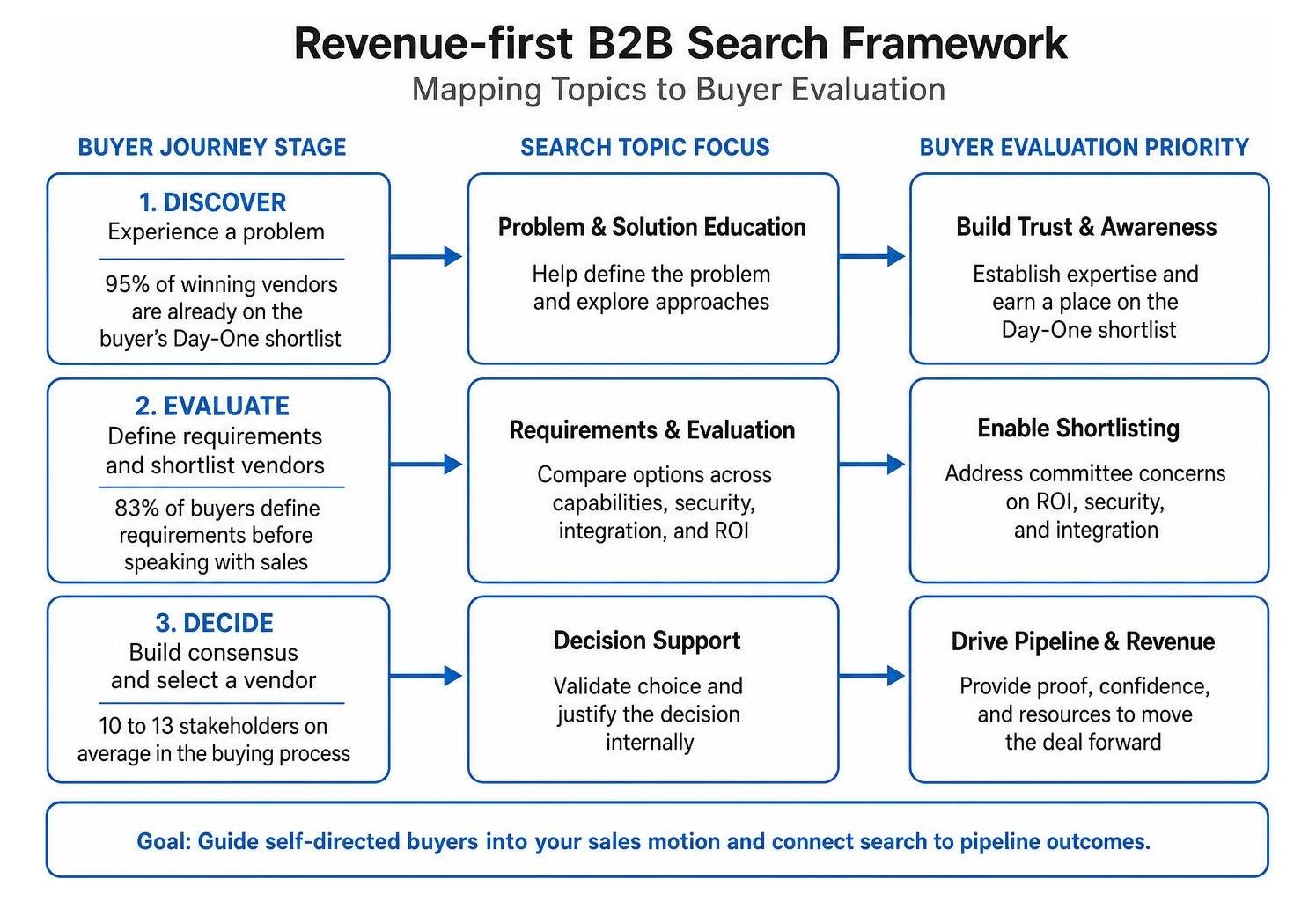
A revenue-first framework aligns search topics with buying needs and pipeline goals, so content can help buyers shortlist vendors and evaluate them.
When business buyers experience a problem, 95% of winning vendors are already on the buyer's Day-One shortlist. Modern purchasing decisions are rarely made by an isolated individual; buying processes involve 10 to 13 stakeholders on average, ranging from technical end-users to finance directors.
A revenue-first plan focuses on producing assets that satisfy Google's guidelines for creating helpful, reliable, people-first content while directly addressing committee concerns regarding ROI, security, and integration.
What Makes a B2B SEO Strategy Fundamentally Different from B2C?
B2B SEO targets multiple buying roles, longer sales cycles, and lower-volume, higher-intent searches.
Unlike consumer shopping where decisions happen quickly on smartphones, B2B website traffic skews heavily toward desktop (68-83% depending on the industry segment). In B2B, a keyword with only 200 monthly searches can generate millions in deal value if those searches come from qualified enterprise leaders.
Targeting these high-stakes queries requires understanding the nuances of multi-month sales motions. Evaluating specialized B2B SEO agencies that deliver leads helps teams focus on high-intent conversion paths instead of chasing empty consumer-scale traffic numbers.
How Does the 95/5 Rule Reshape Funnel Keyword Mapping?
The 95/5 rule requires building bottom-of-the-funnel (BOFU) content for the 5% of buyers in-market now, while using top-of-the-funnel (TOFU) content to educate the remaining 95%.
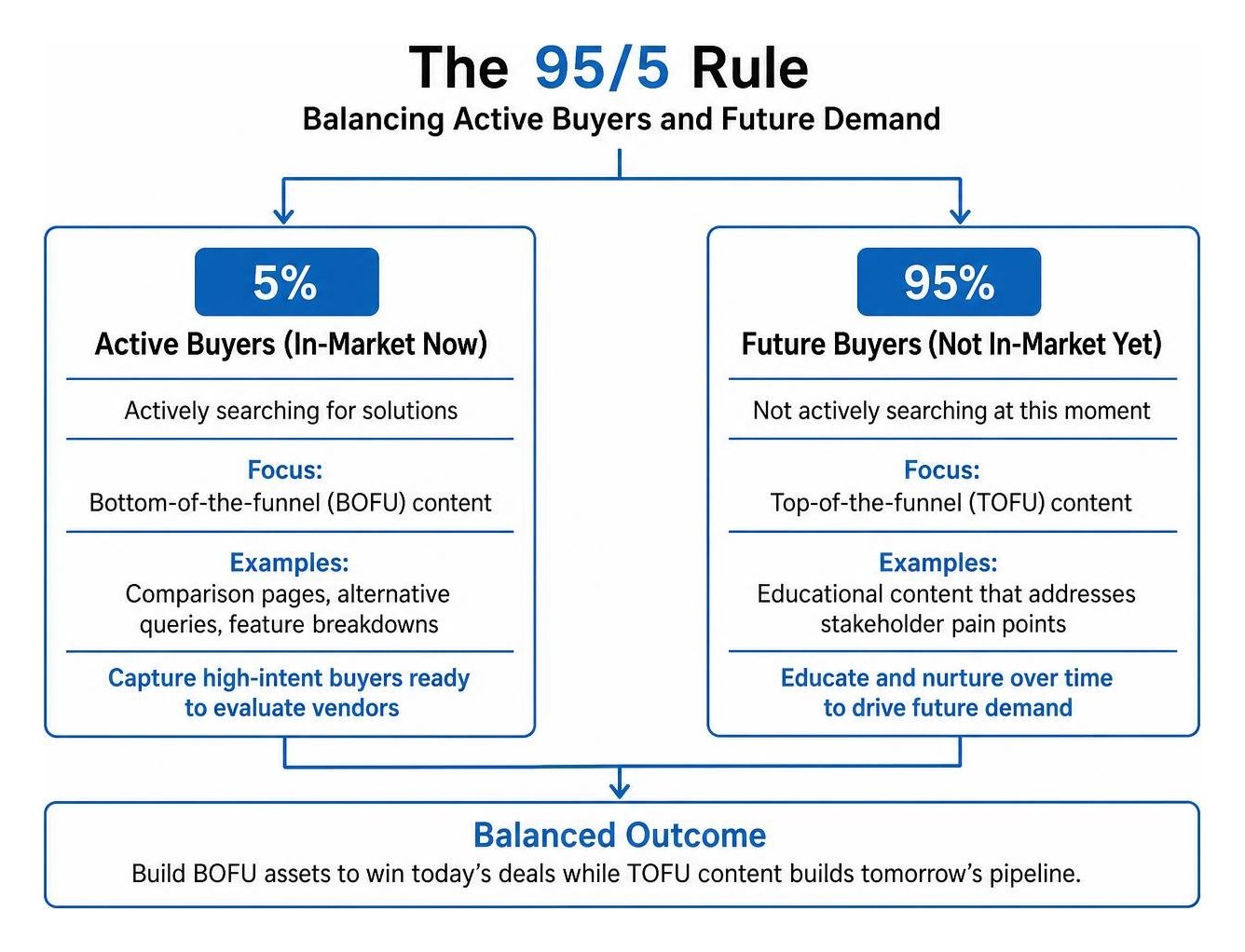
Only about 5% of your target market is actively looking for solutions at any given moment. A successful keyword framework builds BOFU assets first—such as comparison pages, alternative queries, and feature breakdowns—to capture high-intent buyers ready to evaluate vendors.
Simultaneously, educational TOFU content nurtures the other 95% over time. By consulting an A-Z guide to B2B SEO companies, teams can identify how to create customer personas that answer specific stakeholder pain points across every stage of discovery.
How to Build a B2B SEO Strategy Around AI Overviews and Topical Authority?
To build search visibility alongside AI Overviews, create useful, well-linked topic clusters backed by original research and demonstrated industry expertise.
While 51% of B2B buyers now start their research with AI chatbots, 63% of those buyers still cross-check their findings on Google Search. AI answer engines cite authoritative web sources to avoid incorrect answers, which makes search depth essential. Furthermore, more than 55% of decision makers say original research separates useful thought leadership from generic noise.
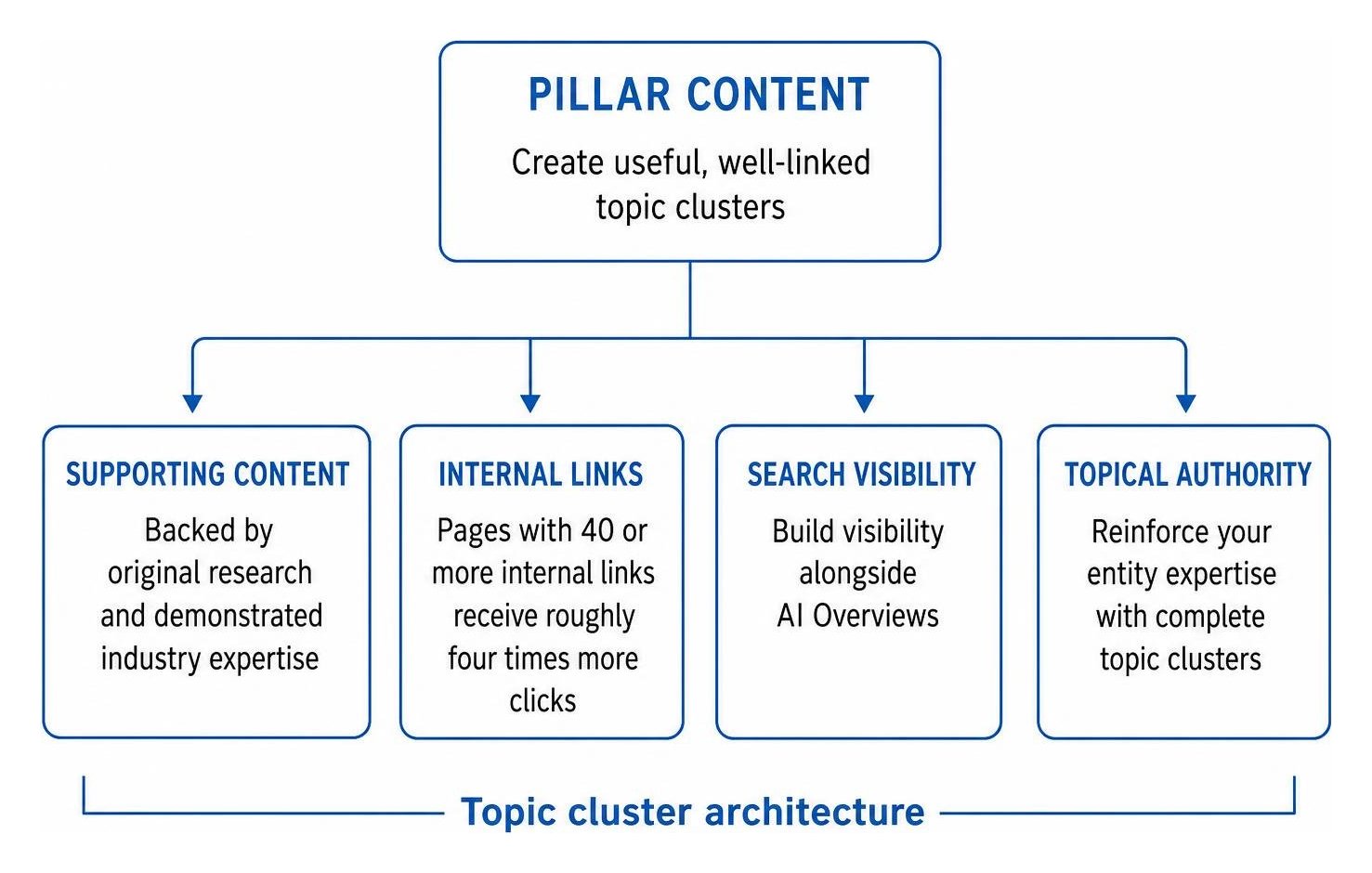
Building complete topic clusters reinforces your entity expertise. Connecting your assets matters just as much: pages with 40 or more internal links receive roughly four times more clicks than those with fewer than five. Applying strategic SEO content marketing ensures your site establishes the E-E-A-T signals search engines require.
How Do You Execute and Measure a B2B Search Program?
To execute and measure an enterprise search program, build clean technical foundations, coordinate with sales and account-based marketing, and track organic performance against pipeline metrics.

Aligning search efforts with sales conversations ensures you target queries prospects actually ask during demos. Incorporating insights from an executive playbook for enterprise SEO allows marketing and sales teams to work from shared pipeline goals rather than disconnected activity metrics.
What Technical and Link Foundations Drive Enterprise Visibility?
Enterprise visibility relies on making the site easy for search engines to crawl and index, followed by earning topically relevant links that build domain authority.
Technical foundations directly influence user experience and crawling efficiency. Currently, only 48% of mobile pages pass all three Core Web Vitals metrics, and slow rendering hurts conversion rates. Structuring your site architecture so key commercial pages sit within two clicks of the homepage ensures crawl budget is spent effectively.
Reviewing a thorough technical SEO guide helps identify crawl errors, improper canonicals, and missing structured data markup. Once your technical base is sound, acquiring high-quality backlinks through digital PR, proprietary data studies, and specialized link building services reinforces your site's authority.
Which Pipeline Metrics Prove Real Organic Search ROI?
To prove organic search return on investment, measure pipeline metrics such as cost per lead, sales-qualified opportunities, and attributed revenue rather than raw traffic.
The typical B2B buying journey includes 7.8 touchpoints, and between 70% and 80% of those touchpoints are completely anonymous. Relying solely on last-touch attribution obscures the multi-touch value of organic search.
At SmallBizSEO, we use our data-driven "Velocity" framework to help businesses build sustainable search visibility and track revenue impact. Using clear SEO metrics tracking and starting with a comprehensive SEO visibility audit gives your team the data needed to evaluate growth and scale pipeline predictably.
Accelerate Your B2B Search Revenue
Building an effective search engine optimization program is a compounding investment that pays dividends across years. By aligning your topics with the questions buying committees ask, maintaining clean technical foundations, and measuring success through pipeline opportunities, your organic search presence transforms into a reliable revenue driver.