An Executive Playbook for SEO for Enterprise Companies

An Executive Playbook for SEO for Enterprise Companies
Why SEO for Enterprise Companies Requires a Scalable System
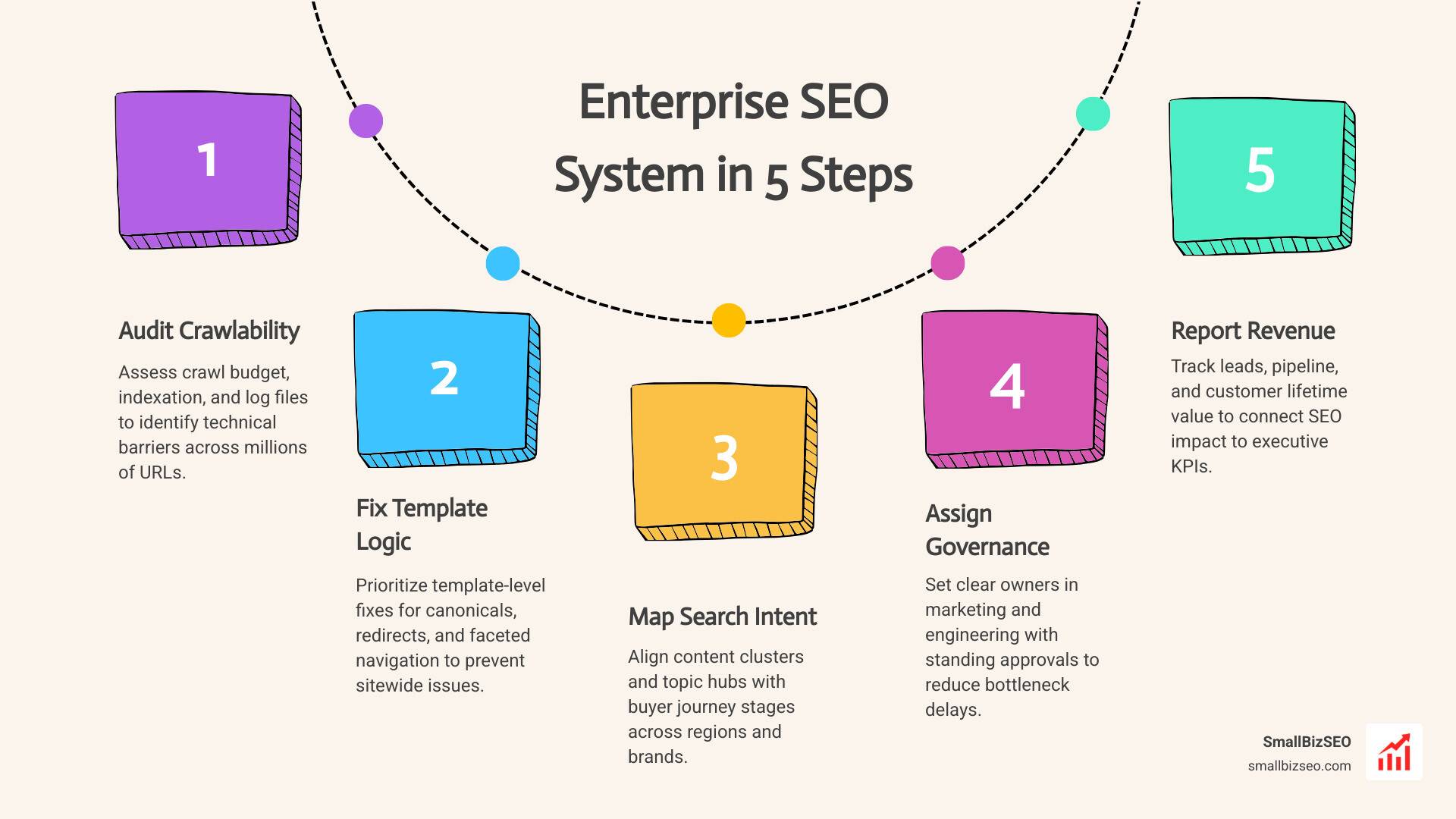
SEO for enterprise companies succeeds when it is treated as a business-wide system, not a checklist. Start by auditing crawlability and indexation, then prioritize template-level fixes, map content to buyer intent, assign clear owners across marketing and engineering, and report outcomes in leads, pipeline, and revenue.
Large organizations often manage thousands or millions of URLs, multiple brands, regions, and CMS platforms. A single broken template, canonical rule, or redirect can affect enormous sections of a site. The harder problem is often operational: getting the right teams to approve and ship high-impact changes before traffic and revenue are lost.
This guide explains how to build an enterprise SEO program that can scale: strong technical foundations, useful content systems, coordinated search intelligence and analytics, and governance that turns recommendations into completed work. It also covers how AI-driven search and answer engines are changing the visibility game.
I’m Clayton Johnson, a digital marketing and SEO strategist who connects search strategy, content, and digital PR to build authority and discoverability. My work in SEO for enterprise companies focuses on helping brands earn trusted mentions, stronger search visibility, and long-term marketing value across search engines, AI tools, and digital media.
What Is Enterprise SEO and How It Redefines Scale
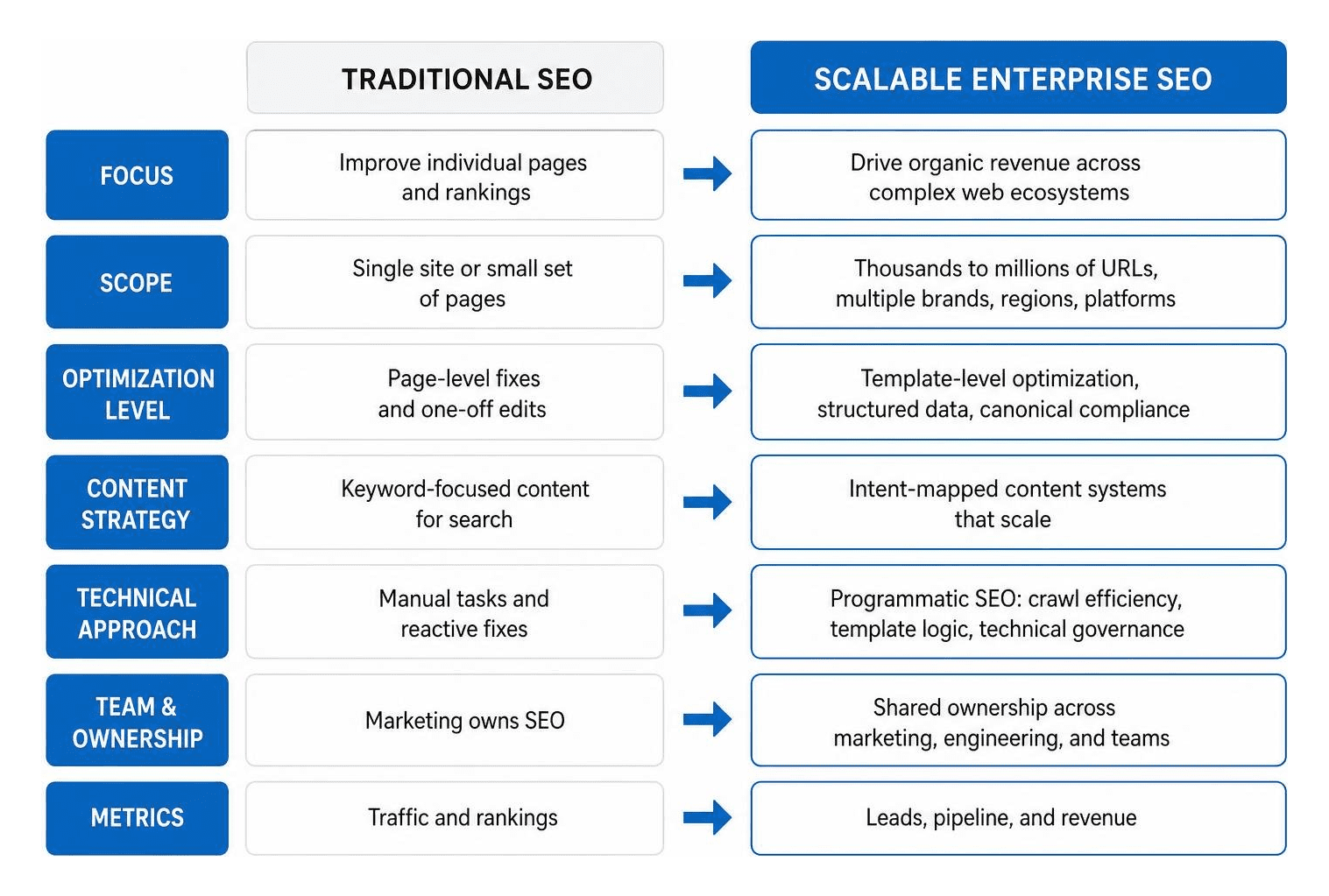
Enterprise SEO is the practice of aligning technical search architecture, content systems, and corporate governance to drive organic revenue across large, complex web ecosystems. While traditional SEO often focuses on optimizing individual blog posts or acquiring single backlinks, enterprise operations focus on template logic, programmatic crawling efficiency, brand protection, and multi-department alignment.
The true differentiator of enterprise search is not just page count—though sites often exceed 10,000 to millions of URLs—it is organizational friction. When 68% of online experiences begin with a search engine, enterprise leaders cannot treat search as an isolated marketing silo. A single algorithmic shift or technical error can jeopardize millions of dollars in pipeline.
Foundational Architecture of SEO for Enterprise Companies
At enterprise scale, optimization must happen programmatically. Manual title tag rewrites or one-off page edits cannot keep pace with product catalogs that change daily. Successful programs focus on template-level optimization, structured data taxonomies, and strict canonical compliance.
The algorithmic rules for crawling and indexing remain consistent regardless of site size, but scale amplifies every defect. In a comprehensive breakdown of technical mechanics, Enterprise SEO highlights how minor template modifications can either restore millions in link equity or inadvertently deindex vast sections of a domain.
Overcoming Scale, Tech Debt, and Multi-Domain Governance
Large enterprises rarely operate on a single, pristine codebase. Instead, they manage legacy CMS platforms, subdomains, acquisitions, and regional microsites. This accumulation of technical debt creates severe bottlenecks.
Enterprise organizations often struggle with:
- Fragmented URL taxonomies across legacy subdomains
- Conflicting canonical tags and duplicate content loops
- Complex hreflang tag configurations across global markets
- Bureaucratic approval chains that delay critical engineering tickets for months
Navigating these challenges requires a mature governance framework. Aligning developer sprints with organic search priorities is a core component of any comprehensive growth strategy for scaling businesses, transforming organic search from a reactive fix-it desk into an executive revenue driver.
Core Pillars: Building a Winning Strategy for SEO for Enterprise Companies
Executing enterprise search requires a programmatic approach across technical hygiene, editorial production, and cross-channel marketing. As detailed in the guide on Enterprise SEO: What it is & how to build a winning strategy, sustainable organic performance demands a clear prioritization matrix: balancing business impact against implementation cost and operational friction.
Technical Health, Site Architecture, and Crawl Economics
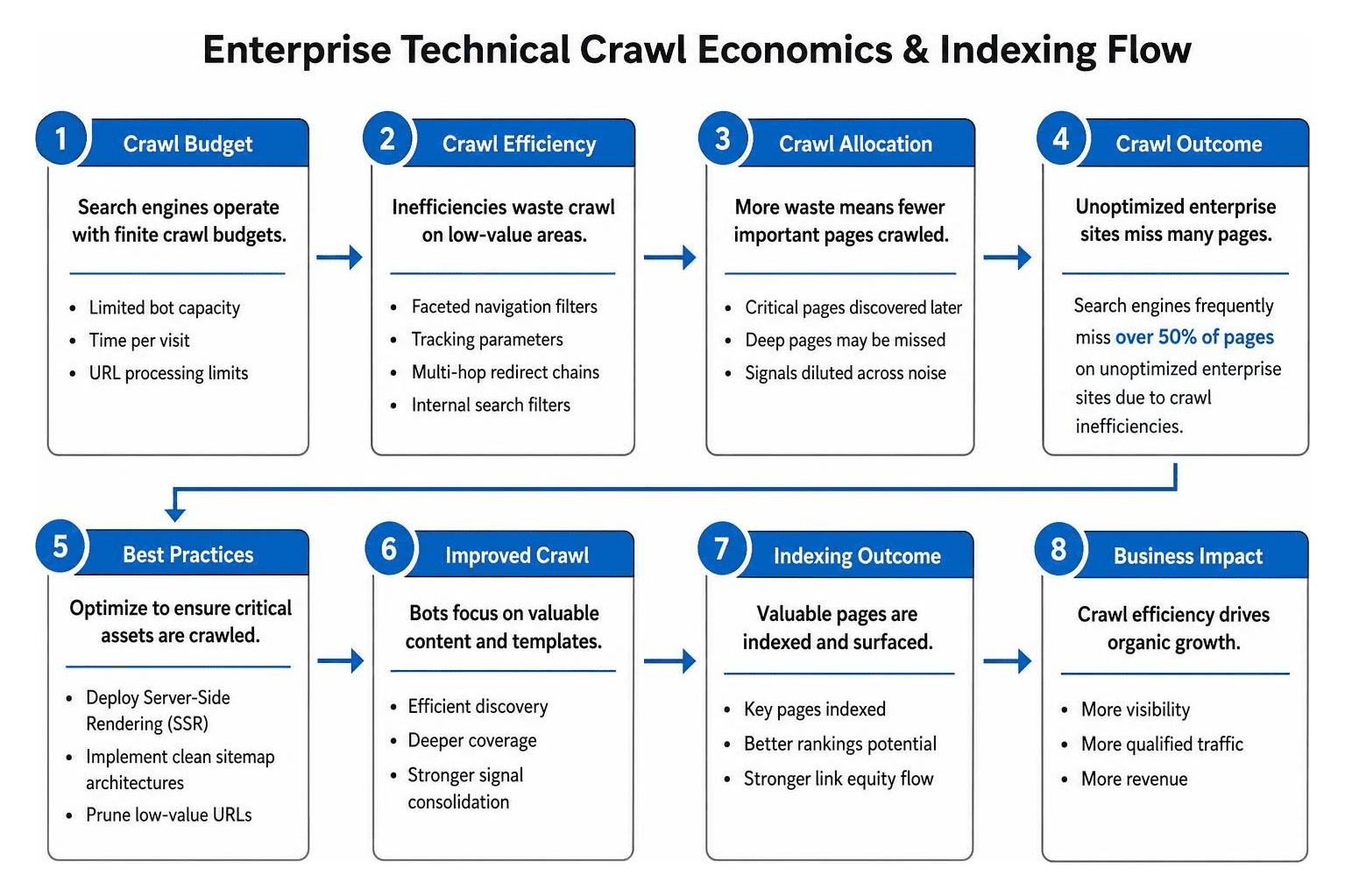
Search engines operate with finite crawl budgets. For large websites, search bots often waste processing power on faceted navigation filters, tracking parameters, and multi-hop redirect chains. In fact, search engines frequently miss over 50% of pages on unoptimized enterprise sites due to crawl inefficiencies.
To ensure critical commercial assets are crawled and indexed:
- Deploy Server-Side Rendering (SSR): Ensure search crawlers ingest dynamic JavaScript applications without rendering timeouts.
- Implement Clean Sitemap Architectures: Use segmented sitemap indexes to monitor indexing health by page template and product line.
- Prune Low-Value URLs: Use robots.txt directives and canonical rules to eliminate crawl bloat from internal search filters.
Scalable Content Systems, E-E-A-T, and Product-Led SEO
Creating high-performing content across enterprise hierarchies requires robust topic clusters and strict adherence to Experience, Expertise, Authoritativeness, and Trustworthiness (E-E-A-T). Research shows that 60% of top-ranking Google results are on pages three or more years old, meaning long-term visibility relies on systematic content refresh cycles.
Leading enterprises also deploy product-led SEO loops. By surfacing programmatic data, user reviews, and proprietary product inventories into crawlable landing pages, companies generate high-intent search assets that automatically compound. Aligning these assets with buyer search intent allows brands to leverage high-performing B2B SEO solutions that attract qualified decision-makers rather than empty traffic.
Cross-Channel Integration: Unifying Search and MarTech
Operating organic search in a silo leads to wasted marketing capital. Unifying search intelligence with broader customer data platforms eliminates blind spots and pinpoints high-converting commercial keywords that organic campaigns should target. Integrating search insights into customer relationship management (CRM) platforms connects organic search touchpoints directly to customer acquisition metrics and pipeline acceleration.
Enterprise SEO Platforms vs. Standard Tooling: Proving Measurable ROI
Standard SEO tools provide point-in-time keyword tracking, but enterprise organizations require unified platforms that integrate real-time anomaly detection, automated policy enforcement, and executive business forecasting.

Feature Capabilities in SEO for Enterprise Companies
Enterprise software must process petabytes of crawl logs, support automated workflows across hundreds of users, and integrate securely into corporate IT systems.
| Feature Area | Standard SEO Tools | Enterprise SEO Platforms |
|---|---|---|
| Data Scope | Single-domain, sample-based tracking | Multi-domain, petabyte-scale log and crawl data |
| User Access | Single-seat or restricted user tiers | Role-based permissions across unlimited team members |
| Security & Compliance | Basic login protocols | SSO, SOC2 compliance, and custom data policies |
| Automation | Manual report generation | Automated anomaly alerts and API-driven task creation |
| Reporting | Keyword rankings and estimated traffic | Multi-touch revenue attribution and pipeline forecasting |
Connecting Organic Visibility to Pipeline and Executive Revenue
SEO leads achieve an average 14.6% close rate, compared to just 1.7% for outbound leads. Furthermore, because the top organic result receives 32% of all search clicks, capturing commercial keywords generates immense financial leverage.
Proving ROI requires translating technical metrics into business revenue:
- Track customer acquisition cost (CAC) reductions achieved through organic customer capture.
- Quantify customer lifetime value (CLV) across organic discovery channels.
- Measure pipeline velocity for enterprise accounts originating via organic search.
Organizations looking to establish these sophisticated measurement systems often partner with specialized enterprise SEO partnerships to accelerate deployment and reporting accuracy.
Future-Proofing Search: AI Search, AEO, and Organizational Governance
The search landscape is expanding beyond standard search engine results pages into generative engines and Answer Engine Optimization (AEO). Forrester research reveals that 94% of B2B buyers utilize generative AI tools during their purchasing evaluations.
Adapting to Generative Engines, Voice Search, and LLM Visibility
Optimizing for large language models (LLMs) requires managing brand discoverability, entity clarity, and external authority. Independent studies show that 84% of AI engine citations stem from earned digital media coverage rather than paid advertorials.
To maintain dominance across generative interfaces and voice search (which 20% of global internet users now use regularly), enterprises must:
- Implement nested schema markups for organizations, products, and technical documentation.
- Monitor "Share of LLM" (SoLLM) to evaluate citation frequency inside AI answers.
- Build digital PR assets that secure authoritative media citations within major industry publications.
Navigating Operational Pitfalls and Execution Roadblocks
The primary reason enterprise search initiatives stall is not algorithmic complexity, but internal governance. Without structured operational workflows, technical audits can sit inside engineering backlogs for quarters.
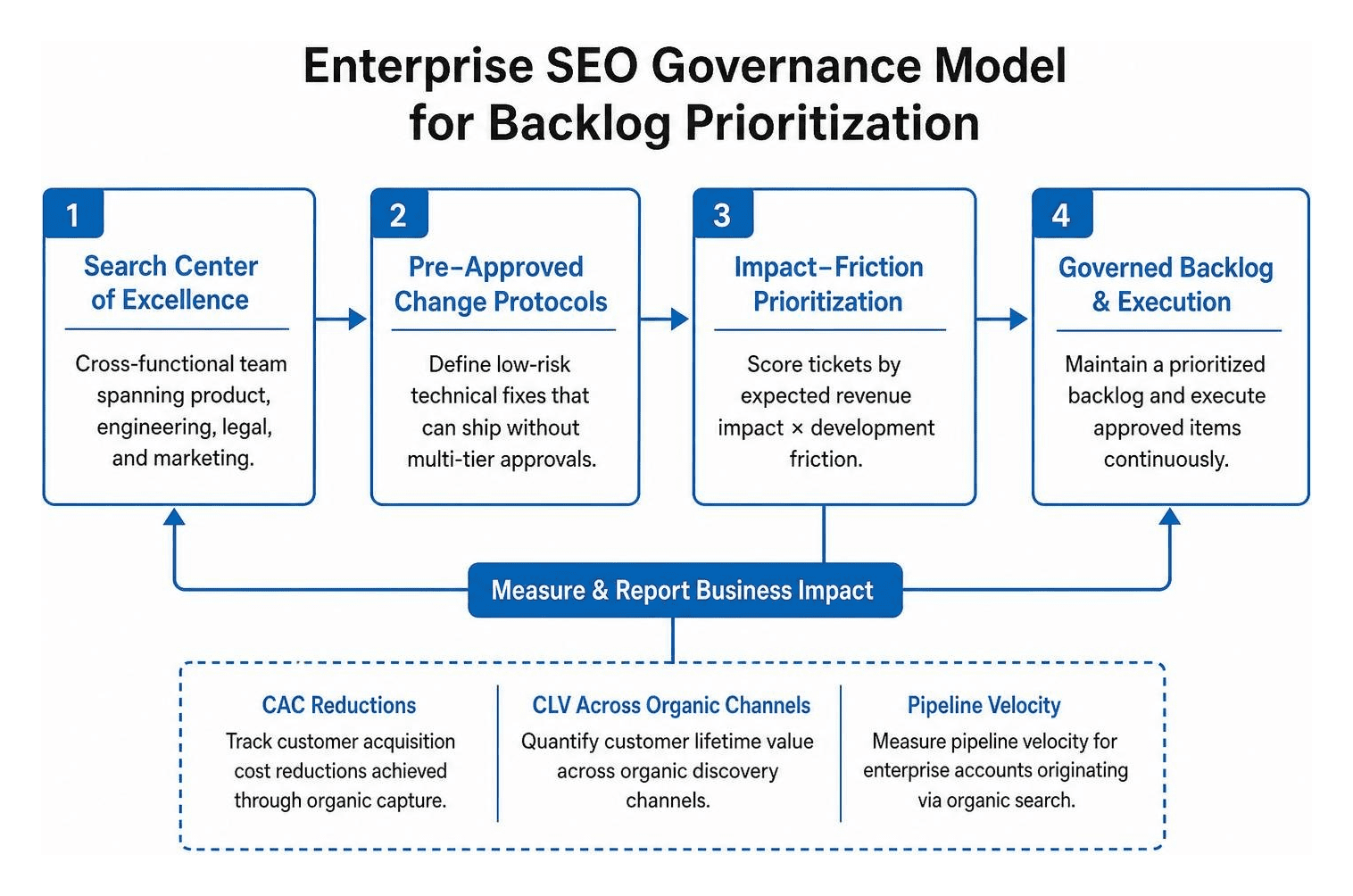
To avoid execution paralysis:
- Establish a Search Center of Excellence (CoE): Form an interdisciplinary group spanning product, engineering, legal, and marketing.
- Implement Pre-Approved Change Protocols: Define low-risk technical fixes (such as canonical normalization and metadata updates) that can ship without multi-tier approvals.
- Adopt an Impact-Friction Prioritization Model: Prioritize engineering tickets by multiplying expected revenue impact against the development friction required.
Sourcing Strategy: In-House Teams, Platforms, or Specialized Agencies
Scaling organic search requires deciding whether to build internal capacity, license software platforms, or retain outside agencies. Most market leaders deploy a hybrid operating model: an internal search lead provides product context and governance, while an external partner delivers specialized technical audits, scalable content execution, and digital PR.

When selecting external advisors, leadership must evaluate an agency’s technical rigor, enterprise references, and experience with complex governance models. Reviewing an executive guide on choosing a professional SEO company ensures that corporate stakeholders select partners capable of delivering verified business returns at scale.
Frequently Asked Questions About Enterprise SEO
How long does it typically take to see measurable ROI from enterprise SEO?
While minor technical fixes and indexation repairs can yield visibility gains within weeks, comprehensive enterprise results typically mature over two to three quarters. Because search engines must discover, re-index, and evaluate changes across massive site architectures, organic performance compounds over time, delivering sustained revenue dividends across multi-year horizons.
What is the biggest reason enterprise SEO programs fail to deliver?
The single largest failure point in enterprise programs is organizational governance. Well-researched technical recommendations often fail to ship because search teams lack dedicated engineering resources or clear ticket ownership. When recommendations sit idle in backlogs, momentum stalls and organic revenue suffers.
How do global enterprises manage multilingual and multi-region search?
Global organizations manage international visibility by implementing proper URL structures (such as subdirectories or regional ccTLDs), establishing strict XML hreflang tag validation, and avoiding automated machine translations. Effective international search requires translating content to match regional search intent and cultural nuances rather than applying direct literal translations.
Elevating Organic Search into a Long-Term Growth Engine
Enterprise search optimization is not a static list of technical tasks; it is a scalable growth engine that requires executive support, cross-functional collaboration, and technical precision. When enterprise organizations align engineering resources with data-driven content systems, organic search consistently outperforms alternative acquisition channels in both pipeline volume and customer acquisition efficiency.
At SmallBizSEO, we provide data-backed technical frameworks, scalable content strategies, and clear reporting models designed to turn search visibility into measurable revenue. To see how leading search frameworks stack up across the industry, review our analysis of the top SEO services in USA compared and reviewed to help guide your organization's organic search roadmap.