A Beginner’s Guide to Choosing Schema.org Types for Multi-Service Businesses

How do you choose schema.org types for a business with multiple services?
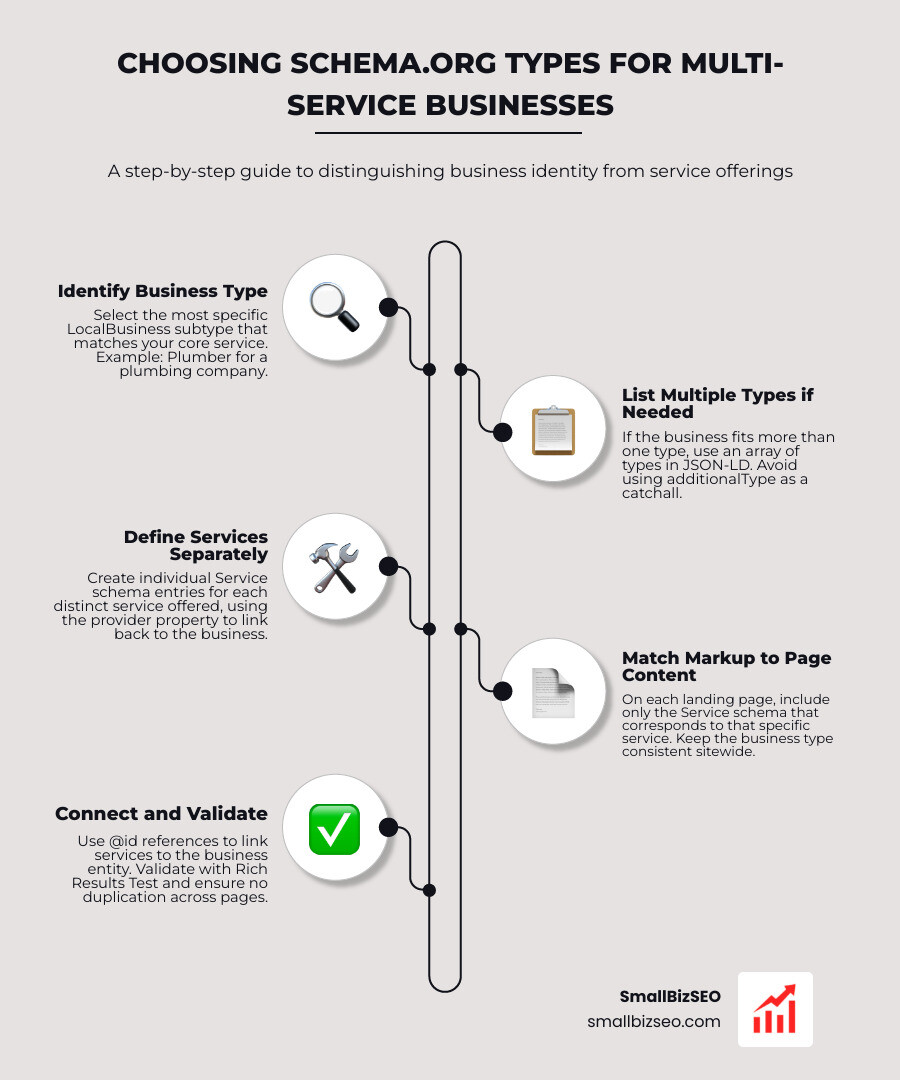
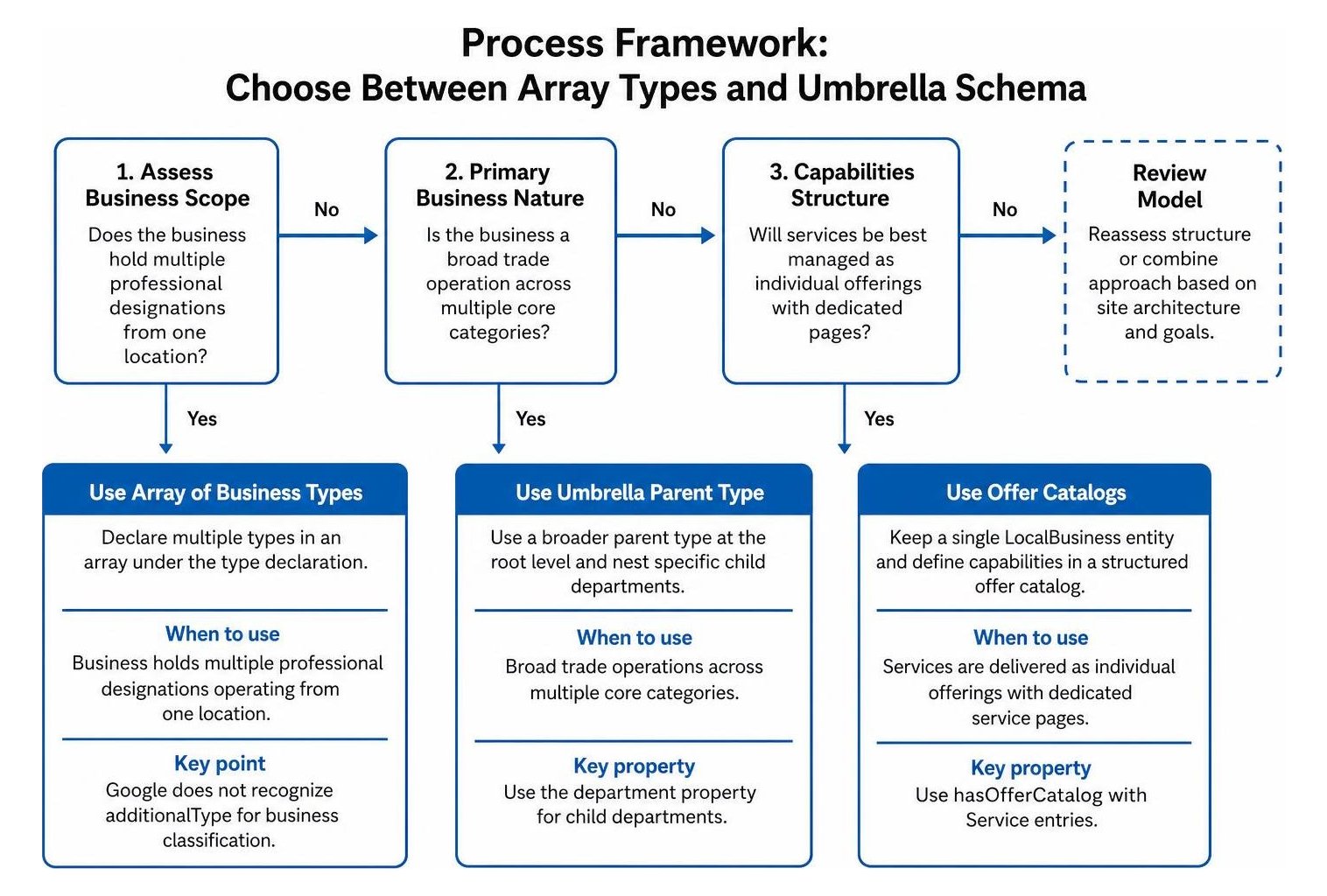
Here’s how to choose schema.org types for a business with multiple services: choose a type for what the business is, then describe what it does separately. A plumbing and HVAC company might use Plumber as its business type and add Service entries for heating, cooling, and drain cleaning. If more than one business type truly fits the same company, you can list those types together. Don’t use additionalType as a catchall for services.
Keep the business identity consistent across your site, but make each page’s service markup match what that page actually covers. That gives search engines a clearer picture without making every page look the same.
I’m Clayton Johnson, founder of SmallBizSEO. I draw on my work in technical SEO and content strategy to explain how to choose schema.org types for a business with multiple services.
How to Choose Schema.org Types for a Business with Multiple Services
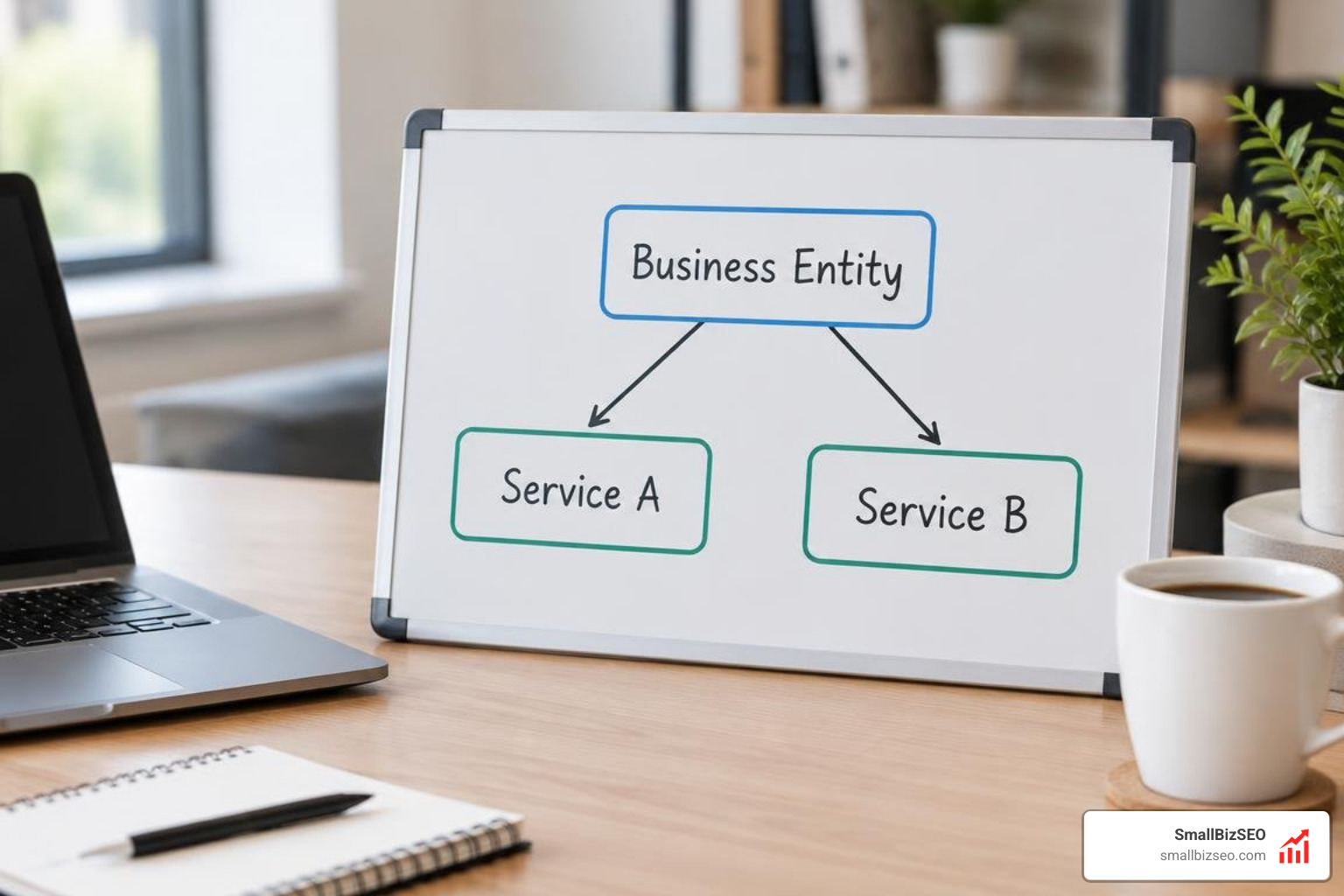
To structure data accurately for a company offering diverse capabilities, you must distinguish between who provides the work and what work is being performed. Getting this balance right builds the foundation of modern entity SEO, helping search engine knowledge graphs understand your organization without confusion.
| Aspect | Business Entity Type | Service Schema Type |
|---|---|---|
| Primary Question | What is the business entity? | What task or capability is delivered? |
| Core Schema Classes | LocalBusiness, HomeAndConstructionBusiness | Service |
| Key Properties | name, address, telephone, geo, openingHours | name, serviceType, provider, areaServed |
| Placement | Homepage and site-wide organization node | Dedicated service landing pages |
| Search Role | Establishes local identity and map placement | Defines capabilities and matches user intent |
What Is the Difference Between Business Entity Types and Service Types?
A business entity type represents your legal organization or commercial storefront, while a service type represents an individual capability you perform for clients.
The most common mistake webmasters make is treating services as business identities. Under the official definitions for LocalBusiness, the markup defines physical attributes like addresses, opening hours, and geo-coordinates. In contrast, the Service specification defines an intangible activity carried out by a provider.
The legacy ProfessionalService schema type is deprecated for primary classification. Modern implementations should choose a specific subtype under LocalBusiness. Rather than labeling an entire business as five separate business subtypes, define your single commercial entity and connect each capability using the makesOffer or hasOfferCatalog property, linking directly to distinct Service entities.
How to Choose Schema.org Types for a Business with Multiple Services Across Core Categories
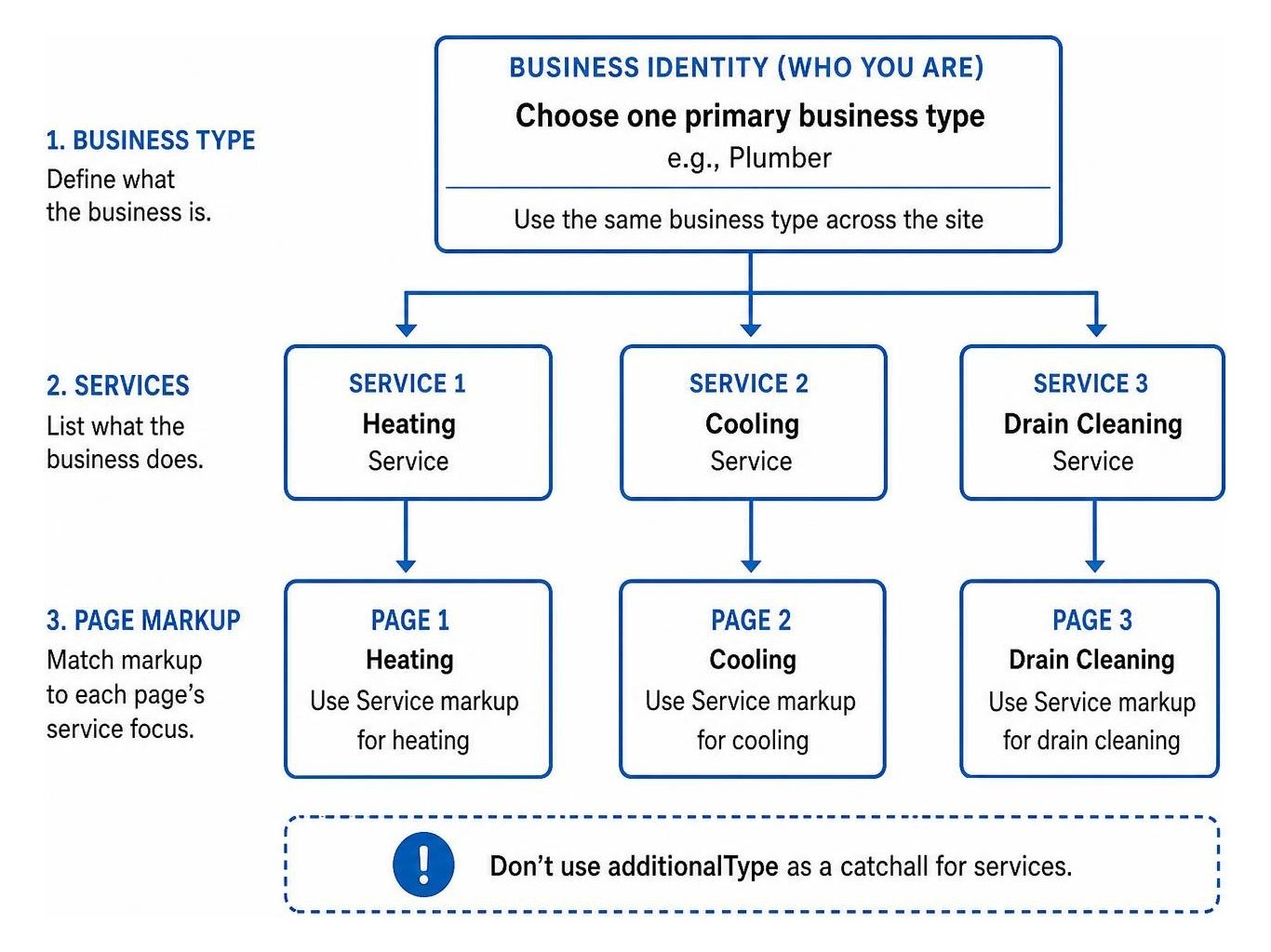
When a company operates across multiple trades—such as a contractor handling roofing, plumbing, and electrical work—you have two valid paths based on official guidelines for Local Business structured data:
- Use an Array of Business Types: If a company genuinely holds multiple professional designations operating from one counter, declare an array under the type declaration (for example, combining Electrician, Plumber, and Locksmith). Google does not recognize
additionalTypefor business classification. - Use an Umbrella Parent Type: For broad trade operations, use a broader parent type such as
HomeAndConstructionBusinessat the root level, then nest specific child departments using thedepartmentproperty. - Use Offer Catalogs: Keep a single primary LocalBusiness entity and define specific capabilities inside a structured
hasOfferCatalognode containing individual Service entries.
How to Choose Schema.org Types for a Business with Multiple Services Offering Products and Hybrid Work
Hybrid businesses provide both physical merchandise and hands-on labor—such as a hot tub retailer that also installs and repairs spa equipment.
For hybrid business models:
- Use
makesOfferto connect your organization to both tangible goods and labor. - Point to
Productwhen a purchasable item has physical dimensions, SKU, inventory status, and checkout capability. - Point to
Servicewhen describing maintenance, installation, or consultations. - Product markup unlocks e-commerce rich results like price and in-stock badges, whereas service markup focuses purely on machine readability for search engines and AI answer engines. Keep price strings concise and strictly under one hundred characters to avoid parsing errors.
Connecting and Implementing Your Multi-Service Schema Architecture
A robust structured data setup connects your website's pages into a single machine-readable graph rather than pasting disconnected code blocks on every URL.

Essential Validation Checks for Multi-Service Schema
- Unique
@ididentifier assigned to the main business entity on the homepage. - Minimal reference stubs used on child service pages instead of duplicating full business details.
- Dedicated
Servicenodes assigned as themainEntityon corresponding landing pages. - Accurate
areaServedvalues mapped using administrative areas or geographic coordinates. - Strict validation passing on both syntax validators and rich snippet testing suites.
How Should You Structure Nested Services on Individual Landing Pages?
Instead of repeating your full business address, phone number, and operating hours on every single URL, establish your primary entity on the homepage with a unique @id URI.
On individual service URLs, implement our recommended local landing page strategy: create a dedicated service schema node as the page's mainEntity, then point its provider property back to your homepage entity ID. Define the target market on these pages using the areaServed property, specifying precise municipal areas or geographic coordinates without duplicating NAP data everywhere.
How Do You Validate Multi-Service Structured Data for Search and AI?
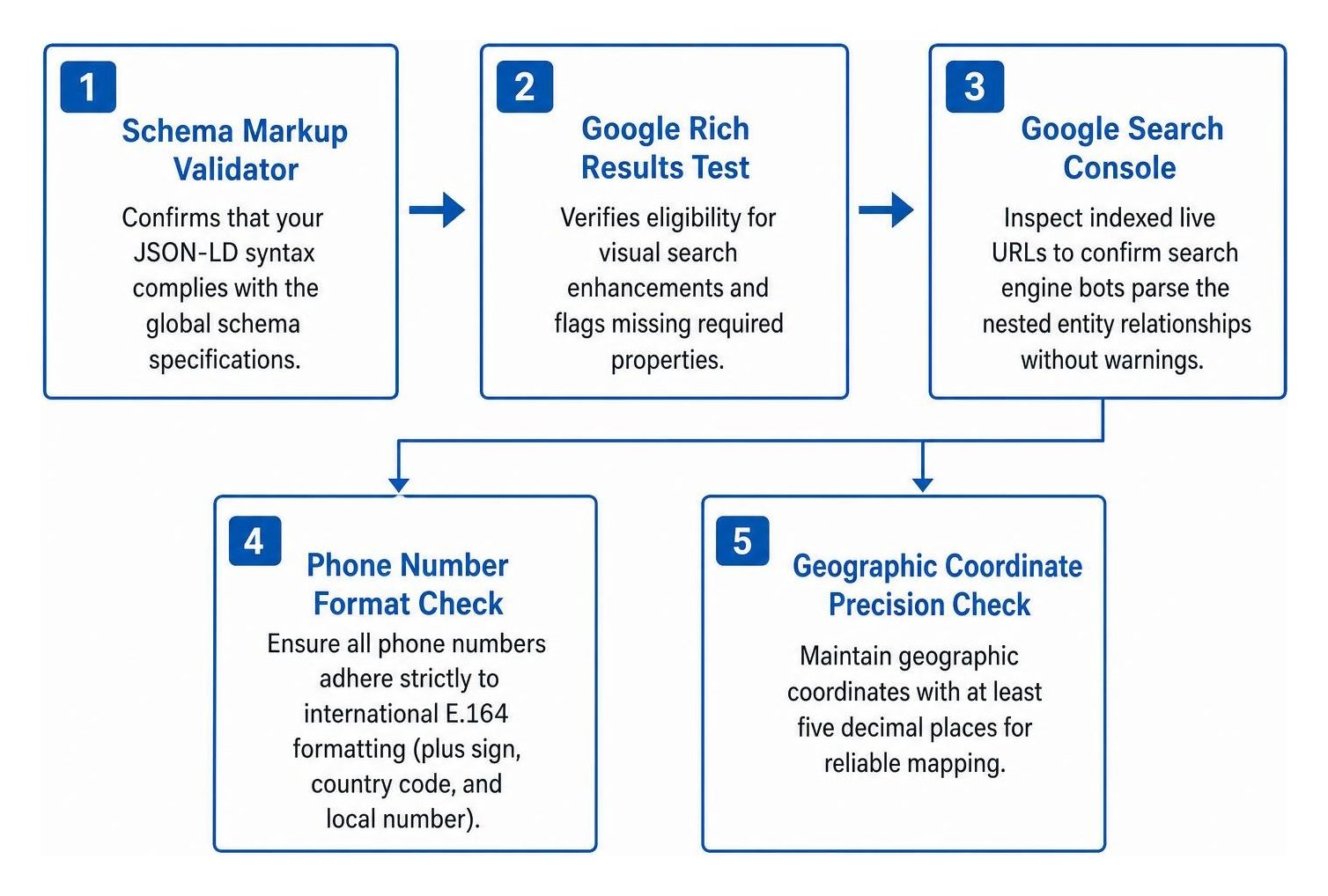
Validating your structured data requires checking both basic code syntax and search engine eligibility:
- Schema Markup Validator: Confirms that your JSON-LD syntax complies with the global schema specifications.
- Google Rich Results Test: Verifies eligibility for visual search enhancements and flags missing required properties.
- Google Search Console: Inspect indexed live URLs to confirm search engine bots parse the nested entity relationships without warnings.
Ensure all phone numbers adhere strictly to international E.164 formatting (such as plus sign, country code, and local number) and maintain geographic coordinates with at least five decimal places for reliable mapping. Clean structured data represents a critical step in sound technical SEO, ensuring AI search systems and answer engines accurately surface your business capabilities.
Power Your Structured Data Strategy with SmallBizSEO
Structuring schema markup across multiple service lines can quickly become technically demanding. Our team applies our proven Velocity framework to deliver clean, fully compliant structured data that boosts your search footprint and builds lasting topical authority. Explore our professional SmallBizSEO schema markup services to turn your service offerings into an organized, high-performing entity graph.