A Data-Driven Guide to Benchmarking Competitors in AI Search

How Do You Choose Competitors for an AI Share of Voice Benchmark?
If you’re asking how to choose competitors for an ai share of voice benchmark, start with the brands AI tools actually name, not just the sites that outrank you in Google.
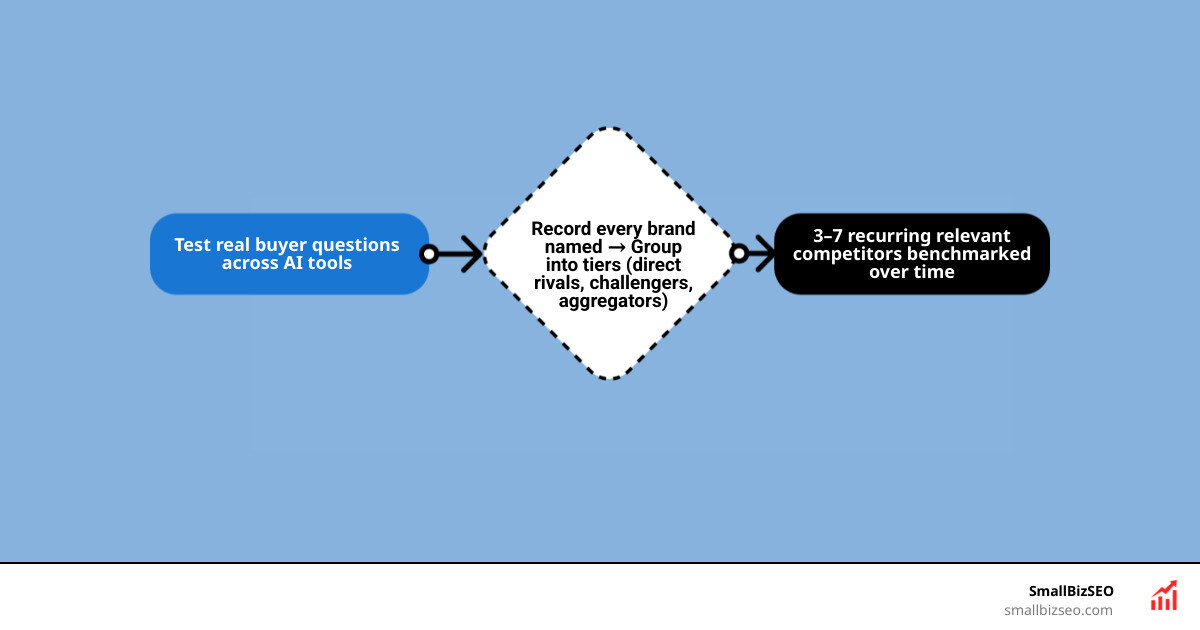
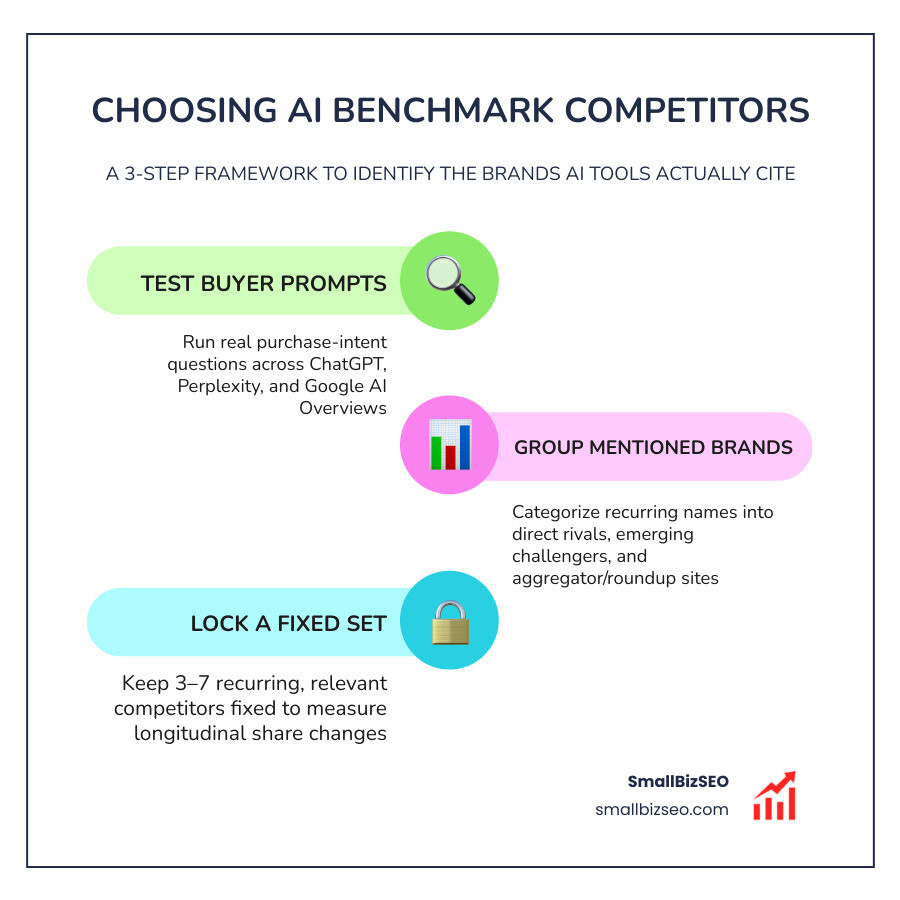
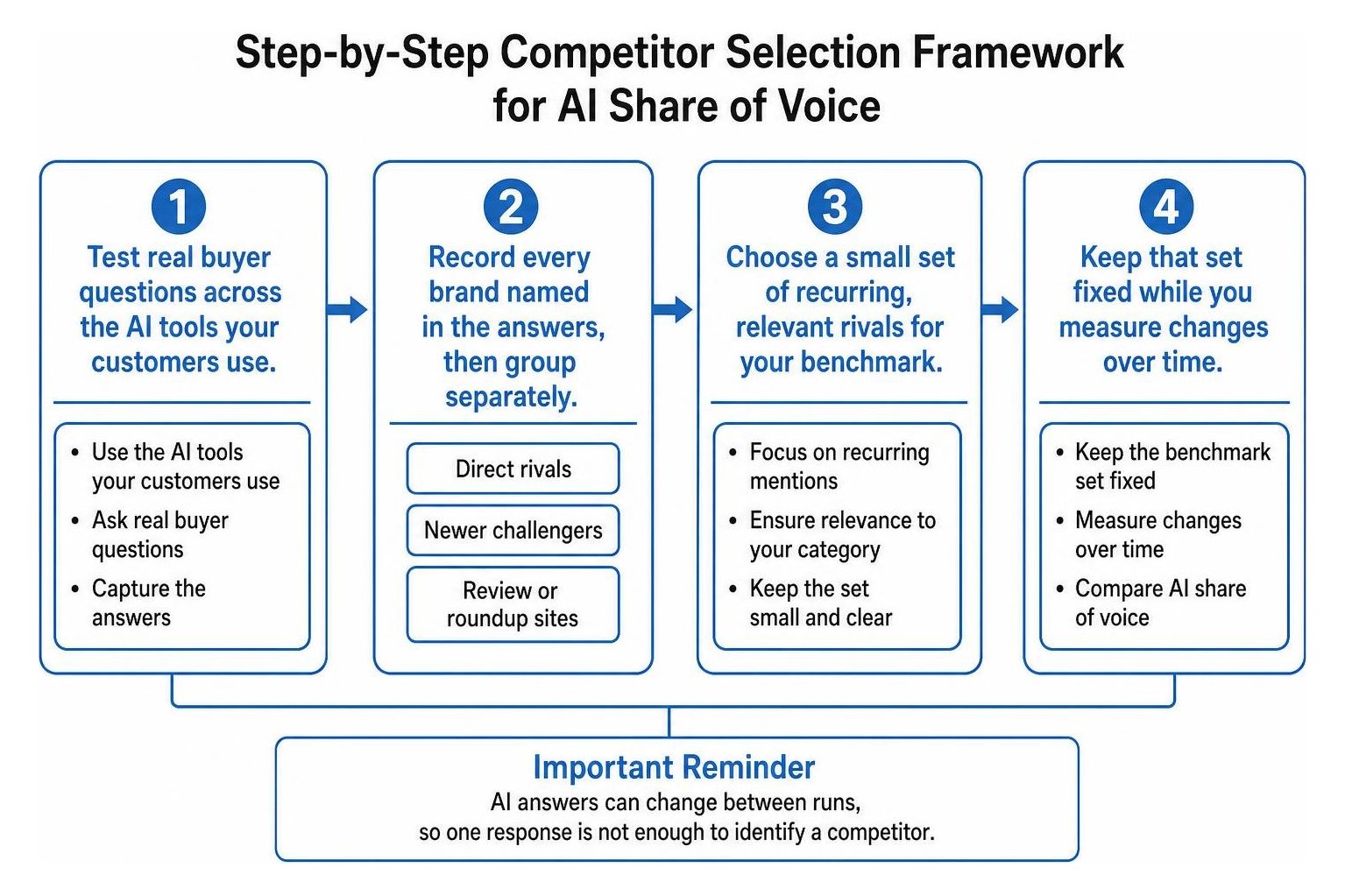
- Test real buyer questions across the AI tools your customers use.
- Record every brand named in the answers, then group direct rivals, newer challengers, and review or roundup sites separately.
- Choose a small set of recurring, relevant rivals for your benchmark. Keep that set fixed while you measure changes over time.
AI answers can change between runs, so one response is not enough to identify a competitor.
I’m Clayton Johnson, founder of SmallBizSEO. My work connecting SEO, content, and AI-generated answers shapes how to choose competitors for an ai share of voice benchmark around the questions buyers actually ask.
Introduction: Why AI Competitive Benchmarking Requires a New Playbook

Measuring ai share of voice requires a fundamentally different strategy than traditional rank tracking because generative engines do not provide ten blue links. In generative search, visibility is zero-sum: large language models synthesize web data to recommend a tightly curated list of three to five brands per answer.
When your brand earns a slot in that synthesis, a rival loses one. Platforms like ChatGPT engage over 800 million weekly active users, while Google AI Overviews reaches over 2.5 billion users each month. Furthermore, 58% of consumers have replaced traditional search engines with generative AI for product recommendations, and 73% of B2B buyers now use AI assistants during their vendor evaluation process.
This audience is also exceptionally high intent. According to industry research, AI-referred visitors convert at 4.4 times the rate of traditional organic search visitors. Reviewing traffic and conversion benchmarks for ai search versus google confirms that conversational citations drive direct pipeline value rather than superficial traffic. Because AI answers are probabilistic—meaning models generate slightly different text each time—establishing a reliable benchmark requires understanding the mechanics of conversational brand extraction.
How to Choose Competitors for an AI Share of Voice Benchmark: A Step-by-Step Selection Framework

To build a reliable benchmark, you must systematically identify which entities consistently displace your brand inside generative answers. A robust competitive audit begins with baseline prompt auditing, answer-engine entity extraction, and continuous ai visibility measurement. Implementing sound aeo ensures your brand's digital assets are structured so that generative engines easily understand your relationship to core category queries. Reviewing How to Increase Your AI Share of Voice: A Competitive Playbook | Am I Cited shows that winning generative visibility is about actively claiming space within answer engines rather than passively tracking standard SERPs.
Why Your AI Competitors Differ from Traditional Organic Search Rivals
Your primary search engine optimization competitors often look nothing like the entities dominating conversational answers. Traditional organic search relies on keyword targeting and direct backlink authority. In contrast, generative models use vector proximity, knowledge graph adjacency, and entity co-occurrence to determine which brands appear in an answer capsule.
Research shows that only 11% of domains are cited by both ChatGPT and perplexity. Furthermore, only 44.3% of URLs in Google's traditional top ten appear within google ai mode responses. If an emergent company publishes structured, highly extractable content, AI engines will frequently cite them over legacy market leaders. Understanding why generative search engines keep changing their top brand picks reveals that structural eligibility, clear data tables, and consensus across digital communities dictate conversational recommendations. Following a structured guide like Benchmark AI Visibility Against Competitors: A Guide | DeepSmith helps clarify how engine architectures prioritize structured sources over raw domain authority.
How to Choose Competitors for an AI Share of Voice Benchmark Across Three Distinct Tiers
To build an accurate competitor set, segment candidate brands into three functional tiers rather than lumping all search rivals into a single bucket. Examining ai brand recommendation data reveals surprising gaps for challengers, demonstrating that distinct competitor types require different optimization strategies.
- Primary Direct Competitors: Businesses offering the same core solution to an identical ideal customer profile. These companies compete directly for commercial and transactional prompts.
- Secondary Challengers: Fast-moving disruptors, niche specialists, or adjacent alternatives that answer engines frequently suggest for specialized use cases.
- Third-Party Aggregators: High-authority directories, publisher roundups, and forums like Reddit. While not commercial vendors, they dominate citation slots and shape the consensus models rely on.
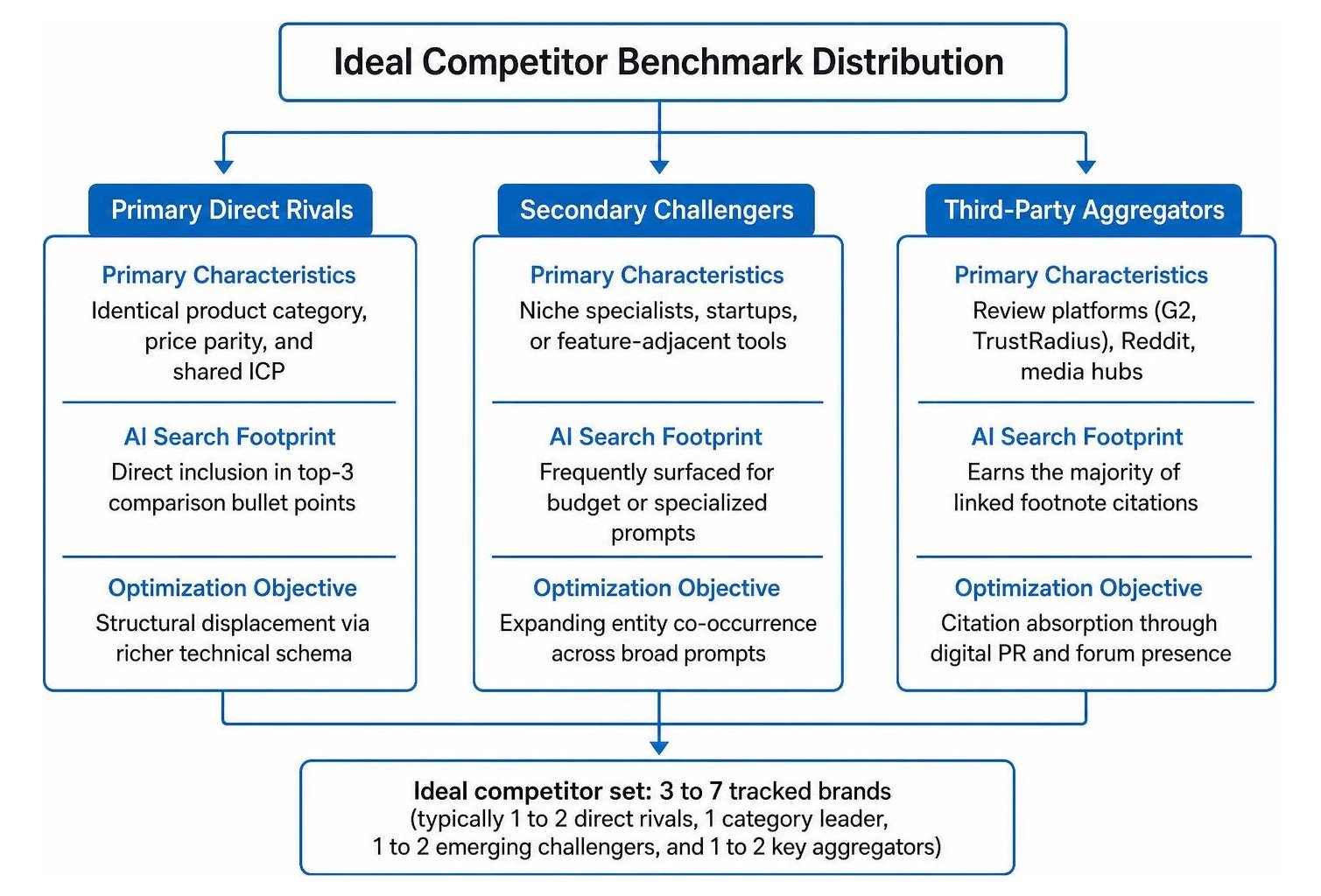
| Competitor Tier | Primary Characteristics | AI Search Footprint | Optimization Objective |
|---|---|---|---|
| Primary Direct Rivals | Identical product category, price parity, and shared ICP | Direct inclusion in top-3 comparison bullet points | Structural displacement via richer technical schema |
| Secondary Challengers | Niche specialists, startups, or feature-adjacent tools | Frequently surfaced for budget or specialized prompts | Expanding entity co-occurrence across broad prompts |
| Third-Party Aggregators | Review platforms (G2, TrustRadius), Reddit, media hubs | Earns the majority of linked footnote citations | Citation absorption through digital PR and forum presence |
Third-party aggregators absorb valuable citation space. When an answer engine recommends three software tools, it often pulls that consensus directly from forum threads or directory comparisons. Tracking aggregator displacement allows you to identify third-party pages that need proactive brand inclusion.
How to Choose Competitors for an AI Share of Voice Benchmark Using Prompt Discovery and Validation
Competitor selection should never rely on assumptions. You must discover and validate competitors by running dynamic prompt discovery across multi-engine test environments. Analyzing real user prompt data shows what people actually ask chatgpt daily reveals that real buyers rarely enter isolated keywords; they submit conversational questions spanning problem investigation, feature comparisons, and pricing inquiries.
To validate genuine category competitors, examine multiple operational data sources:
- Conversational Prompt Audits: Run multi-turn buying queries across major answer engines and record every brand returned.
- Web Analytics Referral Attribution: Audit your analytics platform for referral paths originating from AI engines to identify which platforms generate qualified sessions.
- Knowledge Graph Entity Mapping: Use entity extraction tools to analyze how closely search engines associate candidate brands with your target category node.
- Multi-Query Citation Consistency: Identify domains earning citations across four or more related prompts. Research shows that domains ranking across four or more related queries achieve 87% to 100% citation rates, compared to just 33.8% for single-query domains.
For advanced technical measurement, How to Measure AI Citation Share of Voice in 2026 outlines how semantic structural feasibility and entity co-occurrence shape competitive visibility.
How Many Competitors Should You Track to Balance Signal and Noise?
The ideal competitor set contains 3 to 7 tracked brands (typically 1 to 2 direct rivals, 1 category leader, 1 to 2 emerging challengers, and 1 to 2 key aggregators). Tracking fewer than 3 brands creates an artificially narrow benchmark, exaggerating your visibility rate while blinding you to market shifts. Tracking more than 7 brands introduces noise that dilutes actionable trends.
Testing prompts multiple times is essential for statistical reliability. Experiments from SparkToro show a less than 1-in-100 chance of ChatGPT or Google returning the exact same ordered brand list across repeated runs of an identical prompt. Because outputs are probabilistic, running prompts across multiple iterations and calculating average mention rates removes random variance.
Maintaining and Recalibrating Your AI Share of Voice Benchmark Over Time

A benchmark is only valuable if it provides a consistent baseline for decision-making. As generative engines evolve, tracking how your competitors perform across the most cited content categories across leading ai platforms allows you to execute precise content adjustments. At SmallBizSEO, our data-driven Velocity framework uses automated reporting to turn visibility gaps into high-converting technical and content enhancements.
Why a Fixed Competitor Set Protects Longitudinal Data Integrity
Once you establish your benchmark competitor set, keep it fixed for the entire measurement cycle. The basic AI share of voice calculation divides your brand's total mentions by the sum of all tracked brand mentions across a fixed prompt set:
AI Share of Voice = (Your Brand Mentions / Total Mentions of All Tracked Brands) × 100
If you add or remove a competitor mid-cycle, you change the total mentions in the denominator, destroying your historical comparisons. Digital Applied found that 40% to 60% of cited domains in active categories shift monthly. Keeping your benchmark set constant allows you to isolate whether your score changed because of your content improvements or underlying engine volatility.
How Often Should You Audit and Update Your Competitor Benchmark?
Establish a structured, multi-tier cadence to monitor and adjust your competitive benchmarks without disrupting your data:
- Weekly Spot-Checks: Test your top 10 to 15 high-intent commercial prompts to detect sudden visibility changes.
- Monthly Audits: Run your complete prompt library across all tracked engines to evaluate monthly share of voice trends.
- Quarterly Recalibration: Review the competitive landscape, identify new market entrants, archive obsolete tools, and establish a new baseline calculation.
To dive deeper into multi-platform tracking routines, How to Track Your Brand’s Citation Share in AI Search (ChatGPT, Perplexity, Gemini, and AI Overviews) provides comprehensive operational steps.
Frequently Asked Questions
What is the difference between AI visibility rate and AI share of voice?
AI visibility rate measures the percentage of prompt responses that mention your brand at least once. AI share of voice measures your total brand mentions divided by the total mentions across all tracked competitors, reflecting your overall share of conversational recommendations.
Can I measure AI share of voice using traditional SEO tools?
Traditional SEO tools track static search engine rankings based on keyword position and backlink metrics. AI share of voice requires prompt-level testing across conversational models to evaluate synthesized brand mentions, sentiment, and direct source citations.
Why does a competitor appear in AI answers if they rank poorly on Google?
Generative engines prioritize clear structure, entity clarity, and consensus across digital communities. A competitor with lower domain authority can earn top AI citations if their pages feature structured tables, schema markup, and strong sentiment across review platforms.
Turning Competitive AI Benchmarks into Measurable Market Share
Benchmarking your competitive position in AI search is not a one-time project. It is an ongoing operational framework that reveals exactly how conversational engines evaluate, synthesize, and recommend your business to prospective buyers. By selecting a balanced group of 3 to 7 direct rivals, challengers, and aggregators—and locking that set across consistent prompt runs—you transform noisy conversational outputs into actionable business intelligence.
If you are ready to identify your true generative search rivals and expand your market footprint, explore our comprehensive ai share of voice benchmark services. Our team helps you turn technical and content gaps into consistent citation growth across every leading answer engine.