Real User Prompt Data Shows What People Actually Ask ChatGPT Daily

Real User Prompt Data Shows What People Actually Ask ChatGPT Daily
What Do People Actually Ask AI?
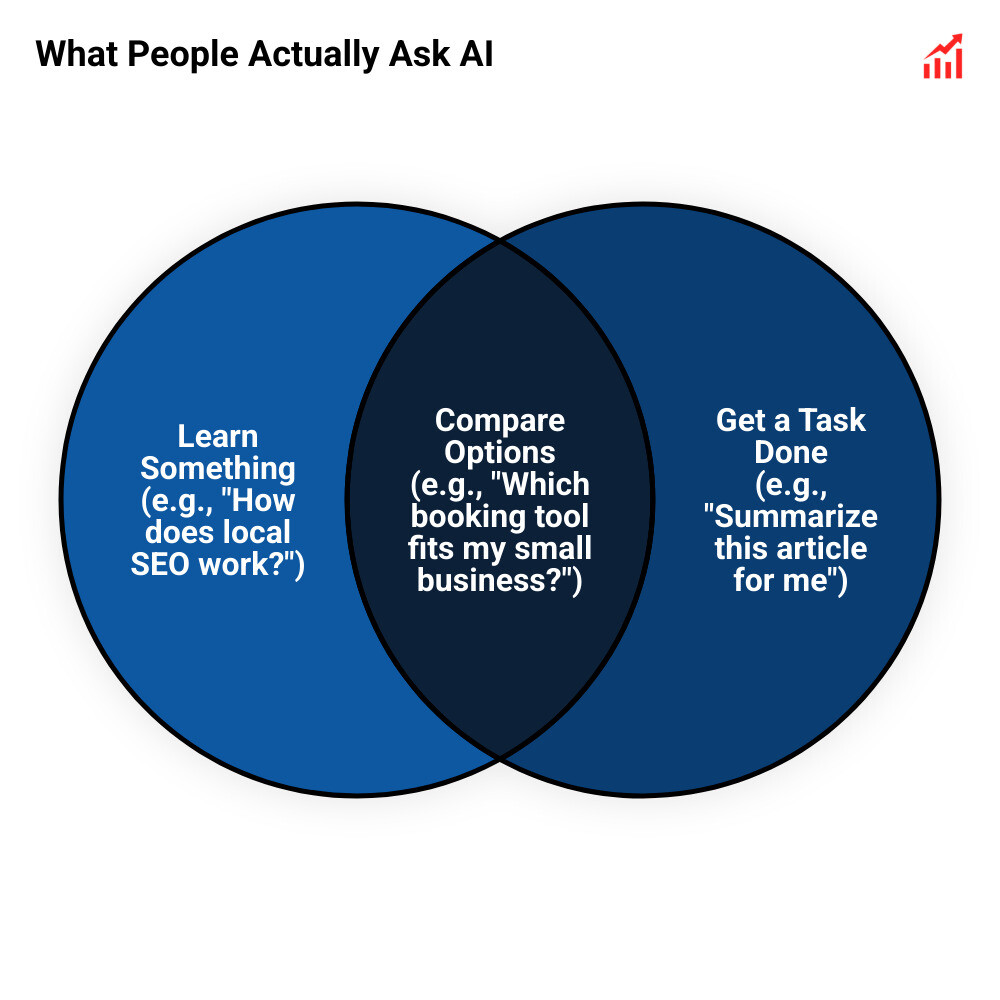
The most common questions people ask AI, along with search intent and prompt statistics, point to three needs: learn something, compare options, or get a task done. Someone might ask, "How does local SEO work?" or "Which booking tool fits my small business?" Unlike a short search keyword, an AI prompt can include the person's goal, budget, and other details.
That context matters for businesses: a page that answers the full question may be more useful than one that repeats a keyword. I'm Clayton Johnson, founder of SmallBizSEO. I draw on my SEO and content strategy work to explain The Most Common Questions People Ask AI: Search Intent and Prompt Statistics and what they mean for search visibility.
Quick look at The Most Common Questions People Ask AI: Search Intent and Prompt Statistics:
- AI Search Visibility by Industry: Which Businesses Appear Most Frequently in AI Answers?
- How Frequently Do AI Search Engines Change Their Recommendations? Citation Consistency Statistics
- ChatGPT Usage Statistics: Demographics, Popular Tasks, and Business Applications
Introduction: How Has Search Shifted from Keywords to Conversational Prompts?
Direct answer: Search has evolved from users entering fragmented keywords into a search bar to submitting rich, conversational prompts that describe complete problems, situational constraints, and desired formats.
For decades, searchers adapted their language to fit search algorithms. We typed disconnected strings like "best accounting software small business" or "plumber near me." Today, conversational interfaces allow users to express their complete context in natural language. A typical query might look like: "I run a boutique consulting firm with five employees; what simple invoicing tools integrate directly with QuickBooks and cost under fifty dollars a month?"
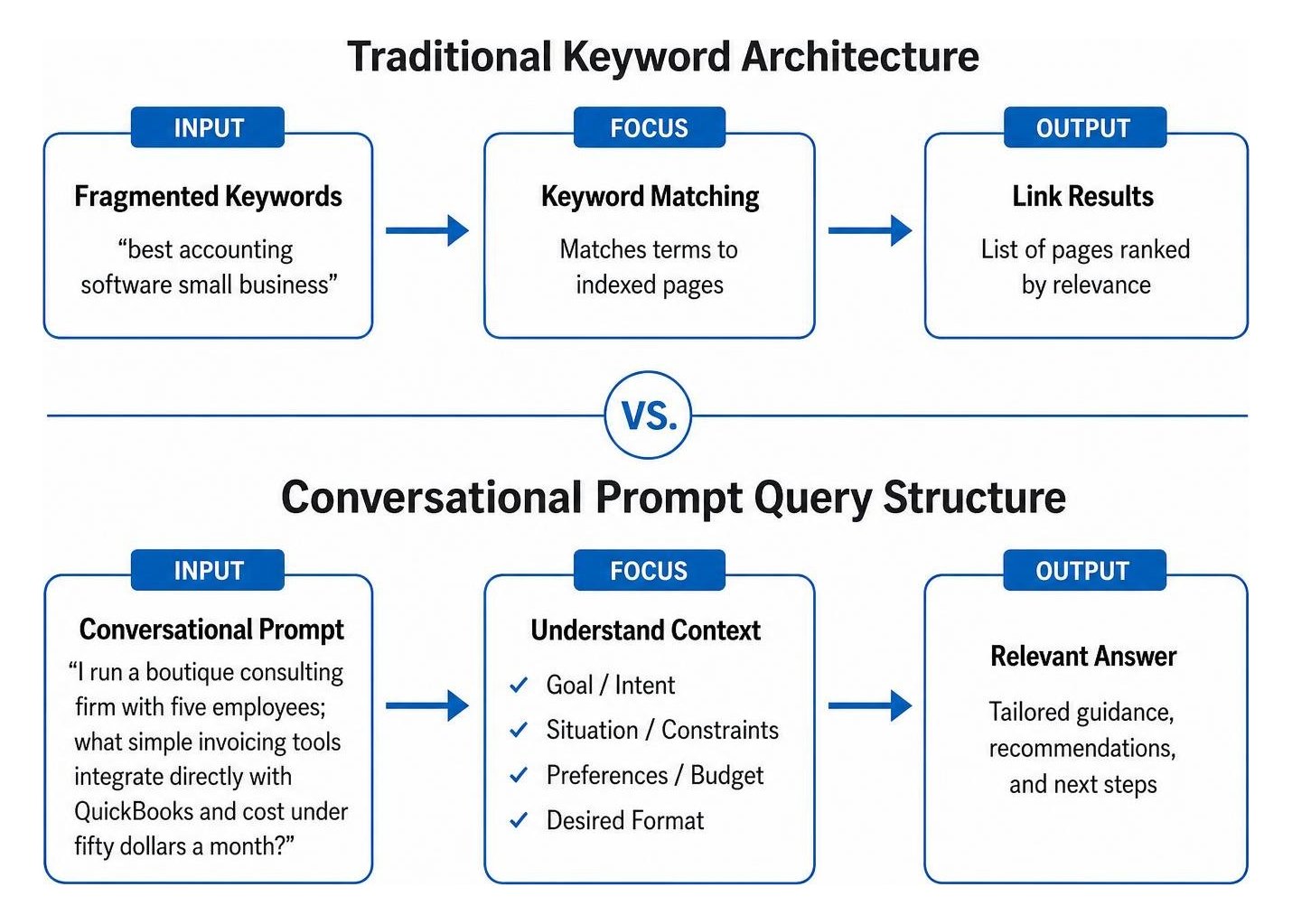
This evolution is reflected in overall query volumes. ChatGPT handles over 2 billion searches every single day, with between 10% and 15% of all web searches occurring directly inside AI search engines. Because users treat AI platforms as intelligent assistants rather than indexing catalogs, the structure of the input has changed completely.
What Are the Most Common Questions People Ask AI, and What Do Prompt Statistics Show?
Direct answer: AI prompts primarily cover generative creation, practical problem-solving, commercial product evaluation, and detailed information retrieval, shifting away from navigational web routing.
When analyzing millions of real-world interactions, user behavior divides across clear functional categories. Unlike standard search engines where the goal is frequently finding a specific URL, AI users seek synthesized answers and completed actions. Studies examining large-scale query sets reveal that conversational platforms serve as tools for direct execution rather than simple directories.
What Are the Most Common Questions People Ask AI Across Categories?
Direct answer: The most common prompt categories are generative requests (creating outlines, drafting copy, coding), informational inquiries, and comparison searches, while traditional navigational search has largely disappeared.
According to a comprehensive AI Search intent study: What 50M+ ChatGPT prompts reveal, generative intent represents the single largest category at 37.5% of all prompts. Users ask the engine to draft emails, summarize documents, debug code, or build custom project plans.
Traditional search metrics break down when applied to these conversational patterns. Informational requests make up 32.7% of AI prompts, while navigational queries (typing a brand name simply to find its website) have dropped from 32.2% in traditional search down to just 2.1% in AI search. Transactional intent has grown ninefold to 6.1%, as users instruct models to perform concrete operational steps. Furthermore, roughly 12.1% of queries represent "No Intent" conversational glue—such as "please," "thank you," or clarifying follow-ups that shape downstream responses.
| Intent Category | Traditional Google Search Share | ChatGPT Prompt Share | Primary User Objective |
|---|---|---|---|
| Generative | ~0.0% | 37.5% | Content creation, code writing, asset synthesis |
| Informational | 52.7% | 32.7% | Deep research, concept explanation, troubleshooting |
| Conversational / Glue | 0.0% | 12.1% | Dialogue management, polite prompts, follow-ups |
| Commercial | 14.5% | 9.5% | Product comparisons, feature evaluation |
| Transactional | 0.6% | 6.1% | Direct execution, drafting action items, workflows |
| Navigational | 32.2% | 2.1% | Direct URL lookup or website navigation |
To see how these broad trends impact everyday operations, review our compilation of 50 generative AI statistics every business owner should know.
How Do Real User Prompts Differ from Traditional Keywords and Synthetic Queries?
Direct answer: Real user prompts are significantly longer, rich in personal pronouns, heavily problem-oriented, and often missing from standard keyword search volume databases.
When comparing real user data against synthetic or estimated queries, notable structural differences emerge. In a study titled I Analyzed 1827 Real User Prompts from ChatGPT - Here What I've Found: Agentic Search Will Be The New Hype, researchers discovered that real prompts average 15.1 words (with a median of 12), compared to estimated prompts which average just 8.8 words. Across the wider platform, ChatGPT prompts average approximately 60 words, whereas traditional Google queries average 3.4 words.
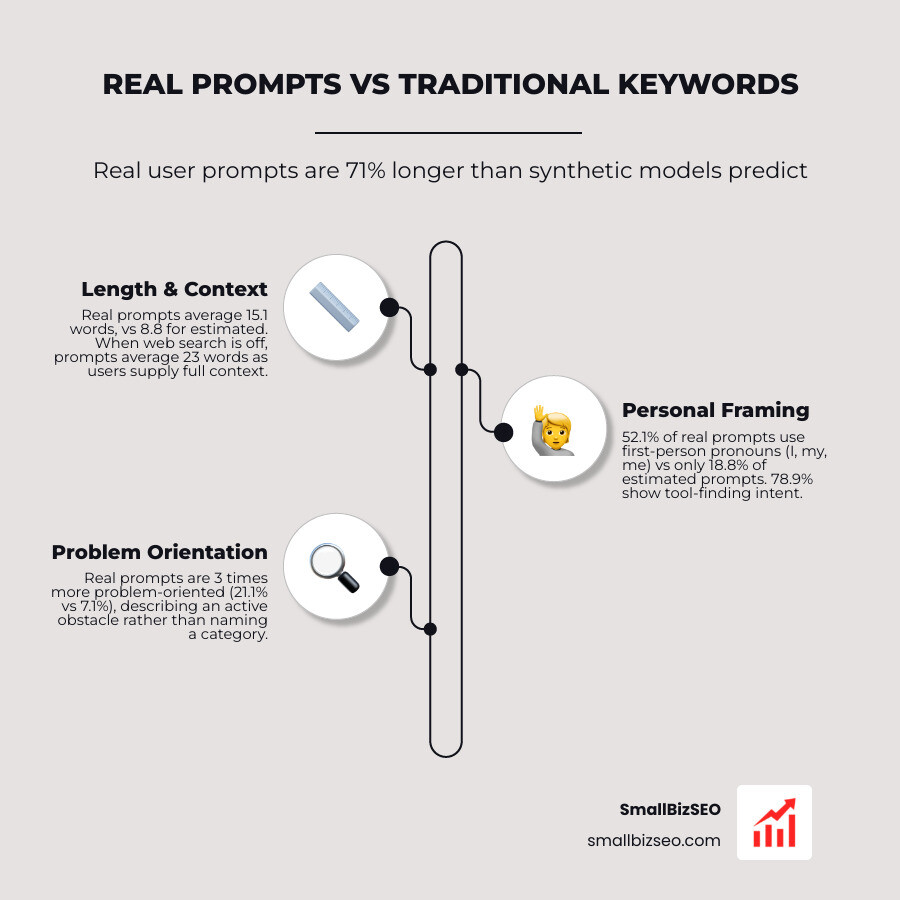
Real prompts are 71% longer than synthetic models predict. Between 65% and 85% of ChatGPT prompts have zero matching keywords in standard SEO databases. When reviewing crucial ChatGPT usage statistics and demographics you should know, the language itself highlights this personal framing:
- 52.1% of real prompts use first-person pronouns ("I", "my", "me") versus only 18.8% of estimated prompts.
- 78.9% of real user prompts exhibit tool-finding and solution-seeking intent (compared to 62.5% of synthetic queries).
- Real prompts are 3 times more problem-oriented (21.1% vs 7.1%), describing an active obstacle rather than naming a category.
- When web search is turned off, prompts average 23 words as users supply full context, compared to 4.2 words when users expect the model to browse the live web.
The most common starting words in real user prompts reflect this exploratory, task-based approach:
- What (definitions, recommendations, scoping parameters)
- How (processes, step-by-step guides, troubleshooting workflows)
- I (first-person scenario framing, problem setting)
- Write / Create (generative task execution)
- Can you (conversational task delegation)
- Best (filtered commercial discovery)
How Do AI Engines Expand Questions into Searches, and Why Can Citations Change?
Direct answer: AI engines use query fan-out to decompose a single prompt into multiple discrete sub-queries, producing unpredictable citation drift across repeated runs.
When a user submits a complex question, modern AI search engines execute "query fan-out." Rather than running a single search, the model breaks the prompt into multiple background retrieval requests. An AI query triggers 10 to 16 times more retrieval events than an equivalent keyword search.
Research into why query intent still matters in AI search and how each engine has reshaped it shows that underlying systems handle this fan-out process with distinct retrieval behaviors.
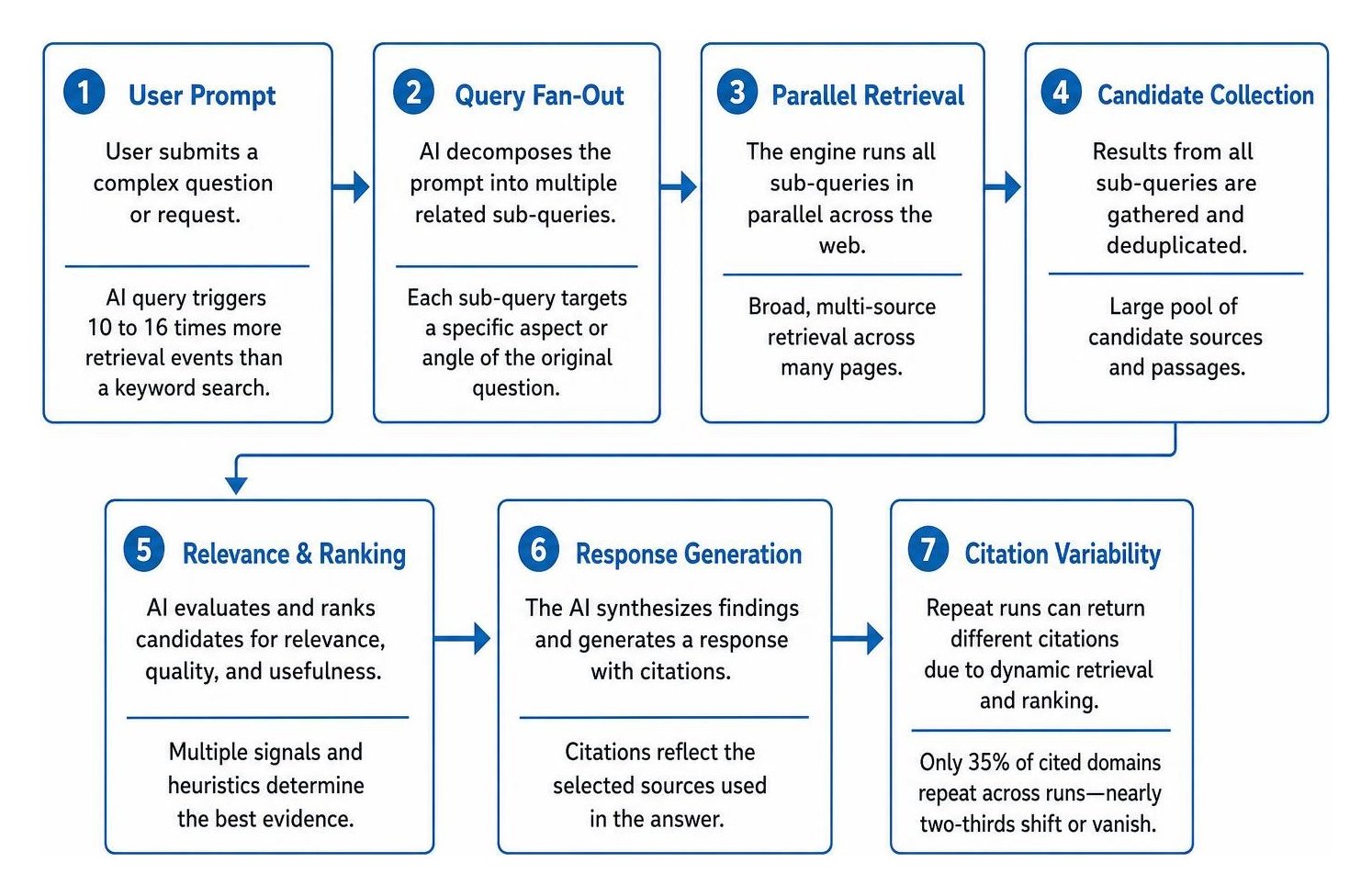
Furthermore, citation drift is a major challenge for brand tracking. On average, only 35% of cited domains repeat across multiple runs of the same prompt, meaning nearly two-thirds of citations vanish or shift between identical query executions. Understanding why certain industries get cited by AI models twice as often requires examining how each platform reconstructs user input:
| AI Engine | Query Uniqueness Rate | Word Overlap with Original Prompt | "Best [Product]" Stability Rate | Core Retrieval Pattern |
|---|---|---|---|---|
| ChatGPT | 91% (nearly always unique) | 13% | 39% | Broad researcher; reformulates prompt dynamically |
| Perplexity | 14% (highly repetitive) | 88% | 65% | Classic search; preserves original keyword syntax |
| Microsoft Copilot | 47% (moderate variation) | 50% | 52% | Query compressor; condenses prompts into keywords |
How Do People Use AI to Discover and Compare Products?
Direct answer: Consumers use AI to evaluate commercial options through complex multi-constraint comparisons, leading to higher zero-click rates but significantly greater conversion value for cited brands.
Product discovery has shifted noticeably toward generative tools. Industry data from how to do prompt research for AI SEO shows that 35% of consumers use AI tools during the product discovery stage, compared to 13.6% who use traditional search engines. AI holds a 2-to-1 usage advantage across every stage of the modern purchase journey.
However, the nature of visibility is fundamentally different. When an AI summary appears, organic click-through rates on search pages drop from 15% to 8%. AI Overviews appear on 36% of informational queries, 8% of commercial queries, and 5% of transactional queries. Yet for comparison-format queries (such as "Brand A vs Brand B"), AI summaries trigger 95.4% of the time.
While zero-click experiences are frequent, the commercial payoff for being cited is massive. Brands cited within AI Overviews earn 35% more organic clicks and 91% more paid clicks than uncited competitors on the exact same search queries. Understanding these mechanics is essential when navigating the future of search and LLM visibility tools.
How Can Businesses Improve Their Visibility in AI-Generated Results?
Direct answer: Businesses can improve visibility by structuring content around problem-solving frameworks, implementing comprehensive entity markup, answering sub-queries directly, and actively monitoring citation drift.
To capture visibility across modern AI search engines, companies must adapt their optimization models away from exact-match keywords toward comprehensive entity and intent coverage:
- Structure Content Around Intent Fan-Out: Because AI engines break prompts into seven primary sub-query types (definitions, comparisons, how-to steps, use cases, objections, entity expansions, and metrics), your content must answer these sub-questions within distinct, clear sections.
- Implement Answer-Ready Formatting: Use direct answers at the top of informational pages, clear subheadings, and structured data tables. AI models quote concise, factual summaries that directly solve a user's stated problem.
- Optimize for High-Stability Formats: Frame comparison assets and category guides around "best [service/product]" concepts, as these structures demonstrate the highest keyword retention rates across all major AI engines.
- Track Conversational Citations: Regularly audit where and how your brand appears across ChatGPT, Perplexity, and Copilot to catch citation drift early and identify missing sub-topic coverage.
At SmallBizSEO, our specialized AI SEO services and citation optimization help businesses build structured, authoritative digital footprints designed to win consistent citations in generative AI responses.
Key Steps to Win Brand Visibility in AI Search
As conversational interfaces become the primary starting point for consumer discovery and research, winning search visibility requires understanding real user intent. Users do not think in fragmented keywords—they ask detailed questions, outline complex scenarios, and demand immediate, synthesized solutions.
By aligning your digital content with the seven dimensions of query fan-out, providing structured direct answers, and maintaining robust entity authority, you can ensure your business remains recommended, referenced, and cited across every major AI platform.