A Practical Guide to Verifying Industry Citations and Supplier Directory Listings
How Can You Verify Company Citations on Supplier and Trade-Association Websites?
To verify company citations on supplier and trade-association websites, start by harvesting all profile URLs for the supplier, then cross-reference each listing against official registries and directories, and finally audit the supplier's structured schema markup for consistency. This process confirms that a supplier holds active, legitimate operational credentials rather than displaying outdated badges. Displaying a trade association logo on a corporate homepage does not prove that a company is an active member or that it complies with industry standards.
When evaluating potential manufacturing partners, procurement teams must distinguish between capability proof and simple fee payments. Roughly 93% of Fortune 1000 buyers rely on major industrial sourcing networks like Thomasnet to discover suppliers, making third-party accuracy essential for request-for-proposal (RFQ) qualification. Furthermore, transparency research indicates that 47% of brands disclose their manufacturing supply chain details, highlighting the growing demand for verifiable data.
Relying on unverified claims introduces operational and regulatory risks into your supply chain. An unverified supplier might list expired quality management certifications or misstate manufacturing capabilities, leading to compliance failures or delivery delays. Using the modern web directory strategy that actually improves search visibility, enterprise buyers and search platforms alike cross-reference public profiles against official registries like the trade associations directory search to establish genuine business legitimacy.
Which Core Company Details Should You Check, Including NAP, NAICS Codes, and Facility Identifiers?
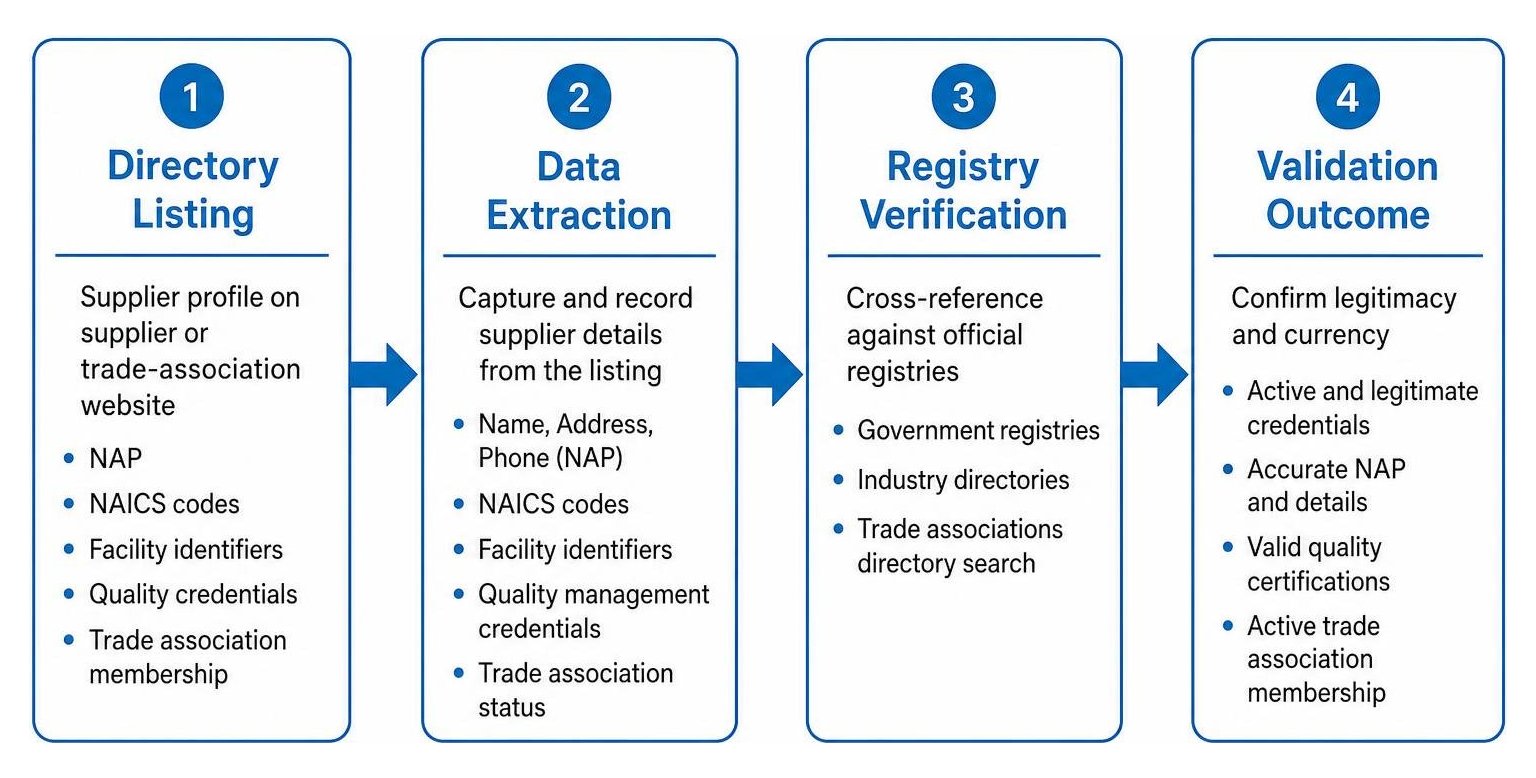
You must check a supplier's core Name, Address, and Phone Number (NAP), along with their North American Industry Classification System (NAICS) codes, facility identifiers, and quality management credentials. Inaccurate listings directly damage trust; research shows that 73% of customers lose confidence in a business when they encounter inconsistent directory details.
To conduct a thorough audit, cross-reference the supplier's website against government registries and industry directories using these checkpoints:
| Data Field | Verification Checkpoint | Primary Risk of Mismatch |
|---|---|---|
| Legal Business Name | State corporate entity filings, SAM.gov | Entity confusion, contract invalidation |
| Physical Facility Address | Google Maps, property tax records, MEP rosters | Routing errors, ghost facility claims |
| Direct Phone Number | Plant switchboard, local directory records | Communication failure, lost RFQs |
| NAICS / SIC Codes | Census database, federal procurement records | Misclassified capabilities, unqualified bidding |
| Quality Certifications | OASIS (AS9100), ISO registrars, Nadcap | Regulatory non-compliance, defective parts |
| Federal Identifiers (CAGE/UEI) | SAM.gov active registration database | Disqualification from government contracts |
Maintaining precise NAP consistency across external platforms is vital because search engines and procurement tools rely on these exact matches to establish organizational trust. Ensuring proper business citation data standards protects suppliers from losing high-value industrial contracts due to basic clerical errors.
You can verify citations by extracting all active listings, matching them against primary legal and certification databases, and logging discrepancies in a centralized audit sheet. This multi-source reconciliation process ensures your supply chain data reflects actual operational facts rather than unverified self-reporting.
How Can You Tell a Ghost Citation from a Verifiable Third-Party Source in AI Search?
A verifiable third-party source links directly to a live, authoritative registry or directory listing, whereas a ghost citation occurs when an AI engine summarizes source material without attributing the specific company behind the data. A study by Semrush revealed that 62% of citations in AI search results are ghost citations, leaving buyers with fragmented or unattributed information.
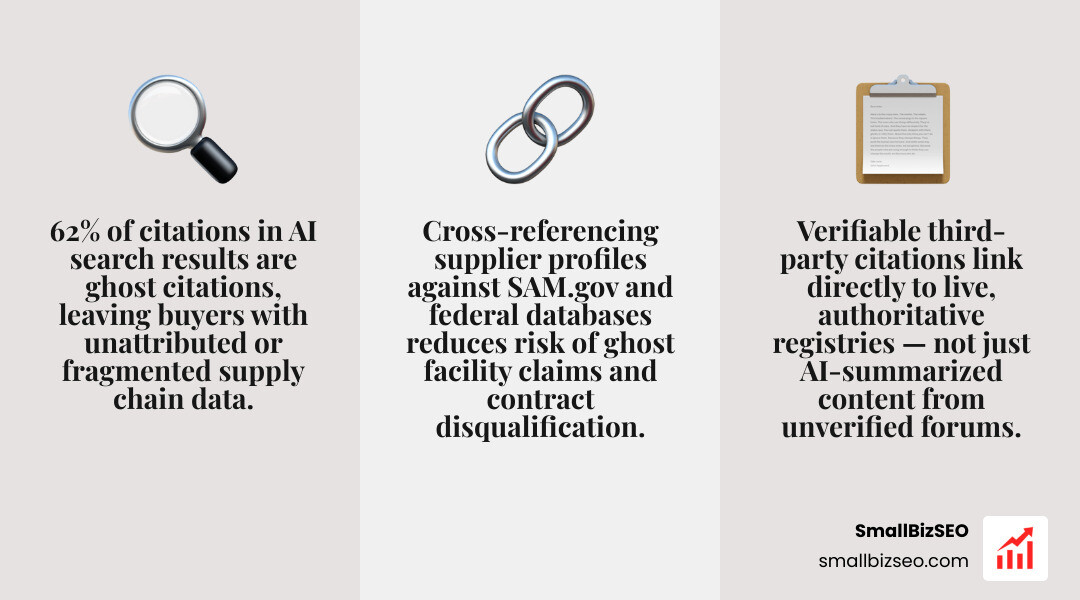
Because generative answer engines synthesize vast amounts of web content, they frequently blend unverified forum posts or lapsed directory profiles into their answers. When evaluating suppliers recommended by AI-driven procurement tools:
- Inspect Root Domains: Follow citations to their original source to confirm the organization is explicitly named and accurately described.
- Evaluate Link Attributes: Understand that even a nofollow link on a trusted association directory provides strong entity validation for search engines, helping when scoring the best local backlinks.
- Screen Against Federal Databases: Check high-risk entities directly against the Consolidated Screening List verification tool provided by international trade agencies.
What Steps Should You Follow to Verify Company Citations on Supplier and Trade-Association Websites?
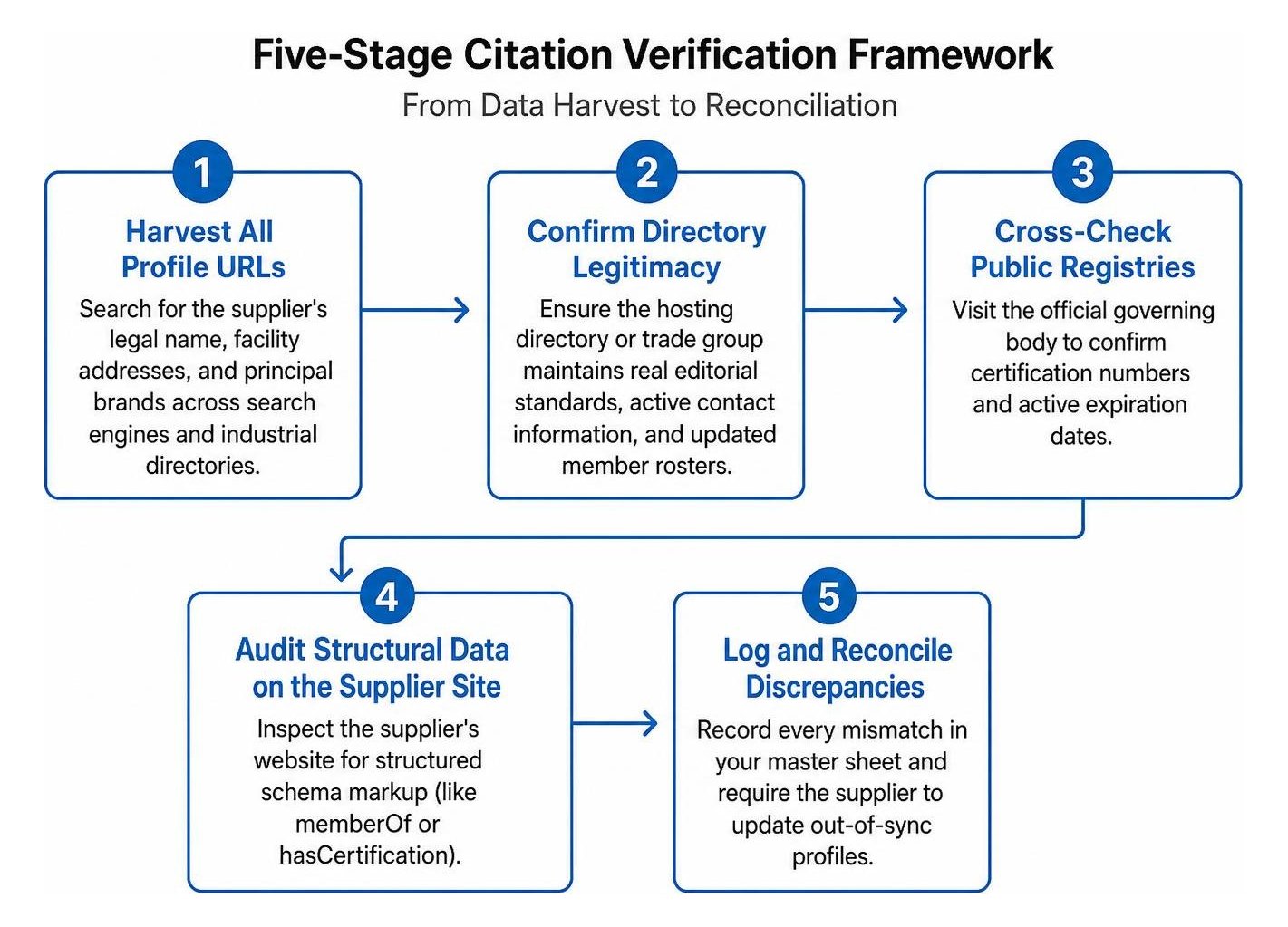
Follow this systematic five-step audit workflow to verify any supplier citation:
- Harvest All Profile URLs: Search for the supplier's legal name, facility addresses, and principal brands across search engines and industrial directories using advanced search operators (such as
site:thomasnet.com "Company Name"). - Confirm Directory Legitimacy: Ensure the hosting directory or trade group maintains real editorial standards, active contact information, and updated member rosters.
- Cross-Check Public Registries: Visit the official governing body (for example, the IAQG OASIS database for aerospace suppliers or state licensing boards) to confirm certification numbers and active expiration dates.
- Audit Structural Data on the Supplier Site: Inspect the supplier's website for structured schema markup (like
memberOforhasCertification) that connects their domain to verified third-party directories. - Log and Reconcile Discrepancies: Record every mismatch in your master sheet and require the supplier to update out-of-sync profiles before procurement approval.
Using structured workflows from our comprehensive local SEO guide helps teams maintain complete visibility over digital listings and third-party profiles across the web.
How Can You Correct Listing Errors and Protect Qualified RFQs?
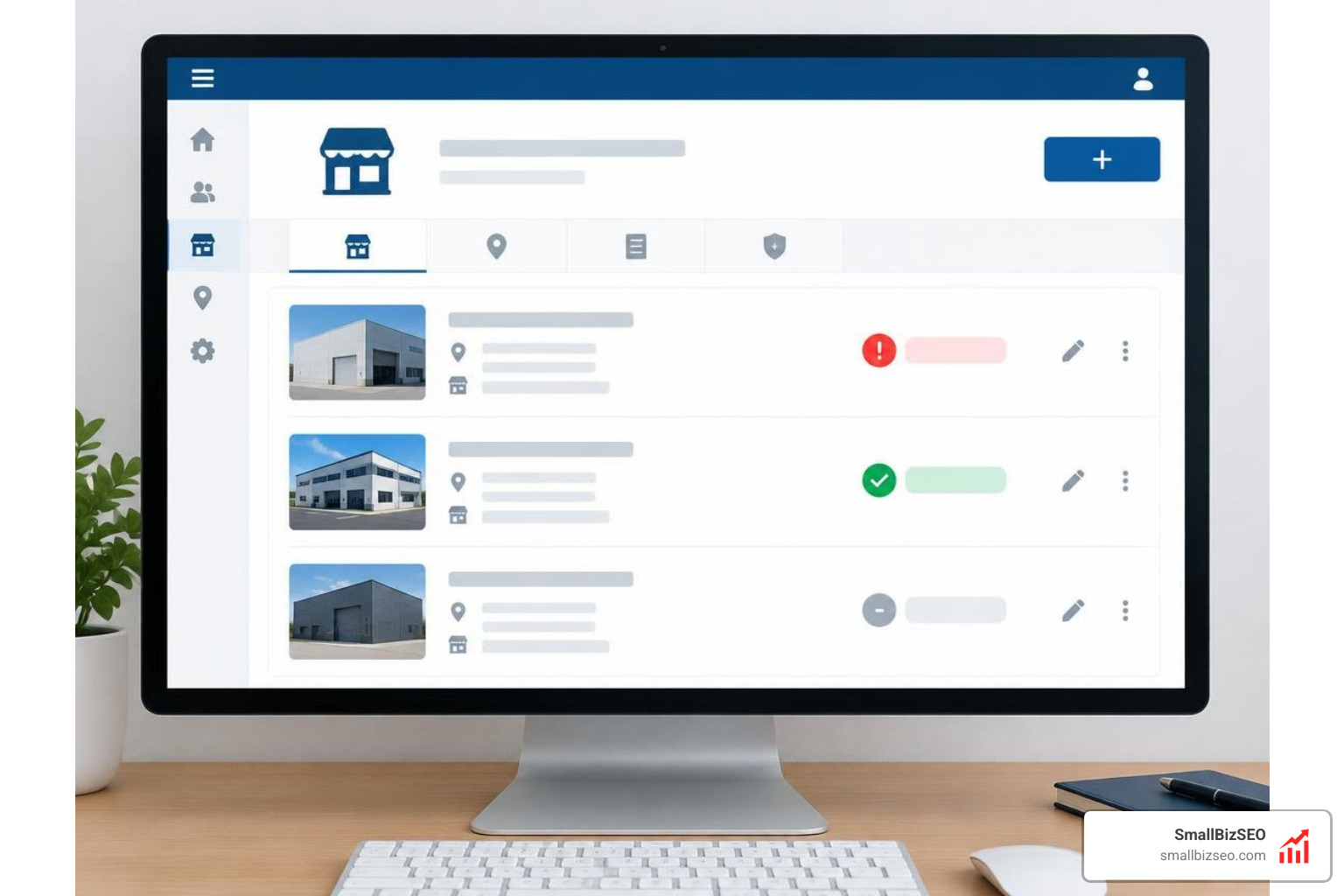
Correct listing errors by claiming profile ownership on each host platform, updating outdated facility data, and implementing a quarterly review process. Uncorrected errors directly disrupt business pipelines; citation signals account for roughly 11% of local search ranking factors, meaning corrupted data reduces search discoverability while driving away qualified procurement specialists.
How Can You Distinguish an Earned Accreditation from a Paid Directory Placement?
To distinguish earned credentials from paid placements, look for independent editorial standards, required third-party audits, and regulatory compliance disclosures.
- Earned Accreditations: Issued by non-profit industry groups, standards bodies (like ISO, ASTM, or ASME), or government agencies. They require rigorous technical evaluations, on-site audits, and ongoing compliance checks.
- Paid Directory Placements: Commercial advertising spots or basic directory memberships where any business can purchase a premium badge or higher ranking.
Federal Trade Commission (FTC) guidelines require clear labeling of paid endorsements and advertising. To confirm corporate legitimacy, cross-reference official filings using the New York Department of State entity database or your local state registry to confirm corporate entity status independently of paid promotional listings.
How Can You Claim and Correct Listings on Platforms Like Thomasnet and SAM.gov?
Claiming and updating your industrial listings prevents lost RFQs and reinforces your digital authority. Follow these steps to correct high-authority industrial profiles:
- Updating Industrial Directories (e.g., Thomasnet): Navigate to the platform's supplier portal, claim administrative rights via official business email verification, and align your product categories, facility specifications, and plant addresses with your master data sheet.
- Updating Federal Procurement Registries (SAM.gov): Log in to the System for Award Management through Login.gov, verify your Unique Entity Identifier (UEI) and CAGE code, and confirm that your legal name matches official tax filings exactly.
- Updating Aerospace and Specialized Registries (OASIS/Nadcap): Coordinate with your accredited third-party registrar to ensure all audit results, scope expansions, and site address updates are published to official registries immediately.
If you discover legacy errors across hundreds of trade associations, our local citation management and comprehensive business citation audit services provide systematic frameworks to clean up your web presence.
Protect Your Procurement Visibility and Supplier Trust
Accurate citations across industry directories and trade associations build long-term trust with commercial buyers, enterprise procurement teams, and AI-driven search engines. By establishing a rigorous verification workflow—auditing core identifiers, cross-referencing official registries, and resolving profile discrepancies—you eliminate supply chain blind spots and capture qualified RFQs. Schedule recurring audits to ensure your technical capabilities and industry credentials remain accurate across every digital platform.