A Practical Local SEO Guide for Growing Your Pest Control Route

A Practical Local SEO Guide for Growing Your Pest Control Route
Why Local Search Matters for Pest Control Growth
To help nearby customers find your pest control business, start with your Google Business Profile. Check that your services, hours, phone number, and service areas are accurate. Then build clear pages for each major service, such as termite treatment or rodent control, and make it easy to call or book from a phone. Ask customers for honest reviews after each job.
These steps help you show up when someone nearby needs help and turn that search into a booking. Focus first on the towns and services you can serve well, then track which calls become jobs.
I'm Clayton Johnson, founder of SmallBizSEO, where I connect SEO, useful content, and digital PR to help small businesses earn qualified leads. I bring that approach to SEO for pest control company owners: answer local questions clearly, build trust, and give customers an easy next step.
Simple SEO for pest control company word guide:
When property owners discover mice in the attic or termites chewing through baseboards, they do not wait around. They grab their smartphones and call the first qualified technician they find.
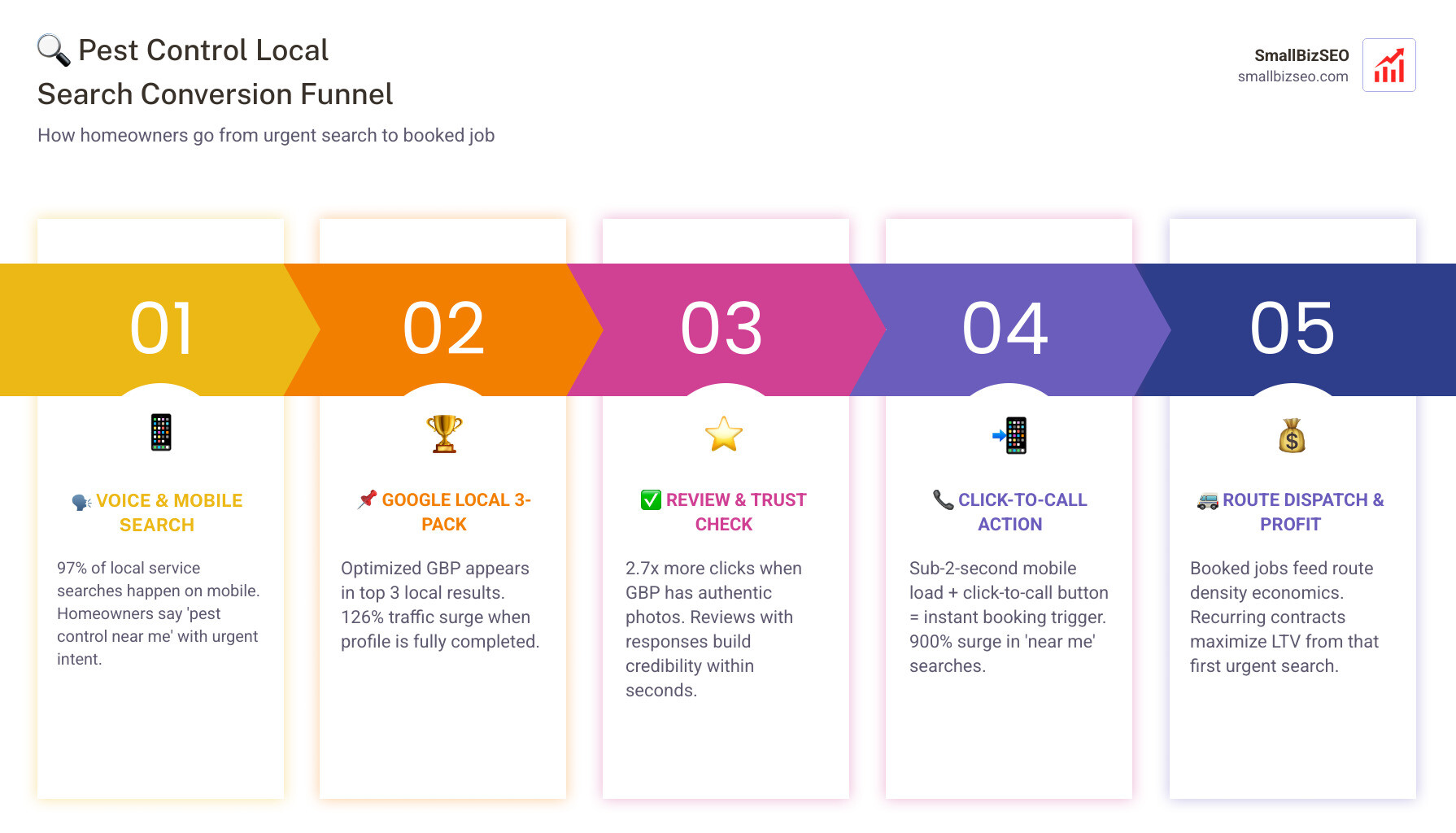
Online search is the primary battleground for local home services. Data shows that 97% of consumers go online to research local services, and 46% of all Google searches carry a local focus. Furthermore, 88% of people who run a local mobile search call or visit a business within 24 hours, while searches containing "near me" have jumped by over 900%.
The pest control industry generates tens of billions of dollars in annual revenue across tens of thousands of operators. Because search traffic spikes dramatically during seasonal pest cycles, capturing high-intent organic visibility directly determines your route density and technician profitability.
How Does an Optimized Google Business Profile Drive Local Exterminator Calls?
An optimized Google Business Profile puts your company directly into the Google Local 3-Pack, which earns 126% more traffic and 93% more user actions than lower listings. A complete profile also makes consumers 2.7 times more likely to trust your business.
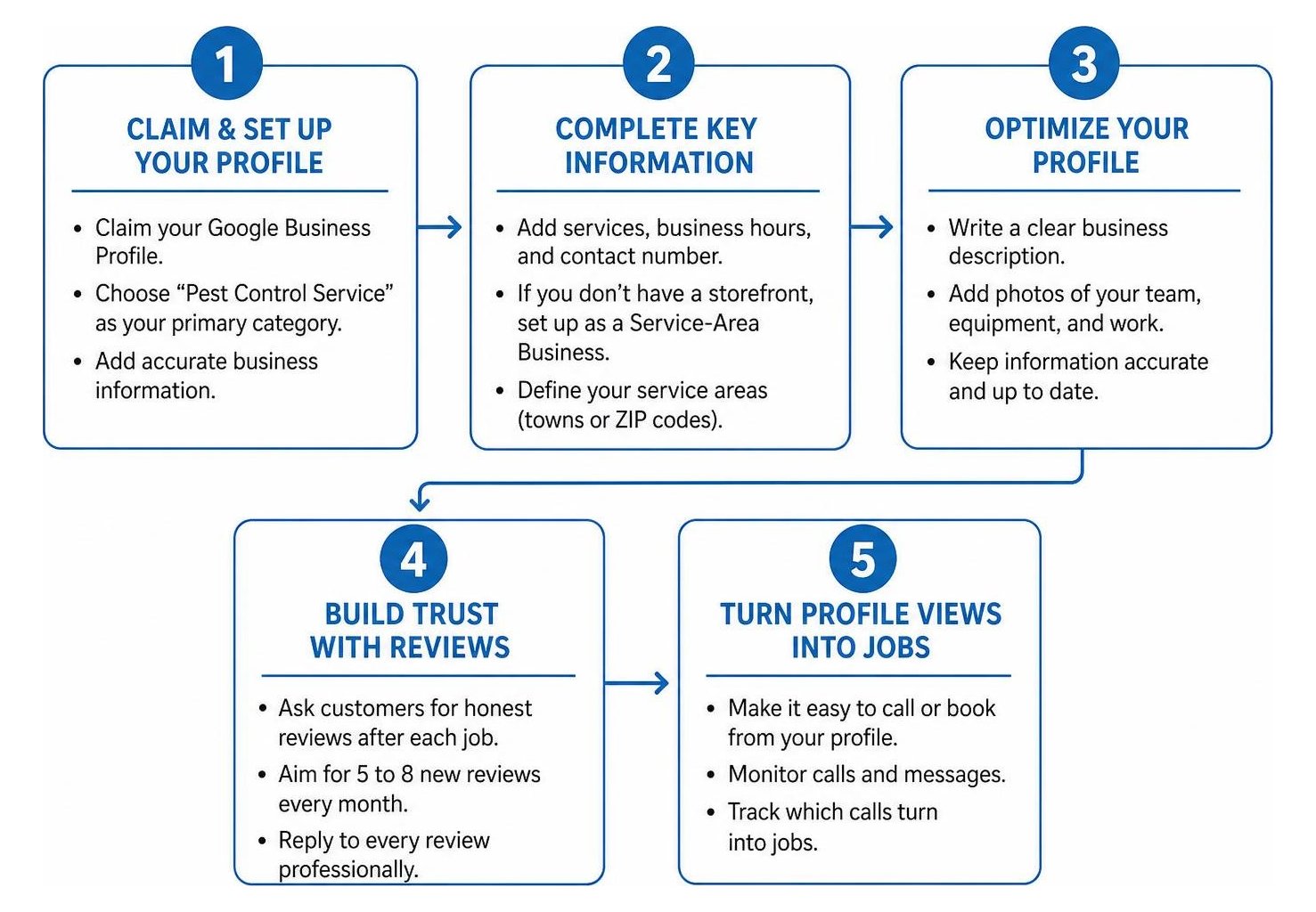
To maximize profile performance, implement these core practices:
- Primary Category Setup: Choose "Pest Control Service" as your primary business category. Add secondary categories like "Animal Control Service" or "Lawn Care Service" only if you perform those operations.
- Service-Area Business (SAB) Configuration: Keep your physical office address hidden if customers do not visit your shop, and designate specific target towns or ZIP codes to prevent profile suspensions.
- Review Velocity: Collect 5 to 8 new, authentic reviews every month. Consistent review acquisition carries significantly more ranking weight than a static collection of old feedback.
- Authentic Media: Regularly upload authentic photos of branded service trucks, licensed technicians, and modern equipment.
Mastering the ultimate guide to local search optimization basics ensures your listings capture maximum neighborhood visibility while keeping your company profile in full compliance.
Step-by-Step Blueprint: How to Execute SEO for Your Exterminator Website
Executing technical and on-page SEO requires a mobile-friendly design, fast page load speeds under 2 seconds, and prominent click-to-call buttons that make booking an inspection effortless.
When homeowners face sudden pest infestations, slow websites cause immediate bounces. Optimizing your Core Web Vitals guarantees smooth mobile browsing, while structured data markup tells search engines exactly which services you offer and where you operate.
What On-Page SEO for Pest Control Company Websites Converts Traffic into Bookings?
High-converting on-page SEO combines location-specific meta tags, structured header hierarchies, and authentic trust signals that prove technical expertise.
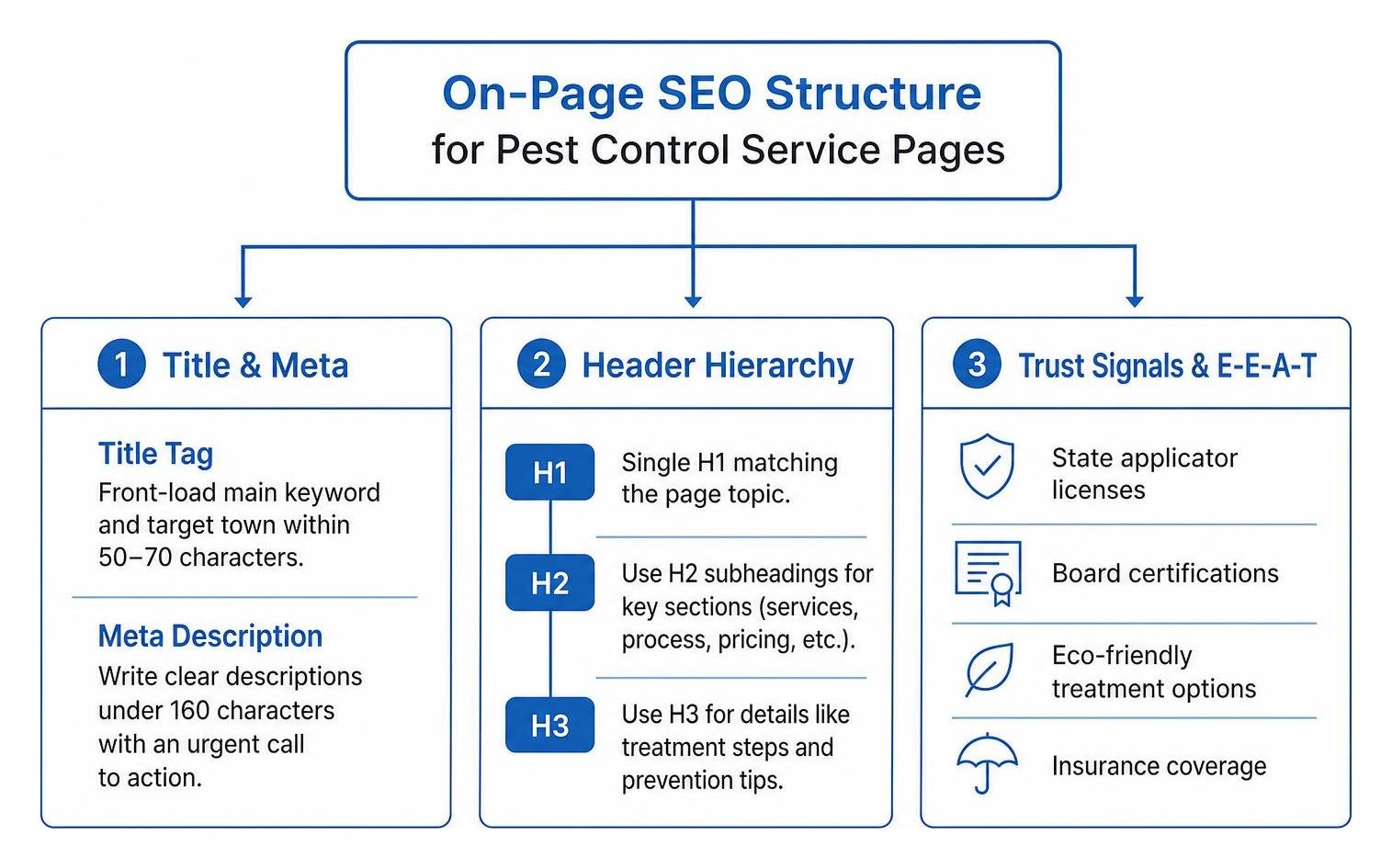
Prioritize these critical on-page elements:
- Title Tags and Meta Descriptions: Front-load your main keyword and target town in the title tag within 50 to 70 characters. Write clear meta descriptions under 160 characters with an urgent call to action.
- Header Hierarchy: Maintain a single H1 tag matching the page topic, followed by logical H2 and H3 subheadings addressing specific treatment processes, pricing factors, and pest prevention tips.
- Trust Signals and E-E-A-T: Highlight state applicator licenses, board certifications, eco-friendly treatment options, and insurance coverage near the top of the page. Learn how to optimize your content for E-E-A-T and build real search trust to boost search credibility.
- Internal Linking Pyramid: Connect your homepage to primary category pages, which then link down to specialized pest treatment pages. Avoid 5 local SEO mistakes killing your visibility, such as broken links and duplicate location copy.
Which High-Intent Local Keywords and Service Pages Win the Most Pest Routes?
The most profitable keywords combine explicit geographic intent with high-urgency pest species terms, such as "termite inspection," "emergency bed bug treatment," and "rodent control."
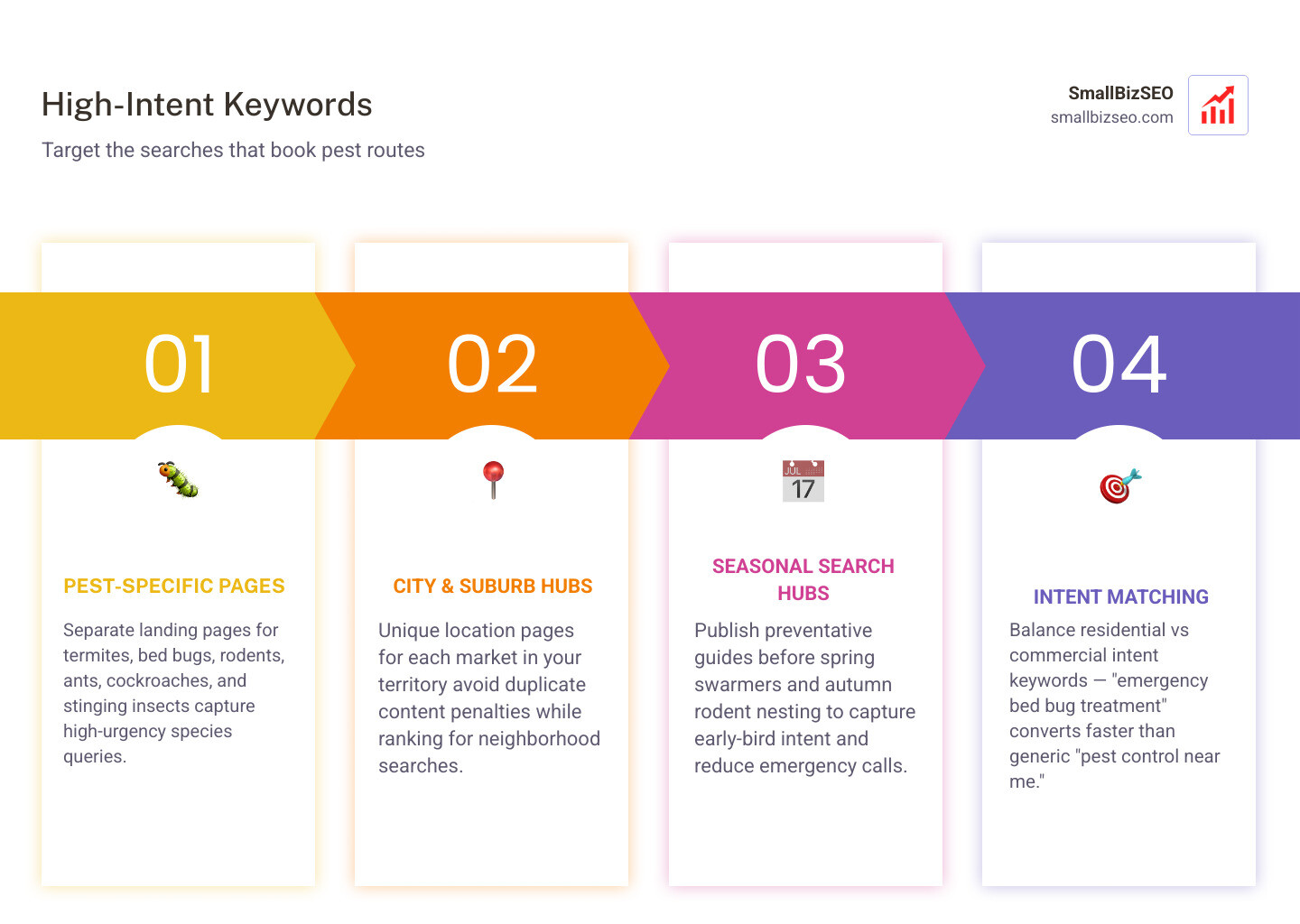
Expand your keyword architecture by consulting proven pest control keyword research frameworks and balancing residential versus commercial intent. Connect your localized content hubs by a practical guide to the 4 types of SEO across technical, on-page, local, and off-page layers.
- Pest-Specific Landing Pages: Build separate, comprehensive pages for ants, bed bugs, termites, rodents, cockroaches, and stinging insects.
- City & Suburb Hubs: Develop unique location pages for each key market in your service territory, avoiding repetitive doorway pages.
- Seasonal Search Hubs: Publish preventative pest guides ahead of spring swarmers and autumn rodent nesting periods.
How Do You Build High-Authority Local Backlinks and Citations?
You build high-authority local backlinks by securing citations with exact Name, Address, and Phone (NAP) consistency, sponsoring local community organizations, and earning mentions in reputable trade publications.
- Chamber & Business Citations: Secure listings on regional chambers of commerce, Better Business Bureau chapters, and local merchant directories.
- Community Sponsorships: Sponsor local youth sports teams, charity runs, and civic events to earn authoritative backlinks from local community websites.
- Trade Industry Mentions: Contribute expert pest management tips and commentary to publications like Pest Control Technology.
- Competitor Backlink Replication: Analyze where competing exterminators get their authority by using the step-by-step guide to SEO analysis for competitors.
Maximizing ROI: Paid Ads vs. Organic Rankings and Tracking Route Growth
Pest control SEO typically delivers substantial ranking and lead increases within 3 to 6 months, generating an enduring stream of phone calls that permanently lowers your blended customer acquisition cost (CAC).
By integrating dynamic call-tracking numbers on your website, you can attribute every inbound call, form fill, and scheduled inspection directly to organic search traffic.
Should Exterminators Prioritize Paid Advertising or SEO for Pest Control Company Lead Generation?
Exterminators should prioritize organic and local SEO over short-term paid advertising to build compounding digital equity and achieve a 30% to 60% lower cost per booked job over time.
| Marketing Metric | Paid Advertising | Local & Organic SEO |
|---|---|---|
| Time to First Lead | Immediate (24 to 48 hours) | 3 to 6 months ramp-up |
| Cost Dynamics | Recurring cost per click | Front-loaded investment, compounding equity |
| Average Cost Per Lead | Higher ($50 – $150+) | Lower ($20 – $45 over time) |
| Traffic Sustainability | Stops the moment budget runs out | Continues delivering consistent organic calls |
| Consumer Trust | Moderate (clearly marked as sponsored) | High (organic rankings build strong authority) |
Partnering with a specialized pest control SEO company ensures your organic marketing assets generate compounding digital equity that decreases your dependence on costly short-term advertising.
How Long Does It Take to See Results and Scale Route Profits with PestPac?
Initial search ranking movements typically appear within 4 to 8 weeks, with substantial lead volume and route expansion taking shape between months 3 and 6.
Integrating field service software like PestPac with your SEO pipeline enables you to track customer lifetime value (LTV), optimize technician route density, and turn single pest treatments into profitable quarterly recurring service agreements.
At SmallBizSEO, our proprietary Velocity framework combines technical audits, localized service content, and white-hat digital PR to accelerate map-pack rankings. To discover where your website currently stands against top competitors, request a comprehensive SEO visibility audit and start scaling your pest routes today.
Ready to Dominate Your Local Pest Control Market?
Growing a sustainable, highly profitable pest route requires dominating both Google Maps and local organic search. By establishing an active Google Business Profile, publishing dedicated service pages for every pest type, building high-authority local backlinks, and tracking call conversions, your exterminator business can generate consistent, exclusive inbound leads all year long. Let our data-driven frameworks help you outrank the competition and keep your service trucks rolling.