A – Z Guide to Local Tile Refinishing, Cleaning & Repair Services
How Can SEO Bring More Tile Refinishing, Cleaning, and Repair Leads?
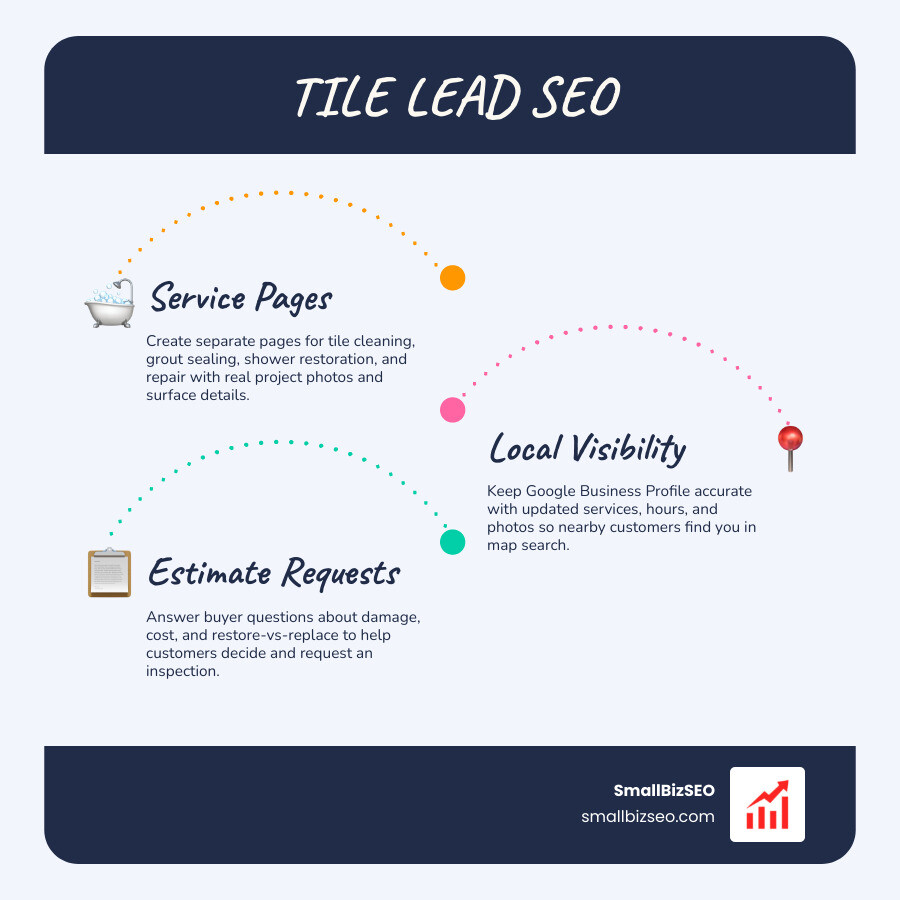
SEO for tile refinishing, cleaning, and repair starts with the jobs customers actually search for. Give tile cleaning, grout sealing, shower restoration, and tile repair their own pages when you offer those services. Show real project photos, explain which surfaces you work on, and make it easy to request an estimate. Keep your Google Business Profile accurate so nearby customers can find you in local search.
This approach also reaches people who are not sure whether to restore or replace their tile. Clear answers about damage, cost, and likely results can help them decide when to ask for an inspection.
I’m Clayton Johnson, founder of SmallBizSEO, where I help small businesses connect technical SEO, content strategy, and link building to qualified leads. My approach to SEO for tiles refinishing, cleaning, & repair draws on that work: answer buyer questions clearly, show credible proof, and give visitors a simple next step.
Terms related to SEO for tiles refinishing, cleaning, & repair:
- SEO for pressure washing service
- SEO for blinds installation, cleaning, & repair
- SEO for home insulation specialists
Complete Blueprint: SEO for Tiles Refinishing, Cleaning, & Repair
A successful search marketing plan for hard surface restoration targets customers at the exact moment they face damaged, stained, or failing tile. Search engine optimization for tile repair and refinishing requires answering buyer concerns about surface compatibility, project pricing, and the choice between restoration and costly replacement.
Research shows that long-tail keywords with four or more words account for 70% of all search traffic. Furthermore, 93% of consumers read online content before choosing a service provider, and 76% of people who conduct a local search on their smartphone visit a business within 24 hours. By aligning your website with these search habits, you capture ready-to-book residential and commercial property owners.
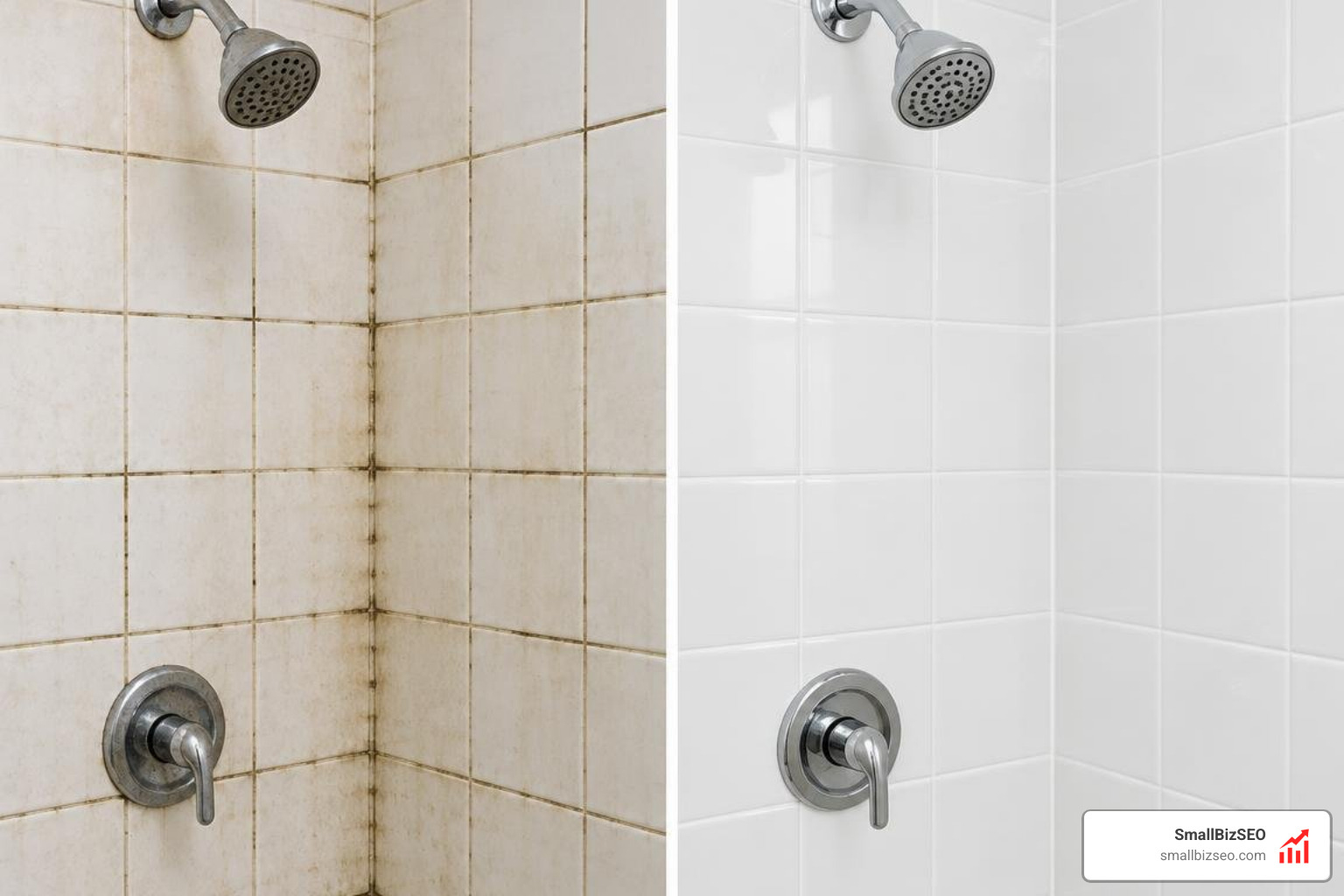
Capturing this audience requires strict adherence to search engine standards. When establishing your local presence, review the official Google Business Profile guidelines to ensure accurate business representation, eligible categories, and compliant address formatting.
Why Does SEO for Tiles Refinishing, Cleaning, & Repair Outperform General Cleaning Marketing?
Targeting specialized tile and surface queries generates significantly higher conversion rates and larger job estimates than generic cleaning campaigns. While general house cleaners and carpet cleaners often list tile as an add-on, property owners facing deep-set grout discoloration, cracked ceramic, or etched marble look for dedicated craftsmen.
General cleaning marketing competes for broad, low-intent terms with modest profit margins. In contrast, specialist positioning captures high-ticket restoration jobs, such as natural stone honing, epoxy regrouting, and chemical slip-resistance treatments. While our beginners guide to cleaning service SEO outlines standard residential janitorial optimization, hard surface restoration demands deeper material-specific authority.
| Strategic Metric | General Cleaning SEO | Tile Refinishing, Cleaning & Repair SEO |
|---|---|---|
| Primary Search Intent | Routine maintenance, recurring vacuuming, dusting | Problem-specific damage, failed caulk, dull finish |
| Average Ticket Value | Lower recurring revenue per visit | High-ticket single-project restoration and sealing |
| Material Depth | Generic surfaces and light detergents | Specialized acid safety, pH-neutral extraction, stone honing |
| Competitor Overlap | High competition with carpet and maid services | Niche authority outranking generalist service providers |
| Conversion Asset | Flat hourly rates or checklist offers | Visual before-and-after proof and surface warranties |
Which High-Intent Surface Pages and Keyword Clusters Capture Restoration Leads?
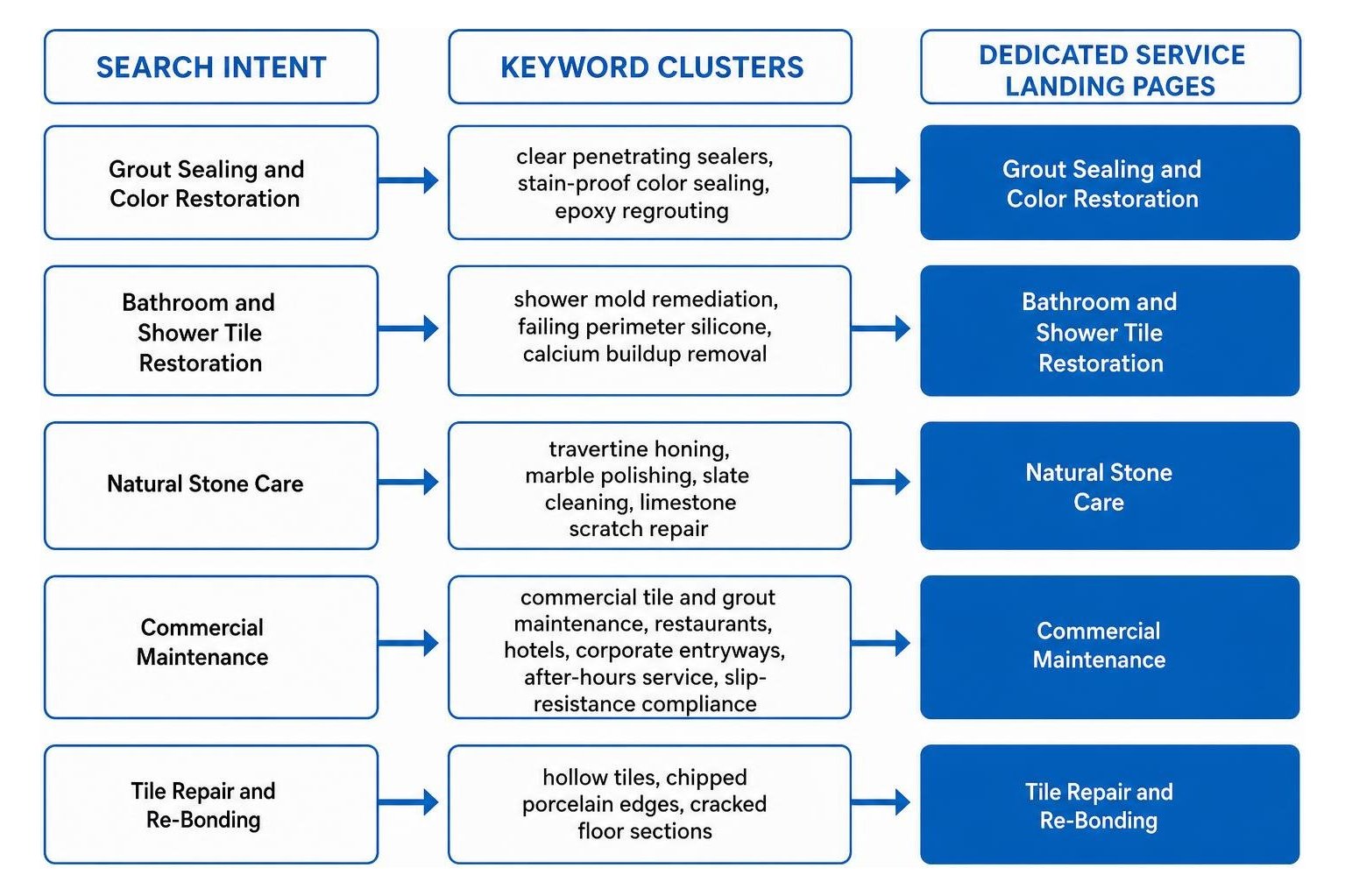
Customers do not search for generic tile services when they have a problem; they search by specific material, room, and damage type. To rank effectively, structure your website into isolated, comprehensive service pages targeting distinct keyword clusters rather than lumping all surface care onto a single catch-all URL.
You should develop separate landing pages for:
- Grout Sealing and Color Restoration: Targeting terms like clear penetrating sealers, stain-proof color sealing, and epoxy regrouting.
- Bathroom and Shower Tile Restoration: Capturing high-intent searches for shower mold remediation, failing perimeter silicone, and calcium buildup removal.
- Natural Stone Care: Prioritizing travertine honing, marble polishing, slate cleaning, and limestone scratch repair. Reviewing flooring material keyword strategies helps map these specific material queries to individual landing pages.
- Commercial Maintenance: Capturing B2B demand for commercial tile and grout maintenance across restaurants, hotels, and corporate entryways that require after-hours service and slip-resistance compliance.
- Tile Repair and Re-Bonding: Solving urgent homeowner issues such as hollow tiles, chipped porcelain edges, and cracked floor sections.
How Does Technical and Local SEO for Tiles Refinishing, Cleaning, & Repair Drive Map Pack Rankings?
Appearing in the local map pack requires a combination of complete Google Business Profile optimization, localized technical signals, and fast mobile performance. Because surface restoration decisions rely heavily on visual proof, technical execution must support image-heavy pages without sacrificing load speed.
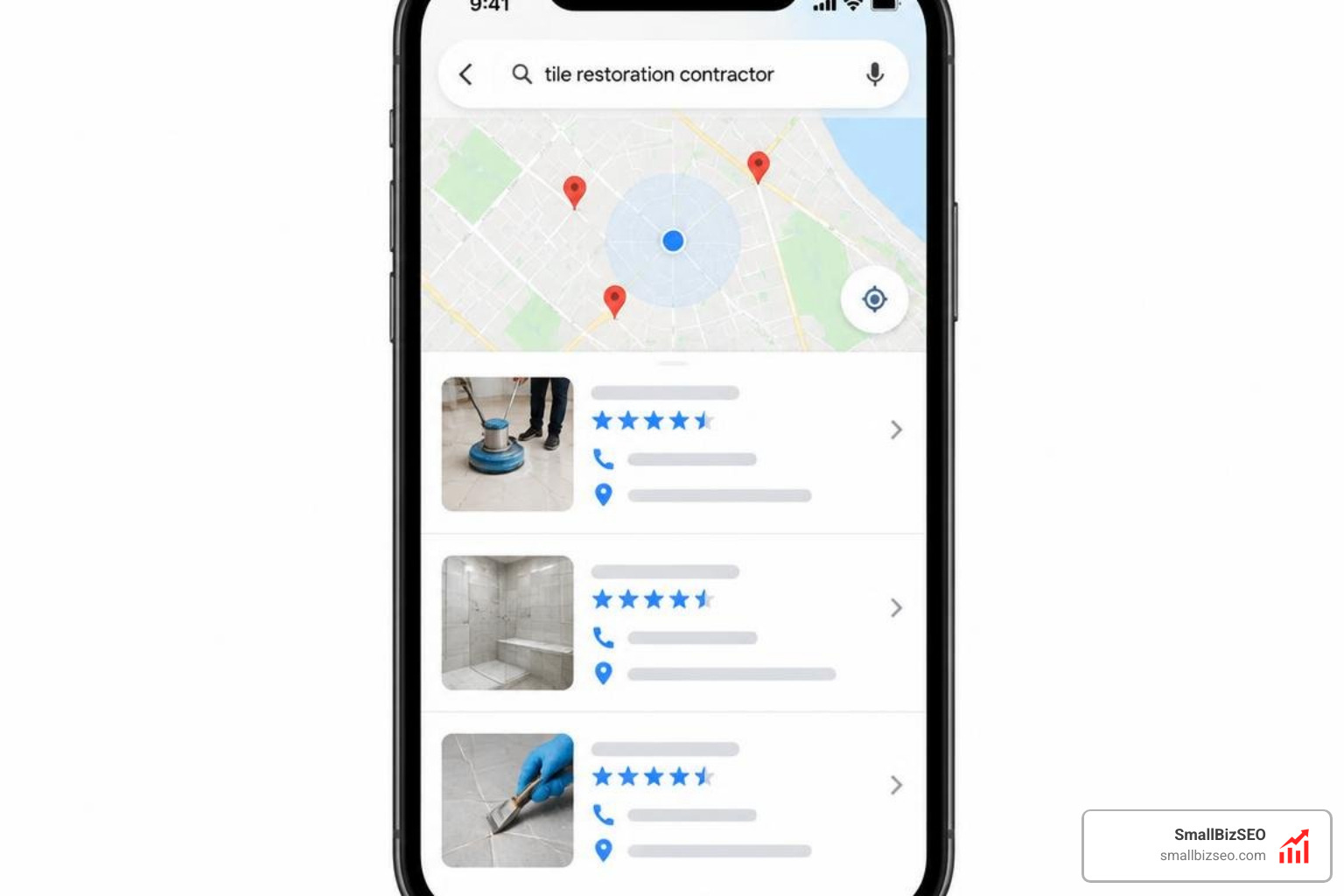
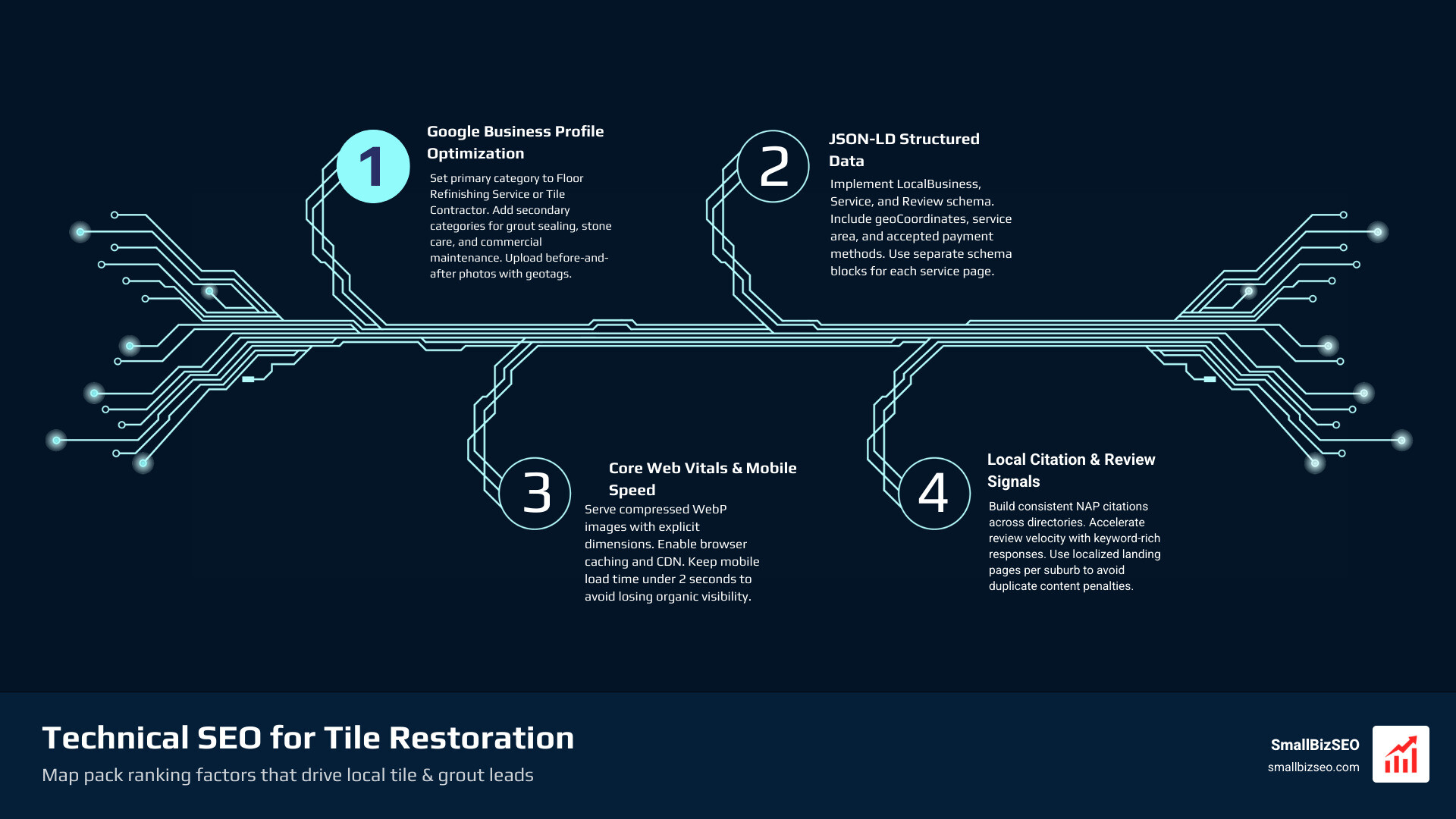
Begin by properly optimizing Google Business Profiles under primary categories such as Floor Refinishing Service, Tile Contractor, or Floor Cleaning Service. Ensure your secondary categories reflect specific restoration capabilities.
To improve rankings across competitive service areas, follow our framework for improving local map pack visibility. Implement JSON-LD LocalBusiness and Service schema markup across your website header. Ensure Core Web Vitals remain optimized by serving compressed WebP images with explicit dimensions and fast caching protocols, keeping mobile load times under two seconds.
Scaling Local Search Visibility and Booking High-Value Tile Restoration Contracts
Expanding your business beyond your immediate neighborhood requires a systematic approach to local search architecture and customer conversion paths. When homeowners and facility managers land on your website, your layout must guide them directly toward requesting an on-site evaluation or sending photos for an estimate.
At SmallBizSEO, our proprietary Velocity framework combines technical architecture, localized content hubs, and authoritative link acquisition to accelerate search visibility for home improvement contractors. To learn how we support contractor growth, explore our tailored home services SEO packages or schedule a thorough audit of your digital visibility to identify missing keyword opportunities.
How Do Generative Engine Optimization (GEO) and AI Search Overviews Impact Tile Contractors?
Generative search engines and AI Overviews synthesize direct answers to complex home improvement queries rather than simply listing links. When a homeowner asks an AI assistant how to save etched marble or restore black shower grout, the engine retrieves data from websites that provide clear, structured, and factual answers.
To capture visibility in AI-generated answers:
- Provide Clear Direct Answers: Lead key service pages and guides with concise, factual summaries that directly answer common restoration questions.
- Implement Question-Based Subheadings: Mirror real customer search patterns, such as comparing the costs of refinishing versus replacing ceramic floor tiles.
- Anchor Local Business Entities: Reference recognizable local landmarks, municipal hard water conditions, and regional architectural styles within your content to help search engines understand your geographic context.
- Deploy FAQ Schema Markup: Structure common questions and answers in clean JSON-LD formatting to make your data easy for search crawlers to index and quote.

What Review and Multi-Location Tactics Prevent Duplicate Content Penalties?
Creating landing pages for multiple suburbs helps you capture traffic across your entire service radius. However, duplicating the same page copy while merely swapping town names creates doorway pages that search engines ignore. Every local landing page must offer unique, localized value.
To build authoritative multi-location pages without triggering content filters:
- Feature Location-Specific Project Photos: Upload original before-and-after photos of jobs completed within that specific municipality or neighborhood.
- Embed Localized Customer Reviews: Showcase feedback from clients in that town, encouraging them to mention the specific service performed (such as travertine polishing or grout color sealing).
- Detail Regional Water Challenges: Explain how local municipal water hardness causes calcium and limescale buildup in regional bathrooms.
- Maintain Consistent Local Citations: Standardize your business Name, Address, and Phone Number (NAP) across major platforms and niche trade directories.
Essential local citation signals that build trust include:
- Major search engine mapping profiles
- Industry trade associations and stone restoration registries
- Local chamber of commerce business directories
- Better Business Bureau verified listings
- Regional home builder and remodeler contractor networks
Turn Local Searches into Booked Surface Restoration Projects
Capturing high-value tile refinishing, cleaning, and repair leads requires moving away from generic cleaning terms and organizing your website around the exact problems, materials, and locations your customers search for every day. By building dedicated surface landing pages, providing clear visual proof, maintaining complete local schema markup, and earning detailed customer reviews, your business establishes the trust search engines reward.
When you align your digital presence with real customer search behavior, your website becomes a consistent engine for high-ticket residential estimates and recurring commercial maintenance contracts. Focus on answering buyer questions clearly, presenting honest restoration evaluations, and making estimate requests simple and accessible across every page.