Accounts Receivable Loan SEO Playbook for B2B Financial Marketers

How Can Accounts Receivable Lenders Turn Search Traffic Into Qualified Leads?
SEO for accounts receivable loans starts with the right pages for the right searches. Build separate pages for AR loans and invoice factoring, since borrowers need different answers about ownership, fees, and collections. Then create industry-specific pages that explain eligibility and costs, make the site easy to use on mobile, and track which inquiries become funded facilities.
I’m Clayton Johnson, founder of SmallBizSEO. My work in technical SEO, content strategy, and link building informs this approach to SEO for accounts receivable loans: answer buyers’ questions clearly, earn trust, and measure results beyond traffic.
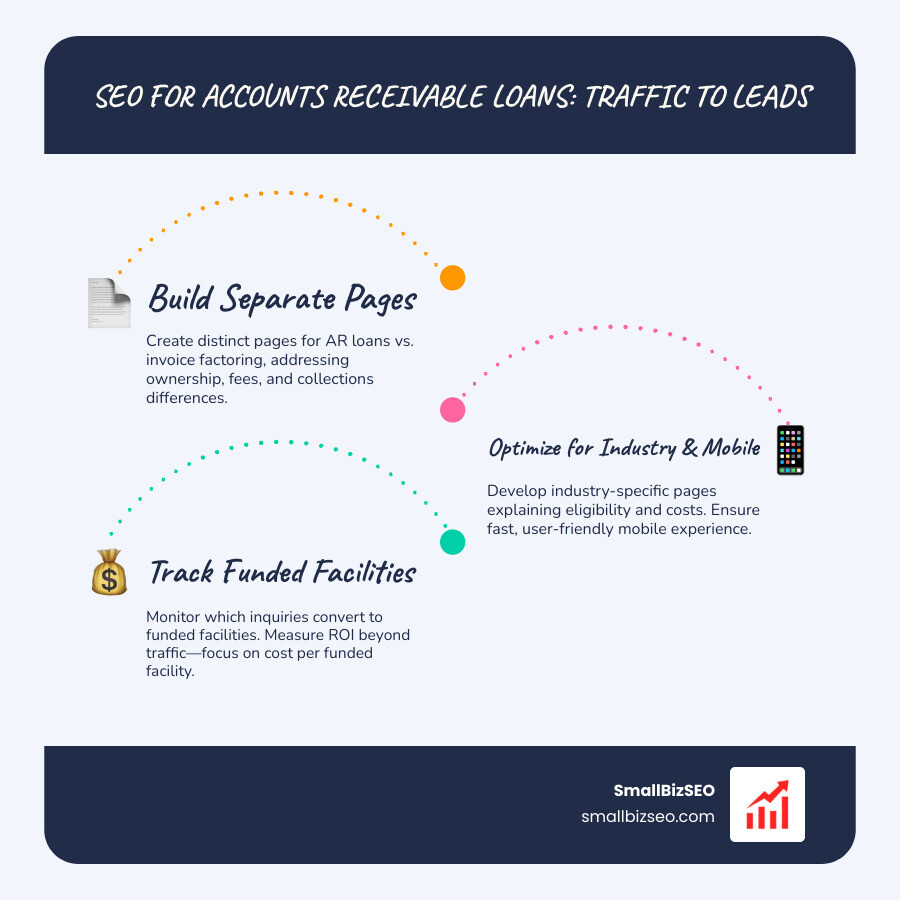
Seo for accounts receivable loans terminology:
The Step-by-Step Strategy for SEO for Accounts Receivable Loans
To capture commercial borrowers looking for working capital, financial marketers must execute a structured SEO strategy that builds topical authority and satisfies rigorous financial search quality standards.
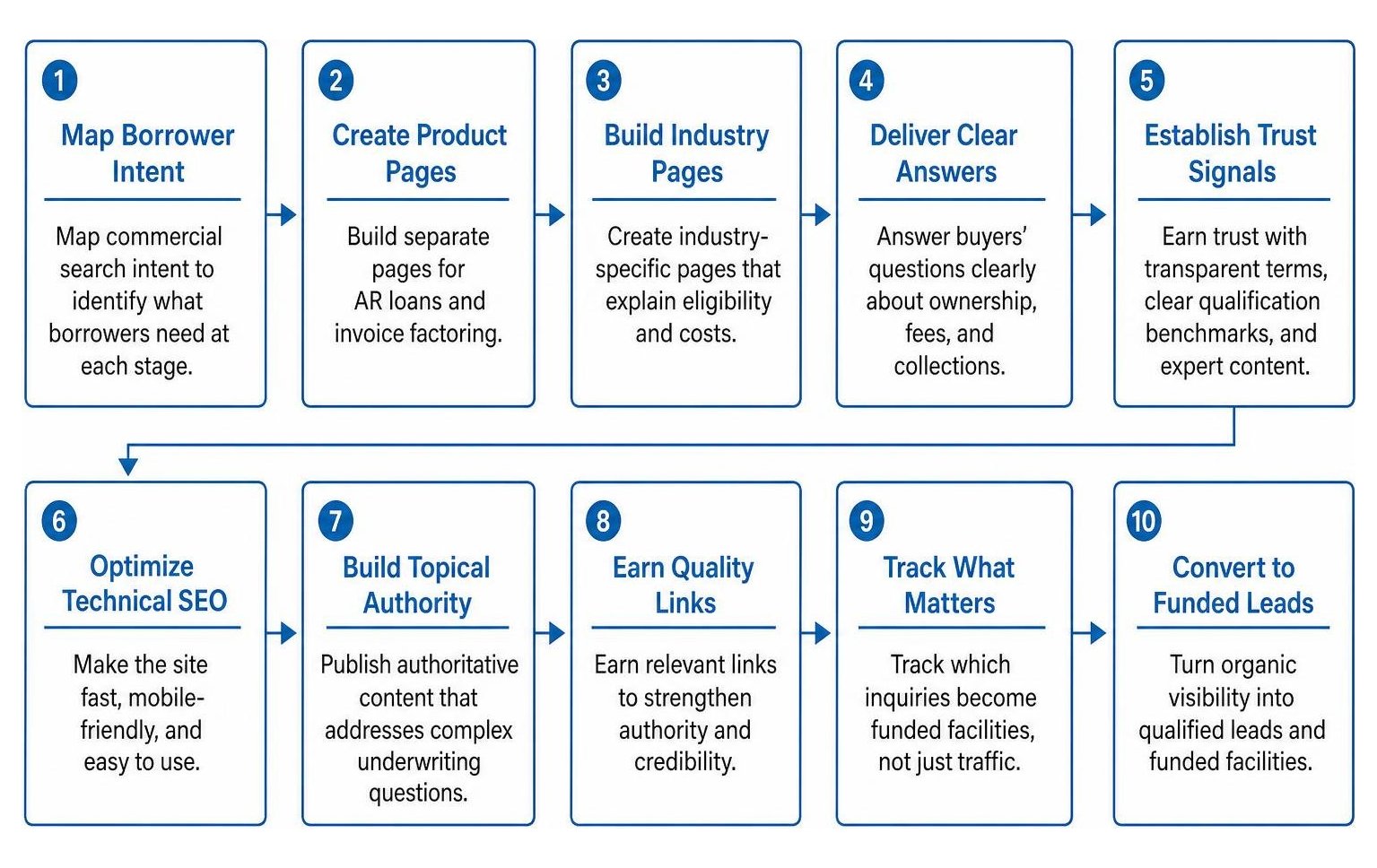
A successful campaign requires a multi-layered approach: mapping borrower intent, establishing regulatory trust signals, and delivering authoritative technical answers. When commercial lenders implement our data-driven Velocity framework, they can transition away from costly paid clicks and volatile broker networks. In fact, structured financial campaigns frequently unlock measurable compounding growth, such as a 138% surge in organic traffic, a 126% boost in engaged sessions, and a 47% increase in qualified conversion rates.
To achieve these outcomes, financial organizations should consult a practical strategy guide to seo for finance companies to align commercial goals with proven technical execution. Maintaining rigorous E-E-A-T (Experience, Expertise, Authoritativeness, and Trustworthiness) standards is critical for Google’s financial evaluation thresholds. Every published page must deliver transparent terms, clear qualification benchmarks, and direct answers to complex underwriting questions.
What Are the Core Differences Between AR Loans and Invoice Factoring in Content Strategy?
Accounts receivable loans and invoice factoring serve different financial needs, and your content architecture must clearly address their distinct accounting, legal, and operational mechanics.
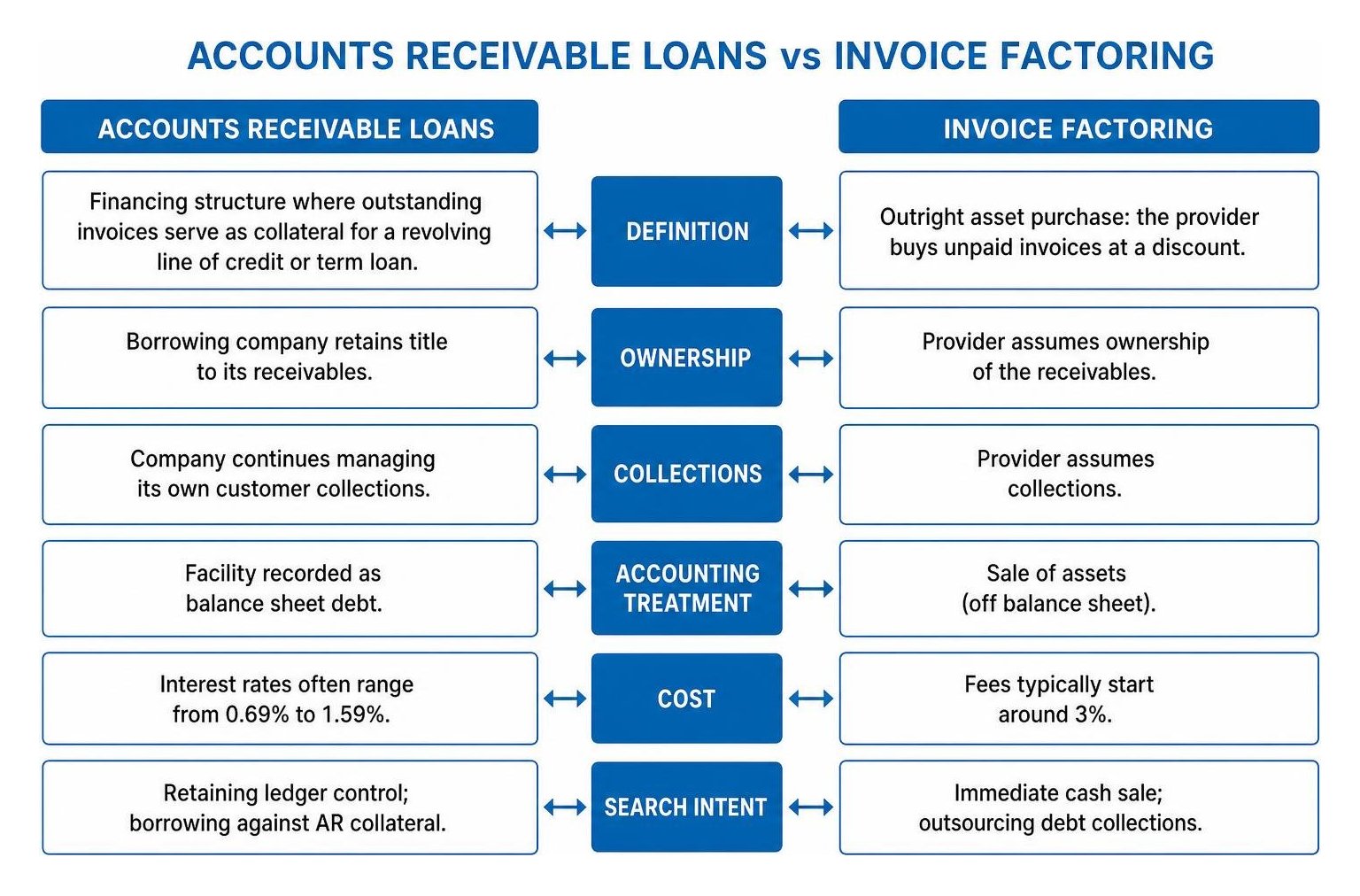
An accounts receivable loan is a financing structure where outstanding invoices serve as collateral for a revolving line of credit or term loan. The borrowing company retains title to its receivables and continues managing its own customer collections, keeping the facility as balance sheet debt. Factoring, by contrast, is an outright asset purchase: the provider buys unpaid invoices at a discount, advances 70% to 90% of their face value upfront, and assumes collections. Factoring fees typically start around 3% of the invoice total, whereas receivables loan interest rates often range from 0.69% to 1.59% depending on risk tiering.
| Feature | Accounts Receivable Loans | Invoice Factoring |
|---|---|---|
| Search Intent | Retaining ledger control; borrowing against AR collateral | Immediate cash sale; outsourcing debt collections |
| Advance Rates | Typically 75% to 85% collateral advance | 70% to 90% upfront cash purchase advance |
| Fee / Rate Structure | 0.69% to 1.59% loan interest rates | Factoring discount fees starting around 3% |
| Balance Sheet Impact | Recorded as a liability (debt) | Off-balance-sheet asset sale (non-debt) |
| Customer Interaction | Confidential; borrower manages client collections | Notification factoring; factor contacts customers directly |
Searchers looking for Invoice Factoring Leads focus on fast liquidity, credit management, and non-recourse risk mitigation. Conversely, CFOs seeking AR loans search for low discount rates, confidentiality, and borrowing-base flexibility. Separating these topics into dedicated pillar pages prevents keyword cannibalization and ensures your content answers the specific questions of each target audience.
How Do You Conduct High-Intent Keyword Research for SEO for Accounts Receivable Loans?
High-intent keyword research focuses on identifying bottom-of-funnel commercial phrases used by business owners and financial controllers who need immediate working capital.
Instead of targeting broad, low-converting terms like "business cash flow," your content should focus on phrases indicating urgent commercial intent. Prioritize queries such as "accounts receivable financing companies," "fast invoice factoring for staffing agencies," and "manufacturing AR credit line." Industry-specific long-tail keywords convert at significantly higher rates because they address distinct business payment cycles, such as the weekly payroll gaps of temporary staffing agencies or the 60-day billing windows common in commercial transportation.
Marketers should leverage dedicated seo content services to map targeted terms to specific landing pages. You must also implement negative keyword filters in your broader research to eliminate consumer finance queries, peer-to-peer lending searches, and student loan inquiries. This ensures every page attracts high-value corporate borrowers.
How Should Lenders Build Compliant Architecture and Local SEO for Accounts Receivable Loans?
Commercial finance websites must combine airtight regulatory disclosures with clean crawlability and geographic visibility to rank reliably.

Compliance and transparency directly influence search rankings in commercial finance. Financial websites must provide clear explanations of rates, non-misleading fee schedules, and transparent repayment mechanics. As highlighted in Compliant MCA SEO Strategies, avoiding deceptive claims such as "guaranteed approval" or "no documentation needed" protects sites from regulatory scrutiny and search engine quality downgrades.
To maximize crawl efficiency, eliminate technical bottlenecks by reviewing the ultimate guide to seo audit errors. Ensure your site features a clear hierarchy:
- Product Core Hubs (
/receivables-loans/,/invoice-factoring/) - Sector Landing Pages (
/industries/staffing/,/industries/logistics/) - Location Pages with optimized Google Business Profile listings and localized customer case studies
This structure enables search bots to crawl deep pages quickly while helping regional businesses connect with nearby commercial underwriters.
Which Content Formats and Link Acquisition Strategies Drive Funded Deals?
Interactive tools, targeted lead magnets, and industry data assets generate qualified inbound inquiries while earning authoritative backlinks naturally.
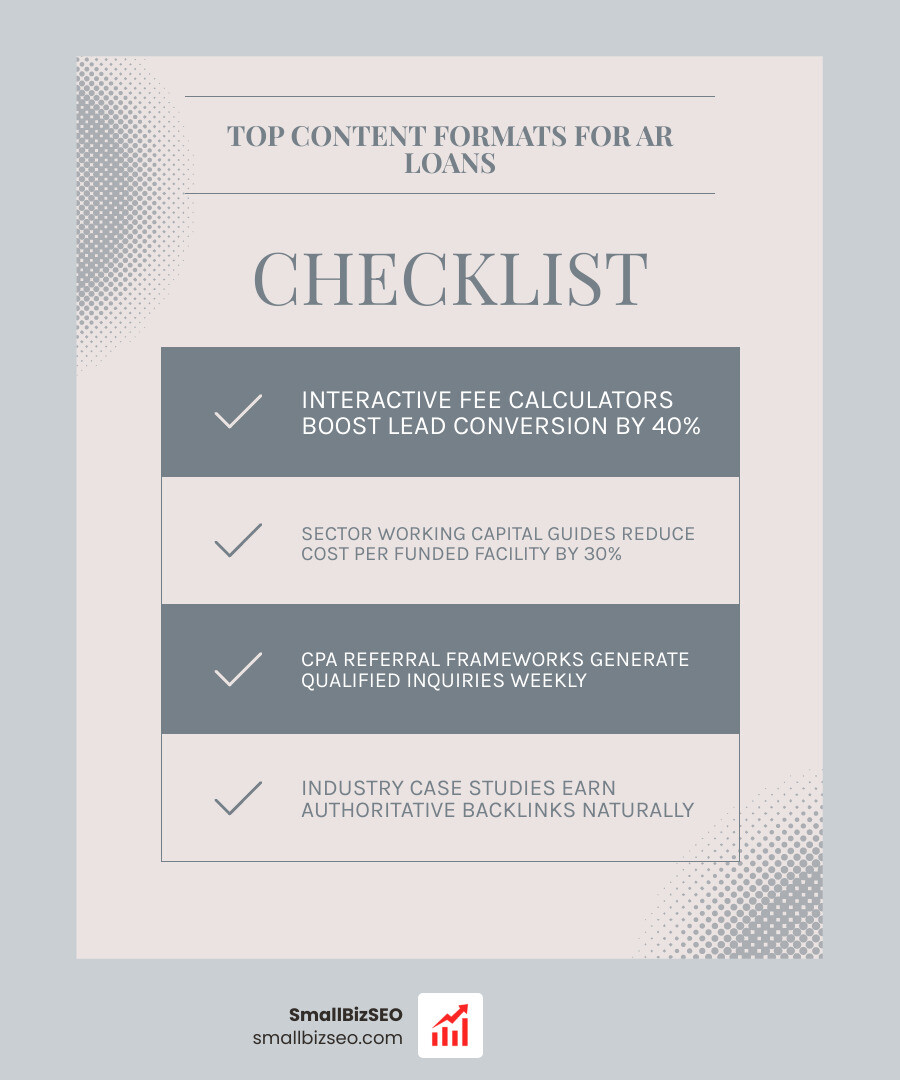
High-value financial content formats convert search traffic into funded facilities far better than generic promotional articles:
- Interactive Fee Calculators: Dynamic tools that calculate advances, discount rates, and net cash flow based on invoice volume.
- Sector Working Capital Guides: Step-by-step roadmaps addressing payroll-funding gaps for specialized industries.
- CPA & Legal Referral Frameworks: Downloadable evaluation matrices that corporate accountants use to assess working capital options.
- UCC Filing Analysis Reports: Original industry reports examining public financing filings to illustrate broader market liquidity trends.
Publishing authoritative original data encourages natural backlink acquisition from trade publications, business chambers, and banking journals. By executing a practical guide to organic traffic growth strategies, commercial lenders can secure high-authority placements that build trust and elevate keyword rankings.
Measuring Pipeline ROI and Future-Proofing Financial Search Visibility
Sustainable SEO success in commercial lending requires tracking closed loan volume and optimizing for artificial intelligence search platforms.
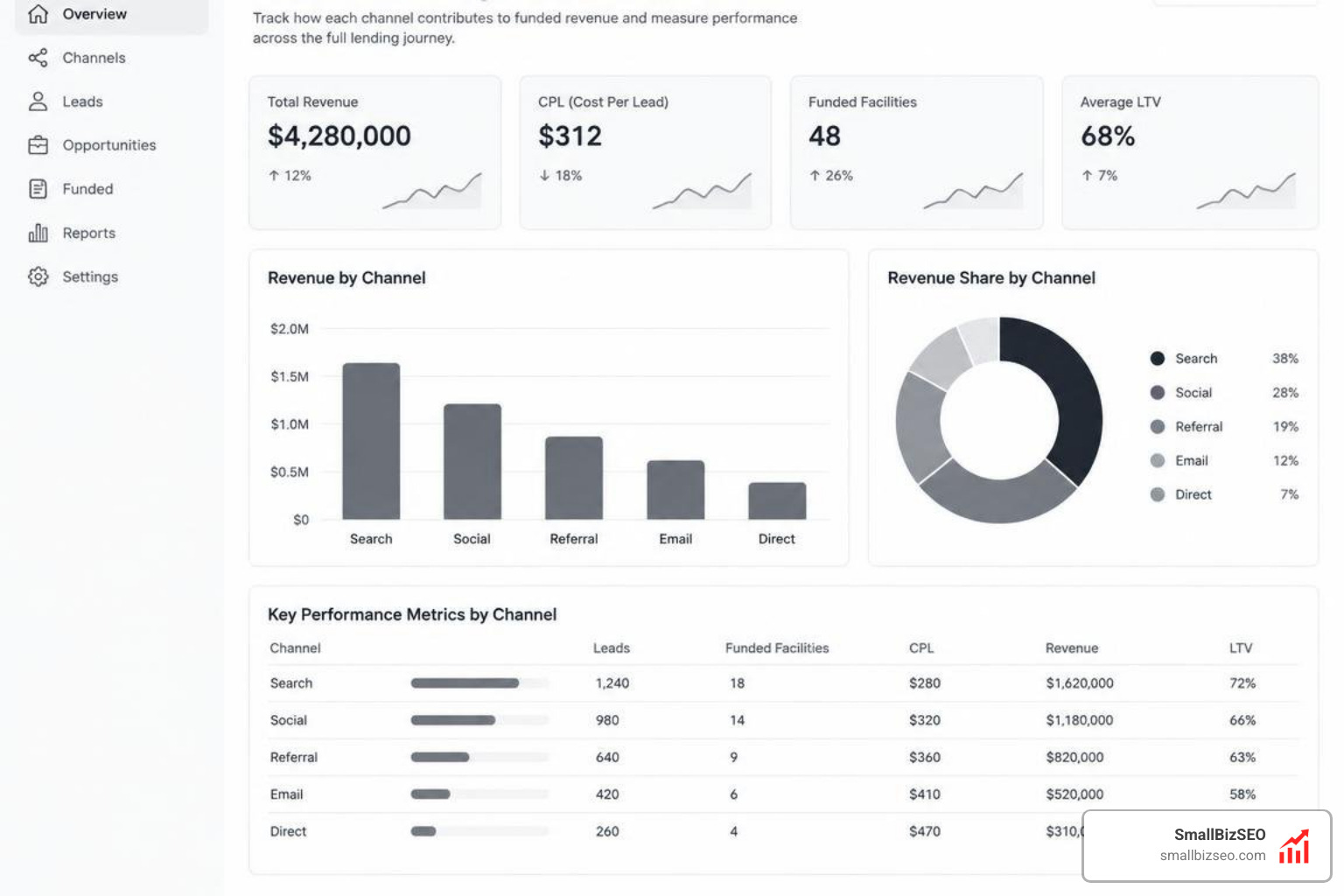
Marketing teams should track metrics beyond basic page views, focusing directly on pipeline economics:
- Cost per Lead (CPL): Inbound SEO routinely lowers qualified commercial finance CPLs from the typical $100–$350+ paid ad baseline down to sustainable organic acquisition costs.
- Cost per Funded Facility: The total organic investment divided by the number of active, funded borrowing accounts.
- Client Lifetime Value (LTV): Receivables facilities generate recurring discount fees over months or years, making initial SEO acquisitions highly profitable over time.
Lenders seeking complete transparency often partner with a specialized finance seo company or consult an accounting seo company to integrate CRM data directly with search analytics, tying every organic session back to funded balance-sheet volume.
How Does Answer Engine Optimization (AEO) Impact Commercial Finance Discovery?
Answer Engine Optimization (AEO) ensures your financing solutions are accurately indexed, cited, and recommended by AI answer engines and large language models.
When prospective corporate borrowers use AI engines to research facilities—asking queries like "Which accounts receivable lenders offer non-notification credit lines for logistics companies?"—these engines generate synthesized answers based on high-authority, semantically structured sources.
To maintain strong visibility across both traditional and AI-driven search, providers should utilize seo visibility audit automation to verify schema implementation, entity definitions, and factual consistency. Structuring your content around clear, direct answers ensures your brand remains the preferred recommendation across all digital search channels.
Turn Your Receivables Expertise Into a Pipeline of Funded Deals
Building a dominant search presence for accounts receivable loans requires more than publishing basic glossaries. It demands a sophisticated search engine optimization strategy that addresses commercial borrower intent, maintains rigorous compliance, and integrates conversion-focused tools like interactive fee calculators.
By structuring dedicated pages for AR loans and factoring, tailoring content to high-demand industries, and maintaining clean site architecture, your lending organization can turn organic search into a predictable lead generation engine. When you provide clear answers and transparent financial terms, search visibility translates directly into funded commercial facilities.