SEO Visibility Audit Automation: Let the Robots Do the Heavy Lifting
SEO Visibility Audit Automation: Let the Robots Do the Heavy Lifting
Search Has Changed — And Most Small Businesses Are Invisible to the New Engines
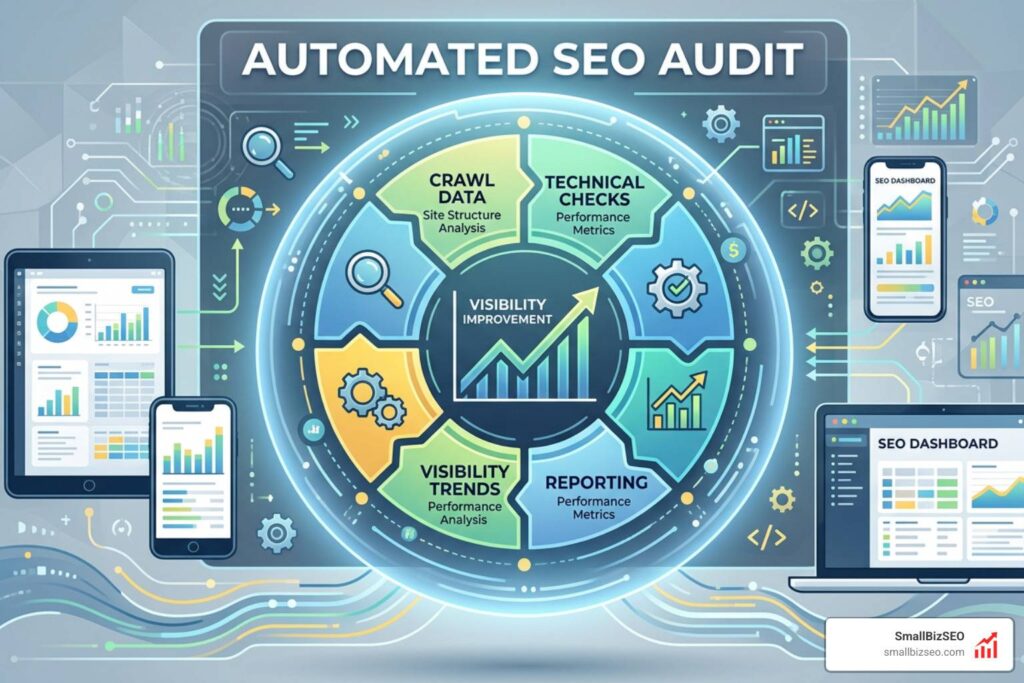
SEO visibility audit automation is the process of using software to continuously scan your website for technical issues, content gaps, and AI search ranking factors — without doing it all by hand.
Here's a quick look at what these tools check and who they're for:
| What It Audits | Examples |
|---|---|
| Technical SEO issues | Broken links, crawl errors, missing meta tags |
| On-page content quality | Headings, keyword usage, content depth |
| AI search visibility | ChatGPT citations, Perplexity mentions, brand authority |
| Structured data | Schema markup, JSON-LD, llms.txt |
| Performance signals | Core Web Vitals, mobile usability, page speed |
Best for: Small business owners, agencies, SaaS marketers, and e-commerce brands who want to rank on both Google and AI engines — without spending hours on manual audits.
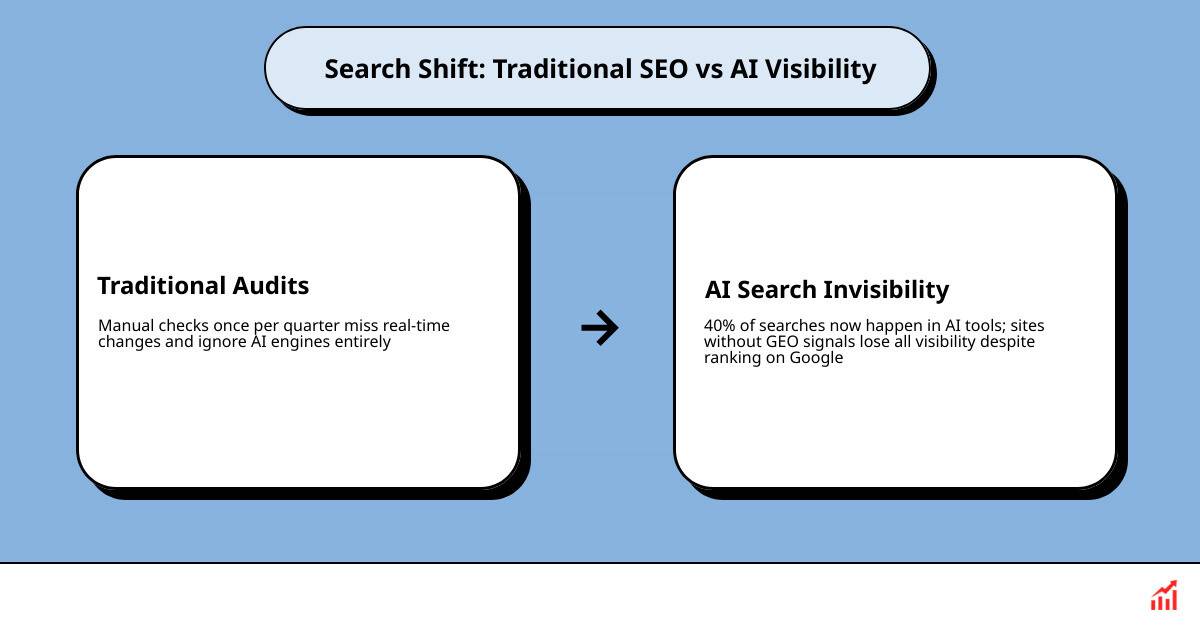
Something big is happening in search right now. Around 40% of searches now happen inside AI engines like ChatGPT, Gemini, and Perplexity. AI-referred traffic is growing at over 500% year over year. And yet, most websites are completely invisible to these new engines.
Here's the problem: your site might rank #1 on Google and still score zero for AI readiness. Traditional SEO audits weren't built to catch that.
That's why SEO visibility audit automation matters more now than ever before. Running manual checks once a quarter is no longer enough. You need tools that watch your site around the clock — and flag issues before they cost you traffic.
I'm Clayton Johnson, and I've spent years using digital PR and technical SEO to help businesses improve their search visibility. I've worked hands-on with SEO visibility audit automation tools across dozens of campaigns, so I know exactly what separates the platforms worth your time from the ones that just look good on a demo call. In this roundup, I'll walk you through the best options available today, so you can find the right fit fast.
The Evolution of Search: Why You Need SEO Visibility Audit Automation
The search landscape is undergoing a massive shift. Gartner predicts a 50% drop in traditional search traffic by 2028 as users migrate to conversational AI assistants. We are no longer optimizing solely for a list of ten blue links. Instead, we must optimize for Generative Engine Optimization (GEO) and Answer Engine Optimization (AEO).
When an AI engine synthesizes an answer, it pulls from websites it deems highly authoritative, structured, and easy to parse. If your site has technical crawl blocks, poor semantic formatting, or lacks clear trust signals, AI crawlers will simply bypass your content.
To keep pace, businesses must move away from static, manual spreadsheets. Investing in an automated SEO Visibility Audit ensures that you are constantly monitoring how search engines and large language models (LLMs) perceive your brand. Transitioning to Continuous Automated SEO Audits allows your marketing team to detect regressions immediately rather than discovering them weeks later when traffic drops.
Key Differences: Traditional Audits vs SEO Visibility Audit Automation
Traditional SEO audits focus heavily on static elements like keyword density, metadata, and backlink profiles. While these elements still matter, they only tell half the story. Automated SEO visibility audits look at real-time accessibility, schema validation, and brand mentions across AI search databases.
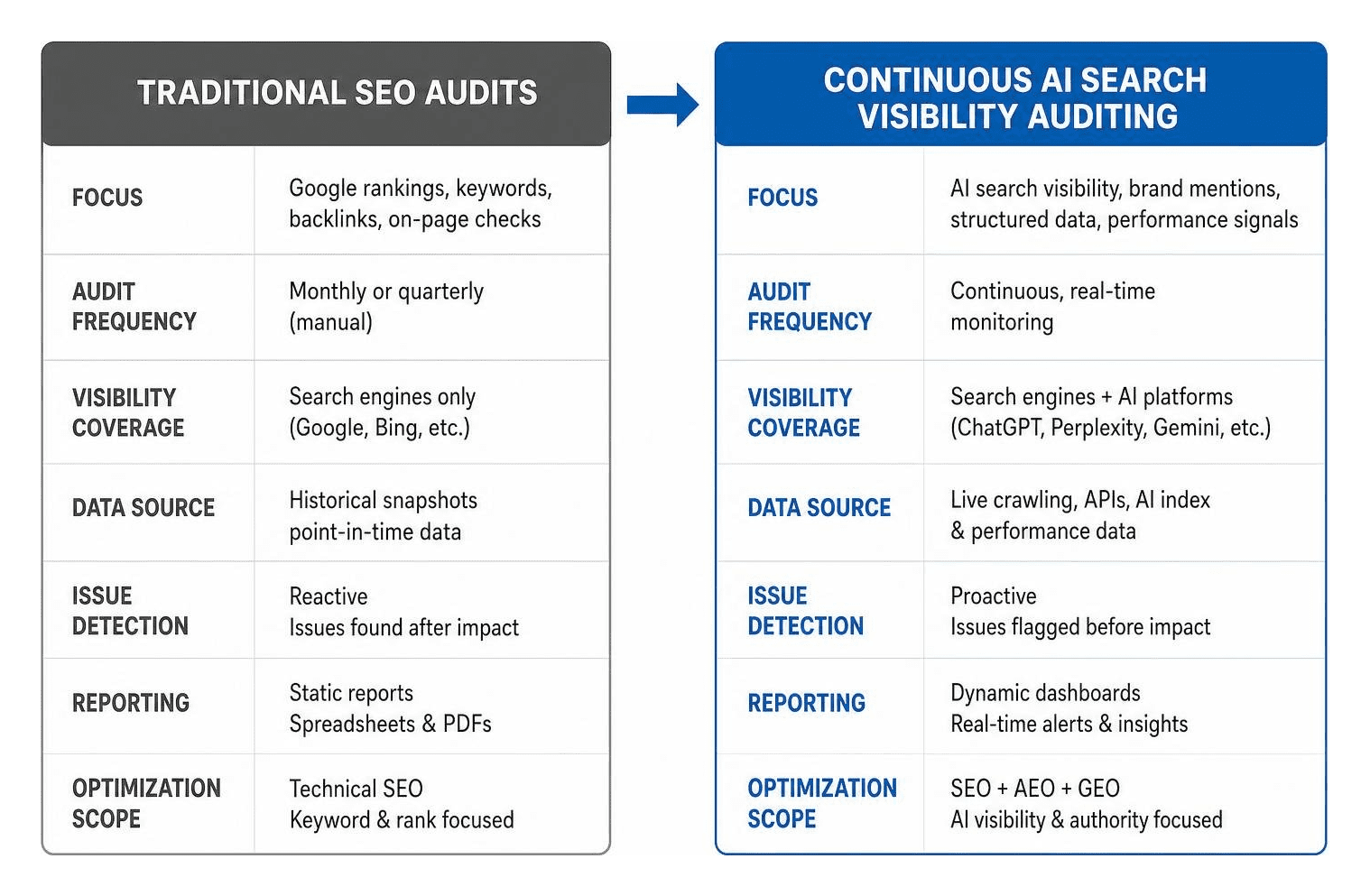
To help you visualize how these two approaches stack up, here is a breakdown of their primary differences:
| Feature | Traditional SEO Audits | Automated SEO Visibility Audits |
|---|---|---|
| Audit Frequency | Monthly or quarterly (manual) | Continuous, real-time monitoring |
| Primary Focus | Keywords, backlinks, on-page tags | AI citation readiness, crawlability, schema |
| Data Sources | Static crawl exports, spreadsheets | Live Google Search Console, GA4, and LLM APIs |
| Actionable Output | Long, static PDF reports | Prioritized issue lists with automated fix prompts |
| Crawl Depth | Limited by manual execution limits | Deep, scheduled multi-agent crawling |
By using a Detailed SEO Analysis tool, you get a dynamic view of your performance across both traditional SERPs and generative engines.
How to Implement SEO Visibility Audit Automation for AI Search Engines
To build an automated workflow that targets engines like ChatGPT, Claude, Gemini, and Perplexity, you need tools that run scheduled prompts and evaluate your brand's share of voice. The goal is to ensure that your site is easily readable by LLM scrapers and that your content is structured in bite-sized, fact-rich blocks.
For developers and technical teams, open-source codebases like context-dot-dev/ai-seo-audit offer a production-ready page-level audit engine. This tool scores your pages across critical categories like content chunking, schema markup, and E-E-A-T signals, generating direct fix prompts that you can feed into coding assistants to deploy updates in seconds.
Top Platforms for Automated SEO and AI Visibility Auditing
Choosing the right tool depends on your team's size, technical expertise, and whether you are managing a single site or a portfolio of client domains. Let's look at the top platforms leading the market.

When evaluating software, some teams choose to partner with external experts. You can explore the 15 Best SEO Audit Companies to see how agencies leverage these automated platforms to scale their client reporting.
SEO Site Checkup
SEO Site Checkup is an excellent all-in-one platform for technical SEO and LLM visibility checks. It features a dedicated LLM Visibility Checker and AI Content Analysis tool that help you understand why AI search bots might be ignoring your pages.
With deep domain analysis across more than 70 technical factors and white-label reporting features, it is a favorite for growth agencies and content-led companies. It helps you quickly identify why your product descriptions or blog posts are failing to trigger AI mentions, allowing you to optimize your pages for maximum LLM comprehension.
Semrush
Semrush remains an industry heavyweight, and its upgraded Site Audit tool now includes robust AI Search Health monitoring features. If you have been wondering Why Your Rankings Are Still Stuck, Semrush's automated tracker can run over 140 technical and on-page checks to find crawl blocks and indexation errors. It helps you ensure that your site meets Google's strict mobile-usability standards while keeping your content structured for easy AI retrieval.
SEOptimer
If you need fast, highly visual, and affordable reporting, SEOptimer is a great option. It features a complete GEO suite that analyzes websites across 100 data points in under 20 seconds. It also includes an embeddable audit tool that digital agencies can use as a lead magnet on their own websites. For teams looking to win local and organic search simultaneously, SEOptimer provides clear, prioritized tasks that do not require deep technical expertise to implement.
Seobility
Seobility excels at automated crawling and deep technical analysis. It checks up to 300 factors on every page, highlighting duplicate content, broken links, and canonical errors.
Crucially, Seobility monitors AI bot accessibility, showing you if your robots.txt file is accidentally blocking crawlers like OAI-SearchBot or Claude-SearchBot. Ensuring that your site passes these checks is essential if you want to learn How to Pass Google's Own SEO Analysis Audits and secure real-time citations.
SEOcrawl AI
SEOcrawl AI is built specifically for the modern search era, offering a native AI visibility layer on top of standard rank tracking. It allows you to configure specific buyer prompts and run them on a recurring schedule across ChatGPT, Claude, Gemini, Perplexity, and Copilot. SEOcrawl AI tracks your brand mentions, competitor citations, and overall share of voice, while integrating directly with Google Search Console and GA4 to segment the actual traffic sent to your site by LLMs.
Measuring AI-Readiness: Metrics, Schema, and Crawler Access
To rank in conversational search, you must measure your site's "AI-readiness." This involves tracking citability scores, brand authority, and technical machine-readability.
For teams looking to build their own custom auditing pipelines, the rawphp/claude-seo repository provides an agent-based SEO analysis system. It orchestrates parallel subagents to analyze technical SEO, Core Web Vitals, and GEO readiness, saving versioned run histories so you can track your optimization progress over time.
Optimizing Schema Markup and Structured Data for LLMs
Structured data is the primary language of AI database scrapers. Without clear schema markup, search bots have to guess what your page is about. Implementing schema markup like Organization, LocalBusiness, and Article templates with robust sameAs signals helps search engines map your brand to the correct entities.
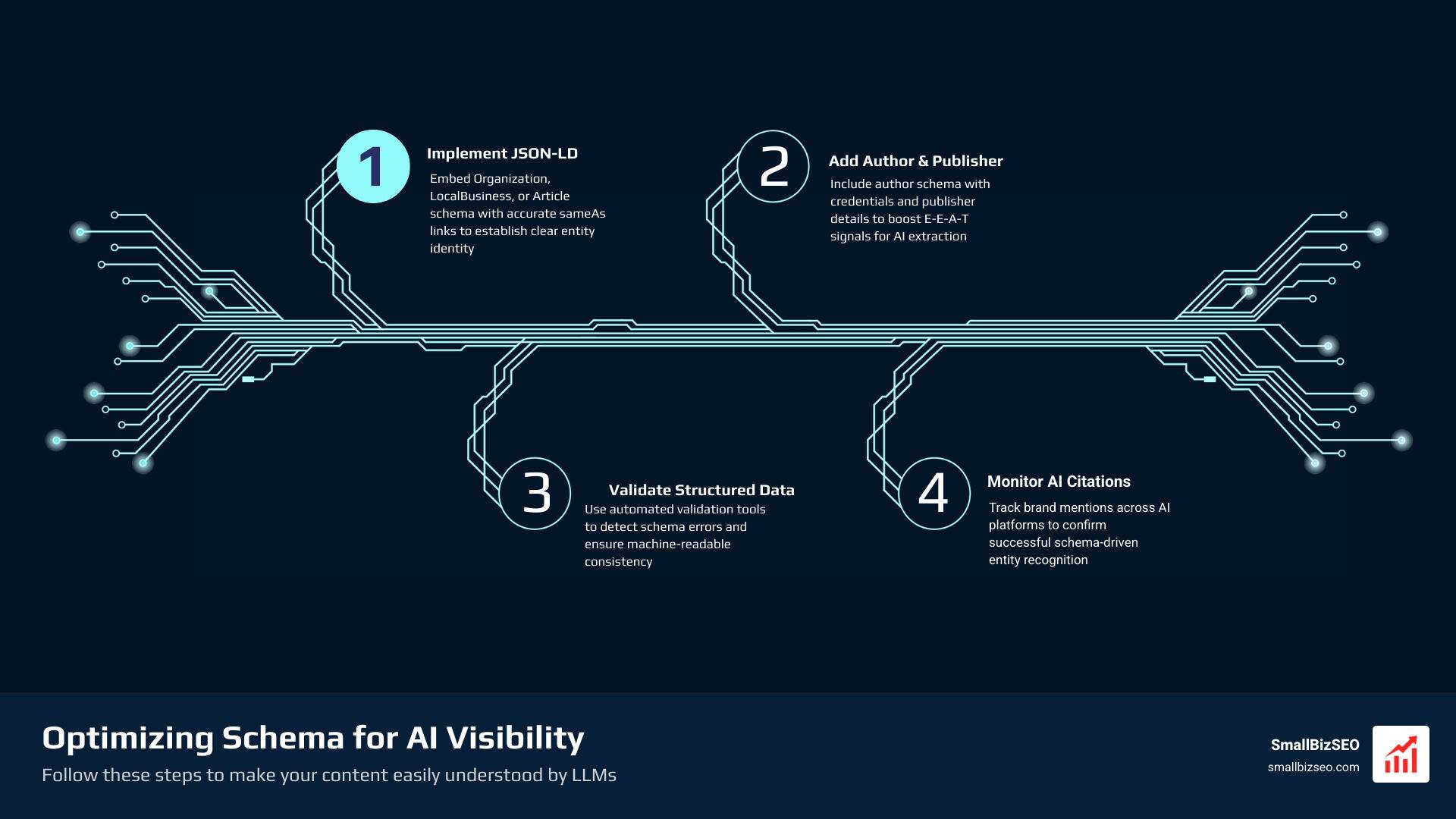
To build trust with both Google and generative engines, you must Optimize E-E-A-T Signals Today. Adding author schema, publisher details, and clear source citations directly into your JSON-LD code makes your content highly credible and easy for AI engines to extract.
Managing AI Crawler Access with Robots.txt and llms.txt
If your robots.txt file blocks user-agents like OAI-SearchBot, Claude-SearchBot, or PerplexityBot, your site will never appear in their conversational answers. Automated audits quickly scan your robots.txt to ensure these crawlers are allowed.
Additionally, modern websites are adopting the llms.txt standard—a simple markdown file located in your root directory that serves as a clean, high-level directory of your site's structure specifically for LLMs. For more advanced implementation details, check out the SEO Features - Visibility.so Documentation to learn how to structure your assets for automated AI crawling.
How Modern Businesses Leverage Automated SEO Audits
Whether you are an agency managing dozens of clients or an in-house marketer keeping a SaaS site healthy, automated audits save hundreds of hours of manual labor. They allow you to focus on high-level strategy and content creation while the software handles the repetitive technical QA.
To build sustainable search traffic, businesses must understand How to Optimize Your Content for E-E-A-T and Build Real Search Trust. Running an automated AI Brand Visibility Audit ensures your brand mentions are consistent across the web, as brand mentions correlate three times more strongly with AI search visibility than traditional backlinks.
Integrating Audits with Google Search Console and GA4
To get the most out of your automated auditing stack, you must connect it directly to your primary analytics tools. This allows you to turn raw Data Into Traffic by aligning technical issues with actual traffic drops.
When your auditing platform integrates with Google Search Console and GA4, it can automatically detect anomalies, segment AI-referred traffic, and send branded, white-label PDF reports to your stakeholders on a scheduled basis.
Overcoming the Limitations of Pure Automation
While automated tools are incredibly powerful, they cannot completely replace human strategy. An automated tool can tell you if a page is missing a keyword, but it cannot tell you if the content actually answers your customer's questions or aligns with your brand voice.
The best approach is a hybrid model: use automation to handle continuous monitoring, crawl errors, and data collection, then use your human team to perform a Keyword Gap Analysis: What It Is and How to Do It Right. This ensures your content remains highly competitive, original, and valuable to real human readers.
Frequently Asked Questions about SEO Visibility Audits
Can automated SEO tools track visibility in AI engines like ChatGPT?
Yes. Modern SEO automation tools use prompt tracking to monitor your brand's presence across ChatGPT, Claude, Gemini, Perplexity, and Copilot. They run scheduled queries, analyze the responses for your brand name or URL, and calculate your share of voice compared to your competitors.
What is the difference between SEO automation and programmatic SEO?
SEO automation refers to using software to automate the monitoring, auditing, and reporting processes of SEO. Programmatic SEO, on the other hand, is the practice of generating large numbers of search-optimized landing pages at scale using structured databases and templates.
How often should a business run an automated SEO audit?
For the best results, you should run automated audits continuously. While traditional audits were performed quarterly, modern platforms allow you to schedule daily or weekly crawls to catch code regressions, broken links, and indexing issues before they hurt your search rankings.
Conclusion
The search landscape is changing fast, but your business does not have to get left behind. By embracing SEO visibility audit automation, you can let software handle the tedious technical checks while your team focuses on high-impact growth strategies.
At SmallBizSEO, we help businesses navigate this new era of search. Our data-driven "Velocity" framework delivers fast rankings and E-E-A-T-compliant growth through transparent, automated reporting.

Ready to see how your website stacks up in both Google and the leading AI search engines? Get started with our comprehensive SEO Visibility Audit today, and let us help you build a search presence that is ready for the future.