AI Brand Recommendation Data Reveals Surprising Gaps for Challengers

AI Brand Recommendation Data Reveals Surprising Gaps for Challengers
How often does AI recommend small businesses alongside major brands?
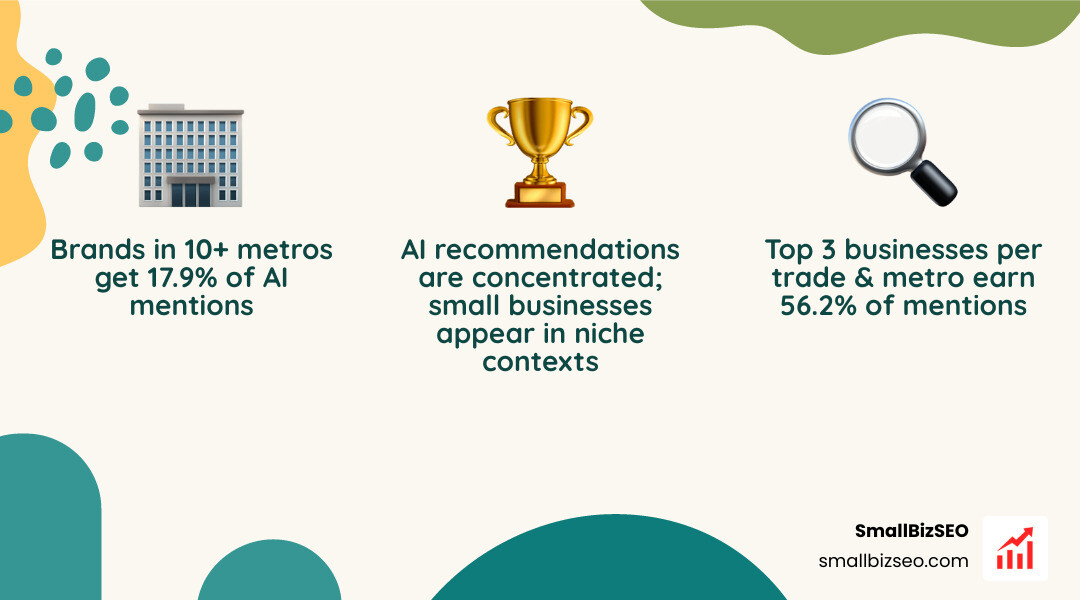
Small businesses do appear in AI recommendations, but there is no single share that applies to every industry or prompt. In one study of local business recommendations across 40 US metros, brands with a presence in at least 10 metros received 17.9% of mentions. The remaining mentions were not all verified small businesses. Visibility was also uneven: the top three businesses in each trade and metro received 56.2% of mentions.
To check your own visibility, ask several AI tools the questions your customers ask. Record which businesses they name, whether yours appears, and whether your prices and services are correct. Repeat the test over time; one answer is not a reliable benchmark.
I'm Clayton Johnson, an SEO and digital PR strategist focused on the question "AI Brand Recommendation Statistics: How Often Do Small Businesses Appear Alongside Major Brands?" My work connects search visibility, earned coverage, and AI discovery so smaller brands can be found and described accurately.
How Often Do Small Businesses Appear Alongside Major Brands in AI Recommendations?
Small businesses appear in AI recommendations frequently, but their inclusion depends heavily on query specificity, industry fragmentation, and local entity signals. While national enterprises capture high baseline awareness, generative models draw from broad web sources where independent companies dominate niche contexts.
When evaluating broader small business statistics, market presence does not automatically translate into generative engine placement. Large language models (LLMs) synthesize information differently than traditional search engines. Instead of presenting a clean list of ten ranked links, AI platforms assemble short, highly concentrated lists of recommendations based on retrieved text across the web.
| Industry Vertical | Top-3 Recommendation Share | National Chain Dominance | Direct Visit Lift After Recommendation |
|---|---|---|---|
| Financial Services | 64.0% | High (>70%) | +7.2% to +14.2% |
| Moving & Relocation | 56.2% | Moderate (51.0%) | +8.5% |
| Pest Control | 54.8% | Moderate (42.0%) | +9.1% |
| HVAC & Home Repair | 52.1% | Near Zero (<5%) | +11.4% |
| Legal & Professional | 48.6% | Near Zero (<2%) | +12.8% |
| Veterinary Services | 47.3% | Near Zero (<1%) | +10.3% |
How Does AI Recommendation Share Compare Across Local Search and Category Leaders?
In local markets, recommendations concentrate heavily among the top three spots, while broad category leaders capture only a tiny fraction of total national prompts.
A comprehensive study on local recommendation concentration revealed that across 21 trades, the top three businesses in any given market secure 56.2% of all AI mentions, with the single top-ranked business capturing 24.7%. However, across broad, non-local product categories, category leaders capture only 2% to 8% of total AI recommendations. In diverse commercial sectors, it often takes between 17 and 76 distinct brands to account for just half of all AI-generated suggestions, creating massive room for challengers.
What Factors Determine Whether AI Models Recommend Small Firms Over National Giants?
AI models recommend small firms when they find clear entity definitions, structured data, and independent corroboration across third-party sources.
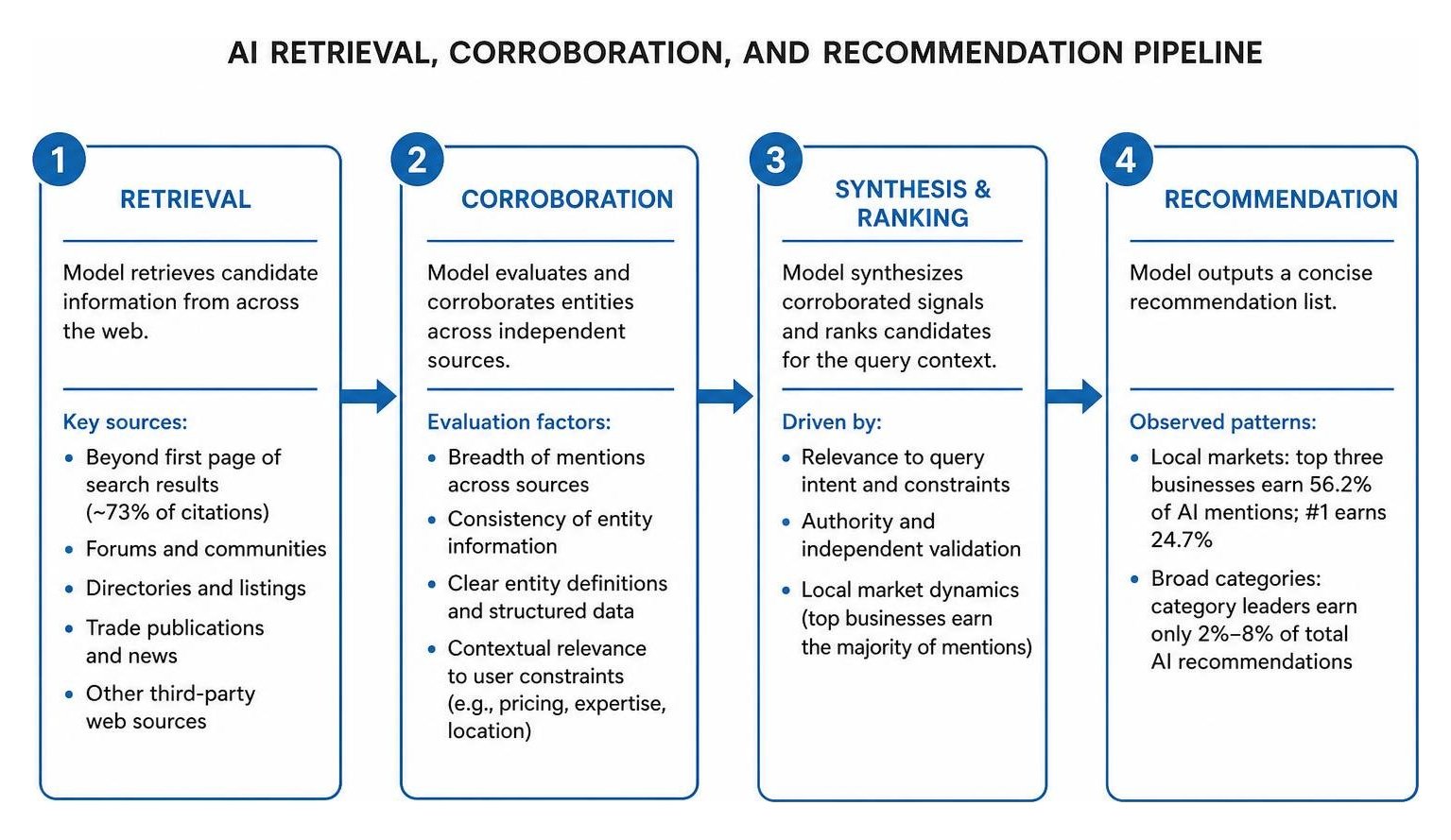
Large brands naturally benefit from massive public text footprints. However, research on AI recommendation retrieval sources demonstrates that AI engines do not simply mirror standard search engine result pages; approximately 73% of citations in AI overviews originate beyond the first page of organic search results.
When models evaluate candidates, they rely on:
- Breadth of mentions across forums, directories, and trade publications.
- Contextual relevance to specific user constraints (such as pricing tiers, specializations, or location).
- Independent verification from third-party reviews and editorial profiles.
How Does AI Recommendation Affect Traffic, and How Wide Is the Adoption Gap?
Appearing in an AI recommendation drives immediate, high-intent traffic directly to brand websites while reducing traditional exploratory search queries.
As documented in a Federal Reserve study on small business AI adoption, consumer discovery habits are changing quickly. Buyers increasingly rely on conversational assistants to shortlist vendors, fundamentally altering how traffic flows from discovery to conversion.
How Do Direct Visits, Branded Search, and Consumer Conversions Change?
When an AI assistant recommends a specific brand, direct website visits increase by 7.2% to 14.2%, while traditional search volume for generic category terms drops by roughly 15%.
For example, when major financial brands like American Express or Capital One are recommended in generative answers, their direct site traffic climbs by 7.2% and 14.2% respectively. Consumers bypass the traditional search engine results page entirely. For small challengers, being named in an AI summary delivers pre-qualified visitors who are already deep in the consideration funnel.
How Do Enterprise and Small Business AI Adoption Rates Compare?
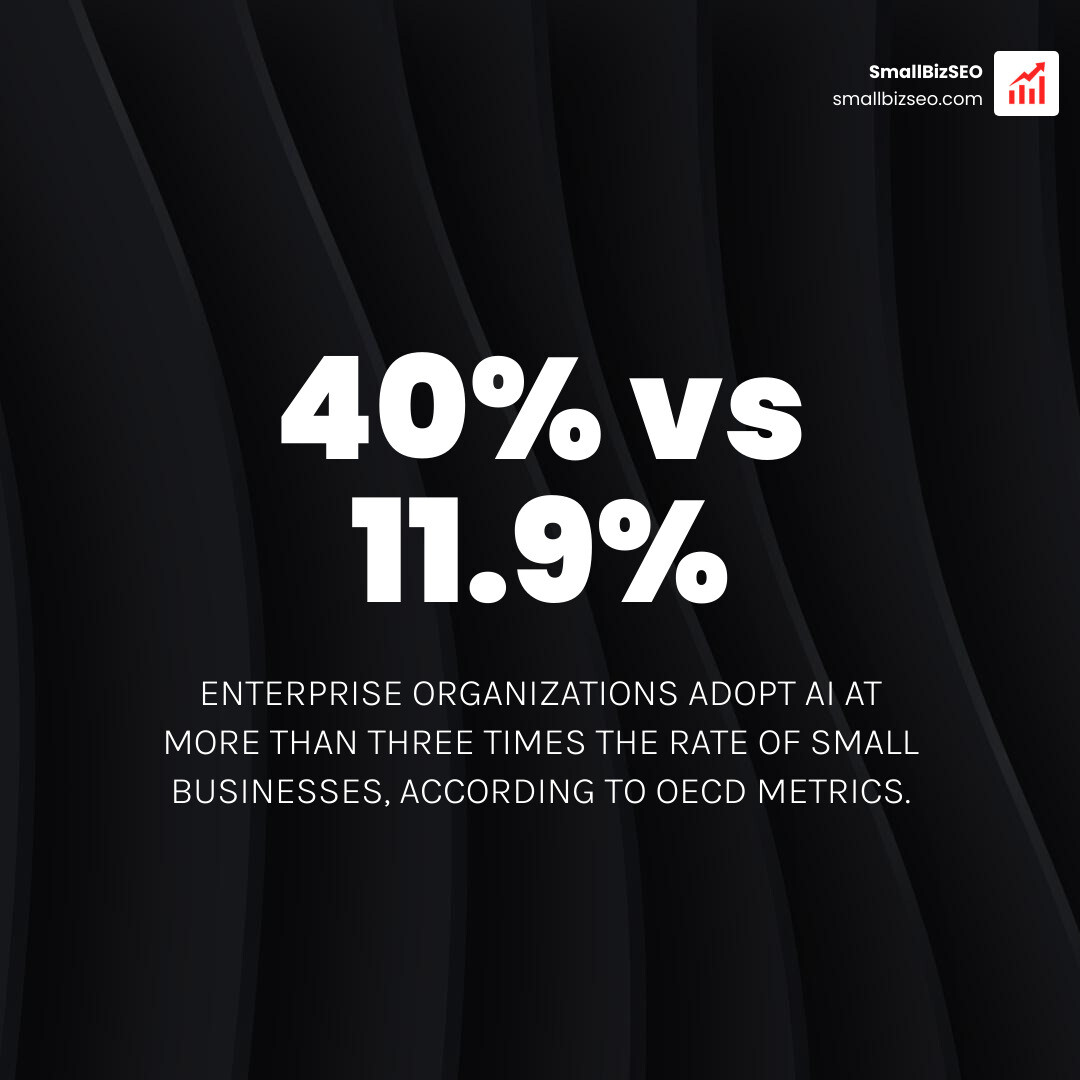
Enterprise organizations adopt artificial intelligence at more than three times the rate of small enterprises, creating a persistent operational divide.
A comprehensive literature review on AI diffusion among small businesses highlights clear structural discrepancies:
- Overall Adoption Divide: Across OECD countries, 40% of large firms use artificial intelligence compared to just 11.9% of small businesses.
- Core Workflow Integration: Among small and medium enterprises utilizing generative AI, only 29% incorporate it into their core business activities.
- Specialized Technology Gaps: Advanced applications like autonomous systems show an adoption gap of 7.2% in large enterprises versus 0.7% in smaller firms.
How Accurate Are AI Brand Recommendations, and Where Do Errors Come From?
Approximately one in five AI-generated brand answers contains factual inaccuracies, and more than half of those errors originate directly from the brand's own website.
The 5W Hallucination Index estimates the baseline error rate in generative brand responses at 20%. Running the AI SEO audit tracking signals regularly helps uncover why these models misrepresent product capabilities, service areas, and operational details.
Why Do Over Half of AI Brand Errors Trace Back to Business Websites?
AI models repeat false claims about 54% of brands because they scrape ambiguous, outdated, or poorly structured pages hosted on the company's own domain.
When businesses update their service offerings but leave legacy landing pages, old PDF brochures, or outdated announcements live on their servers, generative scrapers digest both versions. Lacking human context, the model struggles to determine which information is current and frequently surfaces retired information as active reality.
How Do Pricing Hallucinations and Multi-Source Earned Media Errors Occur?
Pricing data accounts for 12% of all AI brand statements and represents 24% of all AI-generated errors, making it the most volatile topic for brand accuracy.
For two out of three brands, pricing represents the single worst area of accuracy. Furthermore, earned media errors compound this challenge. While the ten worst general web publishers cause only 13% of third-party errors across the web, damage for any single brand typically concentrates on about four specific, unmanaged publisher sites that provide conflicting details to retrieval algorithms.
How Can Challenger Brands Improve Their Discovery in AI Answers?
Small brands can secure consistent placement in generative answers by implementing structured entity optimization, cultivating third-party citations, and publishing clear, factual answers.
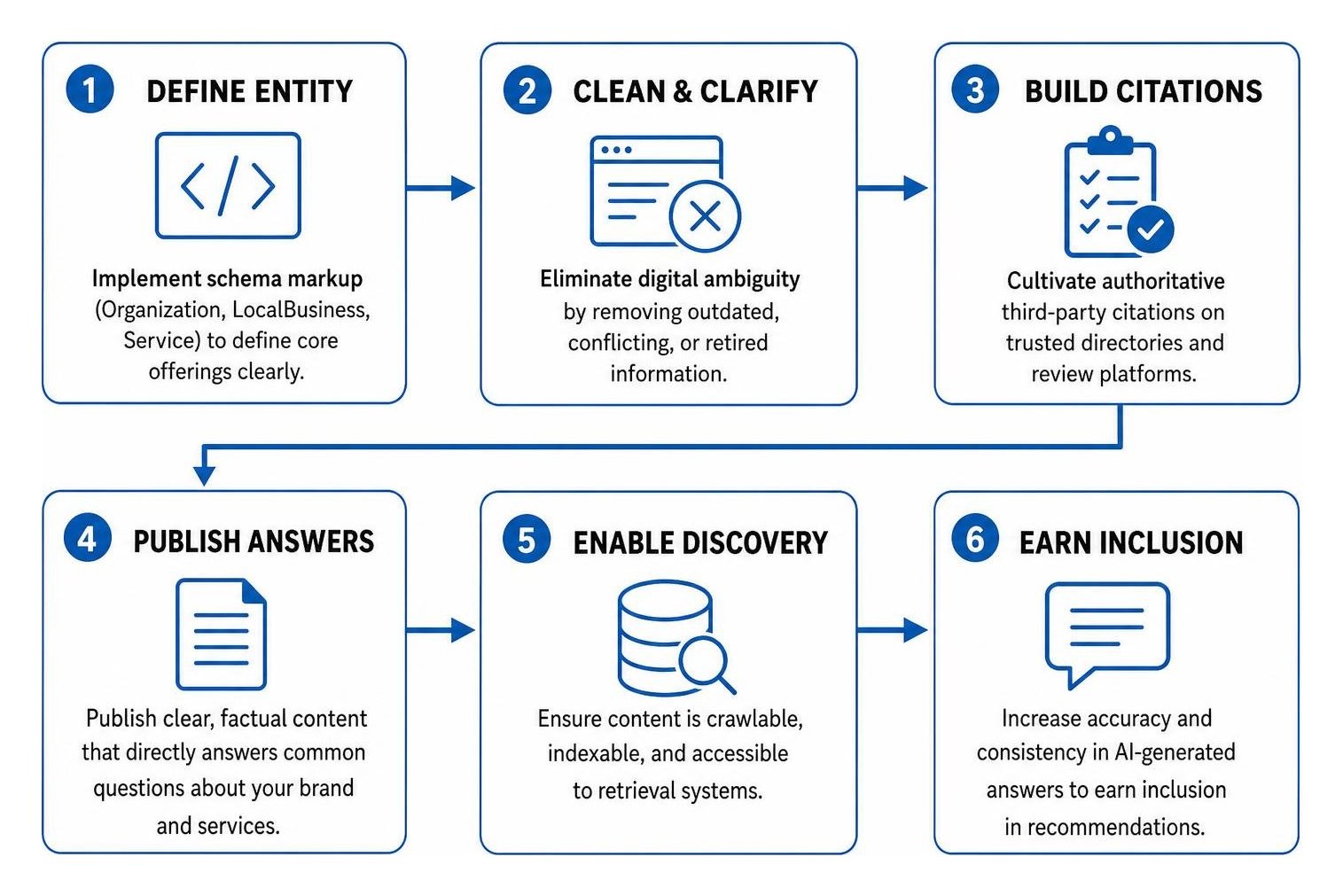
Following our practical guide to showing up in LLM answers, small businesses must align their digital footprints with how retrieval-augmented generation systems gather evidence.
- Implement Strict Schema Markup: Use Organization, LocalBusiness, and Service JSON-LD schemas to define your core offerings unambiguously.
- Eliminate Digital Ambiguity: Audit and remove retired pricing tables, legacy service pages, and conflicting addresses from your website.
- Cultivate Authoritative Directories: Maintain pristine, verified listings on authoritative industry hubs, the Better Business Bureau, and niche review portals.
- Target Qualified Queries: Publish comprehensive guides addressing narrow customer needs (such as vertical-specific compliance or specialized service tiers) where national brands offer only generic advice.
How Often Do Small Businesses Appear Alongside Major Brands in Local Services?
In local service categories, independent businesses dominate recommendation volume, capturing over 80% of mentions in sectors with low chain presence.
While national franchises capture 51% of moving mentions and 42% of pest control suggestions, categories such as HVAC repair, legal services, veterinary care, real estate, and medical spas exhibit near-zero chain dominance. In these trades, local authority and consistent directory citations provide small firms with a decisive advantage over national competitors.
How Often Do Small Businesses Appear Alongside Major Brands Across AI Search Engines?
Cross-platform consensus is extremely rare, with only 1.5% of local businesses appearing across all major generative engines simultaneously.
In empirical testing across hundreds of queries:
- Approximately 80% of businesses mentioned by an AI platform appear on only one specific engine.
- Real-time retrieval engines like Perplexity reflect newly published website updates within weeks.
- Training-reliant models like standalone conversational assistants take months to absorb brand changes.
- Authoritative third-party platforms like the Better Business Bureau, Yelp, and specialized trade directories serve as the primary citation grounding across engines.
What Are the Most Common Questions About Small Business AI Visibility?
Business owners frequently ask how generative models select recommendations, why data inaccuracies occur, and where smaller firms hold the greatest competitive edge.
Can Small Businesses Realistically Get Recommended by AI Over Major Brands?
Yes, small businesses regularly win recommendations on detailed, high-intent queries that specify location, niche specializations, or unique operational constraints. Because large national brands create broad, generalized content, generative engines favor localized and deeply specialized providers when responding to complex user prompts.
Why Does AI Make Pricing and Product Errors About Small Businesses?
AI engines misquote prices because they extract unformatted tables, promotional archives, and outdated third-party reviews. If your pricing structure lacks explicit schema markup or contains conflicting numbers across different web pages, language models frequently hallucinate intermediate or obsolete figures.
Which Industries Offer Small Businesses the Highest AI Recommendation Share?
Sectors with fragmented local markets—including HVAC maintenance, boutique legal practices, veterinary clinics, medical spas, and accounting firms—offer the highest small business recommendation rates. In these industries, national chains represent less than 5% of total generative mentions.
Stepping Forward in the Era of Generative Discovery
Appearing alongside industry giants in conversational search is no longer an insurmountable challenge reserved for massive marketing budgets. Because artificial intelligence prioritizes relevance, local context, and third-party corroboration, agile challenger brands can claim substantial visibility across generative platforms.
By auditing your website for outdated information, structuring your technical data, and establishing verifiable authority across trusted industry platforms, your business can secure its place in modern search shortlists. Review these key generative AI statistics for business owners to keep refining your digital discovery strategy.