AI Citation Rate 101: Understanding Impact & Accuracy

What Is AI Citation Rate, and Why Does It Matter?
AI citation rate is how often an AI answer links to your website across a set of tracked questions. If your site is cited in 8 of 100 answers, its citation rate is 8% for that set. Track it separately for each AI platform: a brand can appear often in one and rarely in another.
For a small business, this shows whether its pages are being used as sources when people ask about the problems it solves. But a citation is not the same as a brand recommendation or a new lead. You also need to know which questions earned the citation and whether the answer described your business accurately.
I'm Clayton Johnson, founder of SmallBizSEO. My work in SEO, content, and AI-driven discovery shapes how I assess ai citation rate: as one measure of visibility, alongside the quality of the answer and the leads it may bring.
Decoding the AI Citation Rate: Cross-Platform Benchmarks and Retrieval Signals
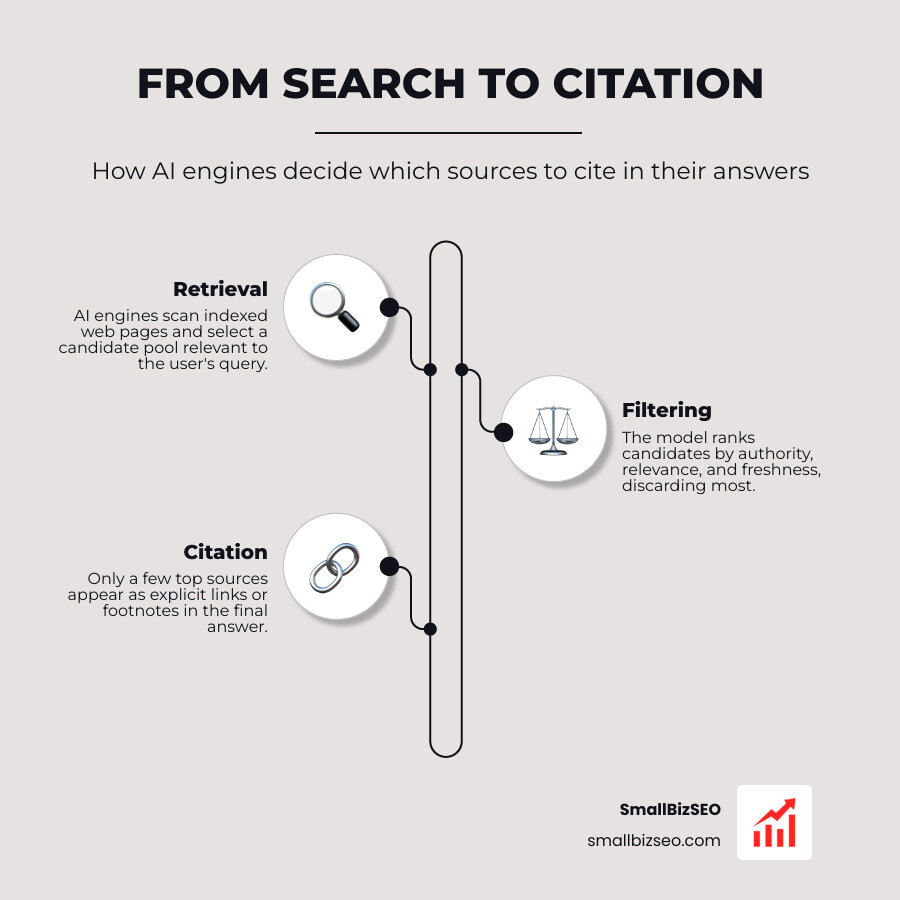
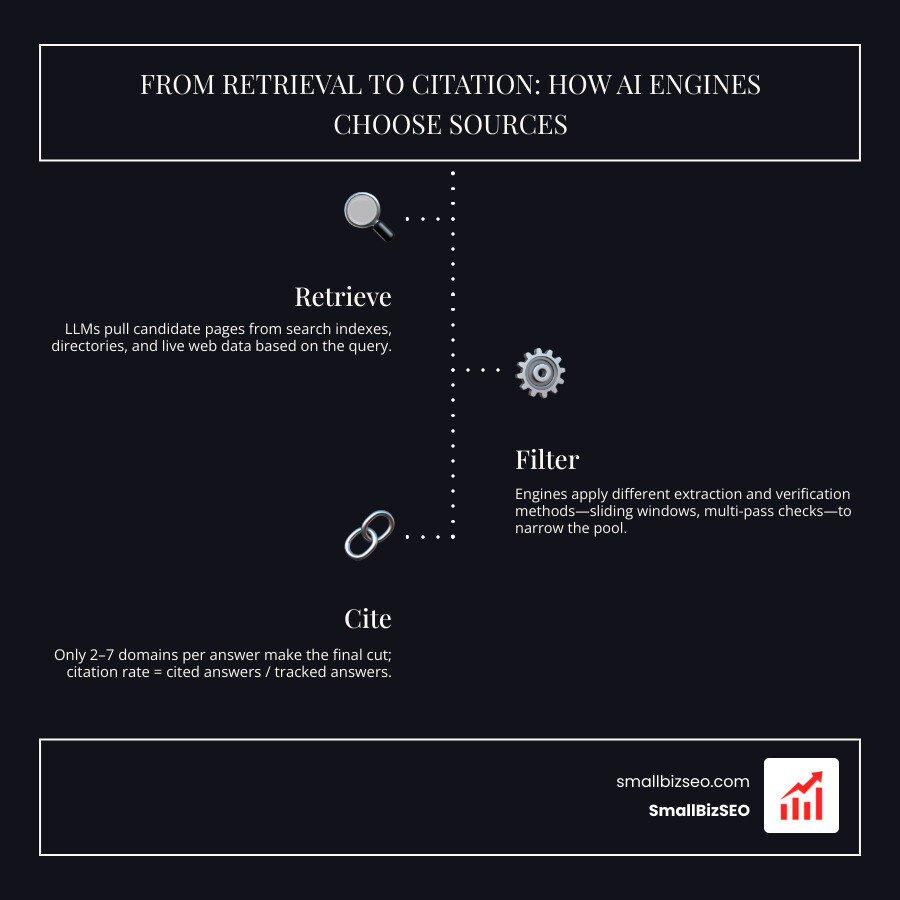
AI citation rates differ dramatically across platforms because each large language model (LLM) uses a unique retrieval-augmented generation (RAG) pipeline to gather web information. In short, being retrieved into an engine's candidate pool does not guarantee that your page will appear as an explicit footnote or link in the final answer. Understanding this transition from retrieval to citation—what we call source-to-cite conversion—is the foundation of establishing sustainable AI visibility.
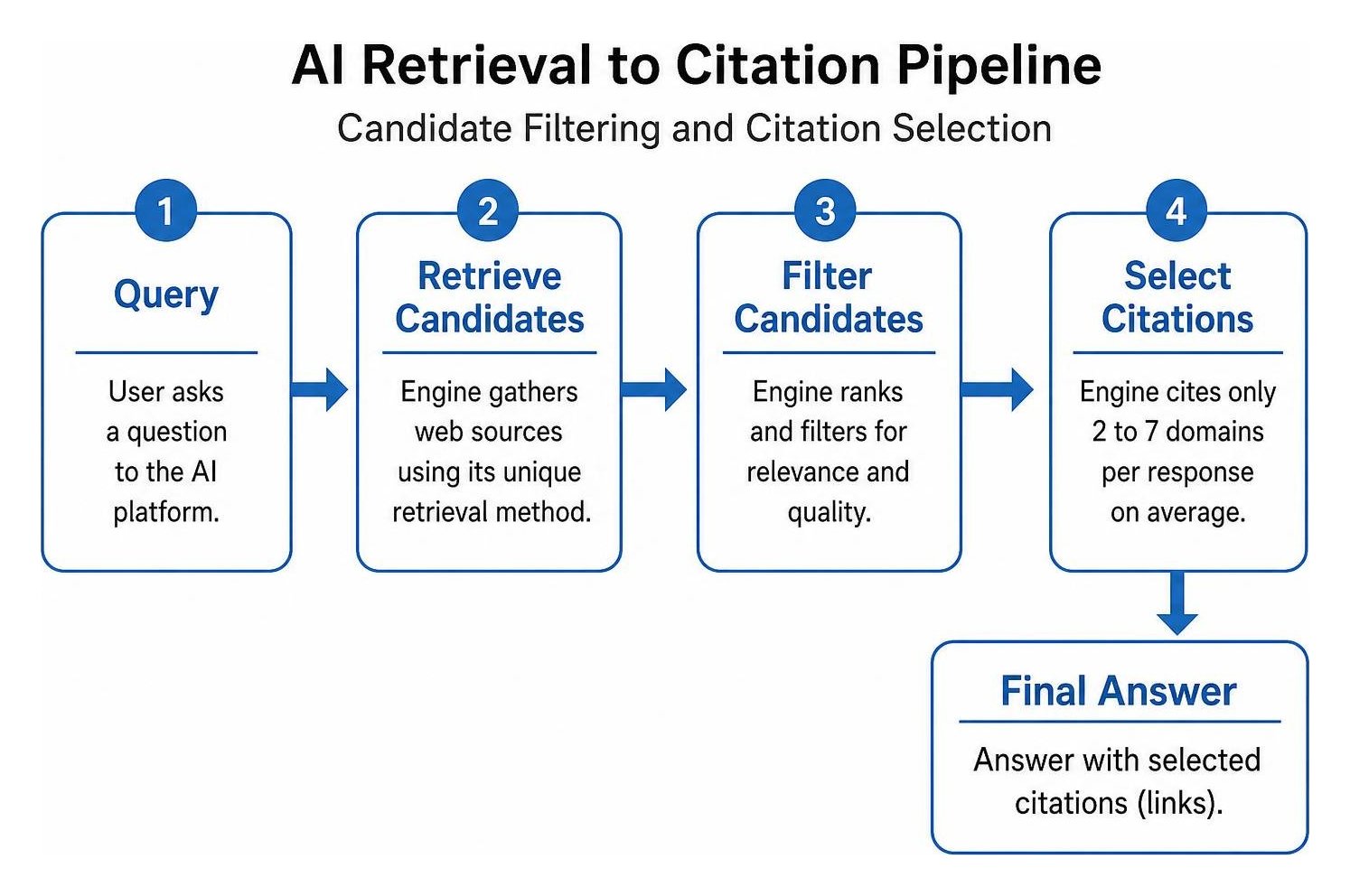
As shown in cross-engine citation analysis, engines process text passages using wildly different extraction mechanisms. While one model might read an entire article and perform multi-pass verification, another might rely purely on short search snippets or a sliding text window of 100 to 200 words. Furthermore, peer-reviewed research on News Source Citing Patterns in AI Search Systems demonstrates that LLMs cite only 2 to 7 domains per response on average. This represents a far more compressed real-estate market than traditional search engine results pages that present ten blue links.
| Platform | Primary Retrieval Focus | Average Citations per Run | Citation Behavior |
|---|---|---|---|
| ChatGPT | Encyclopedic depth, authoritative directories, recent news | Moderate (7 to 8 citations) | Generous with citations, pulling multiple references from authoritative domains. |
| Google AI Overviews | Top-10 organic search results, high E-E-A-T pages | Conservative (balanced) | Highly selective; leans directly on established search rankings and brand-owned pages. |
| Perplexity | Real-time web data, community forums, live feeds | High (20+ citations) | Research-first structure; places inline citations on almost every factual claim. |
What Is a Benchmark AI Citation Rate Across ChatGPT, Perplexity, and Google AI Overviews?
A "good" citation rate depends entirely on the engine you measure. In ChatGPT, citation distribution is generous: roughly 31% of cited URLs appear more than twice per AI answer, and those multi-cited links make up 59% of all platform citations.
Conversely, Google AI Mode and AI Overviews operate with strict restraint. More than 9 out of 10 URLs register a citation rate below 1.0 per query run, meaning the engine rarely references the same webpage multiple times in a single overview.
Perplexity represents an environment of two extremes. Data reveals that 64% of retrieved URLs are never cited in the final output, while an elite 6% of high-performing URLs capture citation rates of 2.0 or higher. According to industry vertical citation benchmarks, the 10th most-cited source in any given category sits at a median rate of 8.6%, though this ranges from 4.3% in competitive niches to 16.1% in specialized fields.
How Do Prompt Intent and Content Formats Influence Citation Probability?
Prompt intent heavily dictates which web pages make the final cut. For informational and commercial intent queries, only 10% to 11% of URLs reach high citation tiers (rates of 2.0 or more), yet those few URLs capture 37% of total platform citations. Transactional and navigational queries, by contrast, yield narrower citation sets centered around direct service pages and brand profiles.
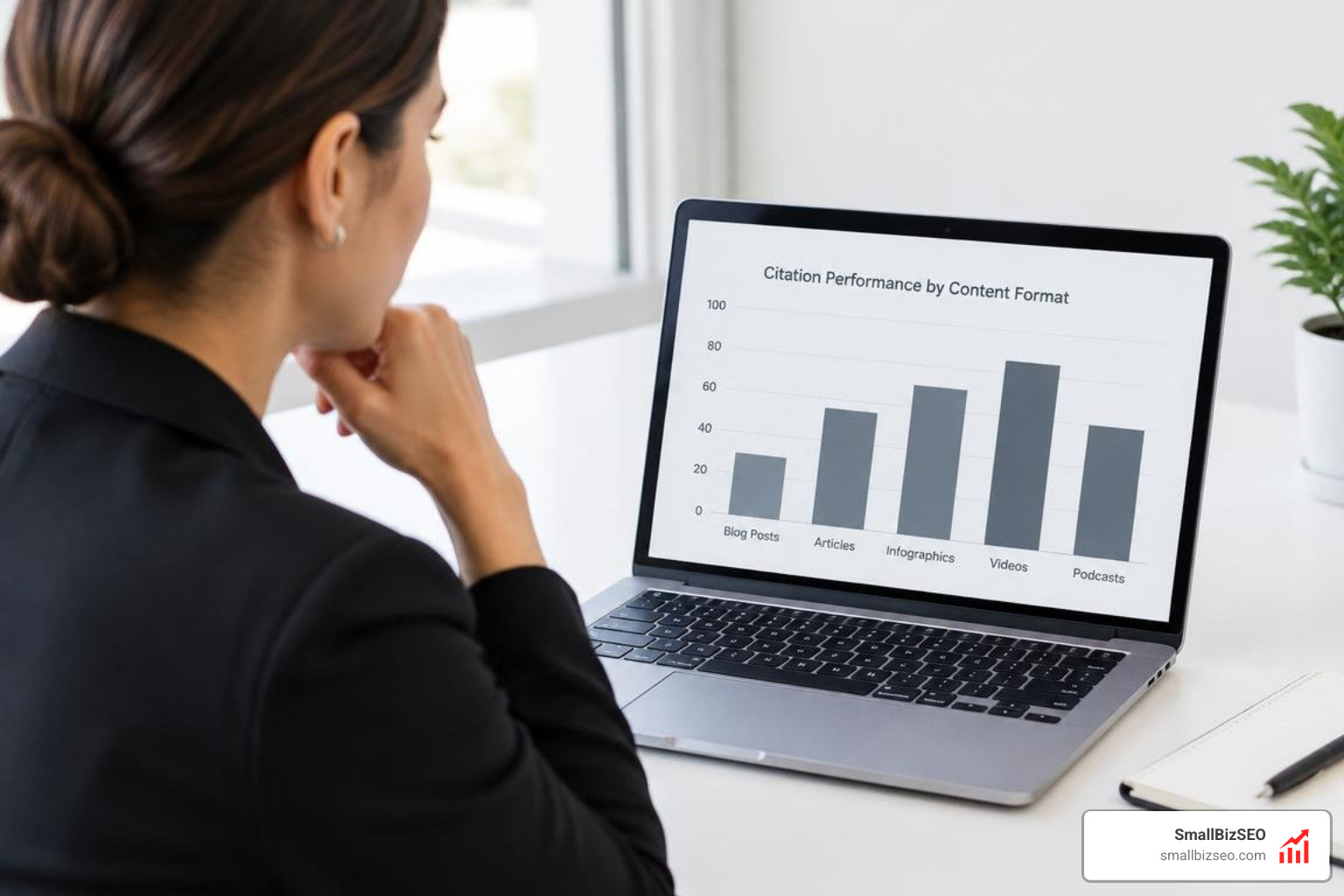
Content structure plays an equally massive role. When looking at content category performance across AI platforms, structured formats consistently outperform unstructured narrative blocks:
- Listicles and Structured Guides: Listicles are the most cited content format on ChatGPT, with 52% of listicles cited more than two times per response.
- Comparison Articles: Pages providing side-by-side evaluations lead overall AI citations at 32.5%, as answer engines rely on comparison grids to resolve commercial evaluation queries.
- Structured Data vs. Unstructured Prose: Structured data formats receive 3 times more citations than paragraph-only text. AI extraction windows prioritize concise, atomic claims located near the beginning of documents; in fact, 44.2% of all LLM citations originate from the first 30% of a webpage's text.
Why Do Top-10 SERP Positions and Source Types Dominate LLM References?
Traditional search optimization remains the bedrock of generative engine visibility. A comprehensive SERP ranking impact study found that 40.58% of Google AI Overview citations pull directly from Google's top 10 organic search results. Furthermore, there is an 81.10% probability that at least one source from the top 10 will appear in any AI-generated answer.
Holding the #1 position on Google boosts your probability of appearing in an AI Overview to 33.07%. While 76% of AI Overview citations originate from pages ranking somewhere in the top 10, only 12% match Google's top 10 organic results exactly. AI engines maintain independent filtering layers based on domain authority, passage relevance, and freshness.
Broader multi-engine citation research shows extreme domain concentration: the top 20% of cited domains capture 80% of all AI references, and the top 15 domains command roughly 68% of consolidated citation share. Wikipedia accounts for 7.8% of all ChatGPT citations and nearly half of its top-10 source share. Reddit represents approximately 40% of multi-engine AI citations across community-focused answers, leading both Perplexity (6.6% of all citations) and Google AI Overviews (2.2%). Meanwhile, journalistic content accounts for 27% of general AI citations, rising to 49% on time-sensitive, trending queries.
How to Measure, Track, and Improve Your Brand's Citation Performance
Optimizing your business for AI citations requires moving beyond traditional keyword tracking toward a passage-level framework. Improving your overall AI share of voice requires clear entity definitions, structured content formatting, and validated external authority.
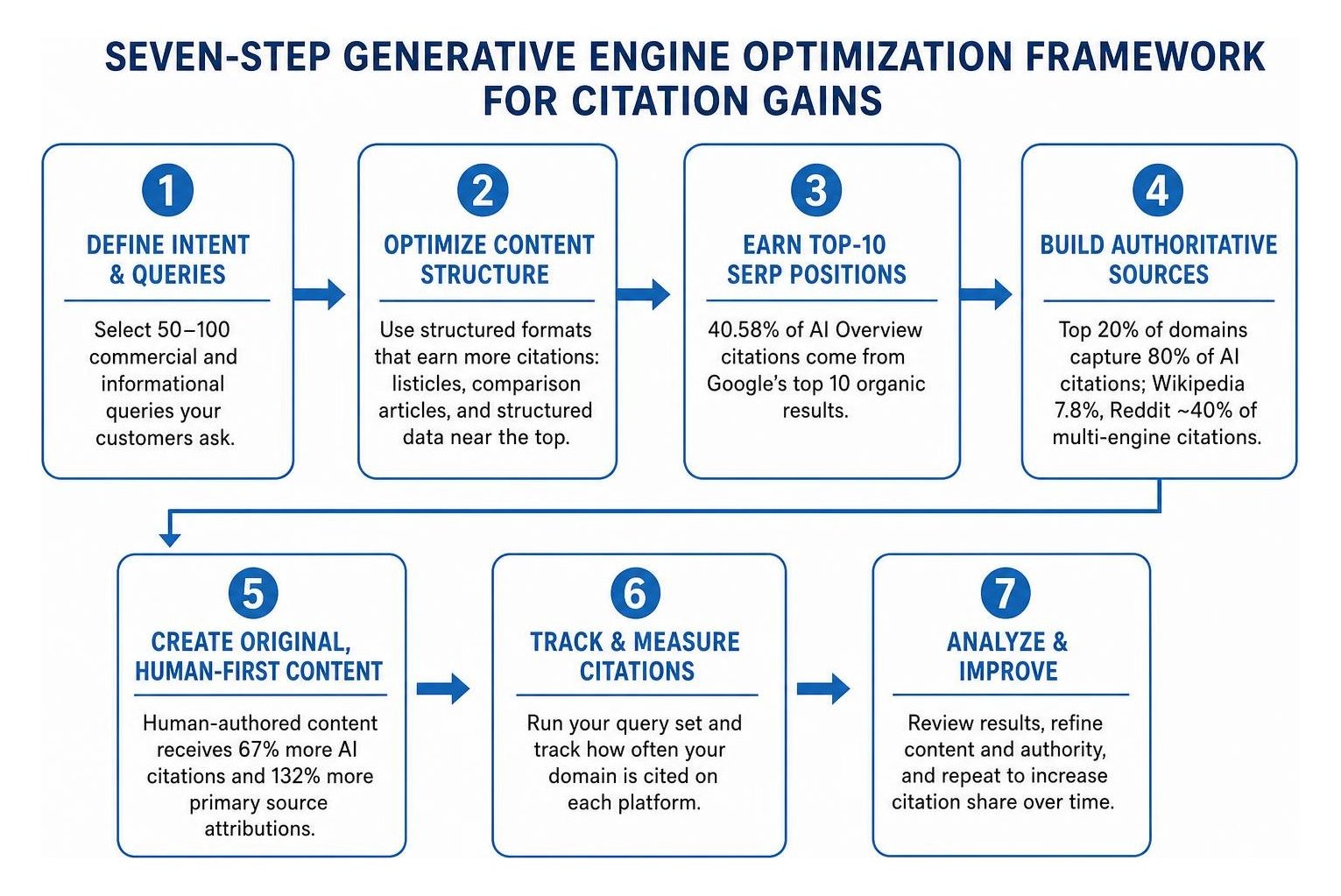
Originality and human perspective also serve as heavy algorithmic differentiators. A recent human authorship citation study analyzing 50,000 pages revealed that human-authored content receives 67% more AI citations than synthetic, AI-generated content. Primary source attributions were 132% higher for original human content, proving that models reward experience and verifiable data over rehashed summaries.
How to Accurately Calculate and Track Your AI Citation Rate Over Time
To calculate your citation rate accurately, select a standardized basket of 50 to 100 commercial and informational queries that your ideal customers ask. Track how often your domain is cited across these runs for each specific platform:
Because models update frequently, longitudinal tracking requires keeping your prompt basket, testing parameters, and measurement rules constant. Applying a disciplined, practical AI SEO implementation enables your team to isolate whether citation shifts stem from content optimizations or platform-wide model updates.
Which Technical Signals and GEO Tactics Maximize Source-to-Cite Conversion?
To transform a standard webpage into an AI-extractable asset, integrate these proven technical and structural optimizations:
- Implement Semantic Schema Markup: Pages with proper schema markup (such as Article, FAQPage, HowTo, and Organization) are 30% to 40% more likely to be cited in generative answers.
- Lead with Answer Capsules: Place clear, declarative answers within the first 40 to 60 words of each core section. Structure these as atomic claims using direct subject-predicate-object phrasing.
- Secure Multi-Source Third-Party Validation: Brands that earn mentions and claims across 5 or more external authoritative domains (such as trade directories, review hubs, and industry journals) see AI overview citation rates improve by 67%.
- Maintain Content Freshness: Perplexity and ChatGPT search modes heavily favor freshly updated assets; keeping timestamps and factual data updated reduces citation drop-off over time.
For a comprehensive evaluation of your site's technical readiness, conducting an AI SEO audit framework helps uncover crawl bottlenecks, rendering issues, and schema gaps that prevent LLM crawlers from indexing your content.
What Are the Common Pitfalls in Tracking and How Can Brands Avoid Them?
Tracking AI citations introduces unique measurement challenges that do not exist in traditional search monitoring:
- Ignoring Platform Volatility: Between 40% and 60% of cited web sources change from month to month as models retrain and adjust their retrieval weights. For example, Reddit's citation share in ChatGPT dropped from roughly 60% to 10% across a six-week period. Avoid making drastic content overhauls based on short-term weekly fluctuations.
- Confusing Brand Mentions with Footnote Citations: A model may mention your brand name in its prose without providing a clickable backlink citation, or it may link to your guide as a factual source without endorsing your services. Measure mentions and citations as distinct KPIs.
- Blending Multi-Platform Metrics: Aggregating citation performance into a single unified score obscures critical platform gaps. Always evaluate ChatGPT, Google AI Overviews, and Perplexity independently.
Taking Control of Your AI Discovery and Citation Footprint
Earning consistent citations across generative search engines is not an accidental byproduct of writing more blog posts. It requires an intentional strategy that bridges technical search foundations, answer-ready content design, and cross-web authority.
At SmallBizSEO, we help businesses build durable digital visibility using our data-driven Velocity framework. By combining high-authority link acquisition, passage-level content optimization, and structured data implementation, we ensure your business earns the references, recommendations, and traffic it deserves across modern search ecosystems. Explore our strategic AI citation rate analysis and strategy to begin auditing and expanding your presence in AI-driven answers today.