How to Choose a Managed AI SEO Company
What should you expect from a managed AI SEO company?
A managed AI SEO company should take responsibility for a defined search program, not simply provide software access or automated drafts. The right partner combines strategy, original content, technical implementation, internal linking, editorial review, and reporting that connects work completed with the business outcomes being measured.
Start by asking what the agency will own, what your team must approve, and what remains outside the engagement. A clear answer is more useful than a broad promise about rankings, AI citations, or leads.
How does a managed AI SEO company differ from an SEO tool or a traditional agency?
A managed provider supplies accountable people and an agreed operating rhythm. It should explain which recommendations it will implement, which changes require client approval, and how it will document work in the CMS or another shared system. An SEO tool can support the work, but it does not replace ownership of research, editorial judgment, technical changes, or stakeholder coordination.
Traditional SEO and AI-focused SEO also overlap more than they differ. Sound technical foundations, useful pages, trustworthy references, and clear information architecture still matter. The additional question is whether the agency can make content easy to extract and verify in answer-oriented search experiences without treating mentions or citations as guaranteed results.
What work should a managed AI SEO company actually deliver?
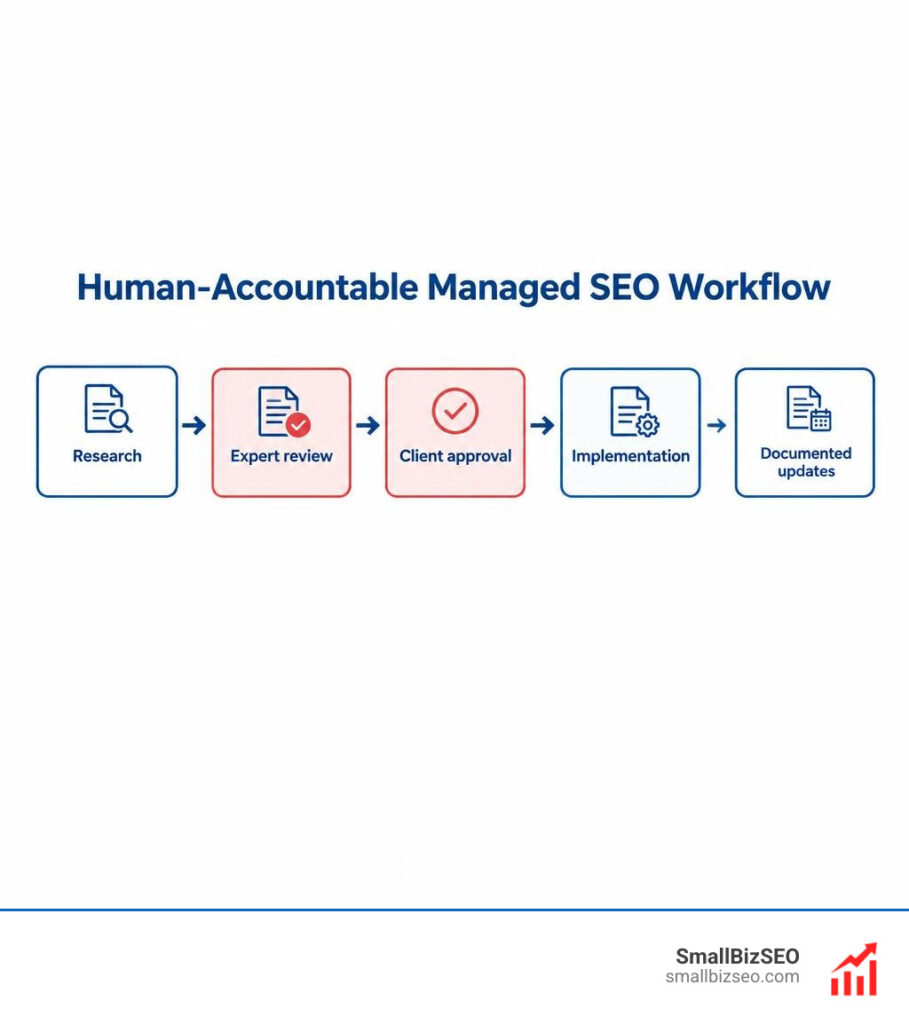
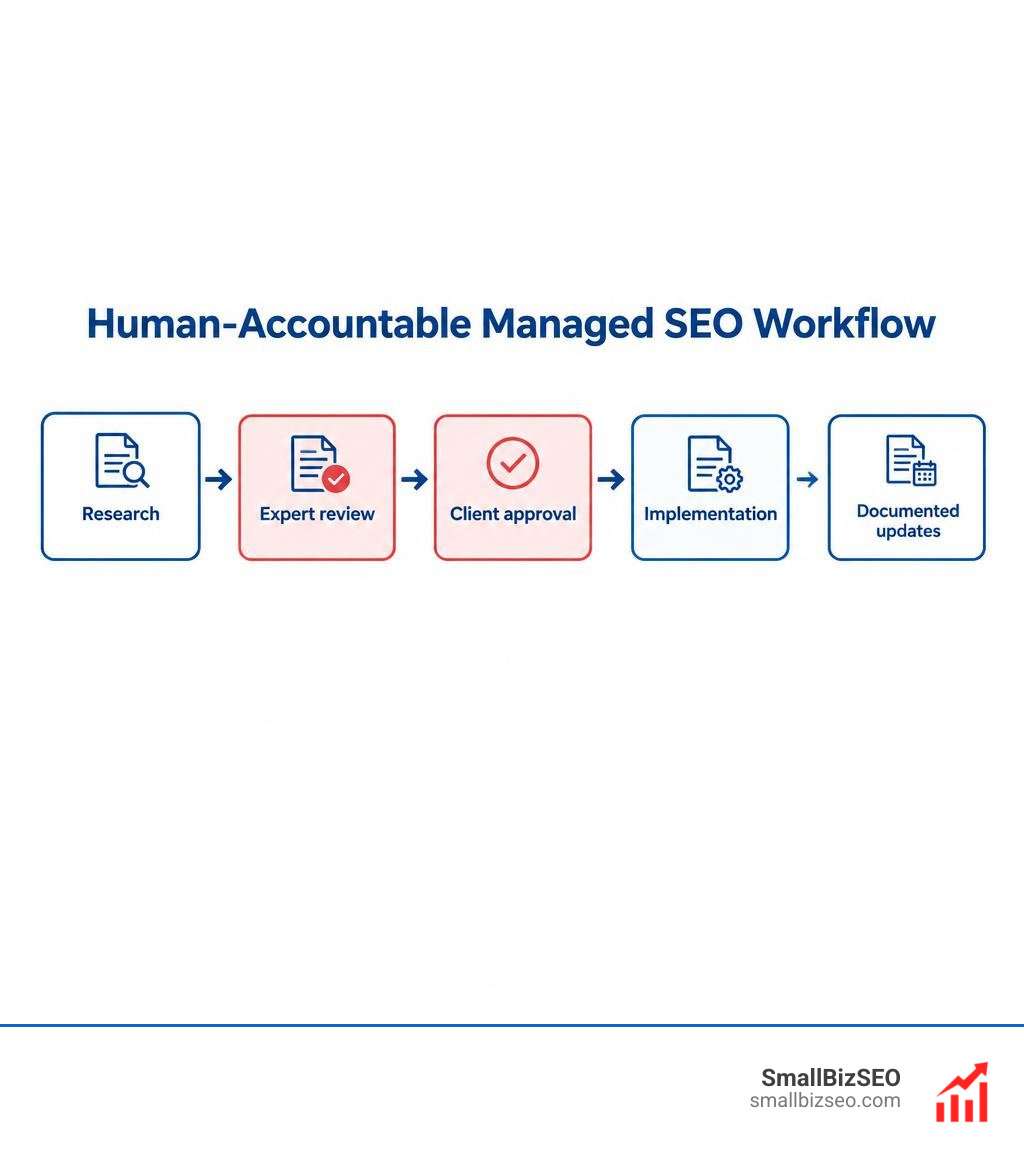
A credible engagement begins with research: the agency should review your services, existing pages, customer questions, search demand, competing results, and technical constraints. For more on the broader shift in AI-informed search strategy, read Beyond Keywords: A Guide to Generative AI SEO Services and GEO. From there, it should produce a prioritized plan with named owners, expected deliverables, review points, and a record of what changed.
A strong provider also treats content as an ongoing asset. That means commissioning original research or expert input where appropriate, refreshing pages when facts or intent change, improving internal links, using SEO content services for well-supported new and refreshed pages, and pursuing editorially relevant link-building services rather than relying on automated exchanges or volume-driven publishing.
Which responsibilities should be included in the scope?
A managed scope can include technical audits and implementation, content briefs and writing, on-page updates, internal-link recommendations or implementation, structured-data review, and editorial outreach. Ask the provider to separate included work from optional projects, third-party costs, and tasks that remain with your team.
What should be reviewed by a human?
Human review should be built into factual claims, subject-matter accuracy, brand voice, legal or compliance-sensitive language, and any change that could affect the site’s structure or customer experience. Automation may speed up analysis and drafting, but an accountable agency should be able to explain the evidence behind a recommendation and accept feedback before publishing. For a practical framework, see The AI SEO Audit: Tracking the Signals That Actually Matter to LLMs.
For a broader look at delivery models and the tradeoffs between managed services and software, see this comparison of AI SEO services.
How should you evaluate an AI SEO company before hiring it?
Use a due-diligence process that tests how the agency works, not just how polished its sales materials look. Ask for examples of completed work that are relevant to your goals, then discuss the decisions, approvals, and tradeoffs behind those examples.
What evidence should an agency provide?
Look for evidence of original research, expert review, technical implementation, useful content improvements, and editorial outreach where it fits the strategy. Screenshots of dashboards or unsupported before-and-after claims are not enough. A provider should be able to show the work performed, explain the measurement method, and identify factors outside its control.
How should approvals and access work?
Before work begins, agree on who can approve content, technical changes, and publishing. Limit access to what the agency needs, require a change log, and confirm that changes can be reviewed or rolled back. If the agency works in your CMS, ask whether it can use your existing workflow and how it will preserve ownership of your content and data.
What should be clear in the contract?
The proposal should state the work included, the expected cadence, exclusions, fees, third-party expenses, reporting format, and exit terms. It should also distinguish recommendations from work the agency will directly implement. Clear boundaries prevent a strategy document from being sold as a fully managed service.
Can AI-assisted workflows still be accountable?
Yes, when people remain responsible for decisions, factual review, and final approval. Ask where automation is used, how sources are checked, when a specialist reviews the output, and what happens when a recommendation is wrong or no longer relevant.
Which service details should you compare across managed AI SEO companies?
Compare the agency’s operating model before comparing labels or software features. The useful question is whether the provider has the people, permissions, and process to improve the parts of your search presence that matter to your business.
| Area to compare | Questions to ask | Strong answer |
|---|---|---|
| Research and strategy | How are priorities chosen? | The agency explains the evidence, target pages, owners, and sequencing. |
| Content and expertise | Who creates and approves copy? | Work includes original input or expert review and a documented editorial process. |
| Implementation | Will the agency make changes or only recommend them? | Responsibilities and access are agreed in writing. |
| Internal links and refreshes | How are existing pages maintained? | The plan includes purposeful internal links and recurring updates when needed. |
| Outreach | How are references earned? | Outreach is relevant, editorially appropriate, and not based on automated exchanges. |
| Measurement | What does each metric represent? | The report separates visibility signals, traffic, leads, and completed work. |
| Ownership and exit | Who owns the content, data, and accounts? | The client retains access and can export essential assets. |
How should you compare costs and exclusions?
Ask for a line-item view of the engagement: strategy, writing, technical work, outreach, tools, and optional projects. Confirm whether CMS development, design, subject-matter review, and third-party fees are included or billed separately. A lower monthly price may reflect a narrower scope rather than a more efficient service.
What should you avoid treating as proof?
Avoid treating a proprietary score, a large content count, or a dashboard screenshot as proof that the strategy is working. Ask how the score is calculated, what action it changes, and whether the underlying work is visible. A good provider welcomes questions about limitations as well as progress.
How can you check whether the agency fits your team?
Discuss communication cadence, turnaround times, escalation paths, and the client-side time required for approvals. The best fit is an agency whose process your team can actually support, not the one making the broadest claims.
How should AI citation monitoring be interpreted?
AI citation monitoring is a directional research method, not a complete measure of market share or a promise of visibility. A useful report defines the prompts tested, the models used, the date of each test, the intended audience or location, and the sample size. Those details make the results easier to interpret and compare over time.
What can citation monitoring tell you?
It can reveal whether a brand or page appears in a defined set of answer experiences, which sources are commonly referenced, and where content may need clearer evidence or structure. Results can vary because models, prompts, source selection, and product features change. Treat the findings as one input to editorial and technical decisions. Google's AI features in Search documentation says that normal SEO best practices apply to AI Overviews and AI Mode. No special schema or AI-specific files are required, and meeting eligibility requirements does not guarantee inclusion. The work should also follow Google's helpful content guidance.
How should results be measured separately?
Citation counts, organic traffic, qualified leads, and revenue answer different questions. A responsible report shows them separately and explains the tracking method for each. An agency should not present a mention in an AI answer as proof of a visit, a lead, or a sale.
What should an agency promise about indexation?
A provider can improve crawlability, technical clarity, and the quality of submitted pages, but search engines decide whether and when to index content. Ask the agency to document the actions it takes and the signals it monitors rather than making guarantees it cannot control.
Choose a Partner With a Clear, Accountable Process
A managed AI SEO company should make it easy to understand what it will research, create, implement, measure, and revise. Choose a partner that welcomes expert input, documents changes, keeps your team in control of approvals, and describes uncertainty honestly.
SmallBizSEO publishes this article and offers AI SEO services. If you want to discuss a managed program for your site, book a conversation.