How to Choose an Accounting Firm SEO Company

Why Hire an Accounting Firm SEO Company?
An accounting firm SEO company should help your practice evaluate and improve its search presence without relying on vague promises. Compare providers by asking how they research your services, create original content, document implementation, protect confidential information, and report work completed alongside meaningful inquiry trends.
The right partner should give you a clear ongoing scope, an accountable review process, and a plan for making approved improvements over time. This guide focuses on the questions that make those differences visible before you sign a contract.
Use the proposal, content-review, and reporting questions below to compare providers on work you can verify rather than claims you cannot.
Start by asking each provider for a written scope, an approval workflow, and a sample report. Those materials reveal far more than broad claims about visibility or lead volume. For broader context, see the local SEO map and SEO for finance companies.
What Should an Accounting Firm SEO Company Deliver?
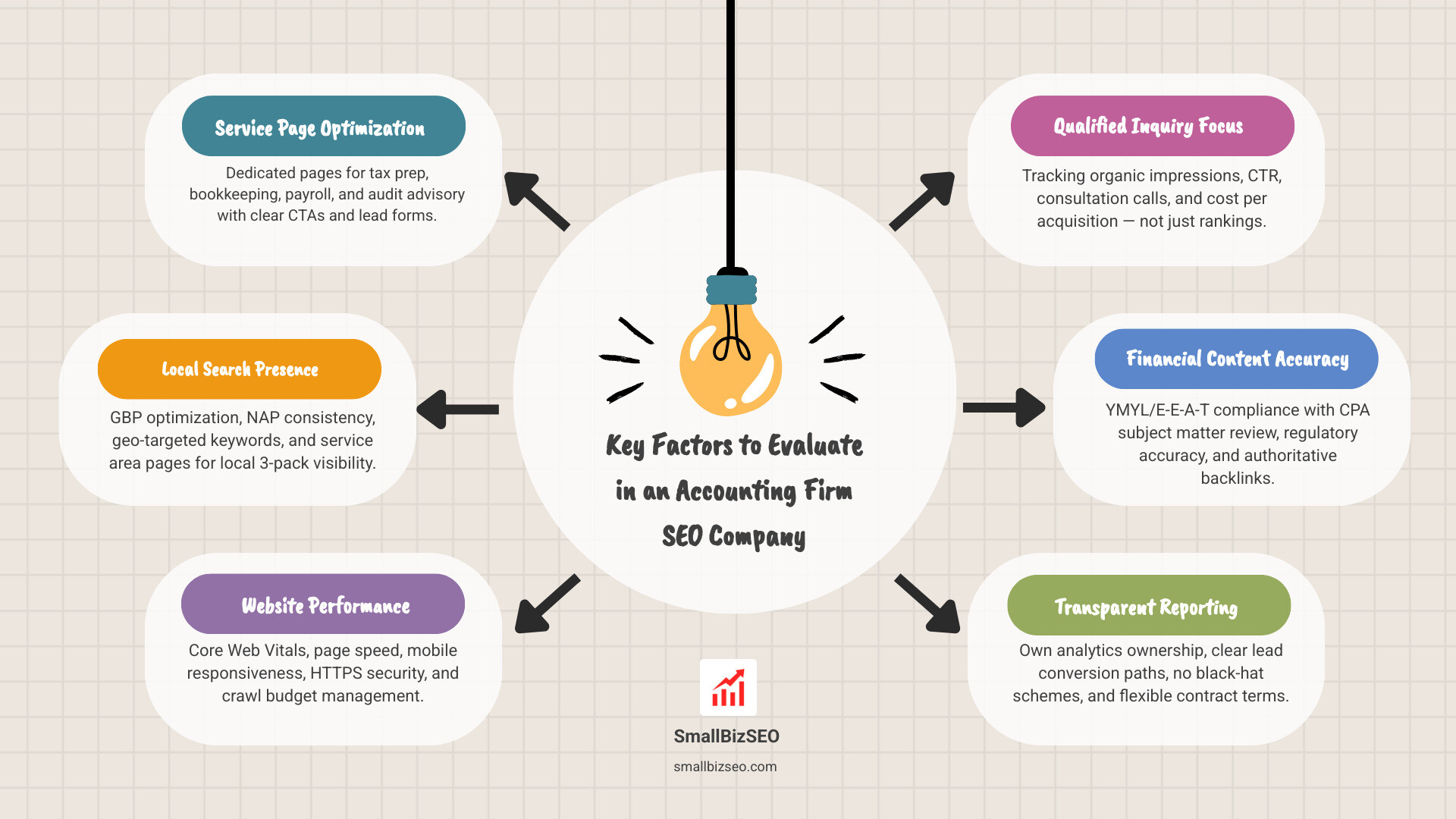
A capable accounting firm SEO company should provide an ongoing program, not a bundle of generic posts or a promise of rapid rankings. Ask the provider to show how it researches the firm’s audience, documents the services actually offered, assigns subject-matter review, and protects confidential information before content goes live.
Which Services Belong in the Ongoing Scope?
The scope should begin with research: service-line discovery, search-intent mapping, technical priorities, and a content plan that distinguishes business audiences from individual taxpayers where relevant. A provider should create or improve dedicated pages for tax, audit, bookkeeping, or advisory work only when the firm genuinely offers those services.
The proposal should also state who confirms the firm’s professional credentials and what evidence is used. SEO providers can verify that a license or designation is represented accurately, but they should not invent credentials or imply a qualification that the practice cannot substantiate.

A practical ongoing scope may include:
- Research and page planning: Review search intent, the firm’s services, and gaps in current pages before proposing topics or page changes.
- Original content production: Write original service and educational content, then route tax, audit, bookkeeping, or advisory claims to the firm’s designated reviewer.
- Technical and on-page implementation: Document recommended fixes, who will implement them, and how changes will be checked after deployment.
- Privacy-safe conversion improvements: Use lead forms that ask only for the information needed to start a conversation. Do not ask prospects to submit tax returns, account numbers, or detailed financial records through an unsecured form.
For an overview of the content work an SEO partner should be able to explain, see SEO content services and a specialized accounting SEO company.
How Should Financial Content Be Reviewed?
Financial-services content needs a clear review path. The SEO team can research queries and structure pages, but the accounting firm should approve factual statements, confirm the jurisdictions where a statement applies, and set a review date for content that may change. Educational pages should avoid personalized tax advice and instead invite readers to discuss their own situation with a qualified professional.
A reliable process identifies the assigned reviewer, the evidence they check, the approval record, and the escalation path when a claim cannot be verified. That approach is more useful than a generic claim of industry expertise. A finance SEO company should be able to document that process clearly.
What Should an Accounting SEO Proposal Cover?
A strong proposal makes the work visible before the contract begins. It should explain which pages, technical tasks, content pieces, outreach activities, and reporting items are included, as well as what the firm must supply for review and approval.
How Can You Compare Two SEO Proposals?
Use the same questions for every provider so that pricing does not hide differences in ownership, review standards, implementation, or contract terms.
| Proposal area | What to ask for | Strong answer |
|---|---|---|
| Ownership | Who owns the domain, content, analytics, search-console access, and accounts? | The firm retains access and ownership, with roles documented. |
| Reviewer | Who approves technical financial claims, credentials, jurisdictions, and revisions? | A named firm reviewer approves relevant content before publication. |
| Work scope | Which service pages, technical tasks, content pieces, and outreach activities are included? | Deliverables are itemized, tied to services the firm actually offers, and explained through professional SEO services. |
| Implementation | Who makes changes, and how are they tested? | Responsibilities, approval steps, and post-launch checks are defined. |
| Reporting | Which inputs, actions, and outcomes will be reported? | Reports distinguish completed work, visibility trends, inquiries, and limits in attribution. |
| Contract | What are the term, renewal, cancellation, and handoff terms? | The agreement is readable, with no hidden ownership transfer or vague deliverables. |
What Local SEO Practices Are Appropriate for Accounting Firms?
Local SEO should use accurate business information, real services, and ethical review practices. A provider can help maintain a Google Business Profile, respond professionally to reviews, and correct inconsistent listings. It should not offer incentives for reviews that distort feedback, fabricate reviews, or use misleading business details. Google’s review policy guidance is a useful primary reference for evaluating these practices.
Technical recommendations should be explained in plain language. The provider should identify needed work such as crawlability, mobile usability, page speed, structured data, and internal linking, then show which items are included in the current scope. SEO packages can help illustrate how defined deliverables make proposals easier to compare.
Which Red Flags Should End the Conversation?
Walk away from proposals that promise rankings, use anonymous link networks, recycle identical articles across firms, or refuse to document ownership and access. Be cautious when a provider cannot explain its review process, treats every accounting practice as the same, or asks for client financial data for a marketing report. A reputable local SEO company should make its methods and responsibilities clear.
Other warning signs include:
- vague monthly deliverables or unexplained fees;
- service pages proposed for offerings the firm does not provide;
- claims that content is reviewed without naming a reviewer or approval step;
- reports that show rankings without showing work completed or lead-quality context; and
- contracts that make it hard to retain content, accounts, or data after the relationship ends.
How Should an SEO Provider Run Content and Outreach Each Month?
A durable program combines documented research, original content, technical follow-through, and selective outreach. It should be planned around the firm’s real services and approval capacity rather than a fixed number of generic posts or a promise of a particular return.
A practical monthly cycle can include:
- Research and prioritization: Review search questions, existing service pages, technical findings, and the next topics that need accountant review. An Answer-Ready SEO methodology can help turn that research into direct, useful page structures.
- Original content and updates: Draft or improve pages, confirm that claims are accurate for the stated jurisdiction, and record reviewer approval before publication.
- Technical implementation: Apply approved on-page and site improvements, then verify that the published page matches the approved copy.
- Editorial outreach: Pitch useful resources, expert commentary, or approved anonymized examples to relevant publications. Relevant editorial links are earned through usefulness and relationships, not purchased placements or spam networks.
- Reporting and decisions: Explain work completed, pages updated, search visibility, qualified inquiry patterns, and the next approved priorities without promising a particular ranking or revenue result.
A case example should be hypothetical unless the client has expressly approved its use. It should remove names, account details, returns, and any information that could identify a client. For a transparent explanation of ethical outreach work, review link-building services.
Which KPIs Help You Evaluate the Program?
Ask for reporting that connects activity to decisions. Useful measures can include the pages published or improved, implementation status, organic search visibility, qualified inquiry trends, and whether the firm can trace a consultation to a landing page without collecting unnecessary sensitive information. Reports should explain attribution limits rather than present every contact as an SEO result.
An accounting firm should be able to see what changed, why it changed, who approved it, and what decision comes next. That makes the provider accountable even when search results take time to develop.
Choose an Accounting SEO Partner With a Clear Ongoing Plan
Choose a provider that can explain its research, respect your review process, and leave your firm with clear ownership of content, accounts, and data. If you want a proposal built around defined content, technical SEO, and ethical outreach deliverables, book a conversation with SmallBizSEO or claim a free SEO visibility audit.