Auditing Generative Search Results Across Different User Locations

Why Do AI Search Answers Change by Location and Follow-Up Question?
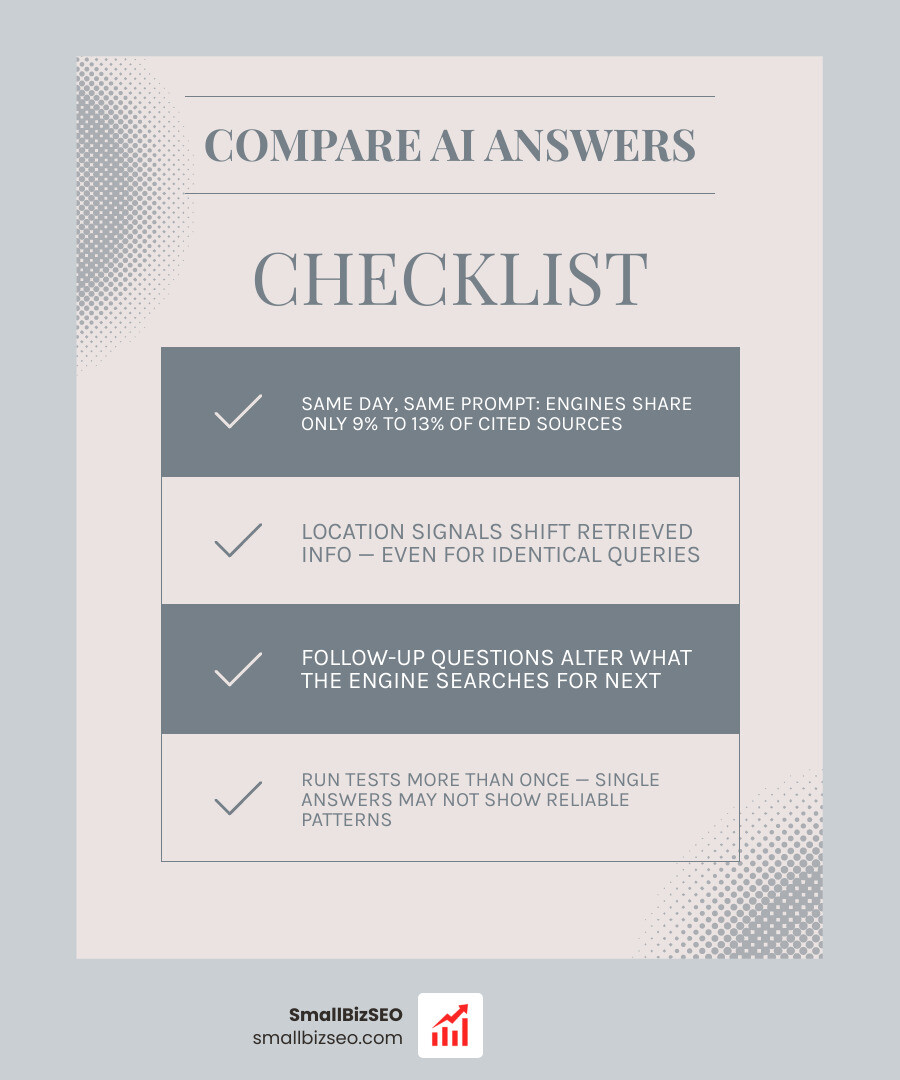
To compare AI search answers across locations and in response to follow-up questions, test the same question in each location, then ask the same follow-ups in the same order. Save each answer and its cited sources. Compare which businesses appear, which facts change, and whether new sources replace earlier ones. Run the test more than once: a single answer may not show a reliable pattern.
Location can affect which information an engine retrieves. Follow-ups can also change what it searches for, even when the topic stays the same. For a small business, the useful question is not just “Do we appear?” but “Do we still appear when a customer narrows their search?”
I’m Clayton Johnson, founder of SmallBizSEO. My SEO and content strategy work informs my approach to comparing ai search answers across locations and follow up questions, starting with clear tests and evidence you can check.
Why Does Generative Search Visibility Vary by Geography and Context?
Generative search answers vary by location and conversational context because engines apply localized retrieval signals, maintain session memory across multi-turn interactions, and evaluate dynamic citations in real time.
When a user submits an inquiry, an answer engine does not simply match keywords against an index. Instead, it interprets user intent, gathers relevant regional information, and produces synthesized prose. In empirical testing across nearly 100,000 queries, different engines answering the exact same prompt on the same day shared only 9% to 13% of their cited sources. When geographic variables enter the mix, recommendations shift even more dramatically.
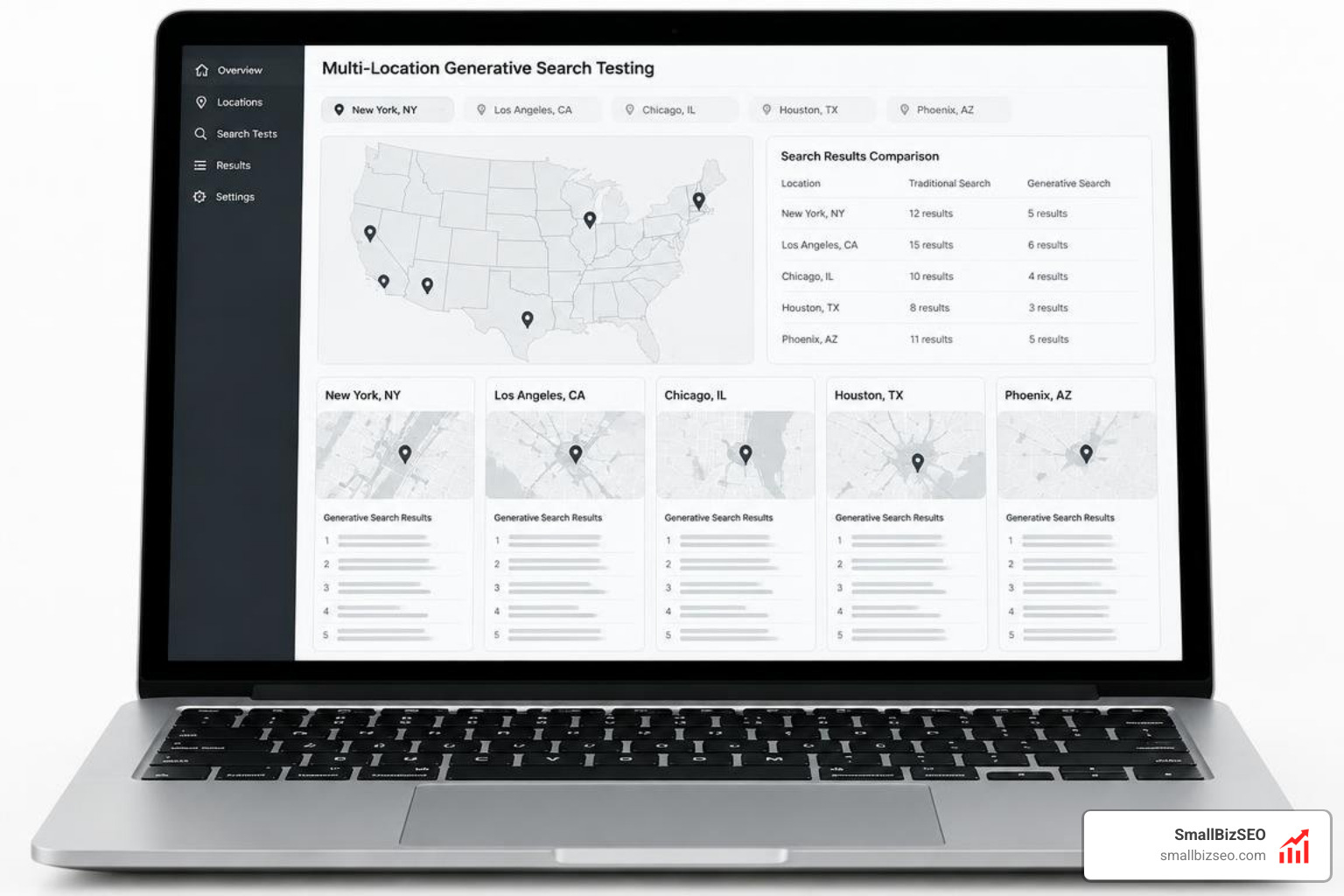
Two primary mechanisms drive these variations:
- Localized Retrieval: Answer engines detect geographic intent from IP addresses, browser coordinates, or explicit prompt modifiers. The system then queries distinct regional datasets, leading to completely different entity recommendations.
- Conversational Context and Query Chains: When users ask subsequent questions, the engine retains conversational state. The model decomposes follow-up queries into sub-tasks, pulling fresh citations to refine the dialogue.
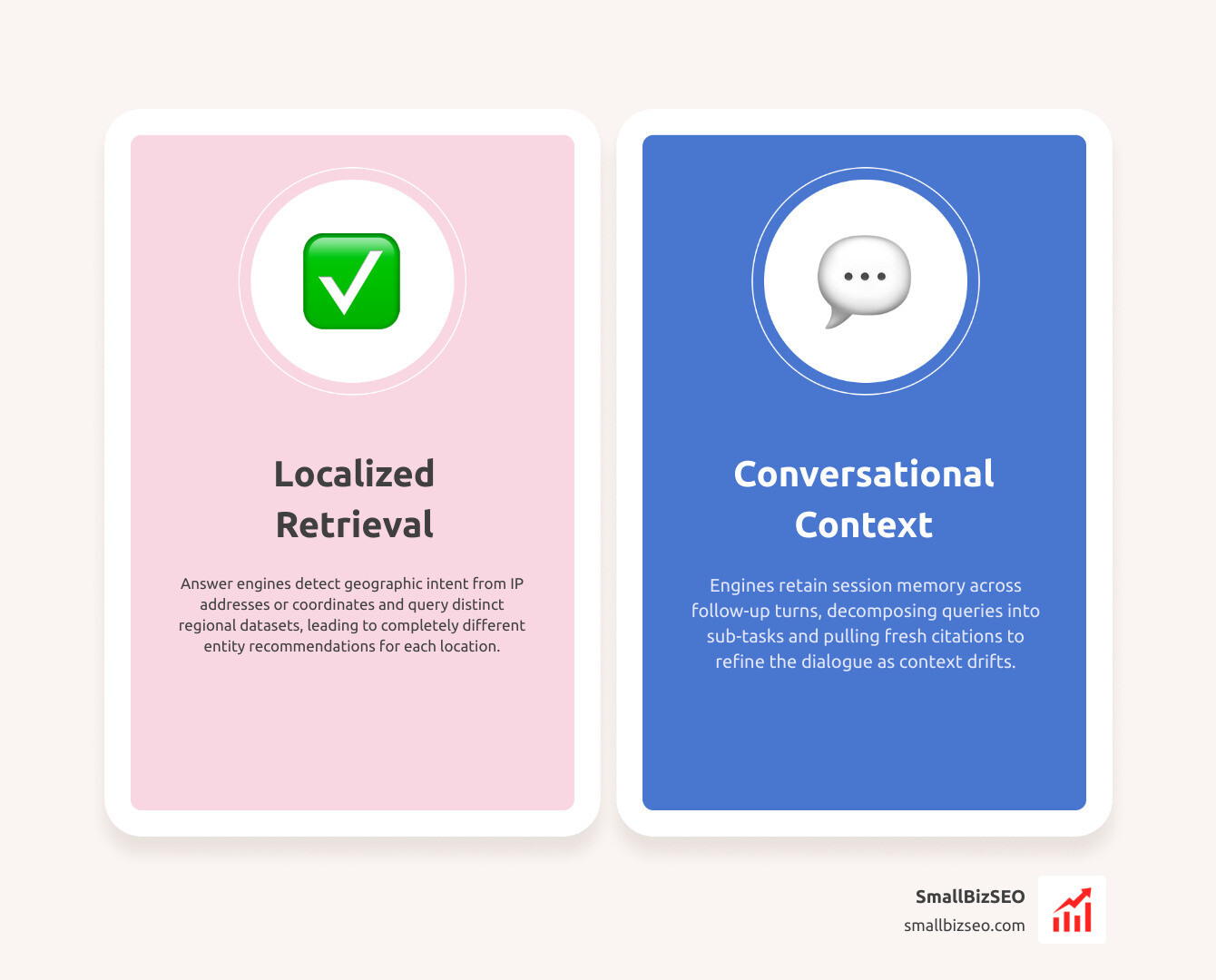
How Can You Compare AI Search Answers Across Locations and Follow-Up Questions?
To compare generative answers reliably, keep your base prompts standardized, run multi-turn sessions across distinct test locations, and log both the synthesized copy and its cited domains at every step.

Studying generative search requires structured observation. Following a practical guide to multi-step AI comparison research allows us to track subtle shifts in entity positioning and source citations over extended conversations.
How Do You Set Up Multi-Location Testing for Generative Search Engines?
To set up multi-location testing, use dedicated residential proxies to isolate geographic locations, establish logged-out browser sessions to prevent personalization bias, and run standardized prompts across target platforms.

Research into why AI answers change by location demonstrates that models like ChatGPT, Gemini, and Perplexity deliver divergent recommendations across different metro hubs. In fact, studies show that over 40% of major metro areas receive a completely different top-recommended product or brand for identical transactional queries.
To configure a reliable audit:
- Standardize Prompts: Build a fixed prompt library containing discovery, comparative, and transactional inquiries.
- Isolate Environments: Use clean, logged-out browser profiles for every run to clear local storage, cookies, and prior session memory.
- Route Traffic via Proxies: Assign high-grade residential proxies matching target test locations to ensure the engine infers the intended locale.
- Select Platforms: Test across core platforms to analyze AI search behaviors across different generative models.
How Can You Evaluate Query Fan-Out and Context Drift Across Locations and Follow-Up Questions?
To evaluate query fan-out and context drift, map how an answer engine decomposes an initial prompt into sub-queries and track how citations shift across successive conversational turns.
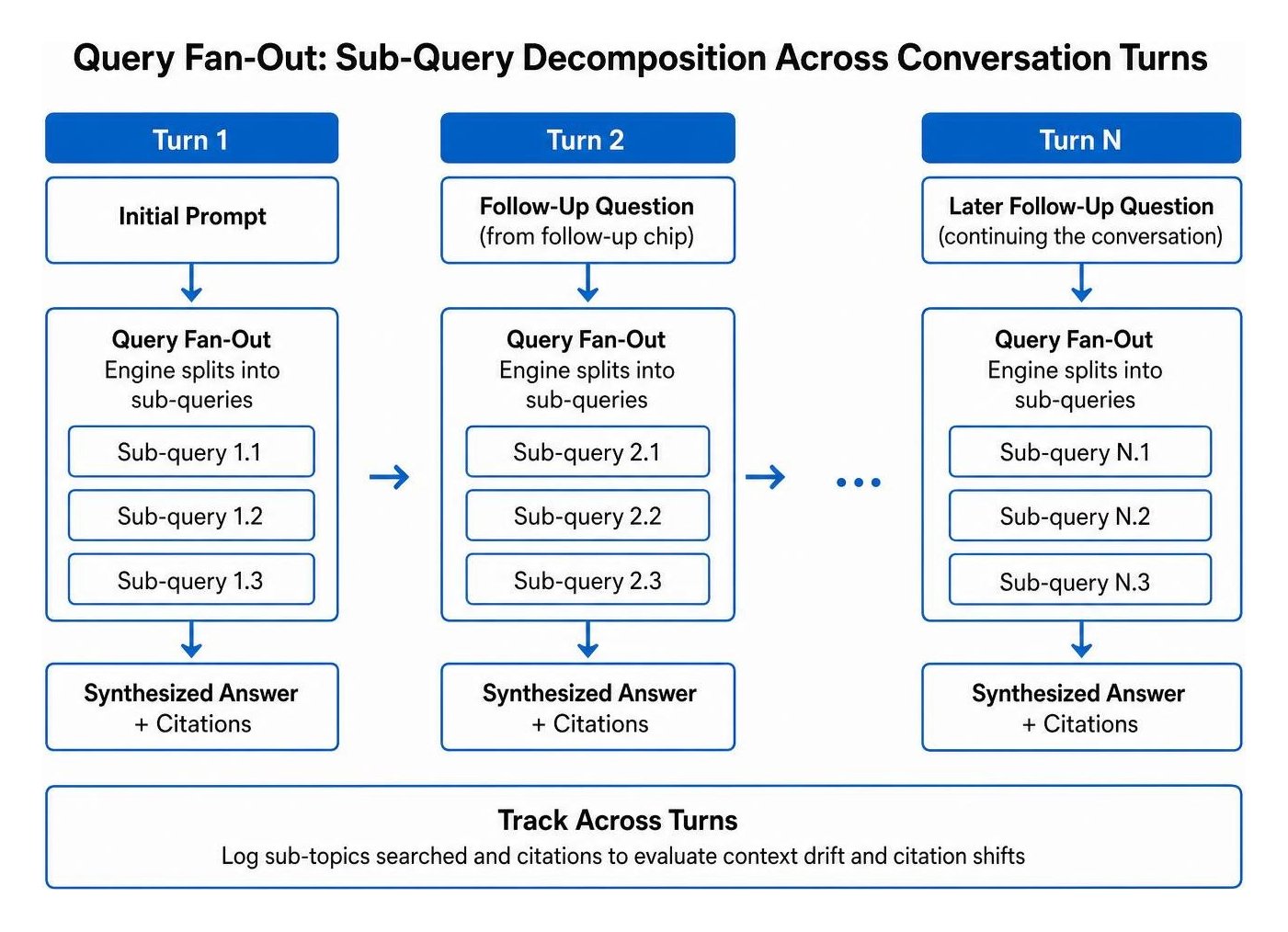
Modern engines employ query fan-out during agentic search interactions. Rather than executing a single search query, the engine splits complex prompts into multiple sub-inquiries simultaneously. As noted in research on AI search prompt testing for brand presence, each subsequent turn introduces conversational state changes, potentially causing "context drift" where early entity associations fade in favor of newly retrieved sources.
To evaluate these shifts, record the suggested follow-up chips generated by engines like Google AI Mode or Perplexity, execute each follow-up systematically, and log the sub-topics the engine searches to construct its response.
How Can You Track Citation Overlap and Source Diversity Across Geographic Hubs?
To track citation overlap and source diversity, extract every referenced domain across test runs, calculate the percentage of shared sources, and identify platform-specific publication preferences.
A dependable grounded answer relies directly on verifiable citations. However, source distribution varies heavily by engine and test location. Broad-scale benchmark research demonstrates that Perplexity averages approximately 14.9 citations per response and queries live sources in 100% of runs. In contrast, OpenAI models cite an average of 4.7 sources and execute live retrieval searches in roughly 73% of responses. Furthermore, Claude references Wikipedia in 32.7% of its cited sources, whereas Gemini cites YouTube in 8.8% and Reddit in 7.1% of its answers.
| AI Search Platform | Avg. Citations Per Answer | Live Web Retrieval Rate | Dominant Citation Types |
|---|---|---|---|
| Perplexity | ~14.9 | 100% | Third-party review sites, forums, blogs |
| Claude | ~11.6 | ~40% of evaluated pages | Wikipedia, institutional sites, documentation |
| Gemini | ~8.8 | High | YouTube, Reddit, merchant pages |
| Grok | ~7.3 | ~25% of evaluated pages | Real-time social data, news sites |
| OpenAI Models | ~4.7 | ~73% | High-authority domain summaries, direct links |
Understanding how engines diverge—as detailed in analysis of why major AI models deliver different answers—is crucial when conducting a data-driven guide to benchmarking competitors in AI search. When two engines evaluate the same query on the same date, ChatGPT-family engines and Perplexity share even a single overlapping citation in only 46% of cases.
How Can You Analyze Results and Improve Multi-Turn AI Visibility?
Analyze audit data by calculating brand share of voice, measuring citation quality, and identifying content gaps across initial queries and multi-turn conversations.

Gaining visibility requires optimizing for information gain. When we evaluate client visibility across regional markets, we quantify how often a brand appears in the primary synthesis and whether it survives follow-up refinements.
How Often Should You Compare AI Search Answers Across Locations and Follow-Up Questions?
Track generative search answers on a consistent weekly and monthly cadence using a standardized scoring rubric to measure trend velocity and brand sentiment over time.
To match shifting search intent, we recommend an operational rhythm:
- Weekly Tracking: Monitor high-priority transactional prompts across core target locations to identify immediate citation loss or negative sentiment shifts. Platforms like NeuroVerdict can help cross-examine multiple model responses simultaneously.
- Monthly Citation Audits: Review secondary and tertiary query chains to uncover emerging third-party sources and review platforms favored by AI models.
- Quarterly Strategy Resets: Conduct competitive gap analysis to refresh structured data, build high-authority external citations, and update comparison content.
How Can You Structure Content for Multi-Turn AI Search and Local Relevance?
To structure content effectively, place clear direct answers at the top of every page, incorporate Schema markup, and build dedicated comparison assets that satisfy multi-turn user questions.
Securing high local relevance across answer engines requires clear formatting:
- Answer-First Architecture: Open major sections with direct, factual summaries that AI parsers can easily extract and cite.
- Structured Data: Use FAQPage, Organization, and Product Schema to make entity relationships unambiguous for retrieval algorithms.
- Prompt-Focused Clusters: Develop listicles, tabular comparisons, and "Best X for Y" resources addressing the full sequence of user follow-up questions.
At SmallBizSEO, our technical SEO, content strategy, and link-building services rely on our data-driven "Velocity" framework. This framework delivers fast rankings and E-E-A-T-compliant growth through transparent, automated reporting. Exploring dedicated AI SEO services helps businesses capture consistent visibility across all generative platforms.
Turning Multi-Location AI Audits into Sustainable Visibility
Auditing generative search answers across diverse locations and follow-up chains provides the data required to protect your brand's digital presence. When you systematically monitor where your business appears, track how citation sources change across turns, and structure your content for rapid retrieval, you ensure that AI engines accurately recommend your products and services to customers everywhere.