Beginner’s Guide to Appeals Attorney SEO

How Can Appeals Attorneys Get Found by the Right Clients?
SEO for appeals attorneys starts with the searches that signal a real need for appellate counsel. Build clear pages for the appeals you handle, such as civil or criminal appeals. Answer questions about deadlines and procedure in plain language, and show which courts and jurisdictions you serve. Then make it easy for prospective clients and referring trial lawyers to check your credentials and contact you.
Appellate search is different from trial practice search. A visitor may need help after a ruling, while another lawyer may be looking for co-counsel to write a brief. Your website should speak to both without implying that every case or deadline works the same way.
I’m Clayton Johnson, founder of SmallBizSEO, where I work on content, technical SEO, and authority building for businesses seeking qualified leads. My approach to SEO for appeals attorneys begins with useful answers and credible evidence, then connects those pages to the people looking for appellate help.
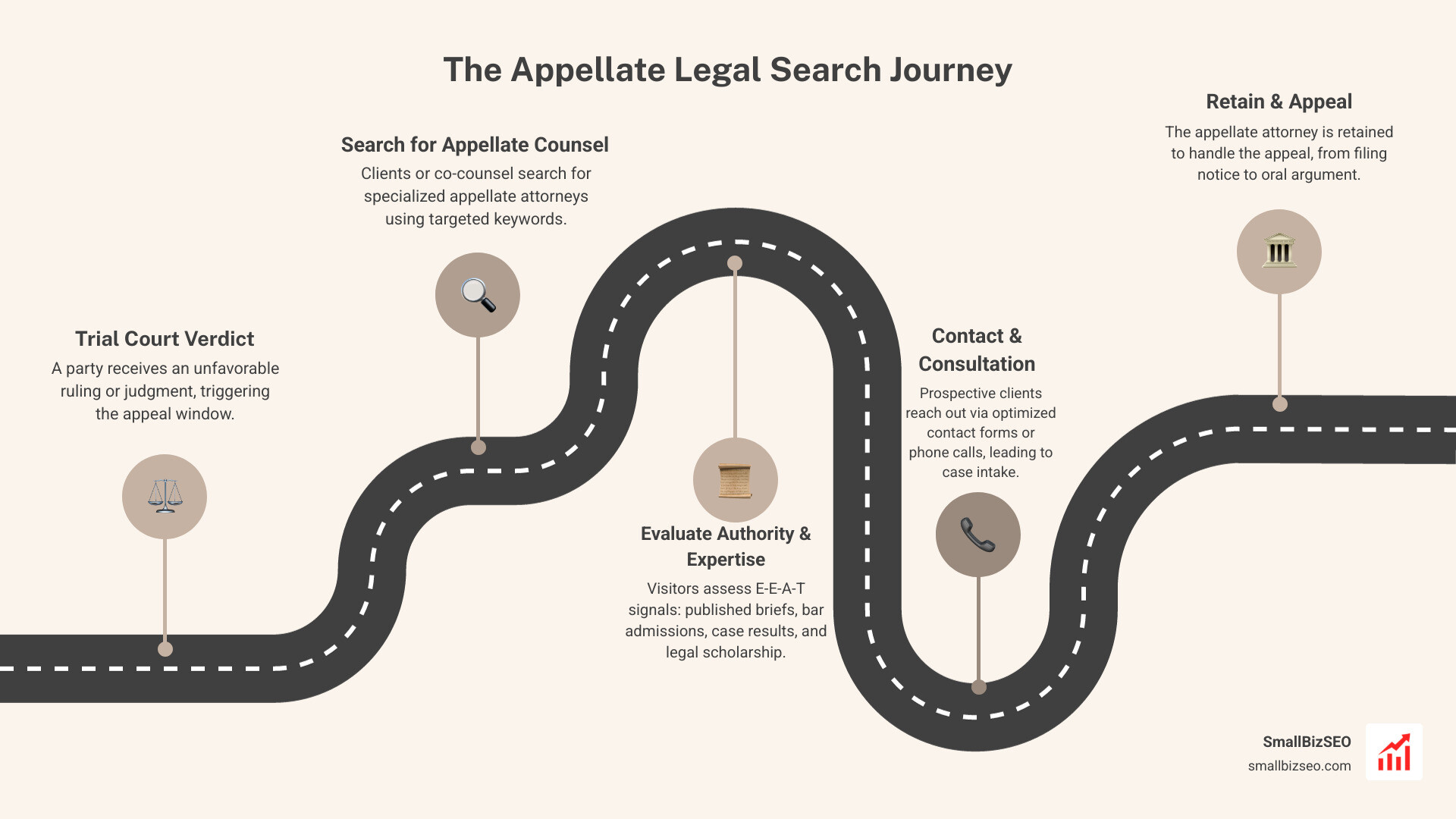
Comprehensive Framework of SEO for Appeals Attorneys
Appellate digital marketing demands an approach tailored to sophisticated legal evaluation. Potential clients find legal representation through two main channels: search engines account for 26.9% of discovery, while online directories and reviews generate 26.5%. Because over 85% of law firms maintain a digital presence and 74% actively use their website to generate client inquiries, standing out requires a structured, authoritative framework.
Modern search engines also evaluate content through the lens of Your Money or Your Life (YMYL) standards and zero-click AI Overviews. To gain visibility, law firms must optimize for Answer Engine Optimization (AEO) by delivering direct, accurate answers that search engines can easily parse and cite. A consistent campaign takes between 3 to 6 months to establish rankings, generating high-value case inquiries and long-term organic authority.

Why Is SEO for Appeals Attorneys Different From Trial Practice SEO?
SEO for appeals attorneys differs fundamentally from trial practice marketing because appellate searches focus on procedural remedies, strict jurisdictional rules, and B2B co-counsel needs rather than immediate localized emergencies. While a personal injury or DUI client searches with urgent geographic intent, appellate clients and trial attorneys search for specific legal arguments, standards of review, and court admissions across federal circuit courts and regional appellate divisions.
Understanding how top law firms attract high value clients with specialized SEO involves recognizing these two distinct audiences:
- Direct Litigants: Individuals or corporate entities facing an adverse ruling who need clear procedural guidance on notices of appeal, filing deadlines, and post-judgment relief.
- Referring Trial Lawyers: Litigators seeking dedicated appellate counsel for complex brief writing, interlocutory appeals, or oral arguments.
| Feature | Trial Attorney SEO | Appeals Attorney SEO |
|---|---|---|
| Primary Audience | Direct consumers facing immediate emergencies | Direct litigants and referring trial counsel (B2B) |
| Geographic Scope | Hyper-local (single city, county, or municipality) | Multi-jurisdictional (statewide appellate districts, federal circuits) |
| Search Intent | Symptom-based and transactional ("lawyer near me") | Procedural and substantive ("interlocutory appeal standard") |
| Core Keyword Focus | Accident types, criminal charges, arrest intake | Brief writing, writs of mandamus, post-conviction relief |
| Primary Trust Signal | Volume of local reviews and settlement sums | Bar admissions, published briefs, and court opinions |
How Should Practice Areas and Appellate Procedure Be Structured?
To capture high-intent searches, an appellate website must use a siloed architecture that organizes content into distinct thematic clusters. A single overview page cannot rank effectively for diverse, complex procedural queries. Each core practice area requires a dedicated landing page supported by procedural guides and FAQs.
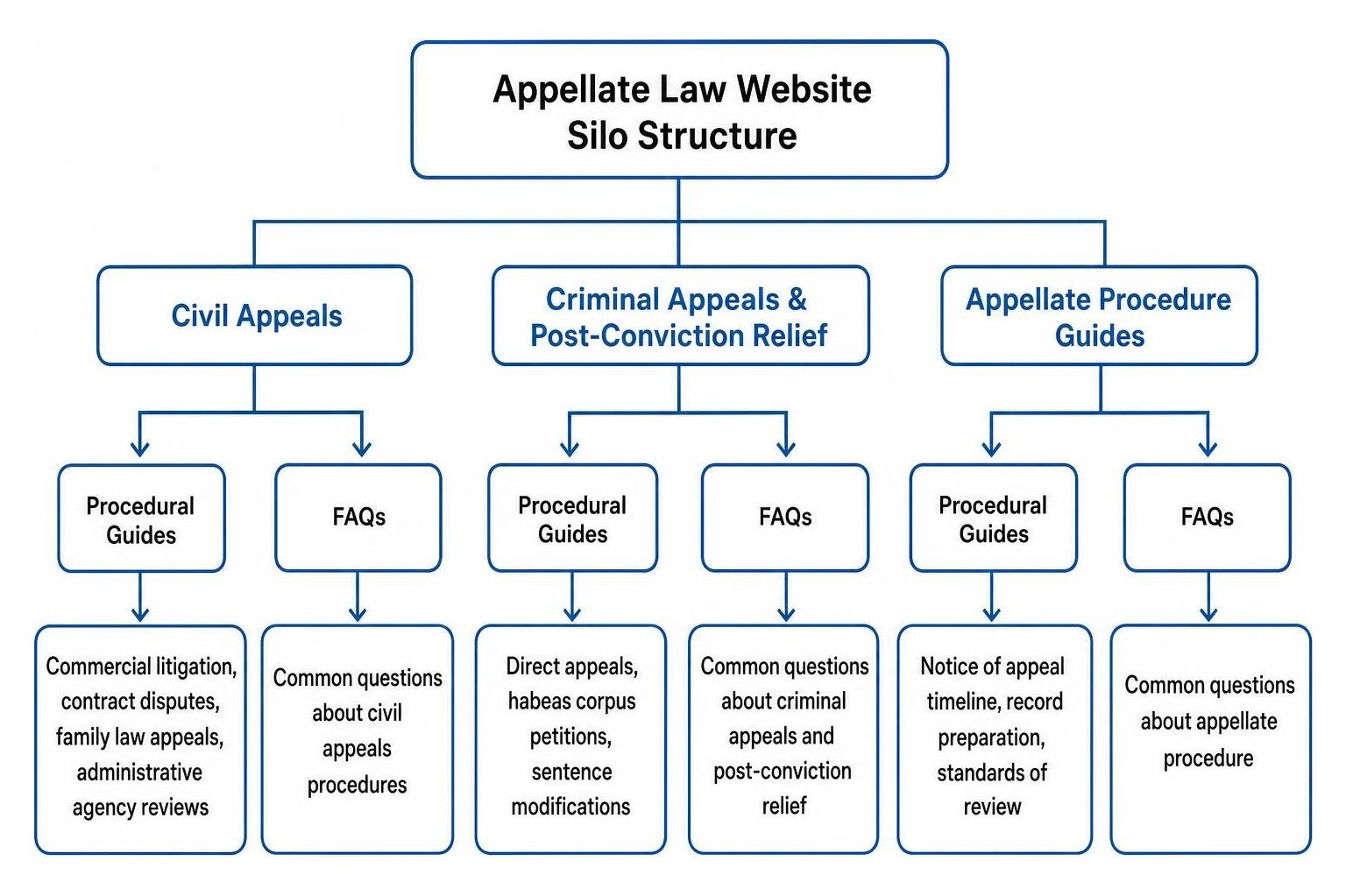
When building out your structure, consider these core service silos:
- Civil Appeals: Dedicated pages for commercial litigation, contract disputes, family law appeals, and administrative agency reviews.
- Criminal Appeals and Post-Conviction Relief: Structured hubs for direct appeals, habeas corpus petitions, and sentence modifications. You can explore our dedicated criminal defense SEO resources for more detailed criminal practice strategies.
- Appellate Procedure Guides: Step-by-step walkthroughs explaining the notice of appeal timeline, record preparation on appeal, and standards of review (such as abuse of discretion or de novo review). Organizations like the Center for Appellate Litigation exemplify the public value of clear legal procedural information.
Each procedural page should lead with a concise 40-to-60-word direct answer immediately beneath the primary heading. This structure satisfies AI search engines while providing actionable clarity for prospective clients under strict filing deadlines.
How Can Appellate Lawyers Demonstrate Strong E-E-A-T and Build Authority?
Appellate attorneys demonstrate Experience, Expertise, Authoritativeness, and Trustworthiness (E-E-A-T) by showcasing verifiable credentials, scholarly analysis, and court admissions. In complex litigation, search algorithms and prospective referring attorneys evaluate detailed proof of competence over generic marketing copy.
Key elements for building high-authority appellate content include:
- Comprehensive Attorney Bios: Detail state bar registrations, federal district and circuit court admissions, supreme court admissions, published articles, and judicial clerkship history.
- Case Summaries and Brief Repositories: Publish anonymized overviews of notable matters, outlining the underlying legal issues, procedural posture, and resolution.
- The Voice-Note Workflow: Busy practitioners can record brief summaries of procedural wins on their mobile devices, transcribing them into compliant website case studies.
- Ethical Compliance: Follow state bar advertising guidelines by avoiding outcome guarantees, limiting unqualified specialist claims, and including necessary disclaimers regarding past results.
Reviewing curated directories like the Best Appeals & Appellate Lawyers in New York City, NY demonstrates how seasoned practitioners highlight credentials to signal authoritative trust. For broader structural advice, read the ultimate guide to attorney website SEO strategies.
What Technical and Local Tactics Matter Most in SEO for Appeals Attorneys?
Technical SEO ensures that search engine crawlers can index complex legal content efficiently while delivering an accessible user experience on mobile and desktop devices.

Prioritize these technical and local optimization fundamentals:
- Page Load Speed and Core Web Vitals: Maintain load times under 2.5 seconds by compressing images below 200KB and using clean, modern code.
- Structured Schema Markup: Implement
Attorney,LegalService, andFAQPageJSON-LD schema so search engines understand your office locations, practice areas, and question-and-answer content. - Google Business Profile (GBP) Optimization: Maintain consistent Name, Address, and Phone (NAP) citations across primary legal directories.
- Ethical Review Generation: Client reviews remain a critical factor in hiring decisions. Request feedback systematically during client offboarding, and respond professionally to all public reviews without disclosing confidential matter details.
Consult our beginners guide to law firm local SEO for step-by-step instructions on setting up your local visibility.
What Backlinks and Referral Strategies Drive the Best Search Results?
Backlinks serve as critical third-party votes of confidence. Research indicates that 66% of web pages have zero backlinks, and 26% receive links from only three domains or fewer. To stand out, appellate practices must earn high-quality editorial links from respected legal authorities.
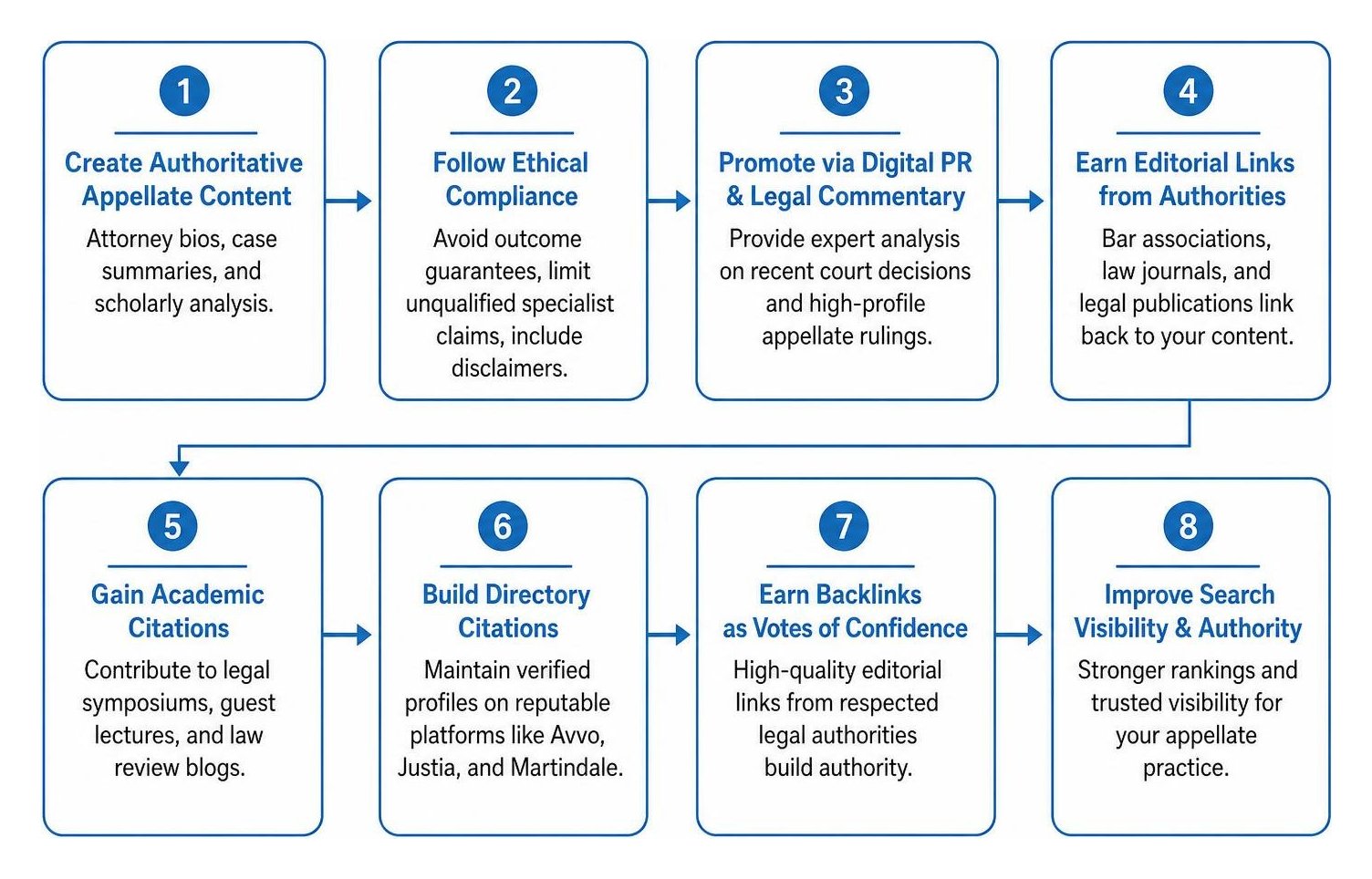
Effective link-building strategies for appellate attorneys include:
- Bar Associations and Law Journals: Publish substantive articles and commentary in state and national bar publications that link back to your bio and topical practice pages.
- Digital PR and Legal Commentary: Provide expert analysis on recent court decisions and high-profile appellate rulings through platforms like Qwoted.
- Academic and Law School Citations: Contribute to legal symposiums, guest lectures, or law review blogs.
- Legal Directory Citations: Maintain verified profiles on reputable platforms like Avvo, Justia, and Martindale to build baseline domain authority.
For additional actionable techniques, review our quick start guide to legal SEO strategies.
Navigating Organic Growth and Scaling Your Appellate Practice
Measuring the success of an appellate SEO campaign requires focusing on business outcomes rather than raw traffic metrics. Because appellate practice involves high-value, lower-volume matters, success is defined by qualified consultation requests, referring attorney contacts, and signed retainers.

Prioritize these core Key Performance Indicators (KPIs):
- Cost per Qualified Consultation: Track inbound leads by organic channel to measure marketing efficiency.
- Search Console Position 8–30 Optimization: Identify search queries ranking on pages two and three, then expand existing content with 200–400 words of targeted procedural answers to capture quick ranking gains.
- Intake Latency Reduction: Ensure contact form submissions and after-hours inquiries receive prompt follow-up, preventing high-intent prospects from contacting competing counsel.
At SmallBizSEO, we help specialized firms build authoritative visibility using our data-driven frameworks and transparent reporting. Request a comprehensive SEO visibility audit today to identify your firm's growth opportunities and build an enduring organic presence.