A Quick Start Guide to Legal SEO Strategies

A Quick Start Guide to Legal SEO Strategies
How can law firms get found online?
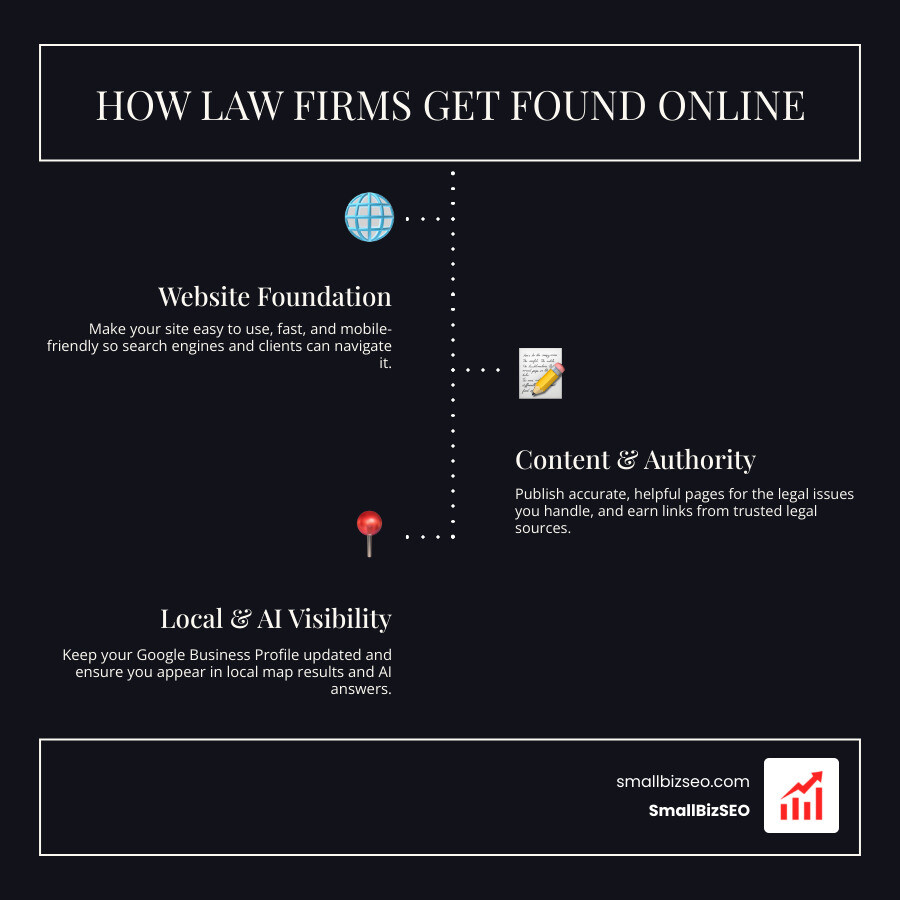
SEO for legal firms starts with three jobs: make your website easy to use and find, publish accurate pages for the legal problems you handle, and keep your Google Business Profile up to date. Focus first on the searches most likely to bring the right clients, not just the most traffic.
Today, people may find a firm through Google Search, Maps, or an AI answer. A good plan helps them recognize your firm, check your credentials, and get in touch. It also keeps every claim in line with your state bar's advertising rules.
I'm Clayton Johnson, a digital marketing and SEO strategist focused on content, digital PR, and lasting search visibility. I'll use that approach to walk through SEO for legal firms, starting with what makes it different.
Essential SEO for legal firms terms:
- search engine optimization for law firms
- local SEO map
- enterprise local SEO
What Makes SEO for Legal Firms Unique?
Legal SEO requires higher trust, strict ethical standards, and precise intent targeting compared to standard commercial industries. Because search engines evaluate legal advice under high-stakes quality benchmarks, practices cannot rely on generic content marketing.
When you master modern search engine optimization for law firms, you balance technical visibility with regulatory compliance. Research shows that 57% of legal consumers begin their search for counsel online, climbing above 70% for clients under 45. At the same time, benchmarks like the AuspiaAI legal search and AI citation study reveal that 78% of legal queries trigger AI-generated answers. Navigating this landscape means understanding both legal ethics and algorithmic scrutiny.
How Can Law Firms Follow State Bar Advertising Rules and ABA Model Rule 7.2?
Law firms must adhere to strict ethical constraints that forbid misleading statements, unsubstantiated comparisons, and guaranteed outcomes. ABA Model Rule 7.2 and state-level bar rules govern how attorneys communicate their services publicly, extending directly to website copy, title tags, and meta descriptions.
To keep your digital presence fully compliant:
- Avoid claiming "expert" or "specialist" status unless officially certified by an accredited state bar program.
- Include necessary jurisdictional disclaimers on every practice page stating that information does not constitute formal legal representation.
- Pair all past case results and settlement figures with prominent, clear disclaimers that prior outcomes do not guarantee future results.
- Ensure all client testimonials respect strict confidentiality guidelines and never promise a specific monetary verdict.
Why Does Legal SEO Require Strict YMYL Compliance?
Search engines classify legal content as "Your Money or Your Life" (YMYL) because inaccurate guidance can impair a reader's freedom, finances, or family safety. As a result, search algorithms enforce rigorous Experience, Expertise, Authoritativeness, and Trustworthiness (E-E-A-T) evaluations. Attorney bios must prominently highlight bar admissions, education, professional associations, and verified case contributions.
| Factor | General Business SEO | Legal Firm SEO |
|---|---|---|
| Scrutiny Level | Standard algorithmic evaluation | Strict YMYL & E-E-A-T compliance |
| Content Authorship | General copywriters | Licensed attorneys or subject specialists |
| Regulatory Risk | Low (standard FTC guidelines) | High (State Bar disciplinary rules & ABA Rule 7.2) |
| Content Investment Priority | Moderate, broad topic coverage | High, practice-area depth with jurisdictional detail |
| Conversion Focus | Direct sales and cart checkouts | Retained clients and signed case intake |
What Are the Core Pillars of a High-Yield Legal Search Strategy?
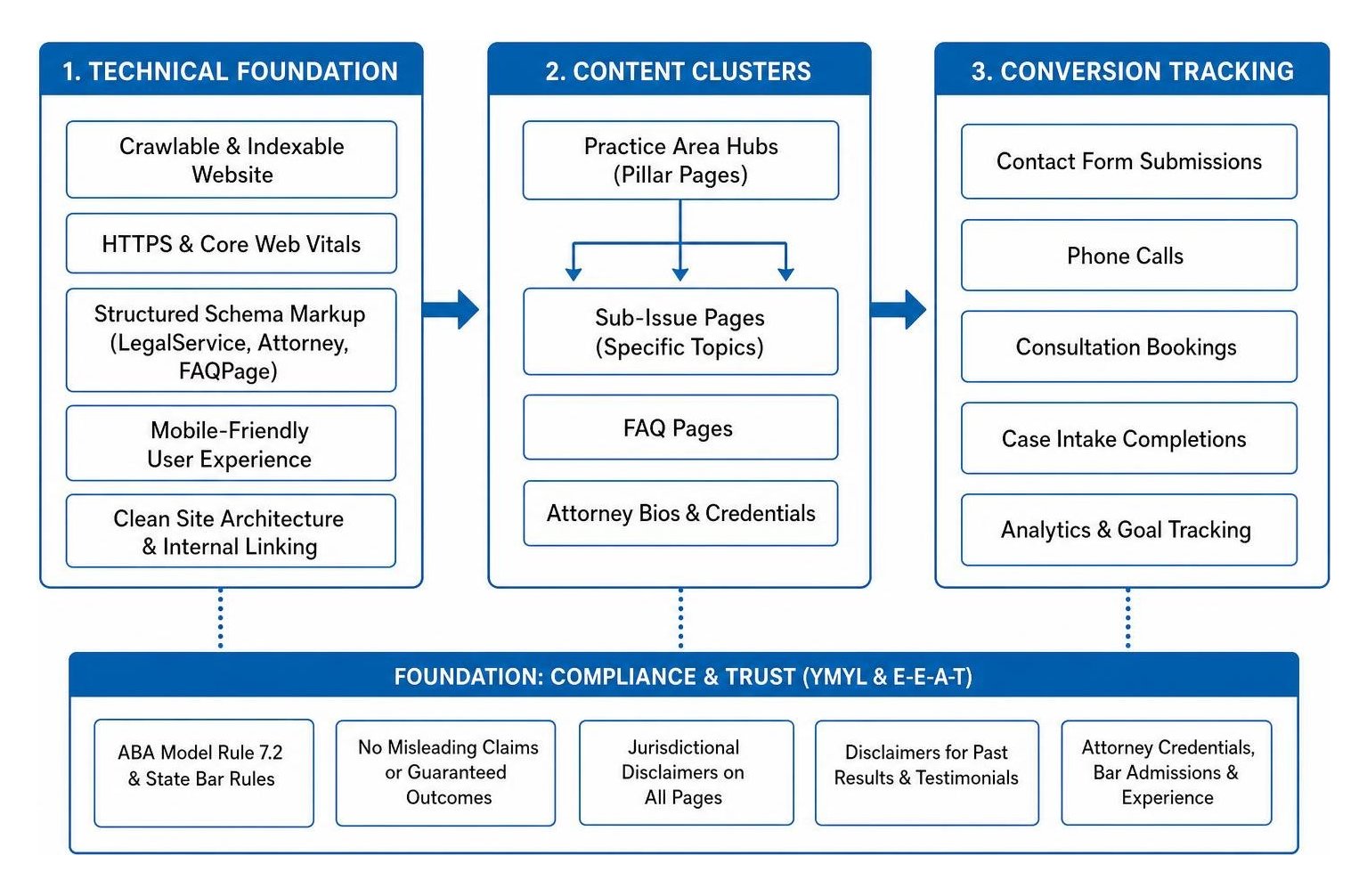
A high-performing legal search strategy relies on a clean technical foundation, a well-structured content architecture, localized authority, and clear conversion tracking. Without these core pillars working in unison, individual marketing tactics rarely produce retained clients.
Adopting proven attorney website SEO strategies ensures search engines can crawl, index, and understand your firm's specific strengths. Implementing structured schema markup—such as LegalService, Attorney, and FAQPage—translates your website's unstructured text into structured entity data that search engines process effortlessly.
How Should Law Firms Structure Content for GEO and SEO?
To win both traditional organic rankings and generative engine optimization (GEO) placements in AI Overviews, law firms must organize their content into distinct topical clusters. Rather than relying on a single generic services page, top-performing firms build dedicated practice area hubs supported by specific sub-issue pages.

Following a template-driven legal marketing architecture ensures every page delivers direct answers immediately. Generative engines favor content that answers real client questions in clear, concise language within the first two sentences of a heading. Legal directories capture at least 51.8% of AI citations, making structured content and entity consistency vital for search engine trust.
How Can Law Firms Build Authoritative Links Ethically?
Ethical link building for attorneys focuses on genuine digital PR, community involvement, and thought leadership rather than buying low-quality backlink packages.
High-authority link acquisition sources include:
- Official state bar association directories and specialized legal associations.
- Thought-leadership guest columns in respected legal publications and local news outlets.
- Legal commentary provided to journalists seeking attorney quotes on emerging court rulings.
- Sponsorships of local community events, university scholarships, and regional civic groups.
How Can Law Firms Improve Local Search Visibility?
Local search visibility represents the fastest route to acquiring qualified clients within your geographic jurisdiction. When an individual faces an urgent legal crisis, they invariably search for nearby representation.
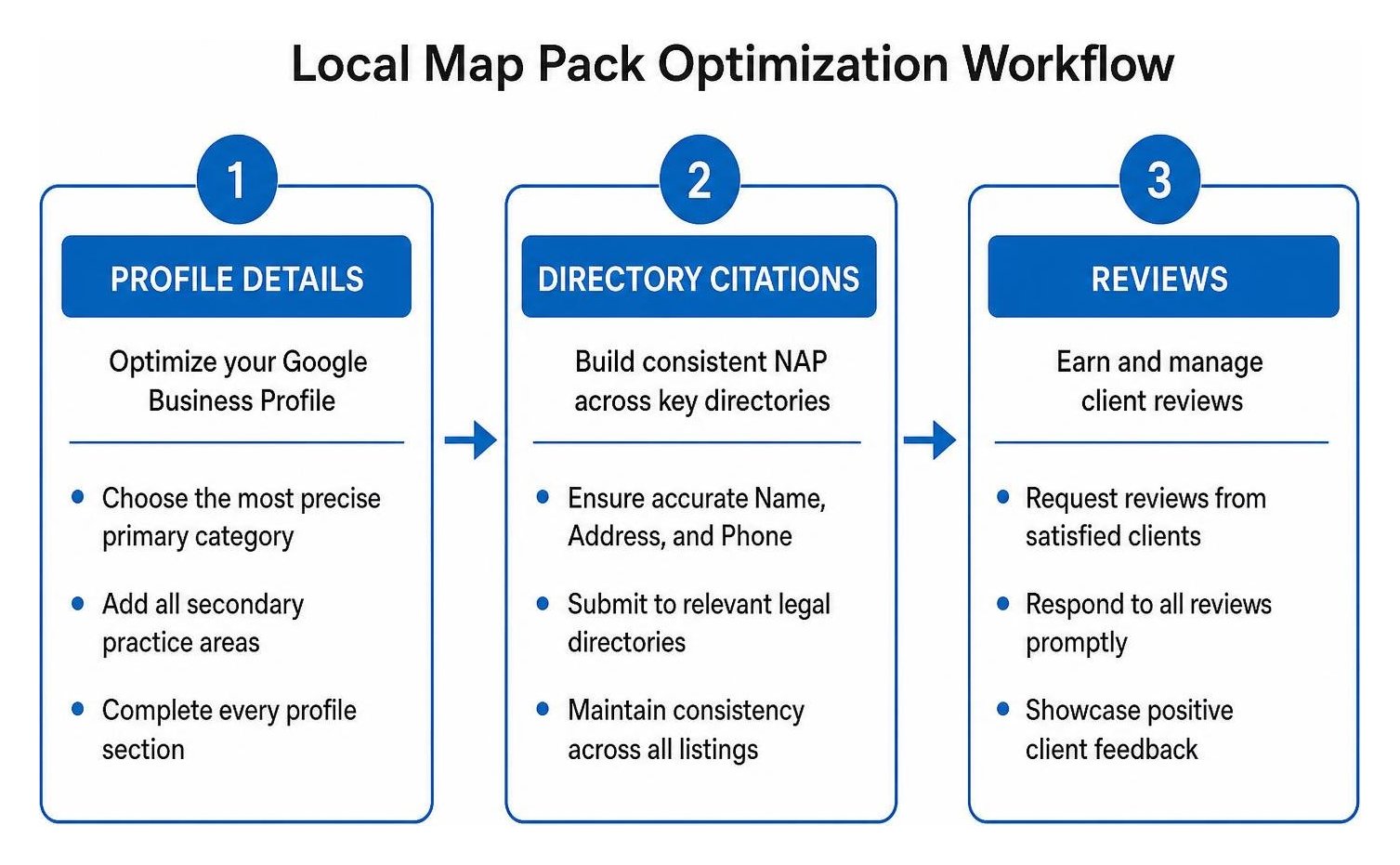
Our beginners guide to law firm local SEO outlines how the local map pack captures roughly 42% of clicks on legal searches. Building a strong local foundation requires absolute Name, Address, and Phone (NAP) consistency across directories, paired with an optimized profile.
How Can Law Firms Optimize Google Business Profile for Map Pack Clicks?
Optimizing your Google Business Profile (GBP) demands active management rather than passive setup:
- Select the most precise primary category (such as "Personal Injury Attorney" or "Criminal Defense Attorney") rather than a generic tag.
- List all secondary practice areas within the detailed services menu.
- Upload authentic, professional photos of your law office and legal team.
- Publish weekly profile updates detailing firm news, recent educational articles, and firm community initiatives.
How Can Law Firms Generate Reviews and Manage Their Reputation Ethically?
Online reviews serve as the primary social proof mechanism for prospective clients, with 87% of consumers reading reviews before choosing a local professional. However, ethical reputation management requires strict adherence to bar rules: never incentivize reviews, never fabricate testimonials, and never disclose confidential case facts when responding to negative feedback online.
How Can Law Firms Target High-Intent Clients With Case-Value Keywords?
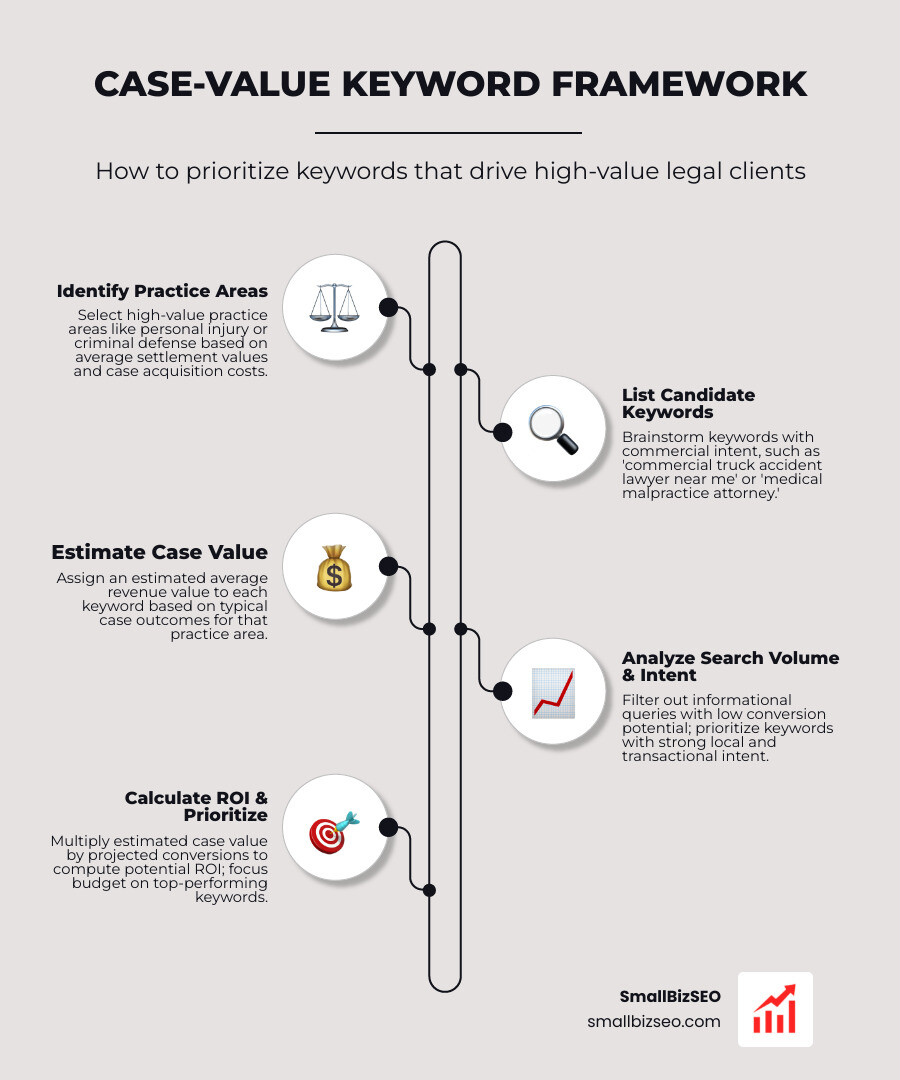
Law firms must prioritize keyword intent and case value over raw monthly search volume. A broad informational query like "what is negligence" may generate thousands of visits, but a commercial query like "commercial truck accident lawyer near me" delivers actual signed retainer agreements.
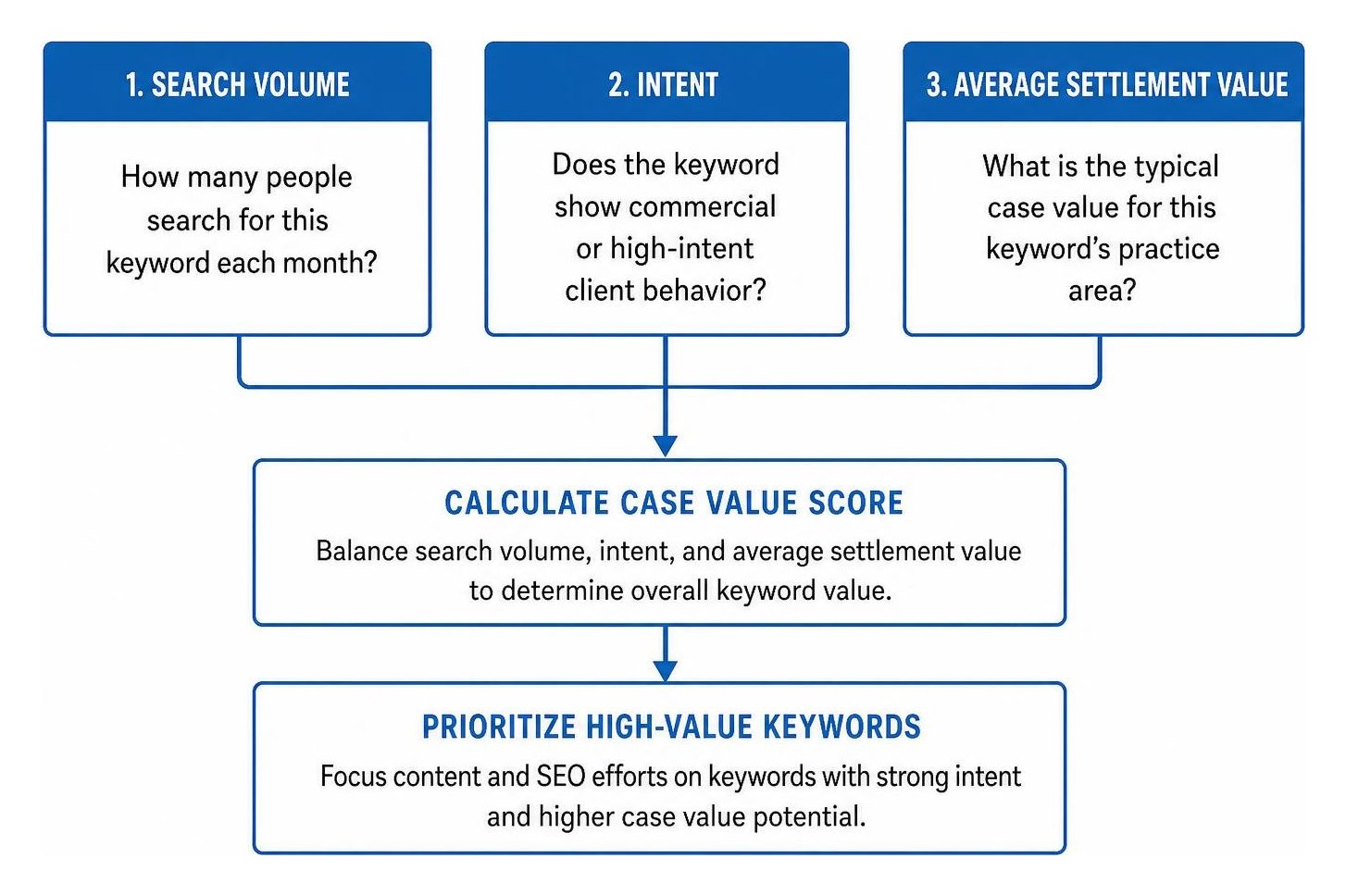
Evaluating keywords using a case-value framework helps allocate marketing resources toward searches that drive meaningful revenue rather than vanity metrics.
Which Practice Areas Should Law Firms Prioritize Over Generic Traffic?
Competitive areas such as personal injury practice areas and criminal defense often represent some of the highest-value client inquiries a firm can capture. For these high-stakes fields, organic search provides an exceptionally cost-effective client acquisition channel over time.
Law firms should build targeted content funnels for their highest-value practice areas:
- Commercial Litigation & Catastrophic Injury: Focus on complex liability and procedural pathways.
- Divorce & Family Law: Address asset division, custody logistics, and uncontested resolutions.
- Estate Planning & Elder Law: Target probate avoidance, trust structures, and long-term asset security.
How Should Law Firms Budget for SEO and Measure Intake ROI?
Investing in legal search marketing requires a clear understanding of acquisition costs and realistic budget expectations. While paid ads deliver immediate clicks at premium prices, organic search builds lasting equity that continually lowers your blended cost per signed case.
Reviewing structured legal professional services SEO packages helps firms match their investment to their market's competitive density. Tracking success requires connecting website form fills and phone calls directly to your firm's intake management software to measure actual retained cases rather than traffic alone.
What Ranking Progress Can Law Firms Expect in Months 1 Through 12?
Organic search is a compounding growth asset that develops across distinct phases:
- Months 1–3: Foundation phase. Completing technical audits, fixing crawl errors, establishing schema markup, and optimizing Google Business Profiles.
- Months 4–6: Ranking momentum. Initial movement in local map packs and long-tail informational queries; direct-answer blocks begin triggering citations.
- Months 7–12: Acquisition maturity. Core transactional practice terms climb to top positions, delivering a steady flow of high-value client inquiries.
What Common Legal Marketing Mistakes Should Law Firms Avoid?
Even established practices often waste budget on outdated tactics:
- Publishing thin, duplicate location pages that swap city names without providing unique local jurisdictional details.
- Relying on automated, unreviewed AI content that lacks attorney oversight and violates E-E-A-T guidelines.
- Failing to install call-tracking numbers and CRM conversion goals to attribute signed cases accurately.
- Abandoning an SEO campaign after 60 days before the technical foundation can mature in search rankings.
Frequently Asked Questions about Legal SEO
How long does it take for a law firm website to rank on Google?
Most law firms observe early map pack movement within 60 to 90 days after completing local optimizations. Significant rankings for highly competitive practice keywords typically emerge between 6 to 12 months as topical authority builds.
How does Generative Engine Optimization (GEO) impact legal practices?
Generative engine optimization ensures your firm appears as a referenced source when potential clients ask AI chatbots for legal guidance. Incorporating clear answer blocks, authoritative citations, and valid schema increases the likelihood of being cited in AI Overviews.
Can law firms use AI to write practice area content?
AI can assist in outlining and drafting basic informational content, but all published legal copy must undergo rigorous review by a licensed attorney. Search engines prioritize real human experience, and bar association rules require strict factual and ethical accuracy.
Build Lasting Search Authority for Your Law Firm
Achieving sustainable organic visibility requires a disciplined strategy that unites technical excellence, ethical compliance, and high-intent content. By focusing on case value rather than vanity metrics, your practice can build a predictable intake pipeline that outlasts shifting algorithms.
Our data-driven Velocity framework at SmallBizSEO accelerates rankings while protecting your professional reputation. If you are ready to expand your caseload, partner with our team as your sustainable legal growth partner to build a dominant online presence today.