Brand-Building Content: 8 Strategies to Make Your Business Unforgettable

Brand-Building Content: 8 Strategies to Make Your Business Unforgettable
Why Most Small Businesses Stay Invisible (And How Content Changes That)
Content marketing to increase brand awareness is one of the most effective — and affordable — ways to get your business noticed, trusted, and remembered. Here's a quick answer if you're short on time:
How to use content marketing to increase brand awareness:
- Publish consistently — blog posts, videos, and social content that solve real problems for your audience
- Show up on the right platforms — meet your audience where they already spend time
- Be authentic — share your brand values, behind-the-scenes moments, and real stories
- Create multiple touchpoints — it takes 5 to 7 brand interactions before consumers remember you
- Track what works — use data to refine your approach over time
- Diversify your formats — repurpose content across channels to maximize reach
- Build topic authority — go deep on a few key subjects instead of spreading thin
- Engage, don't just broadcast — respond, converse, and build real relationships
Think back to when brands first started weaving their stories into newspaper columns — quietly educating and entertaining readers rather than just selling to them. That was the birth of content marketing. And today, the same principle drives one of the most powerful tools available to small businesses.
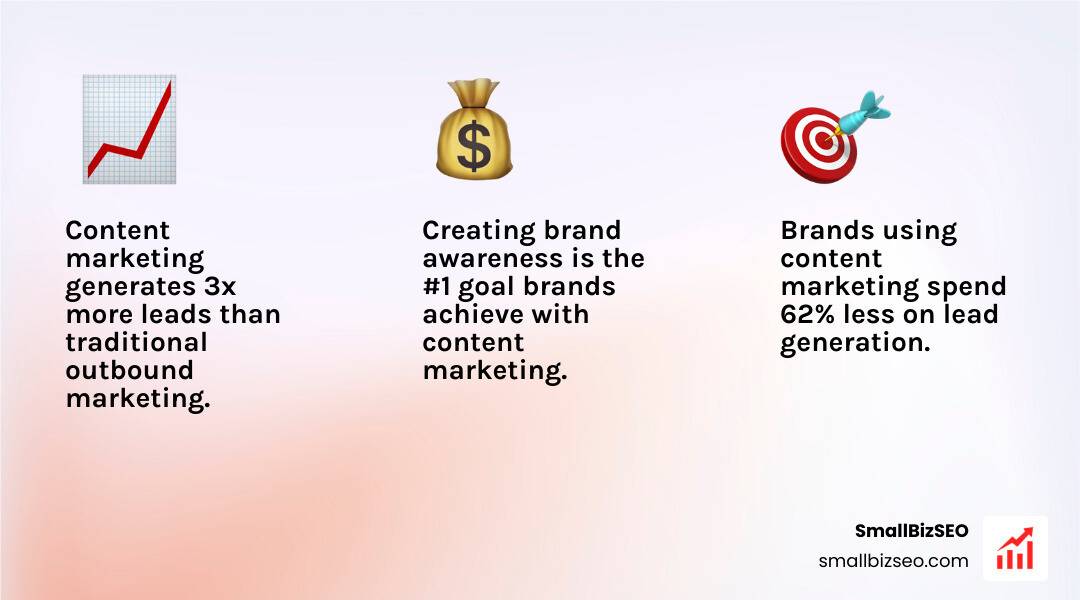
According to an annual survey by the Content Marketing Institute, creating brand awareness is the top goal brands achieve through content marketing. Yet 51% of consumers say less than half of brands create content that actually resonates with them. That gap is your opportunity.
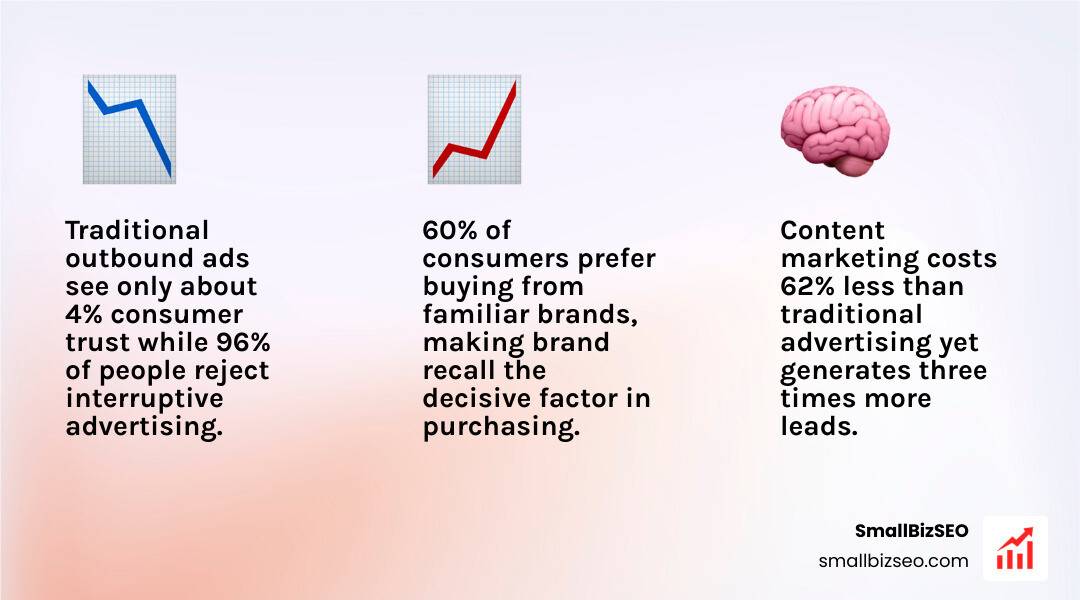
The good news? You don't need a massive budget. Content marketing generates over three times as many leads as outbound marketing — at 62% less cost. For small businesses competing against bigger players, that's a game-changer.
I'm Clayton Johnson, a digital PR and SEO strategist who has spent years helping businesses use content marketing to increase brand awareness through campaigns that build real visibility and drive meaningful engagement. In the sections below, I'll walk you through exactly how to make it work for your business.
The Power of Content Marketing to Increase Brand Awareness
To understand why content is so effective, we have to look at how consumers actually make decisions. We do not buy from brands we do not know, and we certainly do not buy from brands we do not trust. Content marketing bridges this gap by shifting the focus from "look at what we sell" to "look at how we can help."
Content Marketing vs. Traditional Advertising
Traditional advertising relies on interruption. It is the commercial that cuts off your favorite show or the pop-up ad that blocks the article you are trying to read. This outbound approach is increasingly rejected by modern buyers — in fact, roughly 96% of people state they do not trust traditional ads.
Content marketing, on the other hand, is an inbound strategy. Instead of forcing your way into a consumer's day, you create valuable resources that they actively search for. By answering their burning questions and solving their immediate problems, you build an immediate foundation of trust.
To explore this deeper, check out this breakdown of What Is Content Marketing? How It Works | WordStream, which details how helpful, value-first content outperforms disruptive ads.
Why Brand Awareness Drives Consumer Decisions
According to a global Nielsen report, 60% of consumers prefer buying new products from a familiar brand rather than switching to a completely unknown competitor. When a potential customer encounters a problem, your goal is to be the first name that pops into their head.
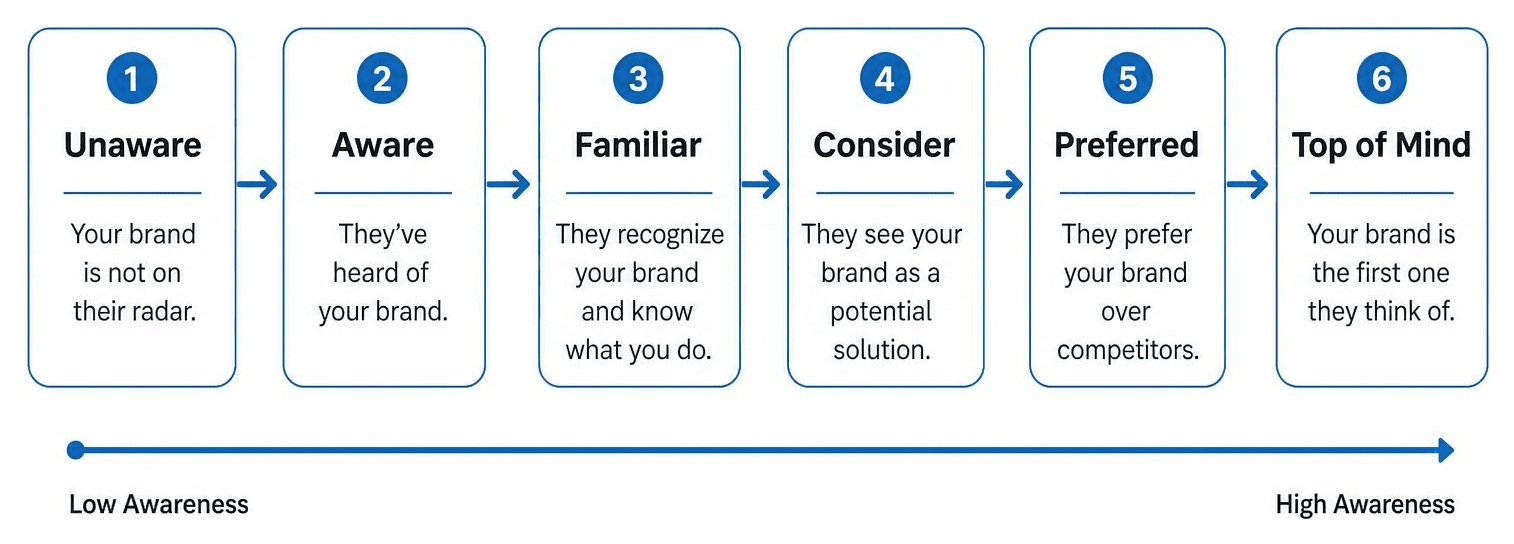
Building this level of mental real estate requires creating strong memory structures. As discussed in Content Marketing Brand Awareness: A Practical Guide, brand awareness is a continuous spectrum. It moves from simple brand recognition (identifying your logo) to brand recall (thinking of your business unprompted when a specific problem arises). When you consistently publish educational content, you cement your business as the go-to solution in your niche.
Key Benefits of Content Marketing to Increase Brand Awareness
Using content to grow your brand footprint offers several compounding benefits:
- Cost-Efficient Lead Generation: It costs significantly less than traditional paid media and builds a digital asset that continues to attract visitors for years.
- Credibility & Thought Leadership: When you solve problems for free, you position your brand as an authoritative voice in your industry.
- Compounding Organic Traffic: Highly optimized SEO blog posts earn permanent real estate on search engines, driving passive, high-intent traffic to your site.
| Feature | Content Marketing | Traditional Advertising |
|---|---|---|
| Cost | 62% less than outbound | Higher upfront & recurring costs |
| Lead Volume | Generates 3x more leads | Dependent on active ad spend |
| Asset Value | Permanent, compounding | Temporary (ends when budget stops) |
| Consumer Trust | High (value-first) | Low (disruptive/promotional) |
8 Strategic Ways to Build Unforgettable Brand Awareness
To turn your content into a brand-building engine, you need a structured approach. Randomly publishing articles and hoping for the best will only drain your resources.

Building a Strategy for Content Marketing to Increase Brand Awareness
The most successful campaigns rely on a structured framework. Rather than covering hundreds of unrelated topics, focus on building topic clusters using a hub-and-spoke model.
- Pillar (Hub) Pages: Create comprehensive, deep-dive guides on broad industry topics.
- Supporting (Spoke) Pages: Write shorter, highly targeted articles answering specific, long-tail questions, and link them back to your hub.
This structure signals to both human readers and search engines that you possess deep, specialized knowledge. For a step-by-step blueprint on setting up this architecture, read through Content Marketing Strategies | Brand Push Insights.
Creating Authentic Content That Resonates
With the rise of generic, AI-generated text flooding the web, authenticity is your ultimate differentiator. Consumers can spot low-effort, copycat content from a mile away. Research shows that 90% of consumers prioritize authenticity when choosing which brands to support.
To build real trust, weave original data, unique founder insights, and real-world case studies into your writing. This aligns perfectly with modern search engine standards for Experience, Expertise, Authoritativeness, and Trustworthiness. Learn how to align your writing with these standards in our guide on How to Optimize Your Content for E-E-A-T and Build Real Search Trust.
Adapting Formats for Different Platforms and Audiences
Your audience digests information in various ways. To maximize your reach, you must meet them where they already hang out, using the formats they prefer:
- Written Content: Exceptional for targeting search queries and capturing high-intent organic traffic.
- Short-Form Video: Perfect for social media discovery, humanizing your team, and explaining complex ideas quickly.
- Audio and Podcasts: Ideal for building deep, intimate connections and maintaining sustained attention.
- Infographics: Great for summarizing complex statistics into highly shareable visual assets.
If you are a B2B business, focus on platforms like LinkedIn, where professional decision-makers actively look for industry insights. If you are B2C, focus on visual storytelling on platforms like Instagram to build an emotional connection with consumers.
Measuring Success and Real-World Examples
You cannot improve what you do not measure. While brand awareness is often viewed as a "fuzzy" metric, modern digital analytics allow us to track brand lift with surprising accuracy.

Key Metrics to Track Brand Awareness
To see if your content marketing to increase brand awareness is working, keep an eye on these five core metrics:
- Brand Search Volume: Are more people typing your exact business name into Google?
- Direct Traffic: Is the number of visitors typing your URL directly into their browser growing?
- Social Mentions and Share of Voice: How often are people talking about your brand online compared to your competitors?
- Backlink Profile: Are other reputable websites linking to your content as a resource?
- Referral Traffic: Are you getting steady streams of visitors from other platforms, communities, or partner sites?
Successful Brand Awareness Campaigns in Action
Many household names built their empires purely on content. Consider a blender manufacturer that created simple, humorous videos blending unusual household items like smartphones and golf balls. This creative content turned a boring kitchen appliance into a viral sensation, proving that even "dry" industries can capture global attention with the right creative angle.
Similarly, many software startups skip traditional advertising entirely. Instead, they publish comprehensive educational guides and templates, becoming the definitive resource for their industry. By the time a reader needs to purchase software, the startup is already their trusted, top-of-mind choice.
Frequently Asked Questions About Brand-Building Content
What is the difference between brand recognition and brand recall?
Brand recognition is "aided" awareness. It occurs when a customer sees your logo, color scheme, or packaging and says, "Oh yes, I've heard of them." Brand recall is "unaided" awareness. This happens when a consumer encounters a problem (e.g., "I need to hire an SEO agency") and immediately thinks of your brand name without any visual prompts. Content marketing is specifically designed to move customers from simple recognition to deep, top-of-mind recall.
How long does it take to see results from brand awareness content?
Content marketing is a long-term, compounding strategy rather than an overnight fix. While paid ads can drive traffic instantly, that traffic stops the moment you turn off the budget. With consistent, high-quality content publishing, most businesses start seeing measurable growth in brand search volume and organic traffic within 3 to 6 months, with massive compounding returns after 12 months.
Is AI-generated content effective for building brand trust?
AI can be a great assistant for brainstorming, outlining, and summarizing data. However, relying purely on raw AI-generated text to build your brand usually backfires. Raw AI content lacks the real-world experience, unique opinions, and human empathy that build genuine trust. To stand out, ensure every piece of content features human oversight, expert quotes, and authentic brand storytelling.
Conclusion
Building an unforgettable brand does not require a million-dollar advertising budget. By consistently publishing helpful, authentic, and search-optimized content, you can bypass the noise, outshine larger competitors, and build lasting trust with your ideal audience.
At SmallBizSEO, we specialize in helping small businesses turn their websites into industry-leading resources. Through our data-driven "Velocity" framework, we deliver transparent, automated reporting alongside E-E-A-T-compliant content strategies designed to get your brand noticed and remembered.
Ready to make your business unforgettable? Explore our SEO Content Services today, and let's build a content engine that drives real, compounding growth for your brand.