4 Ways to Track Meaningful Content Updates Separately From New Posts

How Do You Track Meaningful Content Updates Separately From New Posts?
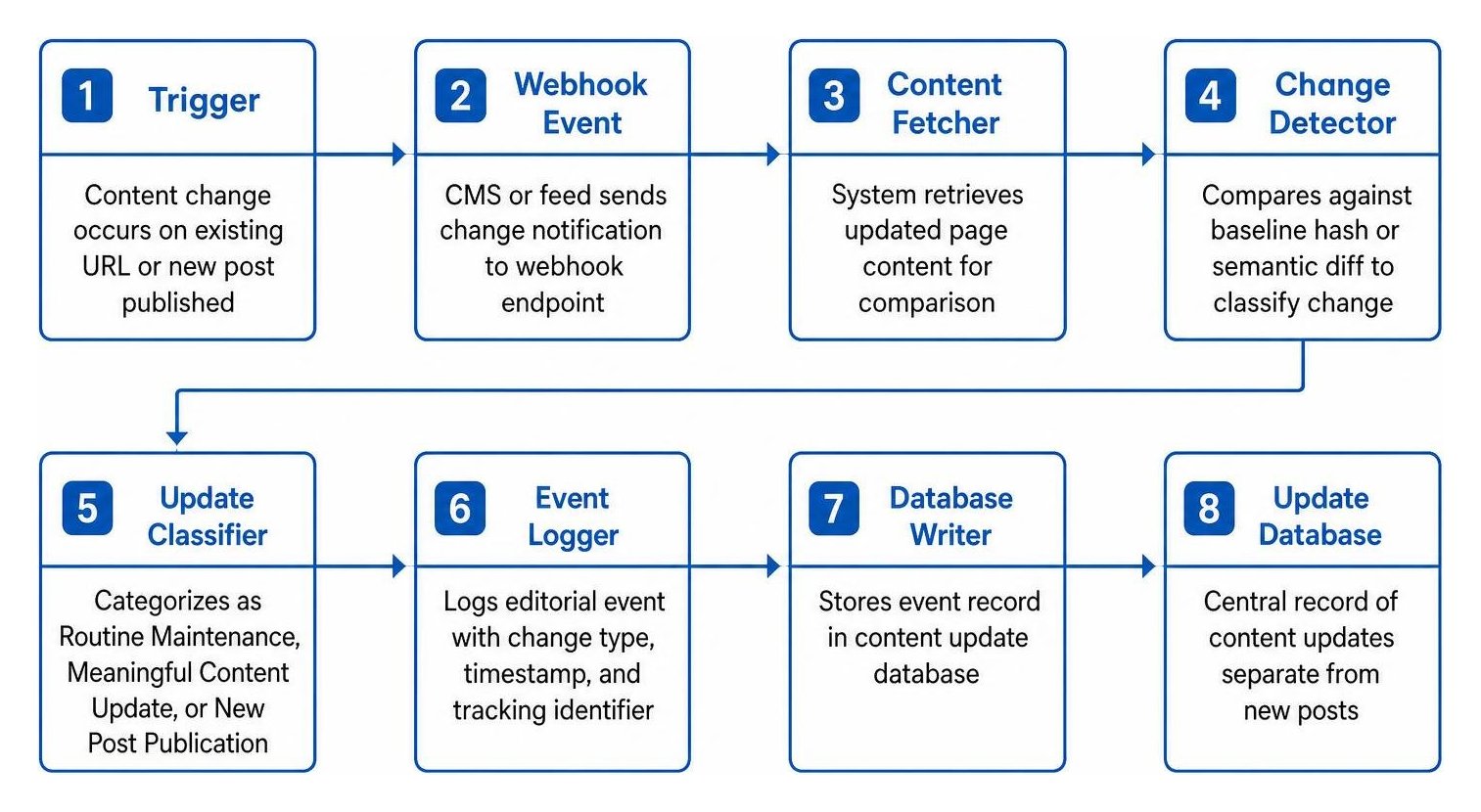
To track meaningful content updates separately from new posts, record a baseline content hash or fingerprint for every URL on your site. When a page changes, automated systems compare the new text against that baseline, filter out minor cosmetic edits, and log substantial text revisions as distinct editorial events. New posts, by contrast, are tracked as newly published URLs with their own sitemap entries and indexing history. This separation lets you compare the performance of refreshed pages against brand-new content without mixing the two.
What Defines a Meaningful Content Update Versus Routine Maintenance?
A meaningful content update involves rewriting substantial sections of text, addressing new search intent, or expanding the page structure with fresh data, media, and practical examples. In contrast, routine maintenance includes minor cosmetic adjustments, updating a broken link, fixing typos, or tweaking a meta description.
When you publish a new post, search engines discover an entirely new URL that needs to build historical authority from scratch. When you perform routine maintenance, the core message of the page remains identical, resulting in minimal changes to ranking trajectories. However, when you execute a meaningful update, you transform the utility of an established URL to match evolving user expectations.
| Change Type | Primary Scope | Search Engine Impact | Tracking Identifier |
|---|---|---|---|
| Routine Maintenance | Typos, phone numbers, broken links, single-line adjustments | Negligible; maintains baseline accuracy | Minor timestamp shift |
| Meaningful Content Update | Rewritten sections, new user intent targeting, added data, expanded framework | Re-evaluation of rankings, intent alignment, conversion lift | Modified content hash or semantic diff |
| New Post Publication | Brand-new URL creation and indexing | New crawl queue, gradual authority accumulation | New unique URL and sitemap entry |
Understanding these distinctions prevents teams from misattributing traffic spikes. If a page recovers lost rankings after you add comparison tables and original data, that growth comes from a meaningful update, not standard site maintenance.
How Do Search Engines Process Meaningful Content Updates Separately From New Posts?
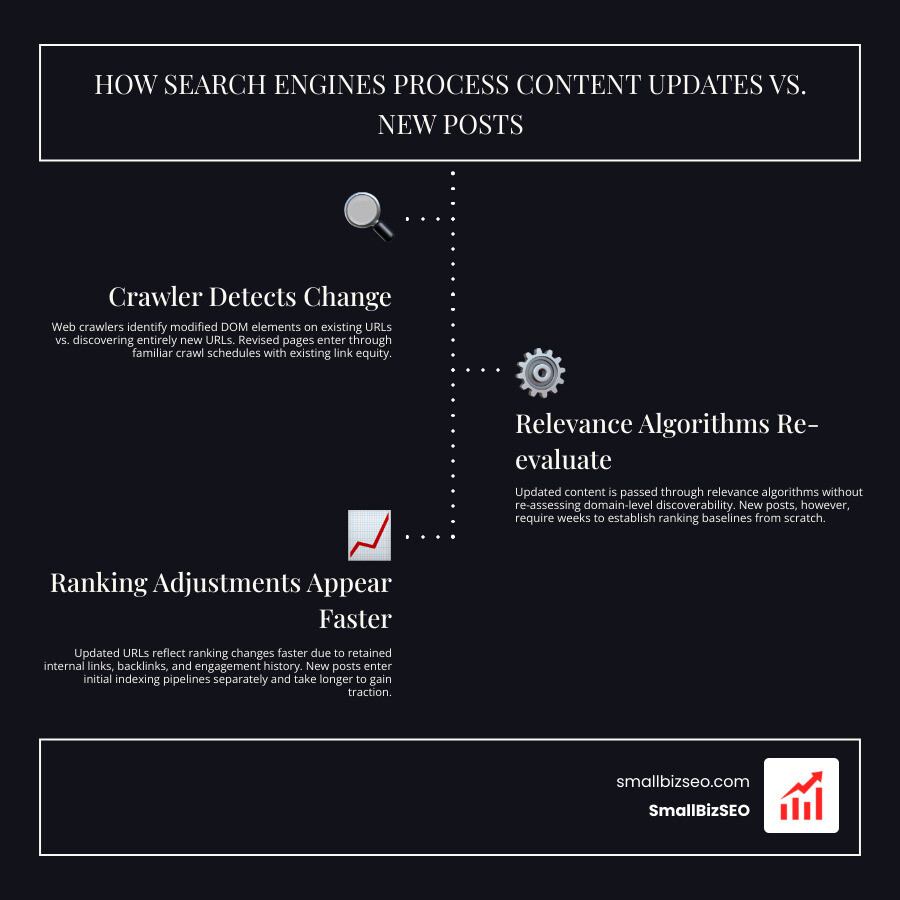
Search engines process revised pages through existing crawling schedules and historical URL logs, whereas new posts enter initial indexing pipelines. When an existing URL receives a substantial refresh, web crawlers identify the modified document Object Model (DOM) elements and pass the fresh content through relevance algorithms without having to re-evaluate domain-level discoverability.
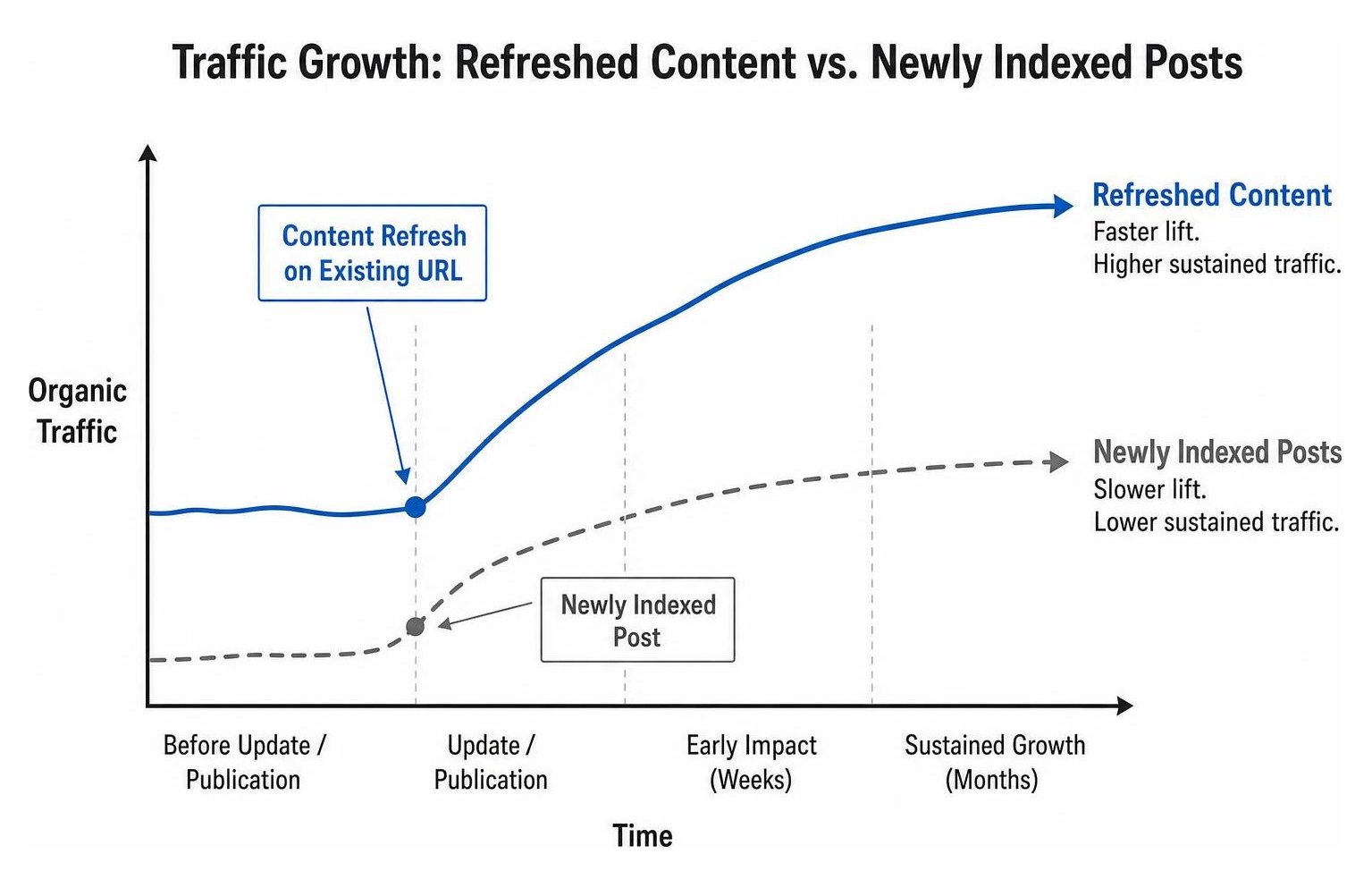
Understanding how long Google takes to process changes helps you separate short-term crawl delays from long-term ranking adjustments. While a new post might take weeks to establish ranking baselines, an updated URL can reflect ranking adjustments much faster because it already holds internal links, backlinks, and user engagement history.
On social platforms, recommendation systems evaluate newly published posts and re-distributed updates differently. Algorithms that predict user interaction prioritize immediate engagement signals, such as completion rate and comment density. Treating content updates as standalone distribution events allows you to test whether updated headlines or refreshed takeaways drive meaningful social interactions without confusing them with new asset launches.
To track meaningful content updates separately from new posts using technical workflows, record a content fingerprint or baseline hash for every URL on your site. When a page changes, automated systems compare the new text against the baseline to filter out minor cosmetic edits and log substantial text revisions as distinct editorial events.
What Automated Methods Track Meaningful Content Updates Across Systems?
Manual spreadsheets often fall behind as your content library expands. Implementing automated tracking ensures that every major edit is systematically categorized and monitored alongside your new publication calendar.
- Stateful RSS and Feed Monitoring: Standard feed parsing only checks for new entries, but stateful diffing tools like the RSS Feed Monitor track item fingerprints across runs. By analyzing unique identifiers, these tools separate newly published posts from revised content entries, preventing duplicate logging.
- Webhook-Driven Change Detection: You can deploy lightweight listeners using patterns from website change detection with webhooks to capture real-time change events. When a page updates, a webhook fires a payload containing the exact semantic diff, recording the modification instantly in your reporting database.
- No-Code Web Monitoring: If custom code is not an option, you can configure platforms based on strategies in monitoring website changes without coding to watch specific content containers while ignoring header and footer updates.
- Incremental Crawling Architectures: Rather than crawling your entire domain repeatedly, applying incremental web crawling techniques allows you to scrape only modified nodes. This method drastically reduces server overhead while capturing real-time snapshots of updated pages.
- Content-Specific Feed Timestamps: When consuming syndicated content, monitoring specialized fields as discussed in feed synchronization tracking ensures your database logs real text updates rather than simple read-status changes.
How Do You Identify When an Existing Page Needs an Update Rather Than Replacement?
An existing page requires a meaningful update when its core URL retains valuable backlink equity, but search engine results page (SERP) intent has evolved or rankings have plateaued. Monitoring your site's content decay rate reveals steady traffic declines that signal outdated information or emerging competitor coverage.
When auditing underperforming URLs, using the ultimate content audit process to revive dead traffic helps you identify whether a page needs restructuring or complete replacement. If top-ranking competitors have shifted from broad theoretical guides to structured comparisons or tool-focused walk-throughs, revising your existing piece can yield dramatic results.
In real-world testing, addressing intent mismatches on existing pages has helped individual posts recover from lower first-page positions into top-three rankings, lifting monthly trial conversions by up to 50%.
How Do You Measure Update Impact, Search Intent Shifts, and Next Steps?
To measure the impact of an update, compare organic impressions, ranking positions, and conversion rates from the pre-update period against post-update performance on the exact same URL. This isolates the effect of the refresh from the baseline performance of new posts.

How Should You Display Last Updated Dates and Manage Scheduling?
Displaying a clear dateModified timestamp on your pages and within your Schema.org structured data signals freshness directly to readers and search engine crawlers. Always maintain transparency: only advance the visible modified date when you have made a substantial, meaningful revision to the text.
Integrating update workflows into your ongoing editorial calendar ensures your team balances net-new content production with continuous asset maintenance. Adopting a structured approach to building an editorial content strategy allows you to allocate resources based on business impact rather than arbitrary publishing schedules.
How Do You Scale Your Content Strategy and Analyze Post-Update Performance?
The internet is seeing unprecedented volumes of auto-generated text. Research shows that roughly 35% of newly published websites contain automated writing, and more than 40% of longform professional social posts are fully AI-generated. On major social networks, engagement distributions remain heavily skewed; for instance, the top 20% of video content often commands over 70% of total platform views.
Because generic content is increasingly common, publishing high-utility, human-verified updates on existing pages creates a defensible competitive moat. Aligning your workflow with the SmallBizSEO content velocity framework ensures that every refresh is tracked, verified, and optimized for sustained search visibility.
Measure What Moves Your Organic Growth
Tracking content refreshes separately from new publications gives you direct clarity on what drives organic performance. By monitoring content hashes, tracking search intent shifts, and measuring pre- and post-update conversion metrics on individual URLs, you can invest your team's resources where they generate the highest return.
When you treat historical content as active digital assets rather than static blog entries, your SEO strategy becomes more agile and resilient. Establish clear tracking protocols today, document every major revision, and let verified performance data guide your content production.