A Practical Guide to Editorial Content Strategy

A Practical Guide to Editorial Content Strategy
Why Editorial Content Strategy Turns Ideas Into Growth
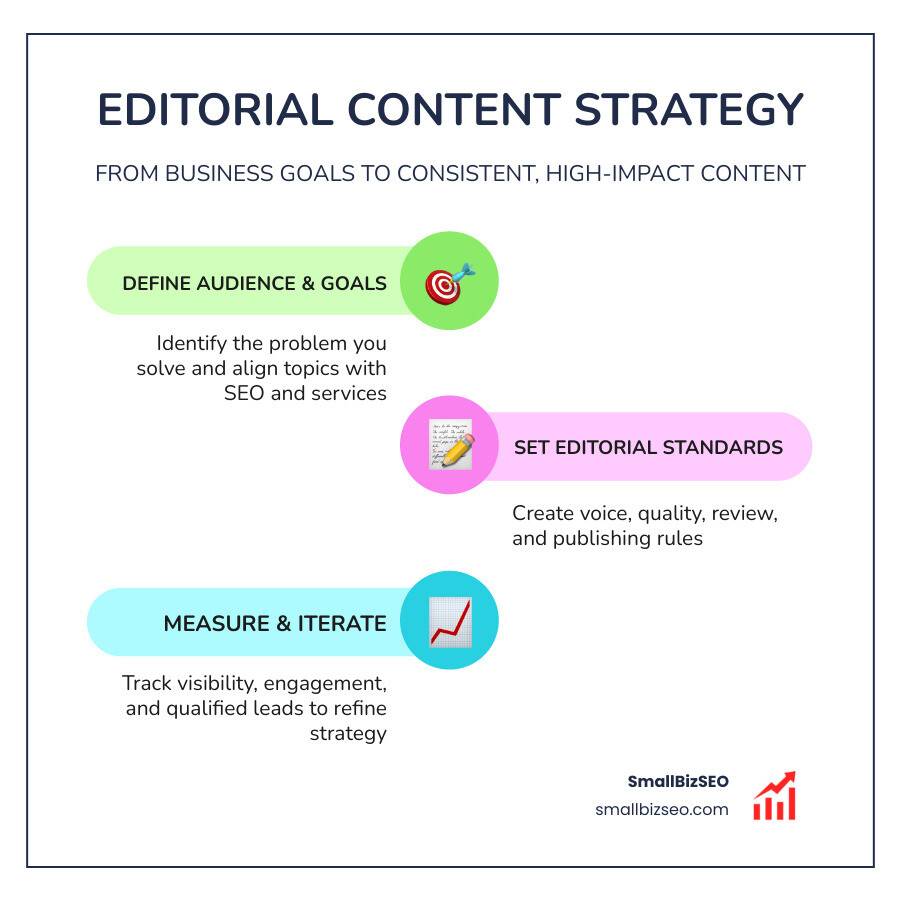
An editorial content strategy is the system that turns business goals into useful, consistent content. It connects what you publish with who it helps, why it matters, how it is reviewed, and how you measure results.
For a small business, start with four decisions:
- Define the audience problem you can solve.
- Choose a few focused topics tied to your services and SEO goals.
- Set clear rules for voice, quality, review, and publishing.
- Track whether content earns visibility, engagement, and qualified leads.
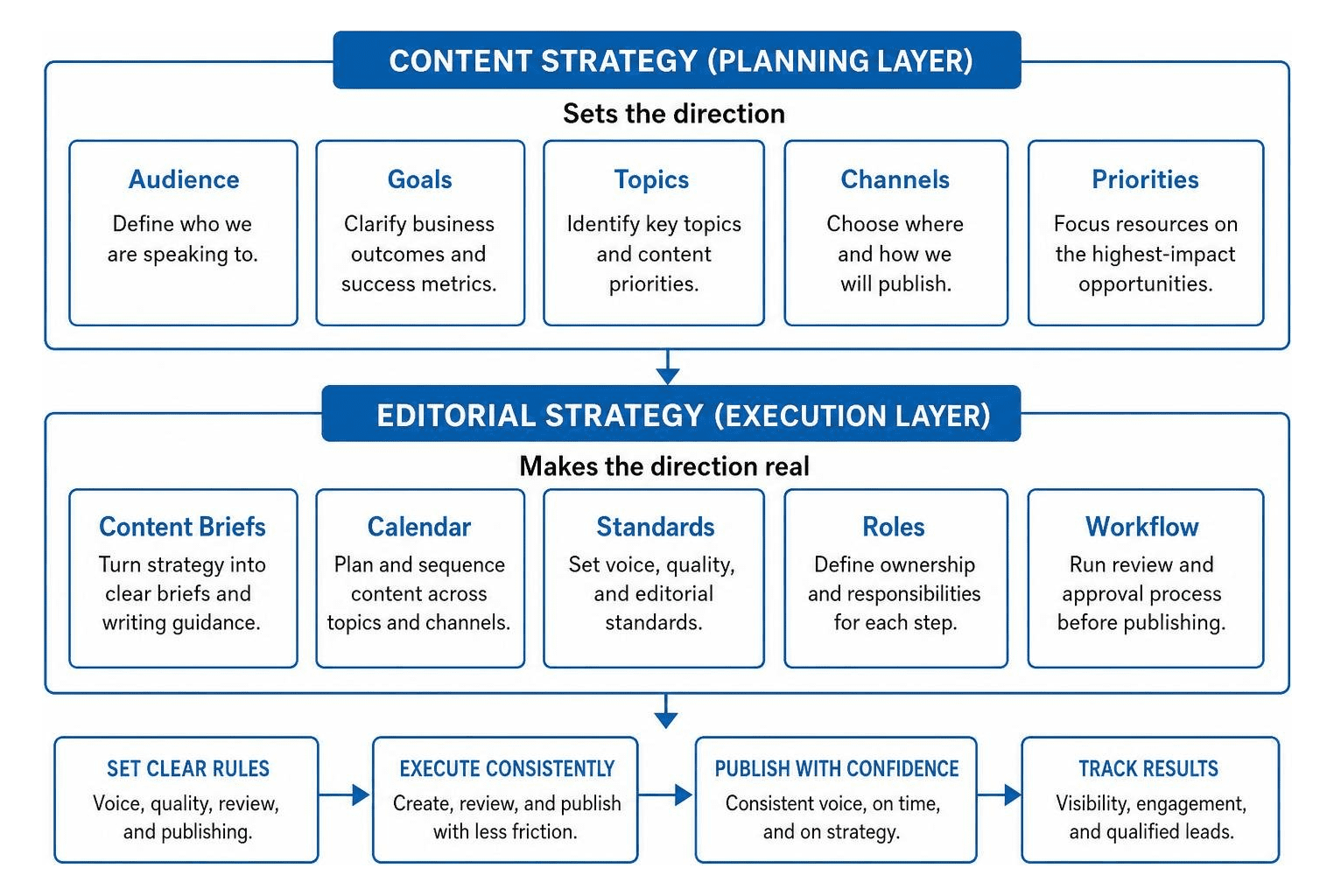
Content strategy sets the direction: audience, goals, topics, channels, and priorities. Editorial strategy makes that direction real through briefs, calendars, standards, roles, and approval workflows. You need both. A calendar full of post titles is not a strategy, and a strong plan cannot help if drafts get stuck in endless reviews or go live without a consistent voice.
The payoff is practical: less guesswork, fewer off-topic articles, faster approvals, and content that can build search visibility over time rather than becoming a random pile of URLs.
I'm Clayton Johnson, and I use digital PR, SEO, and audience-focused campaigns to help businesses improve search visibility and engagement. In this guide, I’ll show how an editorial content strategy can make your publishing process clearer, more consistent, and easier to connect to real business results.
Editorial content strategy glossary:
Understanding Content Strategy vs. Editorial Strategy
Many organizations mix up content strategy and editorial strategy. While closely related, they operate at two distinct levels of your marketing organization.
Content strategy defines the high-level roadmap: who we are speaking to, which business goals we need to achieve, what channels we will utilize, and how we position our brand against competitors. Editorial strategy serves as the operational execution engine. It governs how that high-level roadmap translates into daily production, voice consistency, editorial standards, and review workflows.
When executing an organic campaign, blending high-level business goals with tactical execution is vital for effective seo content marketing.
| Strategic Dimension | Content Strategy (Planning Layer) | Editorial Strategy (Execution Layer) |
|---|---|---|
| Primary Focus | Business goals, market positioning, and audience segmentation | Storytelling mechanics, voice tone, style guides, and formats |
| Key Questions | Why are we creating content? Who is it for? | How do we tell this story? What makes it ready to publish? |
| Core Deliverables | Personas, channel plans, KPI frameworks, topic territories | Content briefs, style rules, editorial calendars, review chains |
| Operational Role | Strategic alignment and commercial purpose | Quality control, brand integrity, and publication velocity |
Why the Strategic Distinction Matters
When a company fails to separate planning from operational execution, content programs stall. A business might understand its target audience and have a complete list of keywords, yet drafts sit in review limbo for months because nobody defined what constitutes publish readiness.
Without formal editorial standards, stakeholder feedback becomes entirely subjective. Executives negotiate personal phrasing preferences rather than evaluating drafts against customer intent. Conversely, having brilliant writers without a strategic roadmap leads to well-written pages that attract zero qualified search traffic. Documenting both disciplines eliminates these operational bottlenecks, as outlined in this Content Strategy Guide.
The Four Core Pillars of an Editorial Content Strategy
A sustainable editorial program relies on four foundational pillars:
- Substance Definition: Identifying the core knowledge, proprietary data, and subject-matter insights that differentiate your brand from generic web content.
- Workflow Governance: Defining the exact handoff protocols, approval stages, and criteria required to move an idea from a draft to a live URL.
- Message Architecture: Establishing the brand voice, tone nuances, and terminology that ensure every article sounds coherent regardless of who wrote it.
- Resource Allocation: Mapping human talent, technical tools, and production bandwidth to ensure publishing schedules remain realistic and sustainable.
Core Components of an Editorial Content Strategy Framework
Building an effective publishing framework requires moving beyond guesswork. A comprehensive system establishes clear standards before any writing begins, ensuring that every asset serves a measurable commercial purpose through a structured content planning process.

Developing Audience Personas and Validating Topic Demand
Effective editorial planning starts with genuine audience pain points rather than arbitrary keyword lists. While search volume metrics matter, validating demand requires qualitative research:
- Reviewing recent sales call transcripts and recorded demos to pinpoint recurring prospect objections.
- Auditing customer support tickets to identify confusing technical concepts that need simple explanations.
- Conducting customer interviews to discover the real-world phrasing buyers use when evaluating solutions.
Understanding user intent ensures you produce targeted answers instead of fluffy overviews.
Establishing Editorial Guidelines, Governance, and Style
A comprehensive style guide prevents multi-author inconsistency and protects brand credibility. It gives every internal writer and external partner an operational rulebook.
Key elements of an editorial governance toolkit include:
- Brand Voice Guidelines: Clear descriptions of your brand's personality, including contrasting examples of how your voice sounds versus what to avoid.
- Mechanics and Formatting Rules: Standards covering capitalization, header hierarchies, bullet point usage, and image alt text best practices.
- Fact-Checking and Quality Checklists: Mandatory verification steps to confirm technical claims, verify data sources, and prevent factual errors.
Equipping your team with these standards allows every content marketing copywriter to create accurate, engaging copy that matches company standards.
Crafting Content Briefs and Multitier Approval Workflows
High-quality drafts depend on high-quality briefs. When a writer receives an ambiguous topic title, the resulting draft almost always misses the mark.
By mastering the art of the seo content brief, you provide creators with essential guardrails: target search intent, required subheadings, primary and secondary entities, internal linking targets, and direct calls to action.
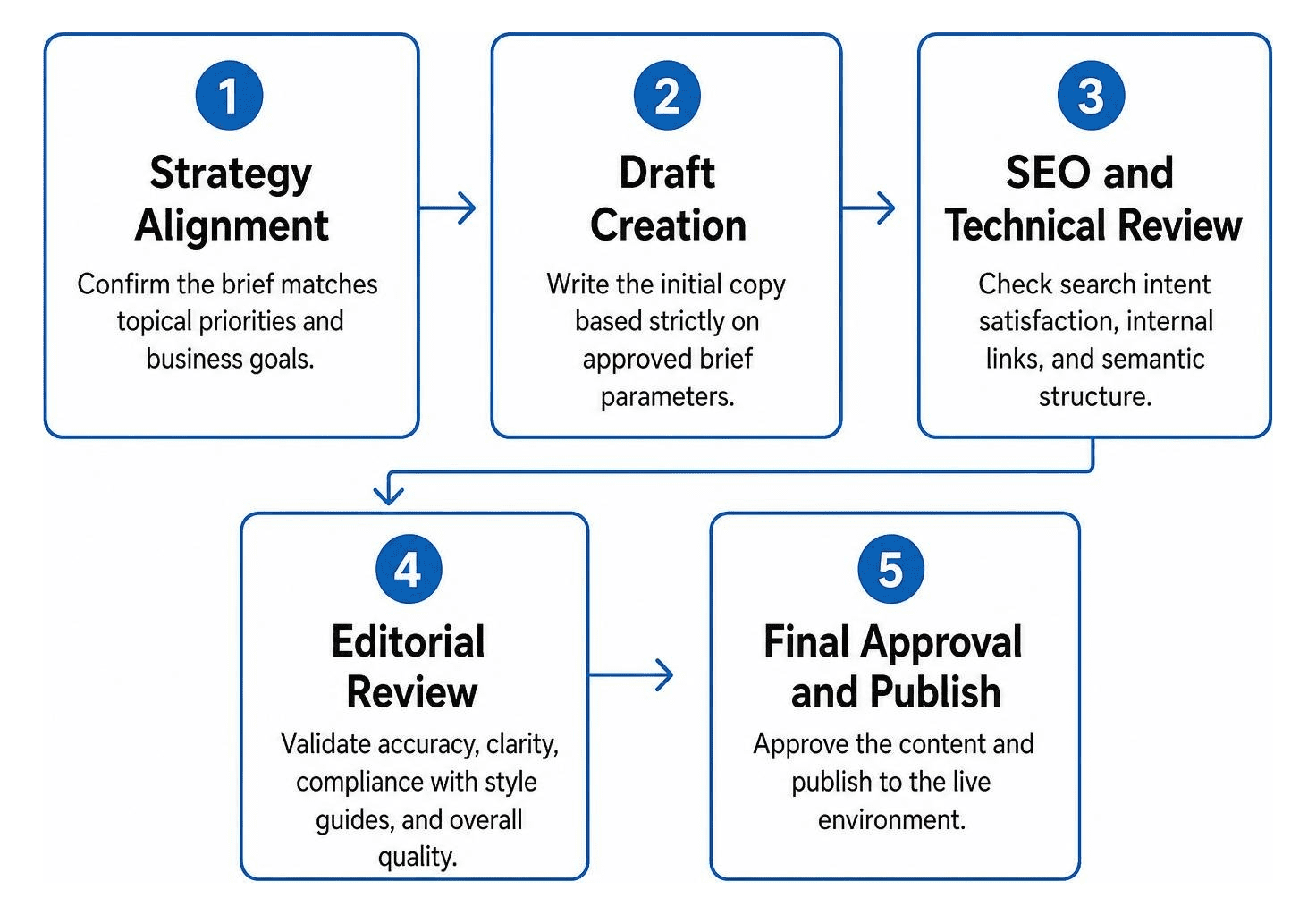
To maintain publishing momentum, implement a structured five-stage approval workflow:
- Strategy Alignment: Confirming the proposed brief matches topical priorities and business goals.
- Draft Creation: Writing the initial copy based strictly on approved brief parameters.
- SEO and Technical Review: Checking search intent satisfaction, internal links, and semantic structure.
- Subject-Matter Expert QA: Verifying technical accuracy and proprietary insights.
- Final Copyedit and Staging: Polishing mechanics, adding metadata, and formatting for publication.
Building a Growth-Focused Editorial Calendar and Workflow Engine
An editorial calendar is an operational execution engine that tracks deadlines, collaborator handoffs, and distribution milestones.

Teams generally choose from three primary calendar formats:
- Linear Calendars: Topics assigned to rigid publishing dates, best for consistent weekly cadences.
- Reverse Calendars: Scheduling workflows backward from fixed product launches, seasonal cycles, or industry events.
- Hybrid Calendars: Blending ongoing thematic production with flexible delivery windows based on team bandwidth.
Maintaining a strategic content calendar keeps contributors aligned without overwhelming internal resources.
Structuring Topic Clusters and Content Pillars
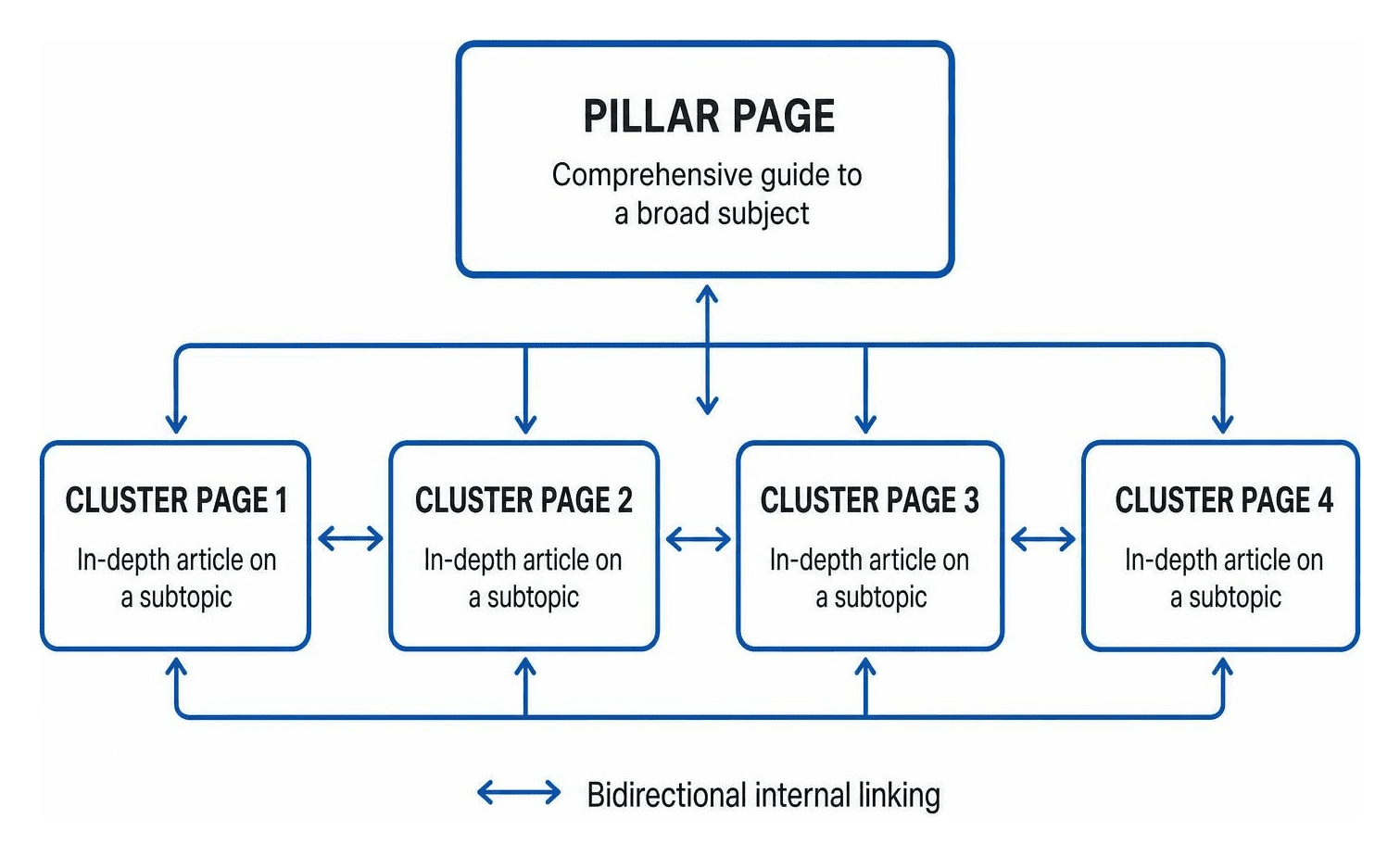
Rather than publishing disjointed articles across dozens of unrelated subjects, top-performing sites concentrate authority into structured topic clusters.
A pillar page acts as a comprehensive, high-level guide to a broad subject, while supporting cluster articles dive deep into granular subtopics. Establishing logical internal links between cluster pieces and their parent pillar demonstrates deep topical expertise to search engines. Mastering this architecture requires consistent, high-standard seo-friendly content writing.
Managing Team Roles and Publishing Workflows
Clear role definitions prevent internal review gridlock. When multiple stakeholders share undefined editorial responsibilities, deadlines slip.
- Content Strategist: Owns keyword research, audience persona mapping, and topical prioritization.
- Managing Editor: Oversees the calendar, assigns briefs, enforces deadlines, and manages review stages.
- Writer / Subject-Matter Expert: Conducts research, drafts content to brief specifications, and integrates proprietary insights.
- SEO Specialist: Verifies technical formatting, metadata, internal link distribution, and schema markup.
Modern editorial teams often integrate advanced workflow architectures, such as The Living Content Graph System, to connect knowledge databases directly to dynamic publishing queues.
Measuring Editorial Performance and Historical Content Optimization
Tracking performance ensures your editorial investments deliver measurable commercial returns. Content programs must look beyond surface-level pageviews and evaluate bottom-line business value.

Publishing without performance tracking makes it impossible to know what works, which is why modern brands must look beyond content optimization toward comprehensive pipeline attribution.
Tracking Downstream Attribution and Content KPIs
Evaluate content success based on the intent of each page:
- Top-of-Funnel (Awareness): Organic impressions, ranking velocity, scroll depth, and brand search growth.
- Middle-of-Funnel (Consideration): Time on page, newsletter sign-ups, lead magnet downloads, and internal link click-through rates.
- Bottom-of-Funnel (Decision): Direct contact inquiries, demo requests, assisted pipeline conversions, and attributed revenue.
Research reveals that 62% of highly successful content marketing organizations maintain a documented strategy, and businesses with documented content processes generate roughly three times more leads per dollar spent than undocumented programs.
Executing Content Audits and Refresh Cycles in Your Editorial Content Strategy
A mature editorial system treats existing content as a living asset library. Over time, rankings decay, factual references age, and search intent evolves.
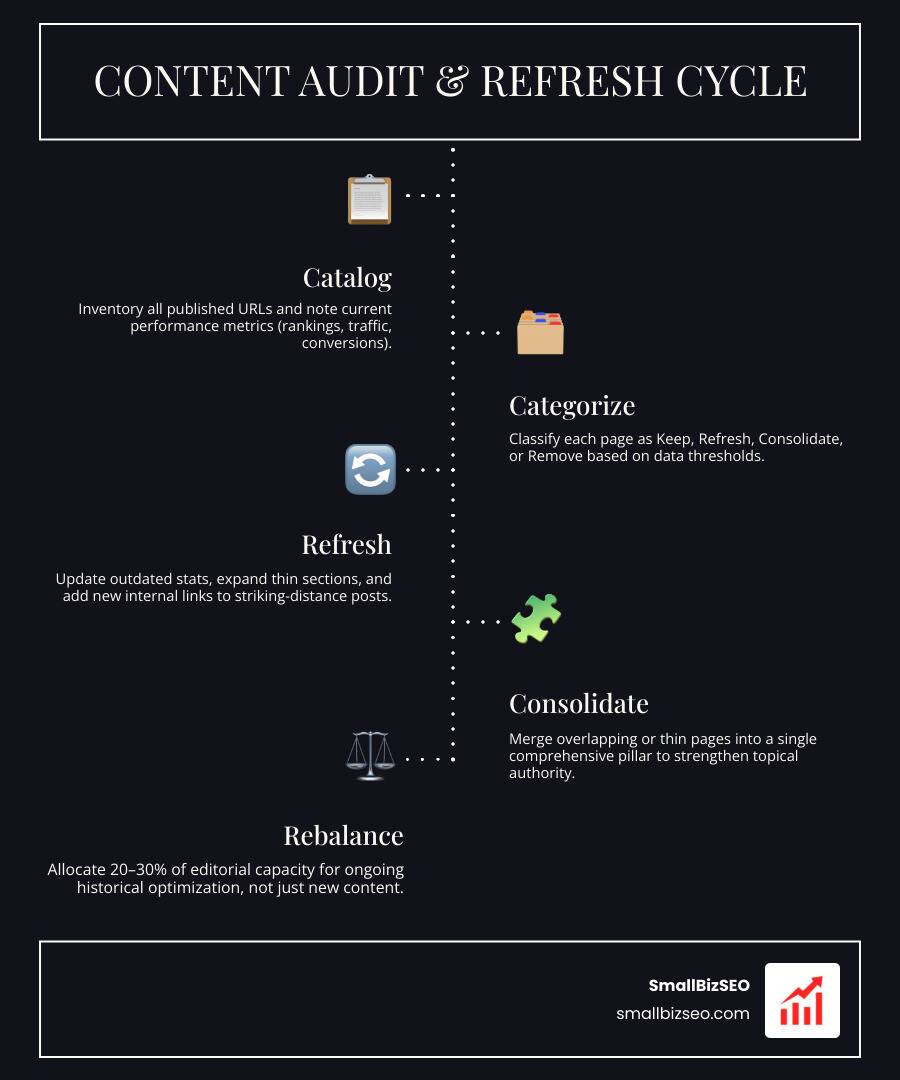
Reserve at least 20% to 30% of your editorial calendar capacity for historical content optimization. Deploy the ultimate content audit process to revive dead traffic by cataloging all published URLs into four clear action categories:
- Keep: High-performing pages that maintain strong rankings and generate consistent conversions.
- Refresh: Pages on striking-distance positions with decaying traffic that need updated data, expanded sections, or better internal links.
- Consolidate: Thin or overlapping pages that should be merged into a single comprehensive pillar.
- Retire: Obsolete, off-topic URLs that dilute domain authority and should be redirected or pruned.
Common Editorial Pitfalls and How to Avoid Them
Even well-funded content initiatives run into trouble when basic operational traps are overlooked.
- Treating a Calendar as a Strategy: An editorial calendar organizes publishing dates, but it cannot replace audience research, competitive positioning, or commercial intent mapping.
- Topical Sprawl: Publishing across too many unrelated topics dilutes topical authority. Stick to three to five core thematic pillars.
- Skipping Content Briefs: Expecting writers to produce high-performing articles from loose titles alone leads to extensive rewrites and inconsistent tone.
- Neglecting Historical Content: Chasing net-new publishing quotas while ignoring decaying historical URLs allows competitors to capture your existing rankings.
- Excessive Review Committees: Involving too many non-editorial stakeholders in line-by-line editing slows output velocity and flattens brand voice.
To avoid these traps, follow our advice to stop posting and start ranking with this small business content strategy.
Frequently Asked Questions about Editorial Strategy
How long does an editorial strategy take to show business results?
Organic search authority compounds over time. While initial indexing and ranking movements often occur within the first 60 to 90 days, consistent organic traffic growth and meaningful lead generation typically materialize within 6 to 12 months of disciplined publishing.
How many content pillars should a business maintain?
Most businesses achieve the best results by focusing on three to five core thematic content pillars. Limiting your focus allows you to build deep topical authority without overextending internal resources.
What is the difference between an editorial director and a content strategist?
A content strategist focuses on research, high-level audience targeting, channel planning, and commercial alignment. An editorial director oversees creative quality, story framing, brand voice consistency, style governance, and day-to-day newsroom workflow management.
Accelerate Your Organic Publishing with SmallBizSEO
Building and managing a disciplined editorial program requires time, technical expertise, and rigorous governance. At SmallBizSEO, we help businesses eliminate publishing chaos through our data-driven "Velocity" framework, delivering fast organic rankings, E-E-A-T-compliant authority, and fully transparent reporting.
Whether you need to design an editorial workflow from scratch, build high-converting topic clusters, or clean up an underperforming archive, our dedicated team handles every step from brief creation to final technical optimization. Explore our comprehensive seo content services today to turn your publishing schedule into a measurable growth engine.