5 Reasons Your Keyword Checklist Fails in the Age of BERT

Can a Traditional SEO Checklist Game BERT?
No. Optimizing for BERT is not a keyword checklist because BERT helps Google interpret words in context. Repeating a phrase cannot make a page answer the wrong question. A checklist can still help you cover SEO basics, but your content needs to address what the searcher actually wants to know.
I’m Clayton Johnson, founder of SmallBizSEO. My work in content strategy and Answer-Ready SEO has shown me why optimizing for BERT is not a keyword checklist: small businesses need clear answers to customer questions, not more phrases squeezed onto a page.
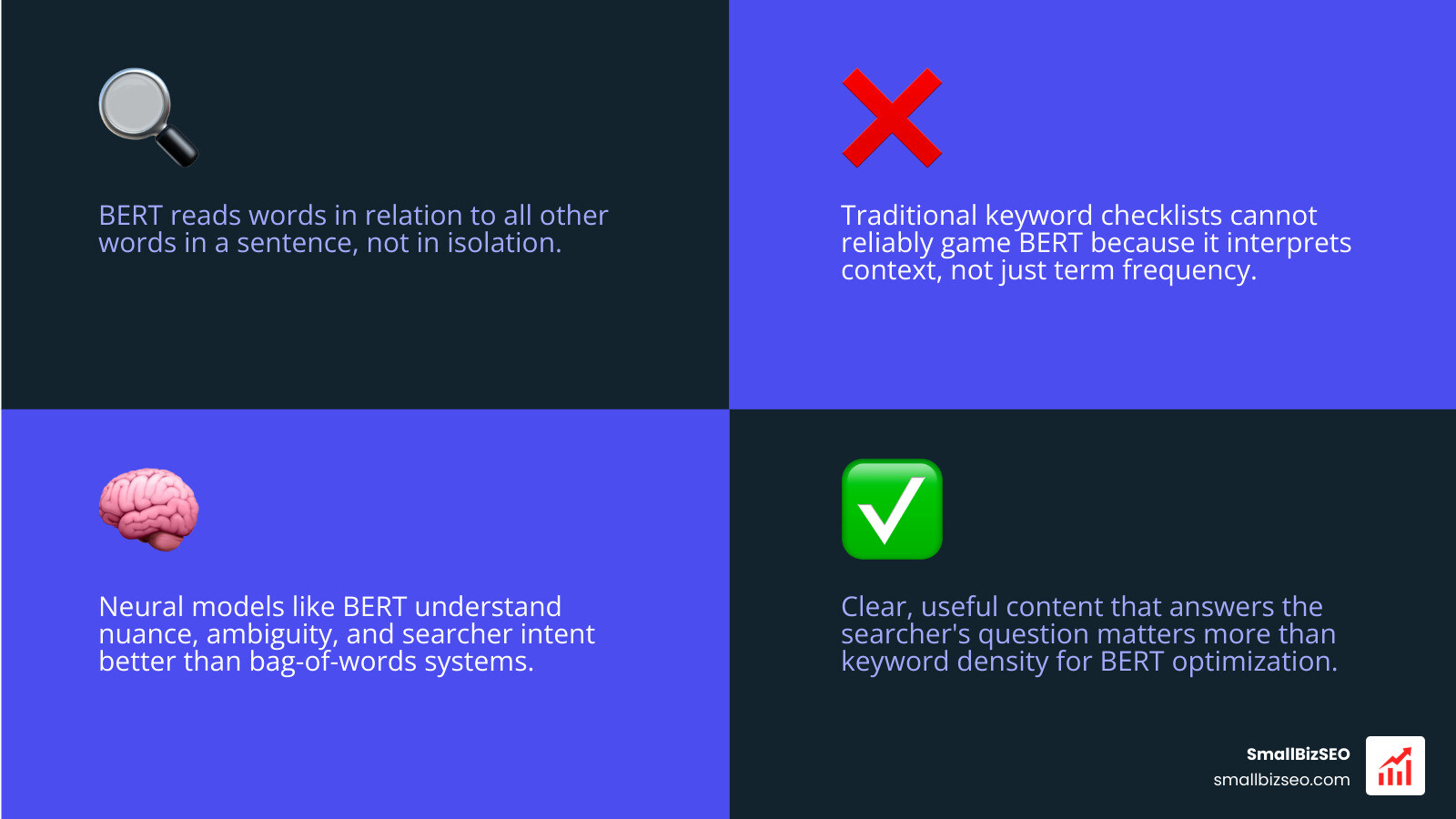
When Google introduced Bidirectional Encoder Representations from Transformers (BERT), it fundamentally changed how search systems interpret natural language. Older retrieval models evaluated search queries as isolated bags of words, but neural models evaluate words in relation to everything else in the sentence. Trying to game modern search by ticking off arbitrary keyword repetitions simply does not work.
Why Isn’t Optimizing for BERT a Keyword Checklist?
BERT is designed to interpret context, nuance, and meaning rather than simply tallying matching terms on a page. The fundamental reason why optimizing for BERT is not a keyword checklist is that BERT functions as a language-understanding model, not an itemized, direct ranking factor.

For decades, the search industry operated under the assumption that search engines scored pages against a static spreadsheet of rules. In reality, modern neural systems process signals holistically. As explored in discussions around whether Google uses over 200 ranking factors, neural retrieval learns weighted representations from live data.
BERT assists search engines in query rewriting, intent disambiguation, and document relevance scoring. You cannot optimize for a language model the way you adjust meta title lengths. Instead, you align your content with the underlying user need so the neural model recognizes your page as the most accurate answer.
How Does Neural Context Work?
BERT evaluates text bidirectionally, looking at the words that come both before and after a target word simultaneously. This allows the model to grasp subtle relationships across complex, conversational queries.
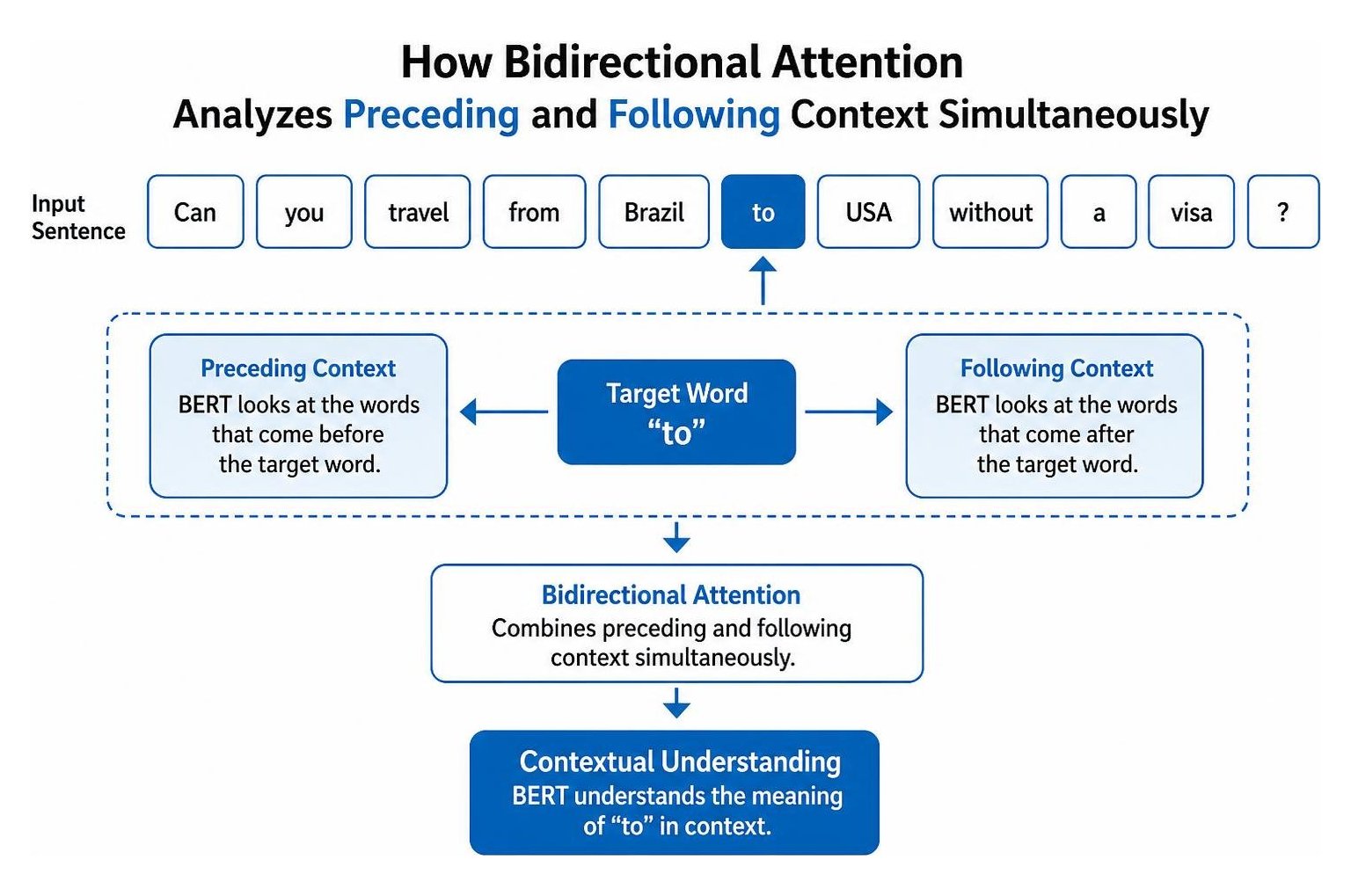
In legacy systems, search engines struggled with conversational phrases, pronouns, and critical small words like prepositions. For example, consider the difference between these two searches:
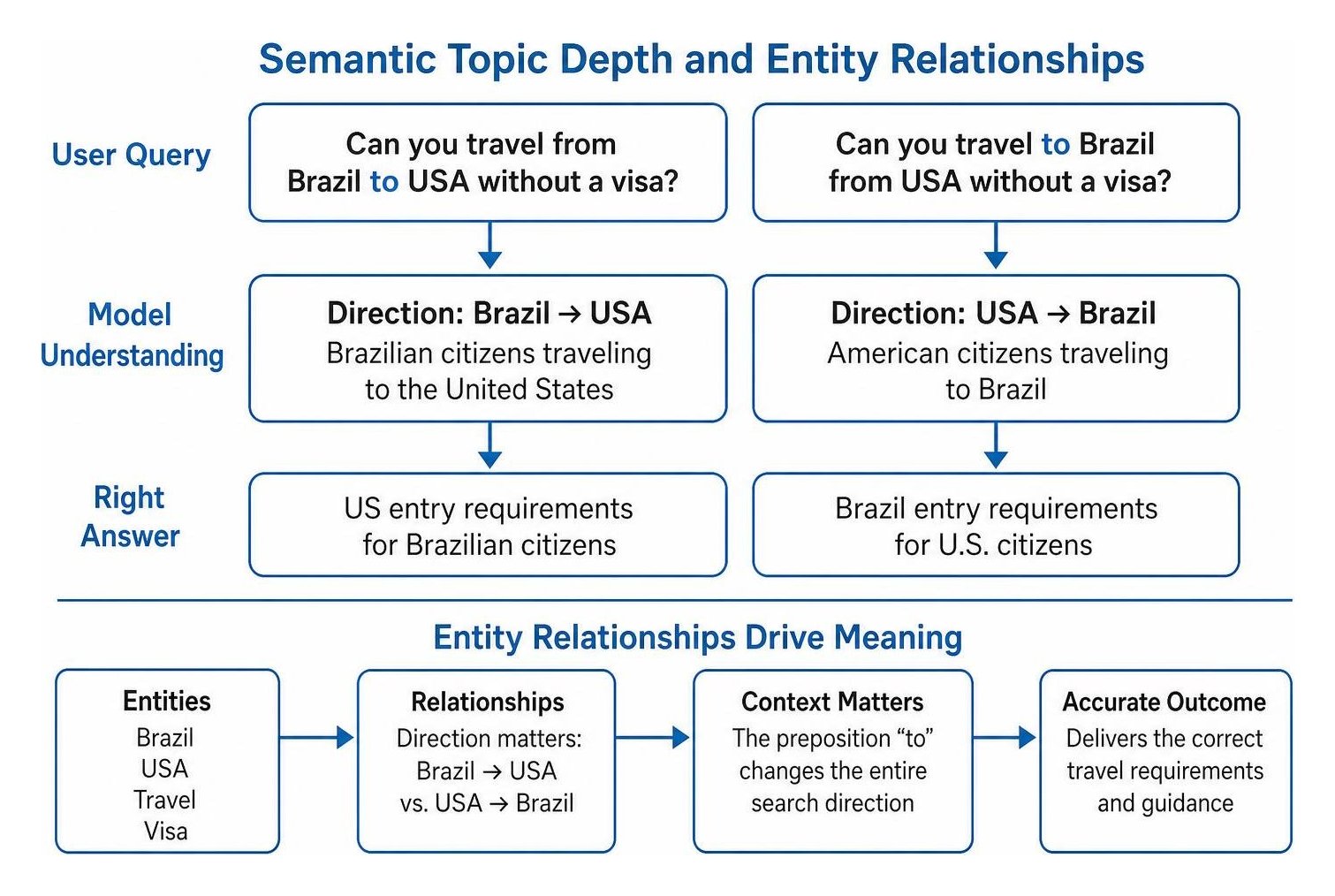
- "Can you travel from Brazil to USA without a visa?"
- "Can you travel to Brazil from USA without a visa?"
A keyword-matching algorithm sees the exact same words—"travel," "Brazil," "USA," "without," "visa." It might serve a page about Brazilian citizens visiting the United States for both searches. BERT’s attention mechanism recognizes that the preposition "to" changes the entire search direction, surfacing the right travel requirements for American citizens visiting Brazil.
This contextual processing is essential for resolving polysemy (words with multiple meanings, like a river "bank" versus an investment "bank"), handling logical negation ("can" versus "can't"), and interpreting semantic search nuances. As detailed in guides on how BERT, MUM, and NLP work together, language understanding operates at the sentence and passage level to ensure high factual accuracy.
How Do Bag-of-Words Tools Differ from Transformers?
Traditional content optimization software relies on Term Frequency-Inverse Document Frequency (TF-IDF) or n-gram matching, treating content as an unordered collection of words. Transformers, by contrast, evaluate semantic relationships and grammar.
| Optimization Element | Bag-of-Words / TF-IDF Tools | Transformer Models (BERT / MUM) |
|---|---|---|
| Primary Metric | Keyword count, density, and frequency | Contextual meaning and conceptual coherence |
| Syntactic Awareness | Blind to word order, grammar, and sentence structure | Analyzes full sentence relationships bidirectionally |
| Ambiguity Handling | Confuses identical words with different meanings | Resolves polysemy based on surrounding words |
| Logical Modifiers | Ignores negation ("is" vs. "is not") | Accurately interprets conditional statements and qualifiers |
| Optimization Focus | Adding specific words a set number of times | Providing clear explanations with semantically related terms |
As highlighted in technical analyses asking if TF-IDF tools can approximate neural language models, frequency counters cannot measure relational logic. A page can hit every suggested keyword frequency target and still provide a contradictory or useless answer.
How Do Passage Vectors and Search Intent Matter More Than Density Scores?
Modern search engines convert text into high-dimensional mathematical representations known as vectors. When a user submits a query, the search engine compares the vector representation of that query against passages across billions of web pages using cosine similarity.

Through passage ranking, Google can identify a single paragraph tucked inside a comprehensive guide that perfectly answers a long-tail query. If that paragraph delivers a precise, direct solution, it can outrank a page repeating the target phrase ten times. Success depends on fulfilling the specific search intent—whether informational, navigational, or transactional—rather than hitting an arbitrary keyword ratio.
How Can You Win in Natural Search When Checklists Fail?
To succeed in modern organic search, we must shift our focus from word counts to topical depth, clarity, and authority. You build visibility by creating clear resources that thoroughly solve user problems and establish recognized expertise.
Rather than treating pages as isolated silos, build cohesive topic clusters that establish deep topical authority. Make sure key subjects, products, and concepts are clearly defined using structured entity SEO principles. Supporting your content with genuine third-party validation, expert consensus, and clear references signals to neural search models that your information is dependable.
How Can Content Creators Build Semantic Authority for AI Citations?
With search engines summarizing web content directly in answer boxes and AI overviews, structured clarity is vital. AI retrieval systems rely on passage-level comprehension to pull concise, factual excerpts.
We recommend applying the following core practices:
- Lead with Direct Definitions: Start main sections with a concise summary answering the target question before expanding into nuance.
- Implement Answer-Ready SEO: Structure content using clear, natural subheadings that mirror the conversational questions real people ask.
- Maintain Factual Consistency: Use clear qualifiers, accurate facts, and unambiguous statements so neural parsers can verify your claims against consensus knowledge.
- Structure for Extractability: Use bulleted lists, structured tables, and focused paragraphs that convey complete concepts independently.
- Avoid Hollow Fluff: Eliminate repetitive keyword variations that break the logical flow of your sentences.
What Are the Practical Steps to Audit Content Without Keyword Stuffing?
Auditing content for neural search does not require chasing arbitrary optimization scores. Instead, find where your content leaves user questions unanswered and refine it for clarity.
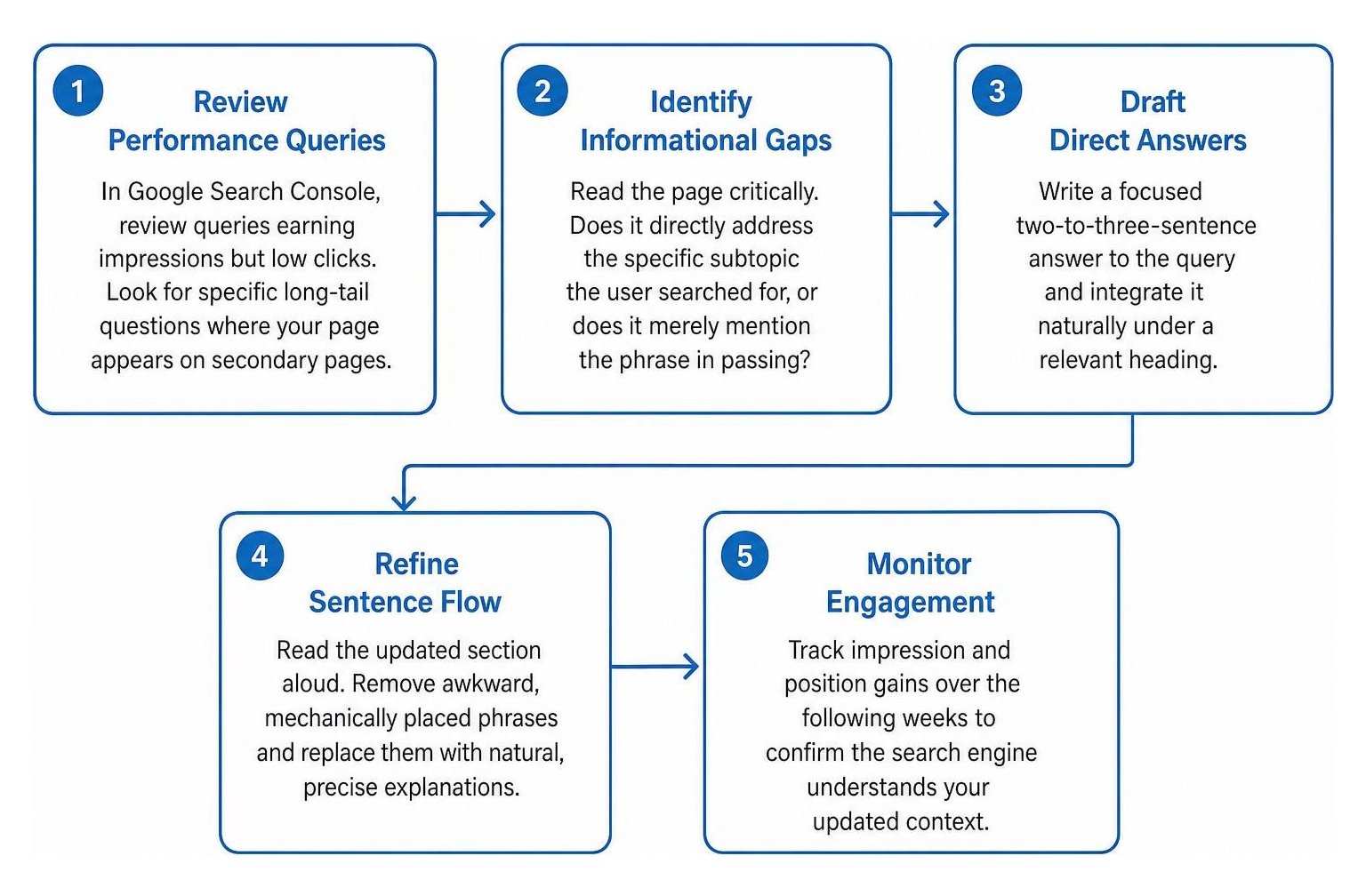
- Review Performance Queries: In Google Search Console, review queries earning impressions but low clicks. Look for specific long-tail questions where your page appears on secondary pages.
- Identify Informational Gaps: Read the page critically. Does it directly address the specific subtopic the user searched for, or does it merely mention the phrase in passing?
- Draft Direct Answers: Write a focused two-to-three-sentence answer to the query and integrate it naturally under a relevant heading.
- Refine Sentence Flow: Read the updated section aloud. Remove awkward, mechanically placed phrases and replace them with natural, precise explanations.
- Monitor Engagement: Track impression and position gains over the following weeks to confirm the search engine understands your updated context.
Through our SmallBizSEO Velocity framework, we use this intent-first approach to help businesses achieve sustainable visibility without resorting to outdated checklist tactics.
Real Answers Outperform Static Keyword Checklists
Search technology has advanced beyond mechanical keyword matching. Neural language models evaluate content the way humans do—by interpreting context, understanding nuance, and prioritizing clarity.
When you stop treating content creation as a checklist of keywords to stuff into a layout, you can focus on what truly drives results: creating authoritative, well-structured, and genuinely helpful resources for your audience. Build your strategy around clear answers, deep topic coverage, and user intent, and search engines will reward your pages naturally.