Practical SEO for Car Decal and Vehicle Graphics Shops
How Can SEO Help Car Decal Shops Get Found?
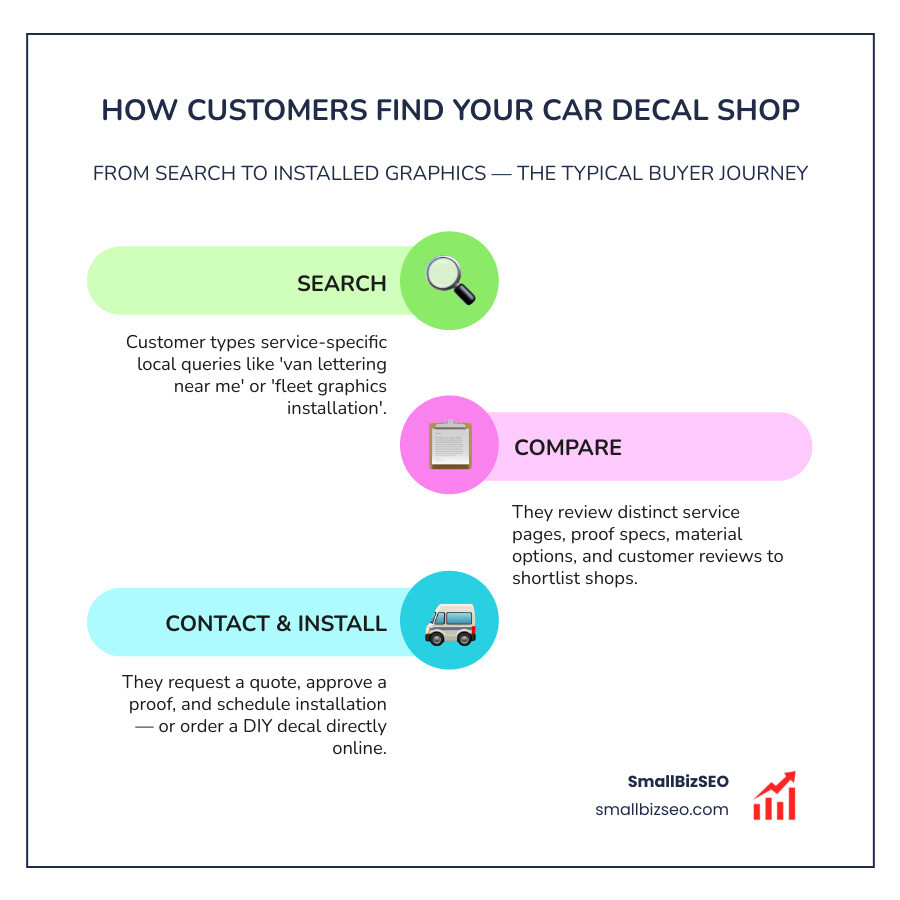
SEO for car decals starts with matching each page to what a customer needs. Give shipped DIY decals, installed vehicle lettering, fleet graphics, partial wraps, and full wraps their own clear pages when you offer those services. Show real, permissioned work, explain materials and installation, and make it easy to request a quote. If customers visit your shop in person, keep your Google Business Profile accurate so local buyers can find you. Physical decals are not a direct ranking factor. Useful pages help buyers evaluate the offer and take the next step.
A fleet manager comparing van lettering needs different proof and quote details than someone ordering a single decal online. Your pages should make that difference clear before either buyer contacts you.
What SEO Foundations Help Car Decal Shops Get Found?
A clear service structure, useful pages, and accurate business information help search engines connect customers with the right shop. When a website bundles every offering onto a single homepage, search engines struggle to identify which queries the business actually satisfies. Creating distinct landing pages for specific decal types establishes clear topical relevance, making it straightforward for both search algorithms and potential clients to find what they need.
Building a solid foundation starts with understanding your core service lines and technical architecture. For those new to search mechanics, reviewing how demystifying SEO fundamentals supports site structure is a practical first step. Use the official Google Search Central SEO Starter Guide to review crawlability, page structure, and helpful-content basics, while recognizing that no checklist guarantees indexing.
| Service Type | Buyer Evidence and Questions | Proof & Artwork Needed | Primary Quote Inputs |
|---|---|---|---|
| Shipped DIY Decals | What surface will receive the decal, and which product-specific preparation instructions apply? | Vector file (.AI, .EPS, .SVG) or high-resolution PNG | Dimensions, quantity, vinyl finish, cut type |
| Installed Vehicle Lettering | Which panels will be lettered, and are there surface-condition or access issues the installer should review? | Scaled vehicle template with typography and placement | Vehicle make, model, year, lines of text, vinyl color |
| Commercial Fleet Graphics | How many vehicles, body styles, and panel conditions need review before production? | Current brand guide and print-ready vector layouts | Fleet count, vehicle variations, square footage, design complexity |
| Partial & Full Wraps | What is the vehicle year, body condition, paint history, and any trim or hardware that may affect the installer’s assessment? | Detailed vehicle wrap template and high-resolution raster art | Vehicle year, body style, surface contours, finish, and warranty questions |
Why Does Vehicle Graphics SEO Need Distinct Service Pages?
Separate pages help customers find the specific type of graphics they need while aligning with their commercial intent. A customer looking for mail-order cut vinyl stickers wants an e-commerce checkout with clear sizing specifications. In contrast, a contractor needing commercial lettering wants to know turn-around times, physical durability, and installation processes.
When implementing vehicle graphics SEO best practices, create separate pages only when the offering serves a meaningfully different buyer intent, service process, or conversion path. Separate pages can reduce overlap when their purpose and content are genuinely distinct, but they do not automatically prevent keyword cannibalization. Each page should explicitly describe:
- Material specifications: Identify the relevant film type, such as cast or calendared, plus the product line and intended use. Cast and calendared describe film construction, not brands.
- Surface compatibility: Explain which surfaces a product or service is designed to address, including flat metal, curved bumpers, or automotive glass where applicable.
- Preparation guidance: Direct buyers to the applicable product provider or installer instructions rather than presenting one universal preparation method.
- Installation methods: Clarify whether the product includes transfer tape for self-installation or requires professional installation in a suitable workspace.
- Care, removal, and warranties: Explain that care, removal, and warranty terms vary by product, paint condition, and installation. For 3M materials, use 3M’s graphics warranties as a primary source and confirm the applicable product terms.
How Should Vehicle Graphics Shops Choose Keywords and Optimize Pages?
Vehicle graphics shops must choose keywords that reflect actual customer search behavior and specific intent. Instead of targeting generic terms with excessive competition, focus on high-intent phrases that combine the product type, surface, and purchase method.
Core keyword groups generally fall into distinct categories:
- Surface and format modifiers: die-cut vinyl decals, perforated rear window graphics, commercial van lettering, reflective fleet decals.
- Intent and durability terms: weatherproof equipment decals, custom truck graphics installation, UV-resistant vinyl lettering.
- Service-specific variations: fleet branding packages, door logo installation, spot graphics for work trucks.
Applying on-page SEO principles ensures that your title tags, headings, and body copy clearly reflect these search terms. If you also sell shipped items online, reviewing Etsy SEO keyword strategies offers valuable insight into how buyers search by surface, aesthetic, and durability traits.
Every page should feature a single H1 matching the primary service, informative subheadings answering common customer questions, and clear next steps to request a quote or upload artwork.
How Should Vehicle Graphics Shops Optimize Google Business Profile and Local Citations?
Accurate business details, relevant services, and genuine customer reviews help local customers evaluate and contact an in-person shop. A Google Business Profile (GBP) is only appropriate for businesses that serve customers face-to-face, either at a physical shop or within a defined local service area; online-only decal stores are not eligible.
When setting up your profile, follow foundational local search optimization basics:
- Choose actual categories: Select only categories that accurately reflect the services the business provides, such as Sign shop, Commercial printer, or Vehicle wrapping service when applicable. Do not add unrelated categories.
- List granular services: Include distinct entries for commercial lettering, fleet graphics installation, and custom vinyl decals only when offered.
- Set the address correctly: If customers do not visit the business location, configure the profile as a service-area business and hide the street address.
- Maintain citation consistency: Ensure your business name and phone number match across online directories, maps, and industry platforms.
- Collect authentic reviews: Request feedback through standard, consented post-project communications without incentives, discounts, or review-gating filters. Encourage clients to mention the type of vehicle and service completed in their honest comments.
How Can Vehicle Graphics Shops Improve Technical Visibility and Authority?
Fast, well-structured pages and credible industry mentions help search engines understand a shop’s work and expertise. A technically sound website ensures search engine crawlers can easily parse content, navigate project portfolios, and index service offerings.
Running a comprehensive SEO visibility audit helps identify technical bottlenecks such as uncompressed gallery images, broken links, missing meta tags, and slow mobile load times that may hinder organic performance.
How Should Shops Structure Project Galleries and Visual Assets?
Captions, descriptive alt text, and nearby project details give customers useful context and improve accessibility. For each portfolio entry, include readable details alongside the photograph, such as the vehicle, service, materials, and project scope.
To optimize your gallery effectively:
- Use descriptive filenames and alt text: Save files with clear identifiers such as
commercial-van-lettering-ford-transit.jpgand write alt text that accurately describes the visual elements. - Provide on-page project spec blocks: Include concise text modules stating the vehicle make and model, vinyl material used, finish type, and whether it was a spot decal or partial wrap.
- Implement accurate structured data: Add schema markup such as
LocalBusiness,Service, andImageObjectonly when it matches visible page content. - Respect privacy: Use only rights-cleared, permissioned photos of customer vehicles. Redact license plates, private phone numbers, and identifying personal information before uploading.
- Optimize image delivery: Keep the hero or other LCP image readily available, and lazy-load images that appear below the fold.
How Can Shops Build Industry Authority and Earn Quality Local Backlinks?
Useful partnerships, community involvement, and digital PR can help shops earn relevant mentions and links. Relevant external links and industry directory listings help signal topical authority and establish trust with search engines and prospective clients.
To build meaningful domain authority, leverage targeted outreach and content:
- Manufacturer directories: Seek a listing only when the business has verified, current eligibility under that manufacturer’s directory requirements. Do not imply certification or eligibility that the business cannot substantiate.
- Local business cross-promotions: Partner with relevant, non-competing automotive businesses to publish genuinely useful case studies or resources. Avoid reciprocal-link schemes.
- Sponsored placements: When a paid placement or sponsorship includes a link, qualify it appropriately with
rel="sponsored"ornofollow. - Community sponsorships: Support relevant regional events, trade schools, or charity initiatives when the relationship can earn a natural editorial mention.
- Content-driven authority: Publish practical guides on fleet maintenance, surface care, and design vector preparation. Refresh useful pages, strengthen relevant internal links, and earn outreach-based mentions because the content is worth citing. Technical SEO content services can support that ongoing work.
Turning Search Visibility into Booked Vehicle Projects
A well-executed SEO strategy connects your vehicle graphics shop with high-intent commercial buyers and individual vehicle owners when they need your services. By maintaining separate service pages where intent differs, presenting readable project specifications, keeping local business listings accurate, and building genuine industry authority, you create an organic pipeline that drives measurable inquiries. Track qualified quote requests, proof approvals, booked installations, and e-commerce orders rather than treating physical decals as a ranking signal.
Focus on providing clear proof of your capabilities, setting realistic expectations about vinyl durability and warranties, and delivering a smooth path from discovery to a completed project. Keep priority pages refreshed, connect related services with useful internal links, pursue earned outreach, and invite ready buyers to book an SEO consultation or book a consultation.