Construction Company SEO Services: What an Ongoing Program Should Include
Construction Company SEO Services: What an Ongoing Program Should Include
Construction company SEO services should turn a contractor’s real services, approved project proof, and customer questions into useful pages that support qualified inquiries. The practical question is not which provider promises the biggest ranking gain. It is whether the monthly work matches the services you sell and produces evidence a buyer can review.
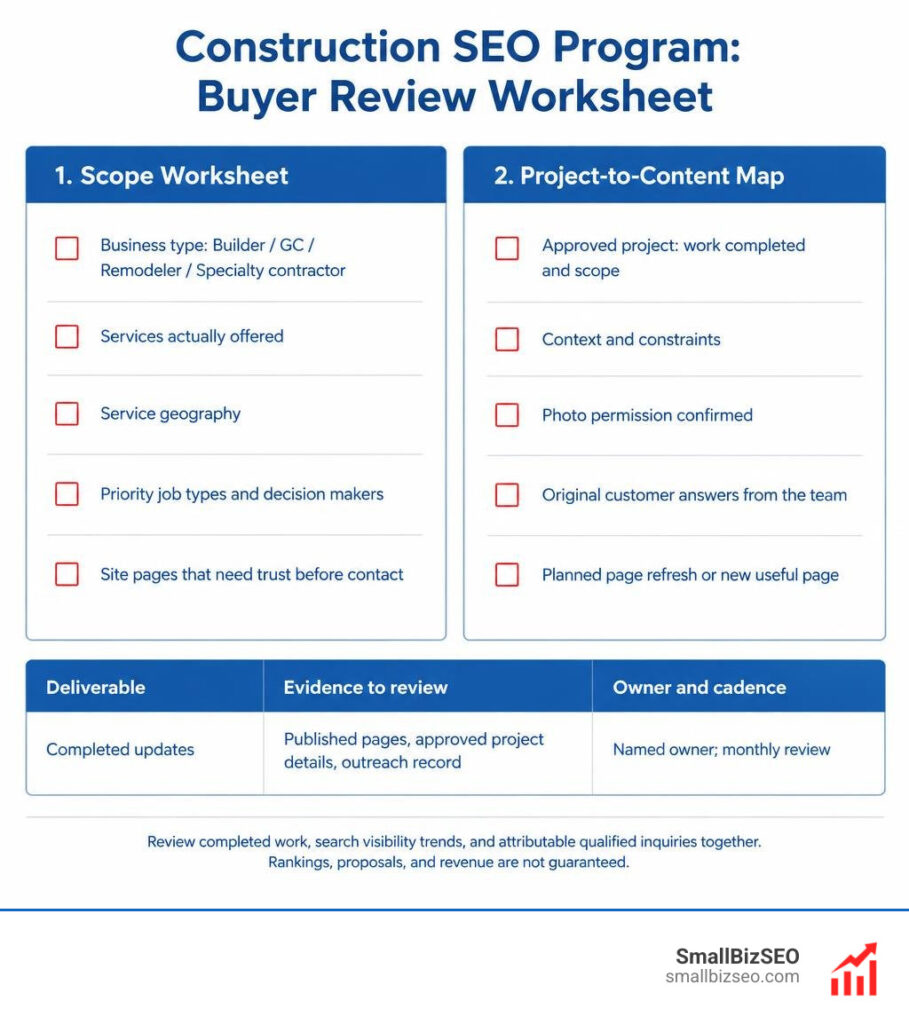
A suitable program starts by defining the business model: builder or general contractor, remodeler, or specialty contractor. It should also document the service geography, priority job types, decision makers, and the pages that need to earn trust before a visitor contacts the business.
Ask an SEO partner to show how it will work with your team’s information. Useful inputs include approved service descriptions, original answers from estimators or project managers, and a real project portfolio. Each portfolio item should identify the work completed, the relevant scope and constraints, the customer-approved context, and whether the business has permission to use photographs.
A strong engagement separates completed work from expected outcomes. It can improve the clarity, crawlability, and usefulness of your site, but it should not present rankings, bid invitations, or revenue as guaranteed results. Review the work completed, the search visibility trend, and the quality of attributable inquiries together.
The rest of this guide gives buyers a practical way to compare an ongoing construction SEO program without relying on unnamed-agency rankings, generic packages, or unsupported industry statistics.
What Should an Ongoing Construction SEO Program Cover?
An ongoing construction SEO program should improve the pages and evidence that help prospective clients understand what your firm does, where it works, and why its project experience is relevant. It is a continuing operating process, not a one-time set of keyword changes.
SmallBizSEO offers services for general contractors, broader contractor SEO, and specialty-trade sites. The appropriate scope still depends on the construction business: a builder may need project and capability pages, a remodeler may need service and consultation pages, and a specialty contractor may need clear pages for its individual trade services.
How Should the Program Define Scope Before Work Starts?
The scope should name the services, customer types, service geography, priority pages, and source material the program will use. A provider should not fill those gaps with generic copy or assumptions about the work your business performs.
The first working plan should identify which existing pages need technical or content updates, which service pages are missing, and which approved project details can support new content. Google’s SEO Starter Guide is a useful reference for the basic goal: make pages understandable and useful for people as well as search engines.
What Evidence Should Be Included in a Quote?
A credible quote explains what will be delivered, what proof you will receive, who is responsible, and when progress is reviewed. It should make the work comparable without treating rankings as the only measure of value.
| Program area | Deliverable | Evidence to request | Primary owner | Review cadence |
|---|---|---|---|---|
| Technical foundation | Prioritized fixes for crawlability, page experience, and internal links | Issue list, change log, and before-and-after validation | SEO team with site owner approval | Regular working review |
| Service and project content | Updated service pages, original FAQs, and approved project pages | Drafts, source notes, approval record, and published URLs | SEO writer and construction subject-matter reviewer | Per page and regular content review |
| Local presence | Accurate business information and supporting location-relevant pages where appropriate | Listing review, page updates, and any unresolved discrepancies | Business owner and SEO team | Regular review |
| Editorial outreach | Relevant trade or local editorial opportunities | Prospect rationale, approved pitch themes, and placed-link reporting | Outreach team with business approval | Regular outreach review |
| Measurement | Reporting for visibility, inquiries, and proposal quality | Dashboard, source attribution notes, and agreed definitions | SEO team and sales or operations lead | Regular business review |
How Should Project Portfolio Content Be Handled?
Project content should be specific, authorized, and useful to the buyer who is deciding whether your experience fits their work. Each page can explain the project type, services performed, materials or constraints when approved, and the business outcome only when it is documented and safe to share.
Use original images only with clear permission and enough context to explain what the reader is seeing. Google’s guidance for image SEO supports using relevant, high-quality images alongside helpful page content; it does not support treating image metadata as a shortcut to rankings.
How Do Local and Trade-Relevant Signals Fit Into the Work?
Local SEO should make accurate business and service information easier to find, while editorial outreach should earn relevant mentions through material that is genuinely useful to the construction audience. Review which listings, service pages, project examples, trade associations, or local publications actually fit the business before committing monthly effort. For specialty trades, a siding contractor SEO company page shows how service-specific coverage can be organized. SmallBizSEO’s home services SEO resource and local SEO guide offer additional context for evaluating local information and service pages.
A practical program refreshes pages as services, portfolio material, and customer questions change, with ongoing SEO content services supporting research, writing, on-page optimization, internal links, and publication support. It can also pursue relevant link-building services and editorial opportunities, but the provider should explain why each opportunity is relevant rather than promising placement or authority outcomes.
How to Compare Construction SEO Proposals and Measure Progress
Choose a construction SEO provider by comparing the proposed work, evidence, ownership, and review process, not by promises about rankings or a fixed results timeline. The right engagement should make it easy to see what has changed on the site and what the next priority is.
Ask each provider to explain how the monthly scope is shaped by your services, service geography, approved portfolio material, technical condition, and internal review capacity. Costs should be tied to that scope and to the level of research, production, technical work, and outreach involved. A clear proposal acknowledges that search results and the time required to earn visibility depend on the market, the site, and execution.
SmallBizSEO’s SEO packages can provide a starting point for discussing a recurring scope. Contractors seeking a broader comparison can also review home services SEO packages. For a program tailored to your construction business, use the consultation page to share the services, project material, and decision process that matter most.
How Should You Evaluate Deliverables and Review Meetings?
Look for a proposal that names the ongoing work, the business inputs required, and the evidence reviewed with you on a regular schedule. Avoid a plan that uses vague labels such as “authority” or “visibility” without explaining the actual tasks and review materials.
Use this buyer checklist when comparing proposals:
- Service fit: Does the plan clearly distinguish the builder, general contractor, remodeler, or specialty services your business actually offers?
- Portfolio permissions: Will project pages use only approved facts, photographs, and customer context?
- Original expertise: Who will gather and review real answers from estimators, project managers, or other knowledgeable team members?
- Page maintenance: How will existing service pages, project pages, and FAQs be reviewed and refreshed as the business changes?
- Relevant outreach: What makes a trade or local editorial opportunity appropriate, and what approval is required before outreach begins?
- Reporting ownership: Who reviews the report, decides the next priority, and records the completed work?
- Content example: Review an implementation resource such as the painting contractor lead generation guide to see whether it explains the customer questions and approvals behind the recommended pages.
How Should You Define a Qualified Inquiry or RFP?
A qualified inquiry or proposal request should be defined with your sales and operations team before reporting begins. That definition may include the service requested, job type, budget range when voluntarily provided, decision-maker role, geography, and readiness to discuss work. Keep the data privacy-safe: collect only the information needed to follow up, restrict access, and report in aggregate where possible.
Rankings can be a diagnostic signal, but they do not prove commercial value on their own. Review attributable calls, form submissions, consultation requests, and RFPs alongside the quality of those conversations. Attribution will never be perfect, so the report should document the source data, gaps, and assumptions instead of presenting a single number as certainty.
Ongoing SEO can make the site more useful and visible over time, but it should be managed as a measured business program: complete the agreed work, inspect the evidence, learn from qualified inquiries, and update the next set of pages accordingly.
Build a Construction SEO Program You Can Audit
A useful construction SEO engagement leaves a clear record: what services and project proof were approved, what pages changed, what outreach was pursued, and what the business learned from inquiries. That record gives you a better basis for improving the program than a promise about a position in search results.
If you are evaluating an ongoing program, start with your real service scope, available project material, privacy requirements, and the questions your prospective clients ask before they request a consultation. SmallBizSEO can help you assess those inputs through a SEO visibility audit.