Local SEO for Boot Camp Fitness Centers

How Can Local SEO Help Your Boot Camp Attract Members?
SEO for boot camp fitness centers helps prospective class members find accurate details before they book. Start with a clear Google Business Profile, a mobile-friendly class page, and a simple booking route that answers practical questions about format, timetable, meeting point, and pricing.
Fitness-class buyers need information that helps them decide whether a session fits their routine: the workout format, actual intensity, beginner suitability, indoor or outdoor meeting point, weather policy, trial terms, accessibility details, and a contact route for questions. Keep these details current wherever people can book or learn about the class.
The sections below focus on accurate local information and useful class-page content, rather than generic tactics or promises about rankings and membership growth.
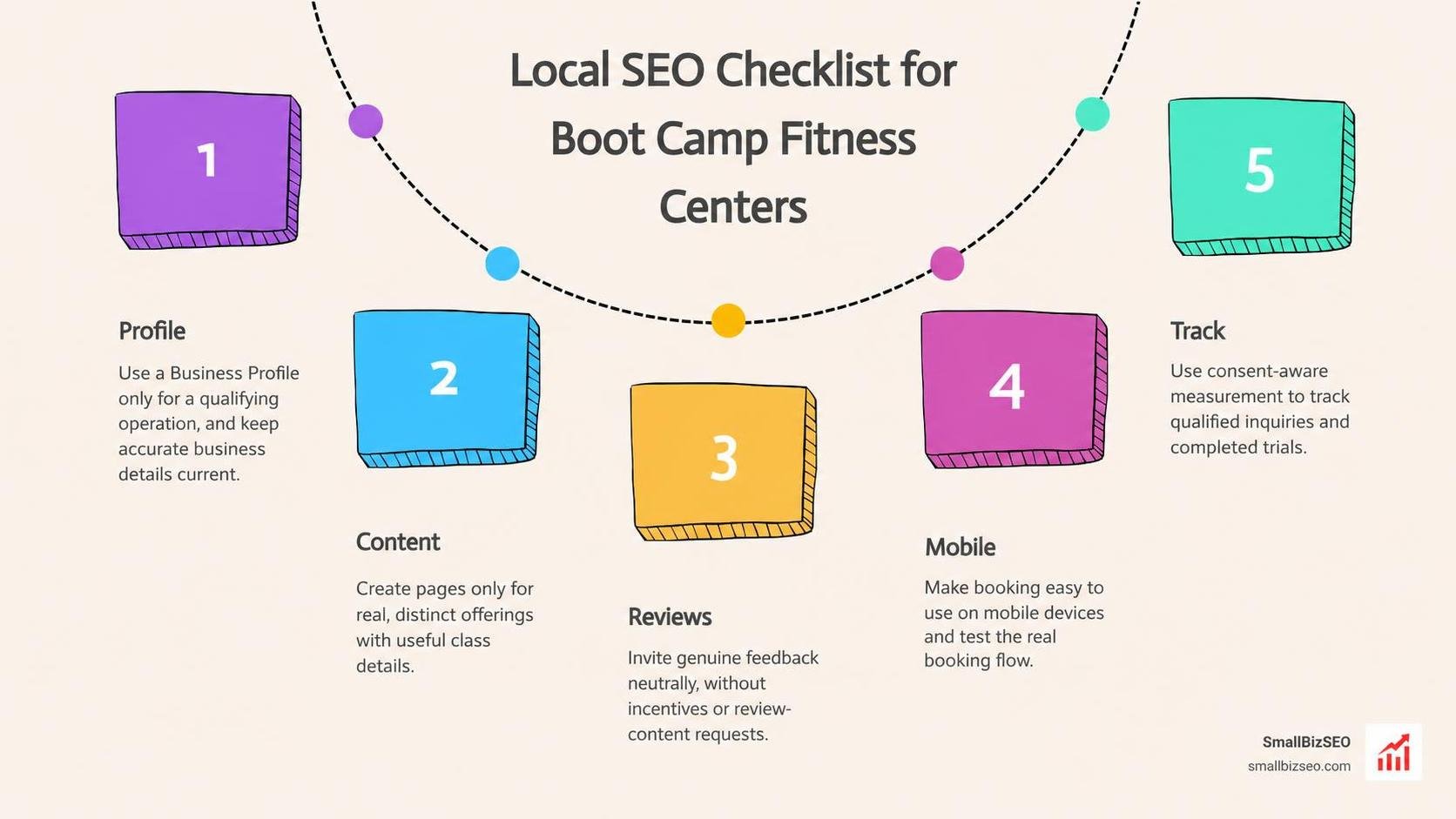
Useful next steps:
What Are the Core Local SEO Strategies for Boot Camp Fitness Centers?
Start with a Business Profile only when the boot camp has a real qualifying operation: a staffed location that receives customers during stated hours, or a legitimate service-area operation that travels to customers. Use one profile for the real business, represent its real-world name and details accurately, and do not create profiles for individual parks, towns, virtual offices, or fabricated addresses. Google's Business Profile guidelines explain the eligibility and representation requirements.
Google says local results are mainly shaped by relevance, distance, and prominence. Complete, accurate information helps customers understand what the business offers, but no one can request or buy a better local ranking. Focus on making the profile useful to a prospective member instead of treating these factors as a ranking formula. Google's local ranking guidance explains these factors.
Keep the business name, address or service area, hours, contact details, and class information accurate wherever they appear. Correct inconsistencies when found, but avoid adding keywords, promotional claims, or locations the business does not genuinely operate from. A service area should describe where a qualifying service-area business works; it does not extend a ranking radius.
| Fitness buyer question | Helpful class-page example | Proof or detail to show | Booking action |
|---|---|---|---|
| Is this class right for my goals and current fitness level? | A page explaining the boot camp format, session length, and stated intensity | Plain-language beginner guidance and any prerequisites | View the timetable or ask a coach |
| Where and when does the class meet? | A schedule with the actual indoor or outdoor meeting point | Arrival, parking, weather, and cancellation information | Choose a session |
| What does a trial or membership include? | A page explaining current pricing and trial terms | Fees, renewal terms, and any equipment requirements | Start a booking or contact the team |
| Who leads the session and how can I get help? | A trainer or coaching page | Verified credentials, accessibility information, and a contact route | Ask a question before booking |
How Should You Optimize Your Google Business Profile?
Choose the most accurate available primary category for the business's real core offering, then add only relevant available categories. Complete the fields that apply to the operation, including hours, contact details, accessibility attributes where available, and accurate class information. Google provides verification methods based on the business, so follow the method offered in the profile rather than assuming a particular method is required.
Do not add category names that are unavailable or use categories to describe every class variation. The best choice is the smallest set of available categories that accurately represents the overall business. A class page can then explain the specific boot camp format, intensity, trainer credentials, and booking details a member needs.
Keep the profile useful over time:
- Update hours, class schedules, closures, and meeting details when they change.
- Add representative photos or videos when they help members recognize the setting and what to expect.
- Respond to questions and reviews thoughtfully, without treating a posting or photo schedule as a guaranteed ranking tactic.
How Can Keyword Research and Content Attract Local Boot Camp Members?
Build content around the questions prospective members ask before booking. A useful page explains the class format, the stated intensity, whether beginners can participate, the timetable, meeting point, weather policy, pricing or trial terms, verified trainer credentials, accessibility information, and a direct way to book or contact the team.
Use search research to identify buyer-focused wording, then reflect it naturally in pages that match a real offering. Examples include searches for outdoor fitness classes, HIIT boot camp sessions, beginner boot camp classes, and class schedules. Avoid building pages around health outcomes or exercise prescriptions that the business cannot substantiate.
Create a distinct class or location page only when it serves a genuine, useful offering. For example, a different program, a separately managed training site, or a materially different timetable may need its own page. Do not generate thin pages for every neighborhood or park. Each page should give members decision-ready information, such as format, intensity, timetable, meeting point, weather policy, pricing or trial terms, verified credentials, accessibility details, and booking options.
How Can You Get Reviews and Manage Local Citations?
Ask for reviews only from people who had a genuine experience, and make the request neutral. Do not offer incentives, selectively ask only satisfied members, pressure people to post on-site, or ask them to include particular keywords. If review reminders are sent by SMS, get the appropriate consent and offer a reasonable opt-out route.
Reviews can help prospective members understand the experience and give the business useful feedback. Thank reviewers or respond helpfully where appropriate, but do not make claims about a rating threshold, click-through rates, or ranking outcomes. Google's review policy allows requests for genuine, unbiased reviews without incentives or instructions about what to write.
Earned mentions and clear navigation can strengthen local awareness. Publish helpful schedule updates and class information, and connect related class guides, timetables, trainer bios, and booking pages so prospective members can move easily between them. Seek mentions from organizations that genuinely know the business or event rather than manufactured signals.
How Can You Improve Technical SEO and Scale Local Visibility?
Improve technical SEO by making class pages easy to use on mobile devices, keeping booking steps clear, and ensuring the site can be crawled and indexed. Test real pages regularly rather than relying on a universal speed target.
Mobile visitors should be able to read the timetable, understand class details, and begin a booking without unnecessary friction. Optimize images and booking flows based on real user experience, then check that links, forms, and contact routes work as intended.
Use structured data only for information that is accurate, visible to visitors, and supported by the page. Depending on the real offering, this may include organization, local business, service, event, or FAQ details. Markup should describe the page faithfully; it does not guarantee special search features or replace clear on-page information.
Create separate location pages only when each one documents a real, distinct, useful offering. A page for a genuinely separate training site can include the actual meeting instructions, schedule, weather policy, accessibility details, and contact route. Do not duplicate pages for every nearby neighborhood or create pages for places where the business does not operate.
How Can You Track Organic Leads and Turn Them into Members?
Measure whether organic search contributes to qualified trial inquiries, completed trials, and member conversions where consent and analytics setup allow it. Rankings can be useful context, but they are not the business outcome on their own.
Review the path from a search visit to a booking:
- Confirm that the class page explains the format, intensity, timetable, meeting point, weather policy, pricing or trial terms, and accessibility details.
- Keep the booking form proportionate to the inquiry and explain how contact information will be used.
- Track completed actions only with appropriate consent and a clear measurement plan.
For help improving class pages, technical foundations, and relevant content, explore SmallBizSEO's content services and fitness SEO services. When the class information is ready, book a consultation to discuss next steps.
Elevate Your Boot Camp Search Visibility Today
A useful local SEO program gives prospective members clear, accurate information before they book. Keep business details, class schedules, meeting instructions, reviews, and booking routes current so people can decide whether a real offering fits their needs.
Start by reviewing the information a prospective member needs to make a decision, then improve the pages and profile details that answer those questions. Track qualified inquiries, completed trials, and member conversions where consent allows, and refresh content when schedules or class details change.