The Definitive Guide to AI SEO Audit
The Definitive Guide to AI SEO Audit
How AI SEO Audits Are Changing the Way Websites Get Found
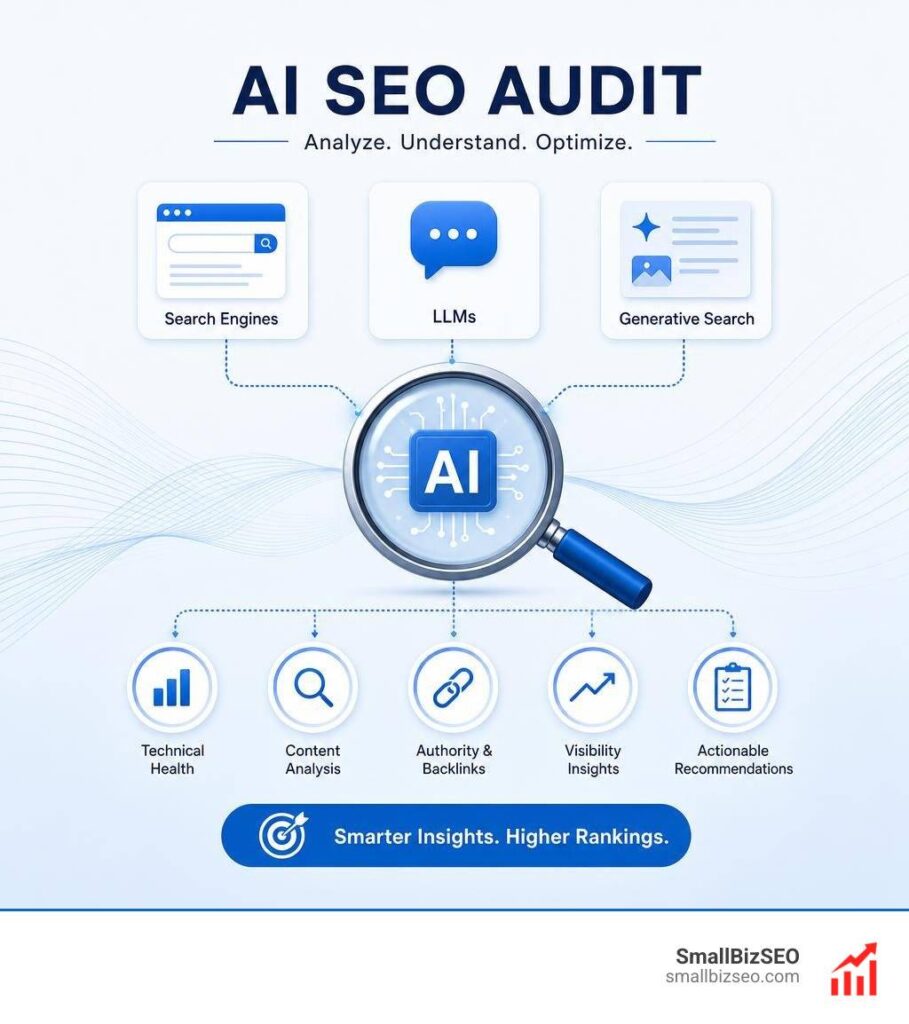
An ai seo audit is a comprehensive website analysis that checks not just how well your site ranks on Google — but also whether AI-powered search engines like ChatGPT, Perplexity, and Google AI Overviews can find, read, and cite your content.
Here's what an AI SEO audit covers at a glance:
| What It Checks | Why It Matters |
|---|---|
| Technical SEO (crawlability, page speed, Core Web Vitals) | Helps search engines and AI crawlers access your site |
| On-page SEO (titles, meta descriptions, headings) | Signals relevance to both Google and AI engines |
| Schema markup and structured data | Helps AI platforms identify and cite your content |
| Content quality and structure | Determines if AI can extract clear answers from your pages |
| AI crawler access (GPTBot, ClaudeBot, PerplexityBot) | Controls whether AI engines can read your site at all |
| E-E-A-T signals (Experience, Expertise, Authority, Trust) | Builds credibility with both Google and LLMs |
| LLM citation-readiness | Measures how likely AI platforms are to recommend your brand |
Search is changing fast. Around 40% of searches now happen inside AI engines — and a page that ranks #1 on Google can still score zero for AI visibility. That gap is exactly what an AI SEO audit is designed to close.
Traditional SEO audits were built for a world where Google's algorithm was the only judge. That world no longer exists. Today, your content also needs to pass the scrutiny of large language models (LLMs) that power AI answers — and they evaluate your site very differently than Google does.
I'm Clayton Johnson, a digital PR and SEO specialist who has spent years helping businesses improve their search visibility through data-driven campaigns — including navigating the shift toward AI-powered search that makes an ai seo audit essential for any business serious about staying visible. In this guide, I'll walk you through everything you need to know to audit your site for both traditional and AI search performance.
Traditional SEO Audits vs. AI SEO Audits
To understand why we need a new approach, we must look at how traditional search engine optimization differs from optimizing for artificial intelligence.
Traditional SEO audits focus heavily on helping Googlebot discover, crawl, and index your pages. They look at technical health, keyword density, and backlink authority. While those factors still matter, large language models (LLMs) do not just index your pages; they synthesize your content to answer user prompts directly.
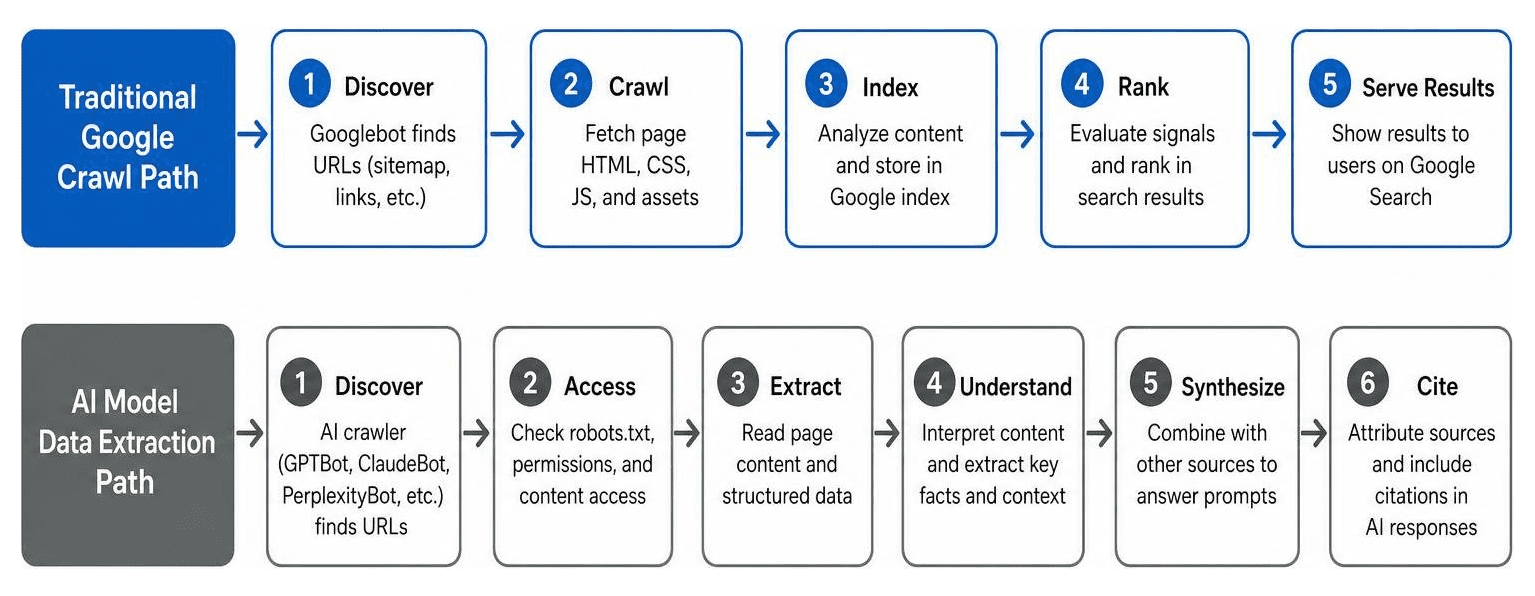
In an AI-driven search landscape, we must optimize for citation-readiness. This means structuring content so that an AI agent can easily extract facts, verify our brand's authority, and credit us as the source.
If you want to understand your current standing in traditional search, starting with a Detailed SEO Analysis is a great first step. However, to prepare for the future of search, executing a comprehensive SEO Visibility Audit that includes AI-readiness metrics is critical.
Here is a quick comparison of how the two approaches stack up:
| Feature | Traditional SEO Audit | AI SEO Audit |
|---|---|---|
| Primary Target | Google and Bing search crawlers | Googlebot + LLM crawlers (GPTBot, PerplexityBot, ClaudeBot) |
| Content Evaluation | Keyword matching, length, and readability | Information density, direct answers, and chunking structure |
| Technical Focus | XML sitemaps, canonicals, and crawl budget | Schema markup, llms.txt files, and API data access |
| Credibility Signals | Backlink profiles and domain authority | E-E-A-T, entity verification, and Wikidata connections |
| Output Goal | High rankings on the search engine results page (SERP) | Inclusion in AI Overviews, chat citations, and recommendations |
Why Your Business Needs an AI SEO Audit
As search behavior shifts, relying solely on traditional rankings is a risky strategy. When users ask ChatGPT or Perplexity for product recommendations or business services, they are bypassed by traditional search results entirely. If your brand is not mentioned by these LLM agents, you are effectively invisible to a massive and growing audience.
AI engines do not rank websites; they recommend brands. They look for structured answers, clear authority signals, and direct responses to questions. If your content fails to provide these, an AI engine will cite your competitor instead.
To bridge this gap, businesses are turning to specialized tools like the AI SEO Audit tool to scan their sites and identify visibility issues. For a complete strategy, integrating these findings into professional AI SEO Services ensures your business remains competitive across all search frontlines.
Key Components of an AI SEO Audit
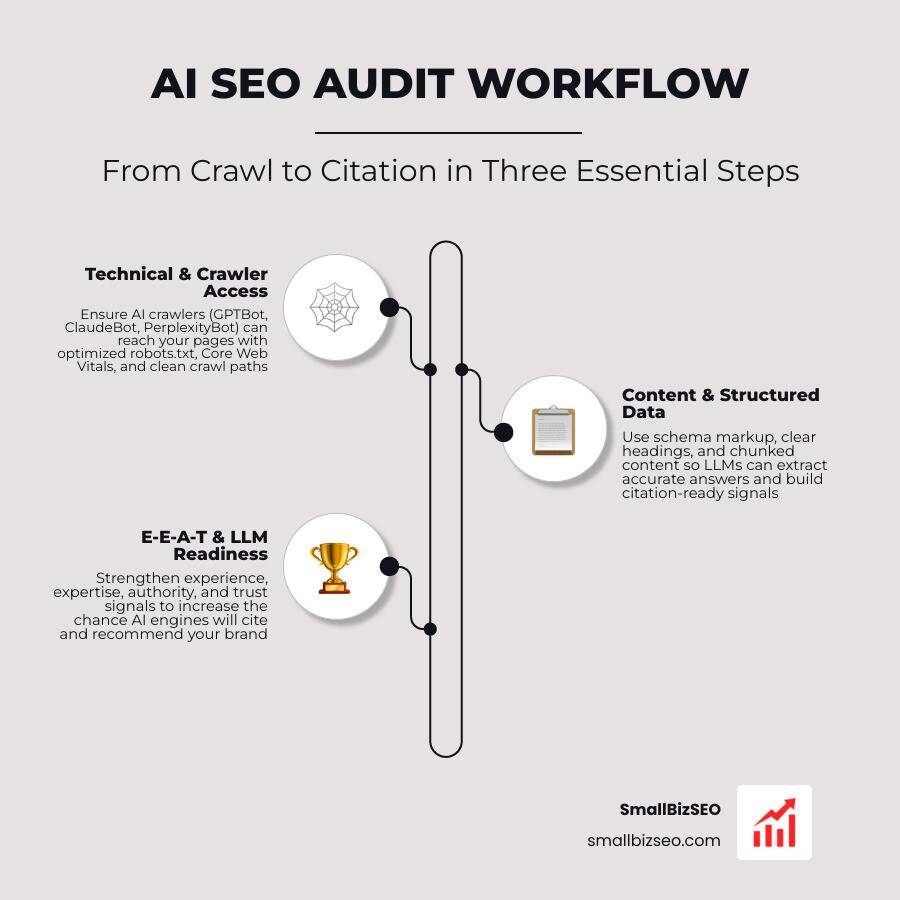
When we perform an audit for AI search, we look at several core pillars:
- Metadata and On-Page Basics: Ensuring search engines and AI models alike can grasp the page's topic instantly.
- Content Quality and Structure: Writing in clear, factual language with direct answer paragraphs that LLMs can easily parse.
- Internal Linking and Crawlability: Helping bots navigate your site smoothly.
- Schema Markup: Providing structured context that explains relationships between your brand, authors, and products.
- Technical SEO Health: Ensuring fast page speeds and clean code. If you want to make sure your technical foundation is flawless, check out our guide on How to Pass Google's Own SEO Analysis Audits.
How to Choose the Right AI SEO Audit Tool
Choosing the right tool depends on your team's technical expertise and business goals. If you have an in-house development team, you might want to explore an open-source solution. For example, you can deploy an open-source AI SEO audit tool that runs detailed checks and generates fix prompts directly for your developers' coding agents.
For agencies and business owners who prefer out-of-the-box platforms, look for software that offers:
- Multi-Engine Tracking: Auditing visibility across multiple AI platforms, not just Google.
- Actionable Recommendations: Clear, prioritized steps to fix technical and content issues.
- White-Label Reporting: The ability to brand reports for clients.
- API and Plugin Integrations: Seamless connections with your existing tech stack.
To learn more about selecting the right tools and strategies for your business, dive into our comprehensive SEO Services Guide.
Key Technical and On-Page Factors Analyzed by AI
AI-driven search engines require a highly optimized technical foundation. If an AI crawler gets stuck on a slow script or blocked by a misconfigured file, your content will never make it into its knowledge base.
First, let's talk about Core Web Vitals. Metrics like LCP (Largest Contentful Paint) and INP (Interaction to Next Paint) are critical. If your site is slow or unresponsive, crawlers may abandon the session before extracting your content.
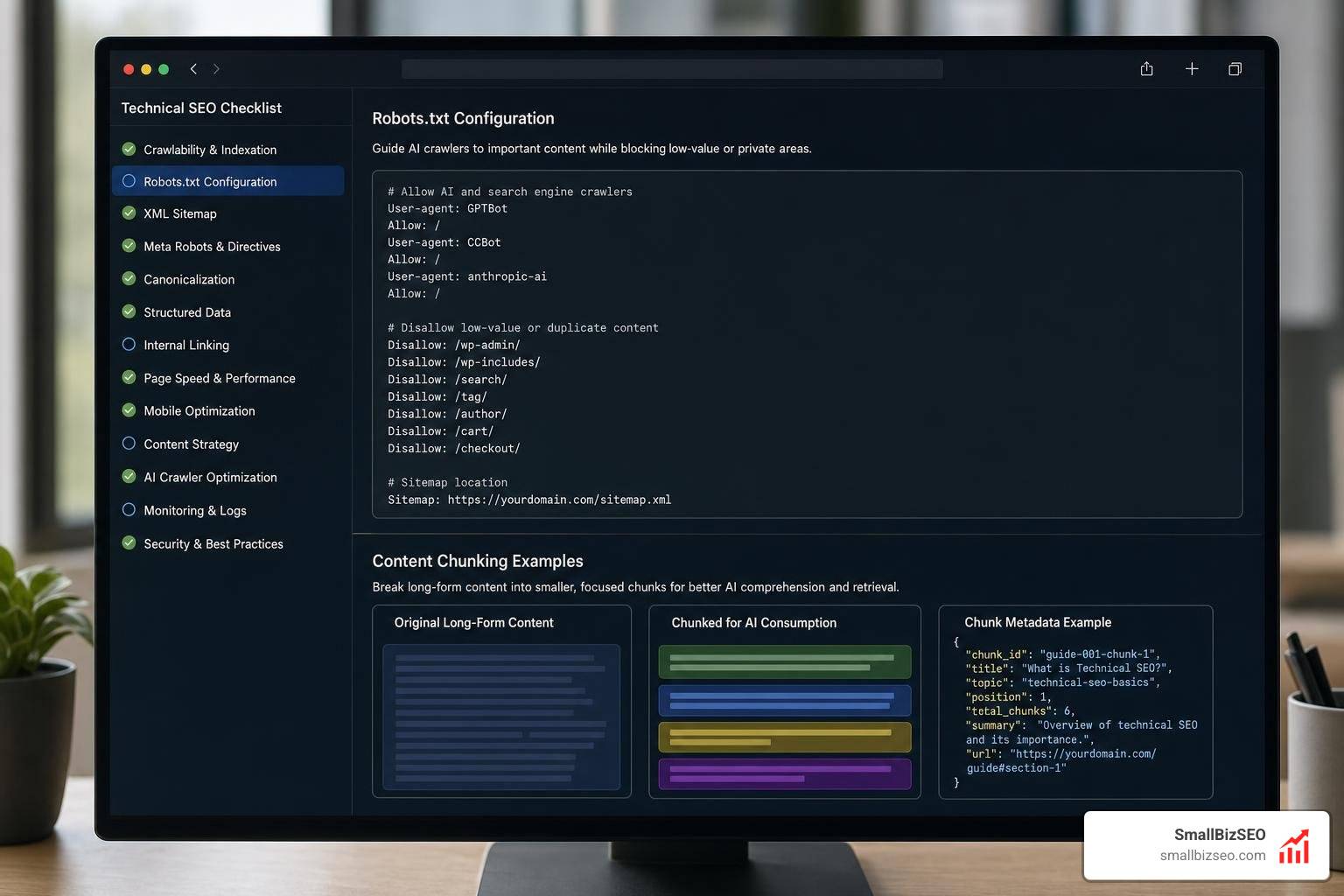
Second, your robots.txt file must be configured to allow AI crawlers. While some webmasters block these bots to prevent content scraping, doing so makes you invisible to AI search. You need to explicitly permit crawlers like:
- GPTBot (OpenAI)
- ClaudeBot (Anthropic)
- PerplexityBot (Perplexity)
Furthermore, AI engines rely heavily on content chunking and heading hierarchy. Because LLMs process text in fragments, your content should be structured logically. Use a single H1 tag, followed by nested H2 and H3 tags. Avoid skipping heading levels (like jumping from an H1 to an H3), as this confuses the semantic parser.
For developers looking to automate these technical checks, utilizing an open-source SEO audit suite inside your command line or terminal can streamline the process, running parallel agents to evaluate technical and AI-readiness factors in minutes.
Optimizing for Generative Engines (GEO) and E-E-A-T
Generative Engine Optimization (GEO) and Answer Engine Optimization (AEO) are the strategies we use to make sure AI platforms choose your content. At the heart of GEO is Google's E-E-A-T framework: Experience, Expertise, Authoritativeness, and Trustworthiness.
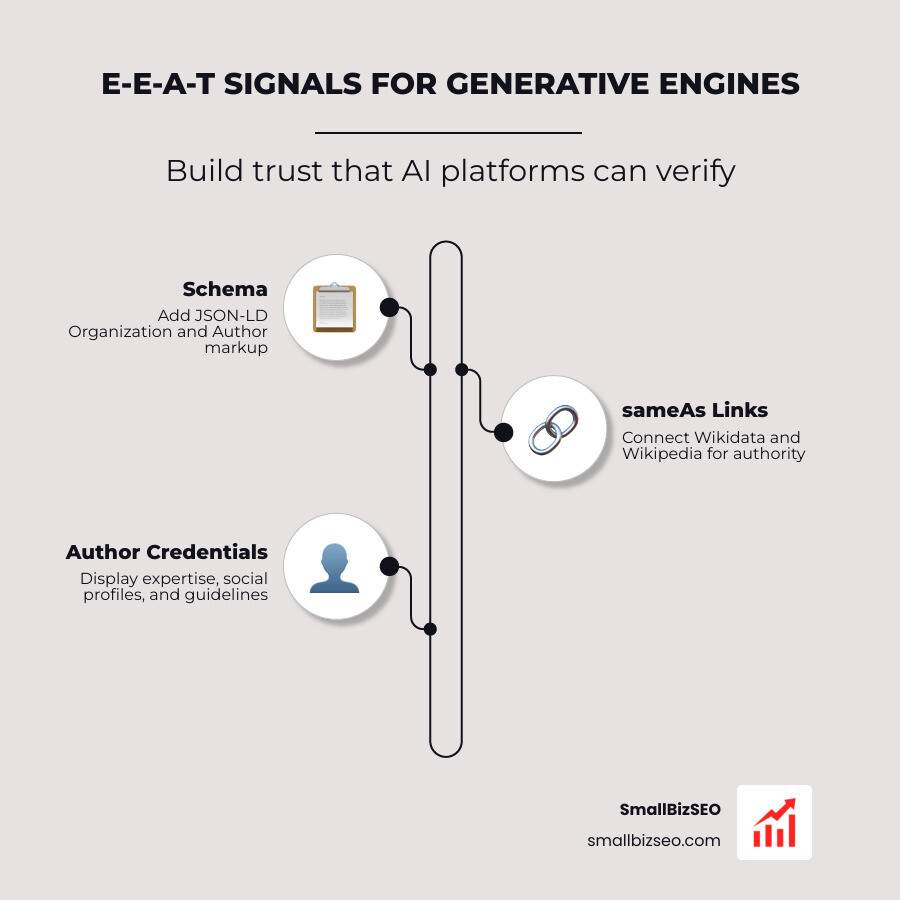
To prove your authority to an LLM, you must make it easy for the model to verify your claims. This is where structured data and Schema.org markup come in. By using JSON-LD schema, you can explicitly define the entities on your website.
For example, using the sameAs field in your Organization schema to link to your official Wikidata or Wikipedia page helps AI engines connect your brand to trusted, global databases.
To build real search trust, you should also focus on author schema. Highlight your writers' credentials, link to their social profiles, and display clear editorial guidelines. For a deep dive into building these trust signals, read our guide on How to Optimize Your Content for E-E-A-T and Build Real Search Trust.
By combining technical schema with high-quality content, you can Optimize E-E-A-T Signals Today to protect your brand from being ignored by AI engines. If you want to run these checks programmatically, you can use a framework-agnostic SEO and AEO audit tool to evaluate your schema depth and AI crawler policies.
Frequently Asked Questions about AI SEO Audits
What is the difference between SEO and GEO?
Traditional SEO focuses on optimizing websites to rank high in search engine results pages (like Google's blue links). Generative Engine Optimization (GEO) focuses on optimizing content so that LLMs and AI search engines (like ChatGPT and Perplexity) can easily synthesize, recommend, and cite your brand within their generated responses.
How often should I run an AI SEO audit?
For most small to medium businesses, we recommend running an audit monthly. If you run a fast-growing e-commerce store or a content-heavy site with weekly updates, running bi-weekly or weekly technical checks is ideal to catch crawl errors and schema drift early.
Can traditional SEO tools track AI search visibility?
Most traditional SEO tools are designed to track rankings on Google SERPs. While some are starting to add AI visibility tracking, a dedicated ai seo audit tool is usually required to accurately measure your brand's citation share and sentiment across different LLM platforms.
Conclusion
The future of search is hybrid. To win, your business must rank well in traditional search engines while remaining highly visible in AI-driven answers.
At SmallBizSEO, we help businesses navigate this transition using our data-driven "Velocity" framework. We combine technical SEO, content strategy, and authoritative link-building to deliver fast rankings and E-E-A-T-compliant growth — all backed by transparent, automated reporting.
Ready to secure your brand's presence in Google and across the AI landscape? Partner with SmallBizSEO for AI SEO Services today and let us build a future-proof strategy for your business.