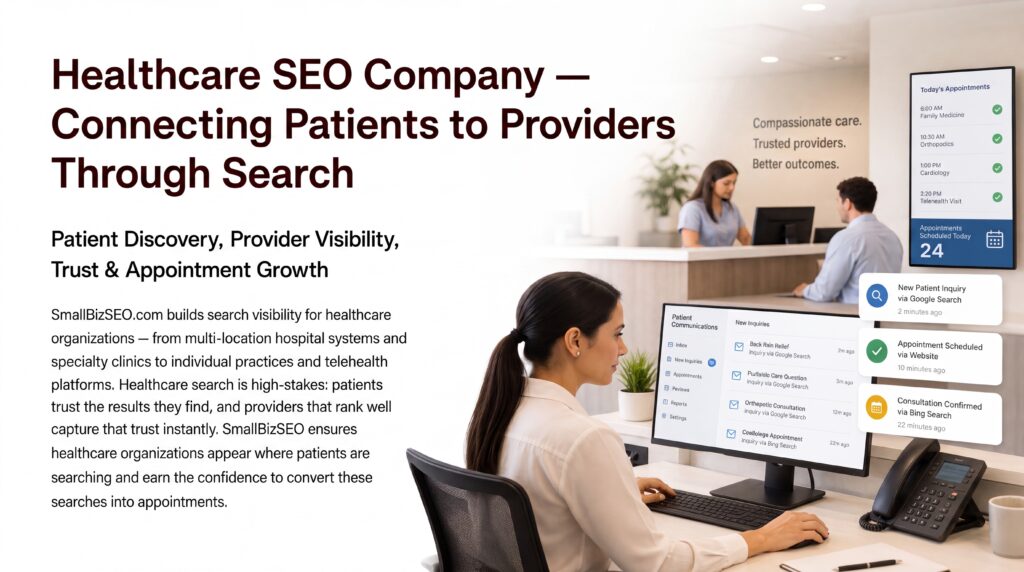
Help visitors connect the service they need to the relevant provider and location information.
A healthcare organization can have multiple services, professionals and sites that do not map neatly onto one another. A visitor may find a service page yet still be unsure which location offers it or how to request an appointment. We organize those relationships around confirmed operational information, improving the public website without implying clinical suitability or universal access.
Search intent & content
Connect service, provider and location research
Link each service line with the professionals and locations associated with it, then connect those pages to the relevant appointment or referral route. Consistent directory relationships help visitors follow the organization’s offering across its website.
Service-line discovery
Create a clear hierarchy for the organization’s actual services, connecting overview pages with meaningful specialties and provider-approved explanations rather than a flat list of unrelated terms.
Example searchhealthcare organization service directory
Provider evaluation
Organize genuine professional profiles with accurate roles and affiliations, linking them to relevant services and locations so visitors can understand where each provider practices.
Example searchhealthcare provider profile information
Clinic and location selection
Give each real site current contact, access and service information, making differences visible instead of implying every location provides the organization’s entire offering.
Example searchhealthcare clinic location services
Appointment and referral pathways
Connect service and provider pages with the organization’s actual appointment or referral route, distinguishing general inquiries from clinical intake and confirmed scheduling.
Example searchhealthcare appointment referral information
Website priorities
Build useful pages around real customer decisions
Maintain a relationship map
Track how services, providers and locations connect so navigation and internal links reflect the organization rather than a collection of disconnected pages.
Resolve directory inconsistencies
Review public profile and location details against authoritative organizational information, especially when staff roles, office addresses or service availability change.
Give content clear ownership
Define who maintains clinical descriptions, professional information and operational facts, allowing different review responsibilities to support a consistent public website.
Measure navigation success
Review how visitors move between services, providers and contact routes where configured, without treating navigation activity as evidence of care delivery or patient outcomes.
Our approach
A practical plan for your website
We begin with the organization’s service-provider-location structure and existing data ownership. That foundation helps prioritize useful directory improvements, content gaps and confusing appointment handoffs.
Review the foundations
Check crawlability, existing pages, customer needs, and the services your business actually offers.
Map services to demand
Connect customer questions to useful service pages and supporting content without duplicating search intent.
Build, measure, improve
Publish useful pages and refine them using search visibility and separately configured inquiry analytics.
- Accurate relationships between services, providers and locations.
- Professional and clinical information maintained by appropriate owners.
- Location pages that reflect actual site-specific offerings.
- Public website inquiries separated from clinical records and intake.
Frequently asked questions
Questions about your industry SEO strategy
How does healthcare SEO differ from a single medical practice plan?
The organizational challenge is often the relationship between many services, providers and locations. A single practice can focus more narrowly on its specialty and direct appointment journey.
Should every provider profile list every organization service?
No. Profiles should reflect the provider’s actual role and confirmed relationships. Overbroad listings can mislead visitors and make it harder to find the relevant professional or location.
Can one appointment form serve the whole organization?
It may, if the organization’s actual workflow supports accurate routing. Otherwise distinct service or location paths can make the process clearer without collecting unnecessary clinical information on marketing pages.
How do we measure whether SEO is helping?
Use Google Search Console for search visibility and page performance. Measure calls, inquiries, and lead quality separately through analytics and intake tracking where configured.
Can you guarantee rankings or new customers?
No. We focus on the work within our control: technical foundations, useful content, clear navigation, and measurement. Search outcomes depend on competition and other factors.
Build a clearer path from search to inquiry
Let’s map your healthcare organization’s services, providers and locations into a clearer public search and appointment journey.
Search rankings & AI visibility — AI SEO / AEO
- Google AI Mode
- ChatGPT
- Claude
- Gemini
- Perplexity


Related services & strategies