SEO for Business Card Printing: Turn Product Searches Into Orders
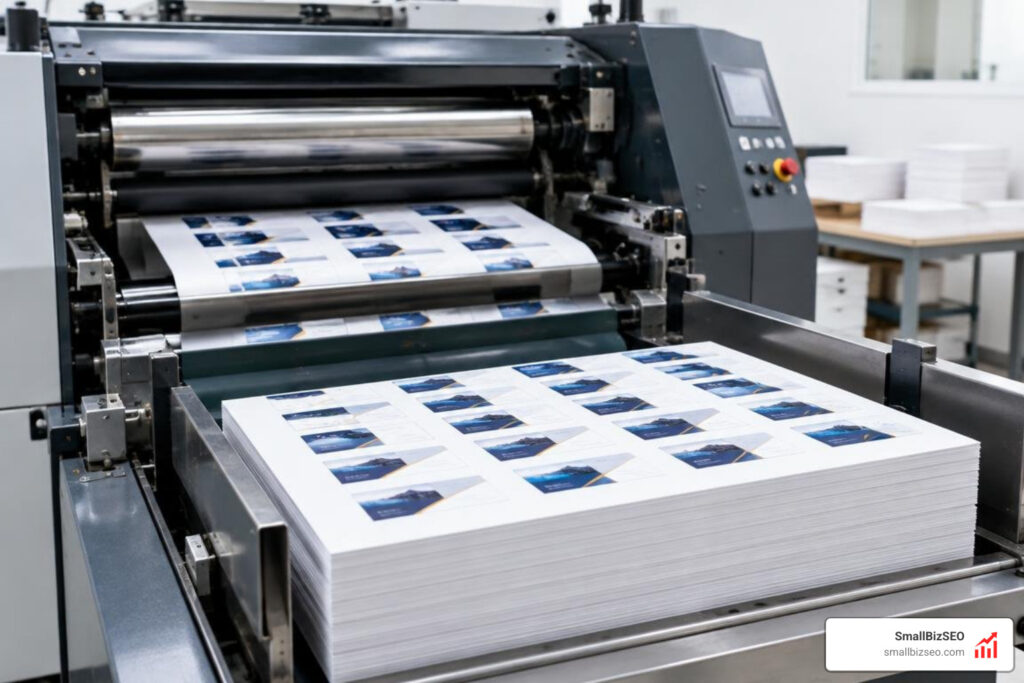
How can SEO for business card printing bring in more orders?
SEO for business card printing starts with matching each buyer’s search to a useful page. If you offer same-day pickup, say so on a business card page that shows real samples, available stocks and finishes, pricing or quote details, and a clear way to order. Keep your local business details accurate, explain how customers should prepare artwork, and track which pages bring in orders or qualified quotes.
I'm Clayton Johnson, founder of SmallBizSEO, where I work on technical SEO, content strategy, and search visibility for small businesses. I bring that experience to this guide to SEO for business card printing, beginning with what customers need to know before they place an order.
Proven Strategies in SEO for Business Card Printing
Business card printing is rarely an impulse purchase. When professionals, office managers, and entrepreneurs search for business card printing, they have distinct requirements: some need cards within hours for an upcoming trade show, while others require specialized finishes, custom artwork assistance, or multi-employee corporate reorders.
To capture these customers, your website must direct specific search intent to dedicated, conversion-ready pages. Rather than grouping all your printing services onto a single generic capabilities page, an effective search strategy structures your catalog so search engines and buyers immediately understand what you provide. Many print providers expand this approach across related product lines, applying specialized commercial printing SEO to help buyers discover everything from marketing collateral to corporate stationery.
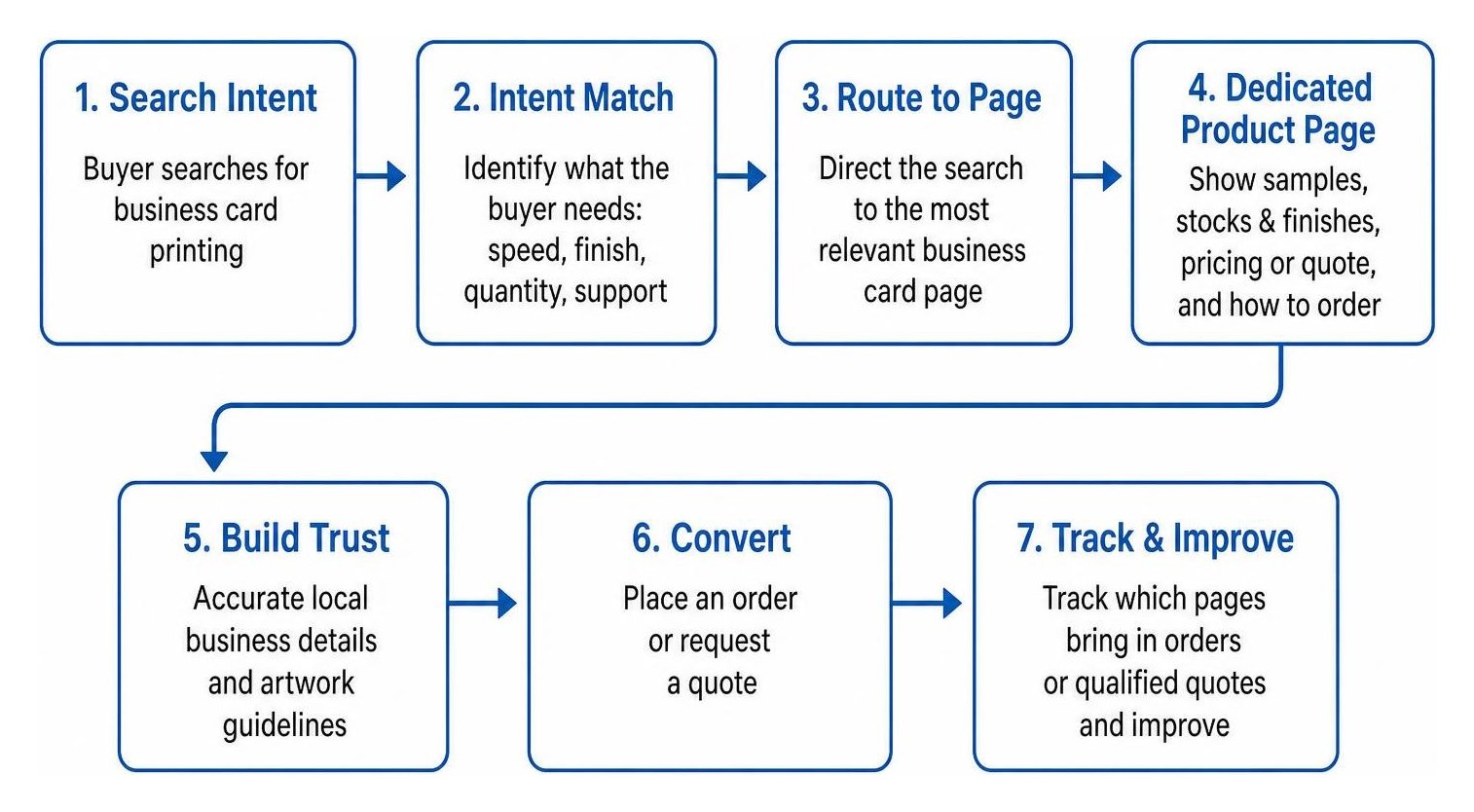
Why is SEO for business card printing essential for local printers?
SEO for business card printing can help print shops connect high-intent buyers with relevant product pages and support stronger commercial relationships over time. Business cards often serve as the entry point for larger print contracts, including brochures, signage, and branded stationery.
When buyers search, their queries reveal exact expectations regarding turnaround time, finish, and ordering support. Applying proven B2B search strategies ensures your site matches these intents with corresponding landing pages and clear conversion paths.
| Buyer Search Query Type | Example Customer Queries | Target Page Type | Primary Next Action |
|---|---|---|---|
| Same-Day Local Pickup | "same day business card printing", "rush business cards near me" | Standard Business Cards (with clear cutoff times) | Order online for pickup or call to verify press schedule |
| Specialty Finish | "foil stamped business cards", "embossed business cards", "matte velvet cards" | Specialty Card Landing Page | Request a custom quote or order sample kit |
| Artwork Assistance | "business card design and print", "help formatting business card file" | Design & Print Services Page | Submit file for review or request design help |
| Corporate Reorders | "bulk business cards for employees", "company business card portal" | Corporate Stationery Solutions Page | Contact commercial sales representative |
How do you structure product pages for SEO for business card printing?
A high-converting business card product page provides direct answers to every pre-order question, including stock weights, finishes, pricing, file requirements, and delivery times. Google’s guidance on helpful, reliable content emphasizes direct utility and clarity, so thin product descriptions or vague "call for quote" forms may leave key buyer questions unanswered.
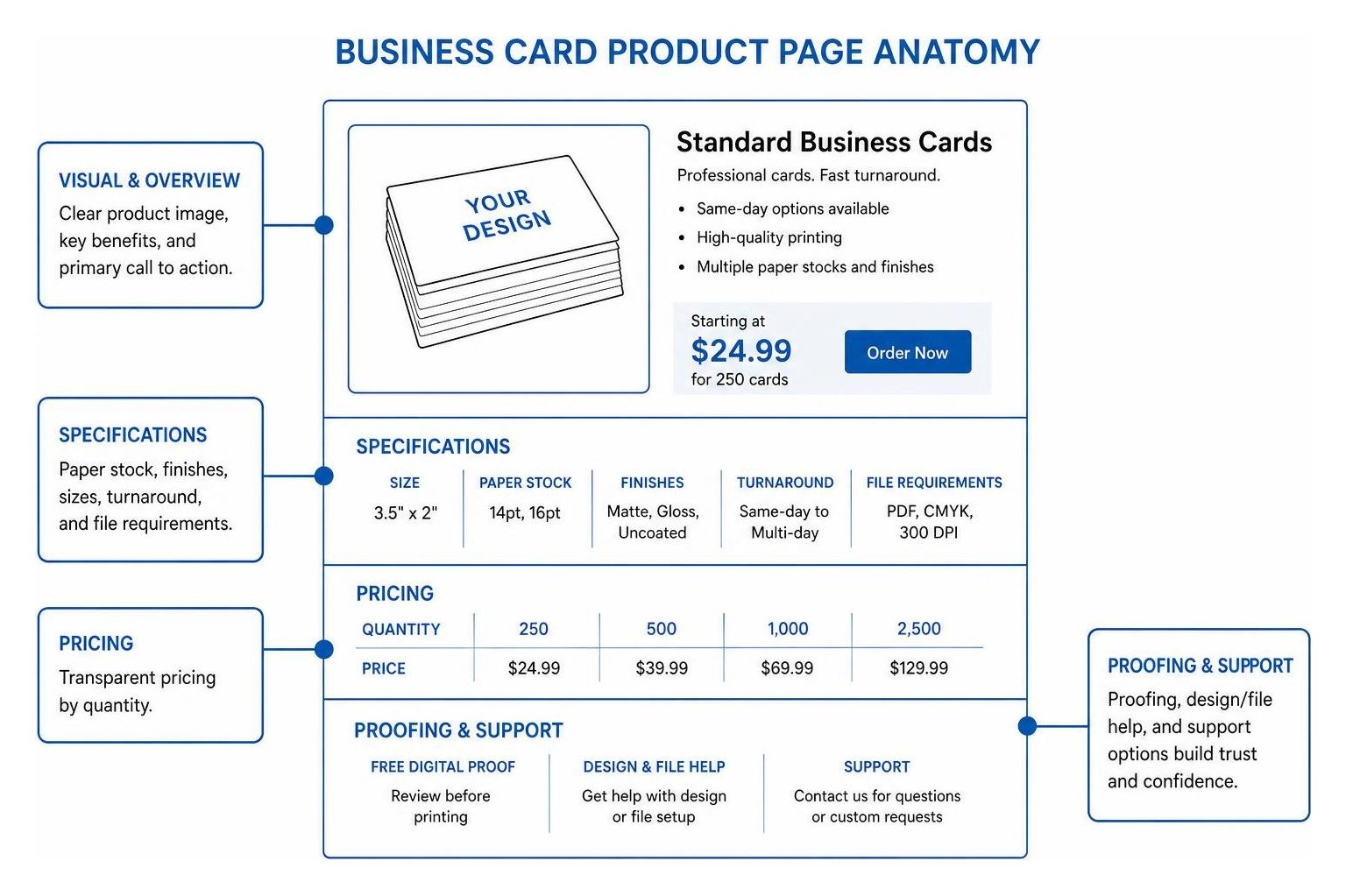
(Note: The diagram above represents an illustrative layout example, not client evidence.)
Separate specialty offerings only when the offer and buyer need genuinely differ. Otherwise, use clear variants on one strong product page rather than creating thin pages.
Hypothetical example, not a description of SmallBizSEO client services: A print shop may offer standard cards for same-day pickup when its production schedule allows, while foil cards may need a separate page because their finishing process, proofing needs, and turnaround are different. Publish pages only for genuine products and real service areas, not thin city pages created solely to capture searches.
Every business card product page should include the following core elements:
- Genuine Product Photos: Use clear, original close-up photography that shows paper texture, corner cuts, and finish details. Follow Google Images SEO guidance with descriptive alt text that explains what each image shows.
- Paper Stock Details: Explicit paper weights (such as 14 pt, 16 pt, or 32 pt triple-layer stock) with brief descriptions of rigidity and feel.
- Finish Options: Clear descriptions of matte, gloss, soft-touch velvet, UV spot gloss, or foil options.
- Turnaround vs. Shipping: Explicit distinctions between press production time, daily pickup cutoff deadlines, and delivery transit times.
- Transparent Pricing or Quote Baseline: Published starting prices or structured tier tables so searchers immediately understand job costs.
- Proofing and Approval Workflow: Clear explanations of how digital proofs are reviewed before printing begins.
- Downloadable Artwork Templates: Direct links to templates featuring exact bleed, trim, and safety margins.
- Clear Call to Action: A prominent order form, file uploader, or quote submission button placed above the fold.
How should print shops optimize Google Business Profiles and local signals?
Local search optimization depends on an accurate, fully completed Google Business Profile that reflects your real-world services. Local buyers frequently look for local commercial providers, making your map listing a primary driver of customer inquiries and counter pickups.
For an eligible print business, use Google’s local ranking guidance to keep the profile complete and accurate:
- Choose the most appropriate available category: Select the category that best represents the primary business, rather than treating any single category as compulsory.
- List genuine print products: Include only services the shop actually offers, such as standard business cards, rush cards, or specialty finishing where available.
- Use authentic business and work photos: Show real production equipment, customer-facing areas, team members, or completed work where appropriate.
- Invite customers honestly: Use a consistent post-order process that invites all customers to leave an honest review, without screening for only positive experiences or promising ranking outcomes.
Clear production capabilities and accurate business details help buyers assess whether a print shop can meet their needs.
What technical setup and artwork guides capture high intent buyers?
Print buyers frequently search for technical specifications before finalizing their artwork. Publishing accurate, step-by-step file setup guides captures high-intent prospects during the design phase, establishing your shop as a trusted authority before they submit their order.
Your technical artwork guides should link to templates and instructions verified against the shop’s own production requirements:
- Product-specific templates: Provide the finished size, layout, and safe-area or bleed guidance that applies to that product.
- Accepted file setup: State file formats, color handling, resolution, and font requirements only when the shop’s workflow requires them.
- Submission and proofing steps: Explain how customers submit artwork, when proofs are provided, and where to get help before production.
- Current production notes: Keep templates and setup instructions aligned with the equipment, finishes, and ordering options the shop actually offers.
Keep the technical foundation clean by checking crawlability, resolving broken links, and using accurate structured data such as Product or LocalBusiness only where it reflects the page and business. Google’s guidance on AI features explains that there is no special AI schema or markup that guarantees inclusion in AI features; useful, accurately represented content remains the priority.
How to Measure Performance and Grow Your Print Orders
Improving your search visibility is an ongoing operational process. By evaluating search queries, click trends, and qualified quotes, print shops can allocate resources to high-margin products and refine pages that underperform.
Print shops looking to implement an ongoing, data-driven optimization strategy often explore our custom SEO packages to structure technical foundations and build durable search authority.
How do print shops measure search performance and quote conversions?
Using Google Search Console alongside web analytics provides accurate visibility into customer demand and page effectiveness. Tracking commercial performance requires reviewing impressions, clicks, form submissions, and direct phone calls rather than focusing solely on overall traffic numbers.
| Metric Focus | Search Console & Analytics Indicator | Hypotheses to Investigate | Next Decision & Action |
|---|---|---|---|
| High Impressions, Low Click-Through | High query impressions with a low click rate on standard-card queries | Position, search-result features, title wording, or the match between the snippet and query intent may be influencing clicks | Compare query position and SERP context, then test clearer titles and descriptions that reflect the actual offer |
| High Clicks, Low Conversion | Solid traffic to specialty-card pages with few quote submissions or orders | Search intent, page usability, offer clarity, product detail, pricing expectations, or conversion tracking may be affecting results | Review the page experience, offer, form flow, tracking setup, and buyer questions before choosing a change |
| High-Intent Discovery | Rising impressions for niche queries such as "linen business cards" | The query may indicate demand worth validating, or it may not align with current production capability | Confirm the shop can genuinely deliver the product, then improve a variant section or build a dedicated page only if the offer differs |
| Repeat Visits | More return visits to artwork-upload or reorder pages | Repeat visits alone do not prove retention; they may reflect ongoing evaluation, support needs, or a return purchase path | Pair analytics with order, quote, and customer data to determine what returning visitors actually do |
What is the prioritized implementation checklist for print shops?
Executing an SEO plan requires focusing on high-impact operational priorities first.
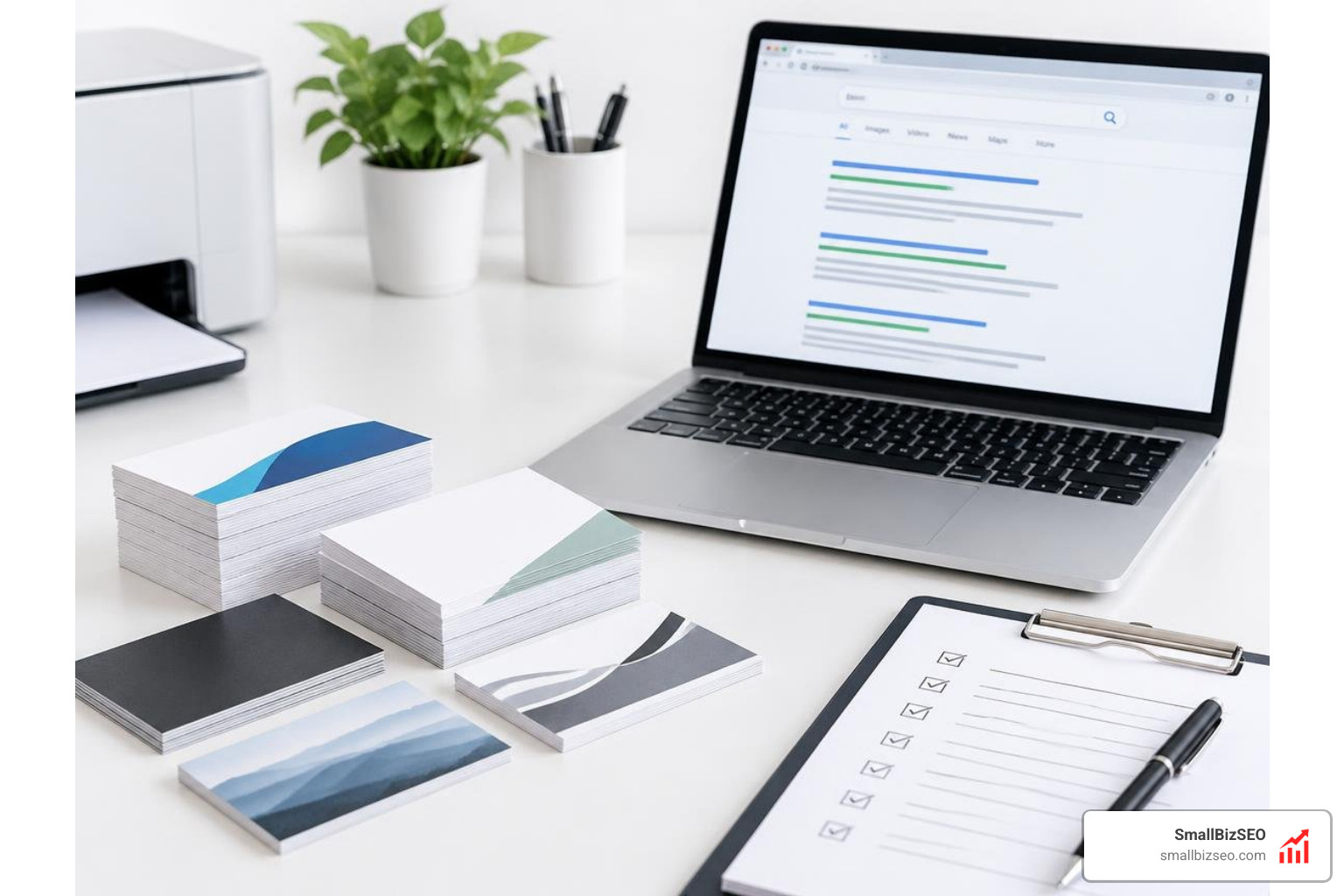
Phase 1: Technical & Accuracy Baseline
- Verify business name, local phone number, and operating hours across website footers and online directories.
- Run a crawl check to fix broken links, slow loading assets, and mobile usability errors.
- Configure accurate
LocalBusinessandProductstructured schema markup.
Phase 2: Product Page Optimization
- Create distinct pages for core offerings: Standard Digital Business Cards, Specialty Finished Cards, and Corporate Accounts.
- Add genuine, high-resolution close-up photography showcasing card stocks, finishes, and edge profiles.
- Publish clear turnaround times, pickup cutoff schedules, and transparent starting prices.
Phase 3: Artwork & Conversion Enablement
- Publish a comprehensive file preparation guide detailing bleed, margins, CMYK color profiles, and resolution standards.
- Provide direct download links for artwork layout templates.
- Streamline quote request forms and file upload workflows to minimize user friction.
Phase 4: Local Profile & Review Systems
- Complete Google Business Profile listings with accurate service menus and production photos.
- Deploy an automated post-pickup review invitation process for completed orders.
- Monitor Search Console queries monthly to identify emerging print demand and refine underperforming pages.
Getting Started on Your Print Search Growth
Building a reliable organic search pipeline for your print business requires clear product information, genuine portfolio assets, and an accurate local presence. By aligning your website with how buyers actually search, you make it easier for prospective clients to evaluate whether your shop is relevant to their business-card and commercial-printing needs.
If you want an experienced team to audit your technical setup, refine product pages, and build a practical search strategy, book a consultation with SmallBizSEO. Our SEO packages can help structure ongoing technical and content work around your business goals.