Indexing Infrastructure Changes Versus Ranking Updates: Why Crawl System Shifts Fool SEOs

Why Do Indexing Changes Look Like Ranking Updates?
The difference between indexing infrastructure changes versus ranking updates is where they act. Indexing changes affect how pages are discovered, stored, or refreshed. Ranking updates change how indexed pages are scored and ordered for a search.
That distinction matters when your traffic moves. If an important page is not being crawled or indexed, changing its content may not fix the problem. If it remains indexed but drops for key searches, a ranking change is one possible cause. AI search adds another test: can the system retrieve current, trustworthy evidence to support its answer?
I'm Clayton Johnson, founder of SmallBizSEO. My work in technical SEO and content strategy helps small businesses separate indexing infrastructure changes versus ranking updates before deciding what to fix.
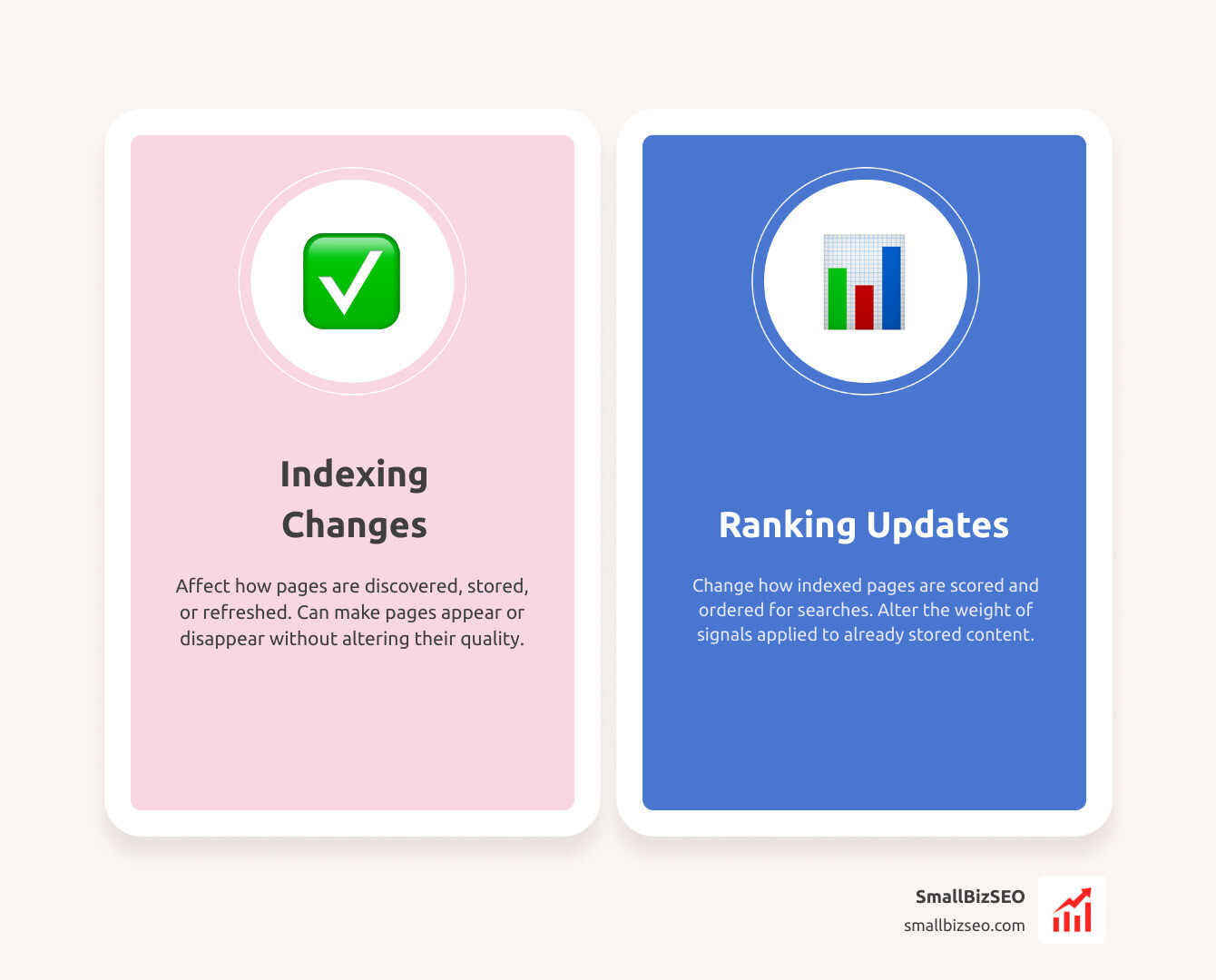
How Do Indexing Infrastructure Changes Differ from Ranking Updates, and What Causes SERP Volatility?
An indexing infrastructure change modifies the physical or logical architecture used to discover, process, parse, and store web documents. In contrast, a ranking update alters the mathematical weighting and evaluation criteria applied to documents that already sit inside that repository. When search results fluctuate wildly, site owners often blame an algorithmic penalty when the true culprit is an infrastructure shift altering how rapidly pages are fetched or rendered.
| Dimension | Indexing Infrastructure Changes | Ranking Algorithm Updates |
|---|---|---|
| Primary System Layer | Ingestion pipeline, parsing engine, sharding tiers, vector stores | Scoring models, neural rerankers, quality classifiers |
| Immediate Visibility | Often completely silent or invisible unless crawling fails | Sudden, highly visible SERP volatility and rank position shifts |
| Primary Metric | Ingestion throughput, crawl lag, storage efficiency, index drift | Relevance scoring, user engagement, precision, click-through rates |
| System Rollback | Complex; requires database snapshot restoration or alias swaps | Fast; toggle feature flags, model weights, or score thresholds |
| Impact on Corpus | Modifies what data is physically retrievable by the query engine | Reorders the existing pool of retrievable documents |
What Is the Core Difference in Indexing Infrastructure Changes Versus Ranking Updates Under the Hood?
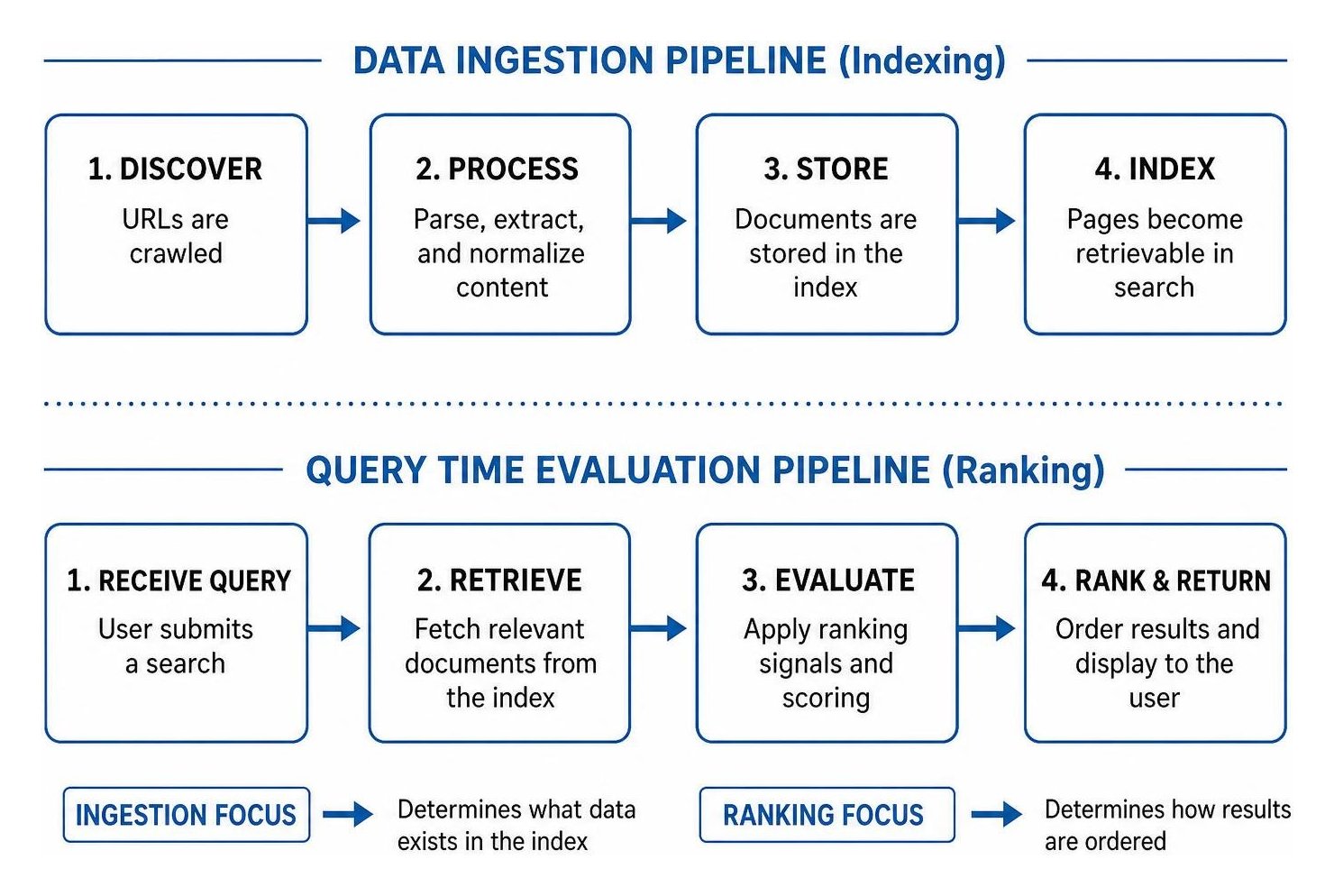
Under the hood, indexing infrastructure determines whether a document exists in searchable memory, whereas a ranking system decides its position on a results page. Search engines process billions of pages by separating document ingestion from query-time evaluation.
Historically, search engines processed web documents in sequential batches using frameworks like MapReduce. The shift outlined when the Google search index splits with MapReduce paved the way for distributed database systems like BigTable supported by the Colossus file system. This transition powered the historic Caffeine infrastructure overhaul, which boosted index freshness by fifty percent without fundamentally changing how algorithmic signals scored relevance.
Modern crawling systems run continuous, incremental updates. Instead of rebuilding an entire index at once, ingestion pipelines rely on incremental append operations—a process known in patent literature as treadmilling. New document versions append to live token repositories while older versions await background garbage collection.
When infrastructure upgrades alter how a canonical url resolves across duplicate pages, or how redirect pipelines handle parameters, the effect on search visibility can be massive. The historical Big Daddy infrastructure update spent months resolving technical canonicalization and redirect handling without deploying new ranking formulas. Similarly, the early Fritz update ended monthly index refreshes by moving search into a continuous daily rebuild. When backend data ingestion changes, the resulting search volatility stems from index availability rather than an adjusted search algorithm.
Traditional Web Discovery vs. AI Grounding: How Do Index Goals Differ?
Traditional web search indexes prioritize lexical recall and broad coverage, whereas AI grounding indexes require high factual fidelity, verifiable source provenance, and conflict detection.
In traditional search architectures, engines build inverted indexes using lexical algorithms like BM25 alongside global authority signals like PageRank. A human user reviews a list of blue links, compares the options, and manually discards outdated snippets. If a search index surfaces a page containing superseded information, the user simply clicks back to find a better source.
Grounding an artificial intelligence model requires an entirely different standard. When an AI system synthesizes an answer directly for a user, a single stale fact or unresolved contradiction causes the system to generate inaccurate statements with high confidence. According to insights on Real-Time Indexing: 6 Costly Mistakes to Avoid, indexing lag directly translates into factual errors in generative responses. Grounding indexes must continuously validate facts, verify timestamps, and measure the strength of evidence rather than simply checking for keyword matches.
RAG Pipelines and Vector Stores: Measuring Indexing Infrastructure Changes Versus Ranking Updates in AI Systems
In Retrieval-Augmented Generation (RAG) and neural search, an indexing change involves altering the chunking strategy or switching the vector embedding model, while a ranking update involves modifying the cross-encoder reranker or generative prompt instructions.
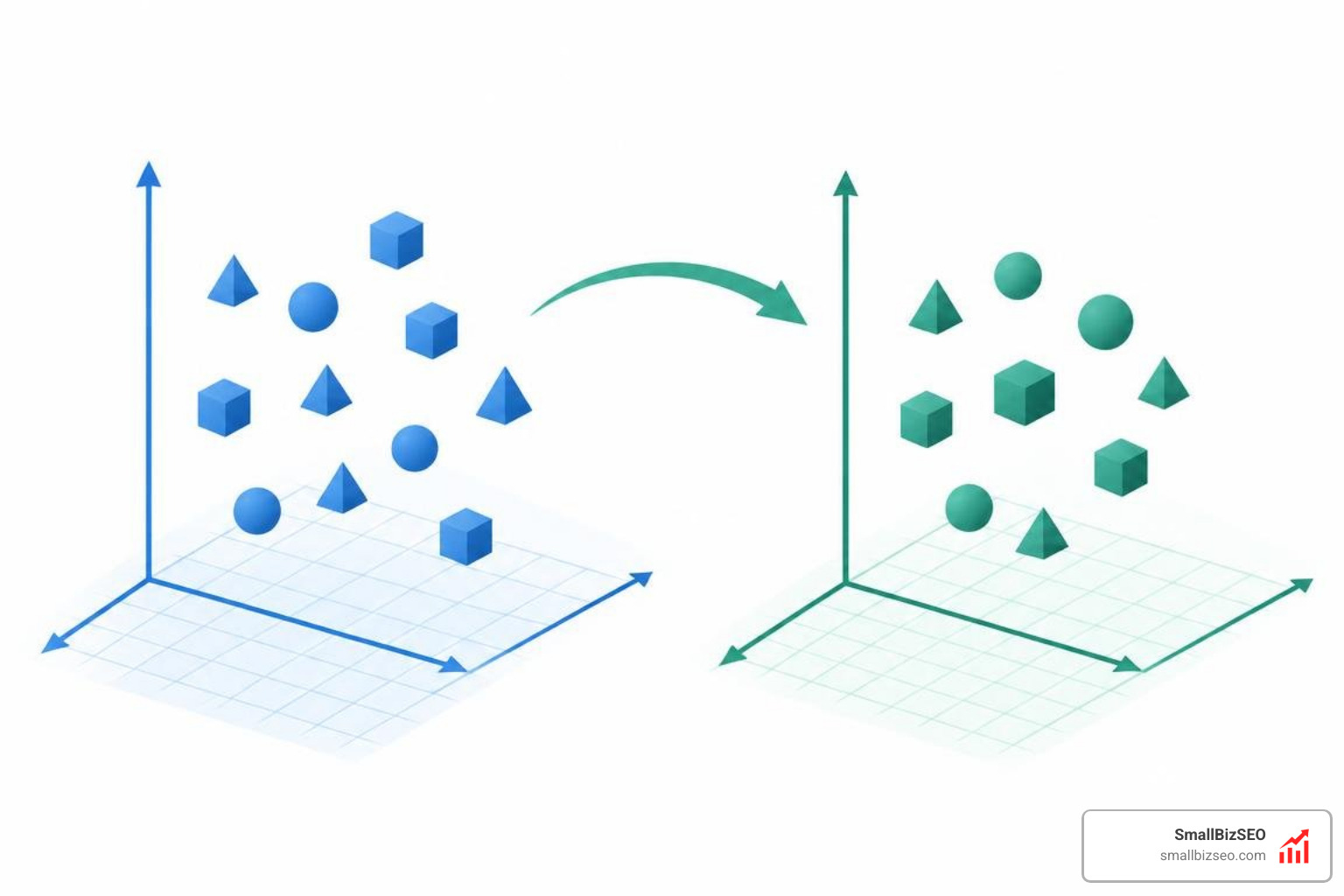
As detailed in The Embedding Upgrade That Silently Re-Ranks Your Entire Corpus, changing an embedding model is an architectural schema migration, not a simple configuration tweak. Every embedding model maps text into its own unique high-dimensional coordinate space. Cosine similarity calculations between vectors generated by different models are mathematically meaningless.
If a system updates its embedding model without rebuilding the entire vector database, a mixed-version index forms. This silent corruption can degrade retrieval accuracy by double digits without generating an explicit database error. Upgrading a RAG indexing pipeline requires creating a parallel shadow index, running a dual-write pipeline to keep incoming records synchronized, backfilling the legacy corpus, and running regression tests against a golden query dataset before cutting over traffic.
Deployment Dynamics: Why Do Blue-Green Upgrades Matter for Indexing but Not Ranking Algorithms?
Blue-green deployments are essential for indexing infrastructure because re-indexing alters underlying data stores, whereas ranking updates operate in stateless compute layers that support canary rollouts.
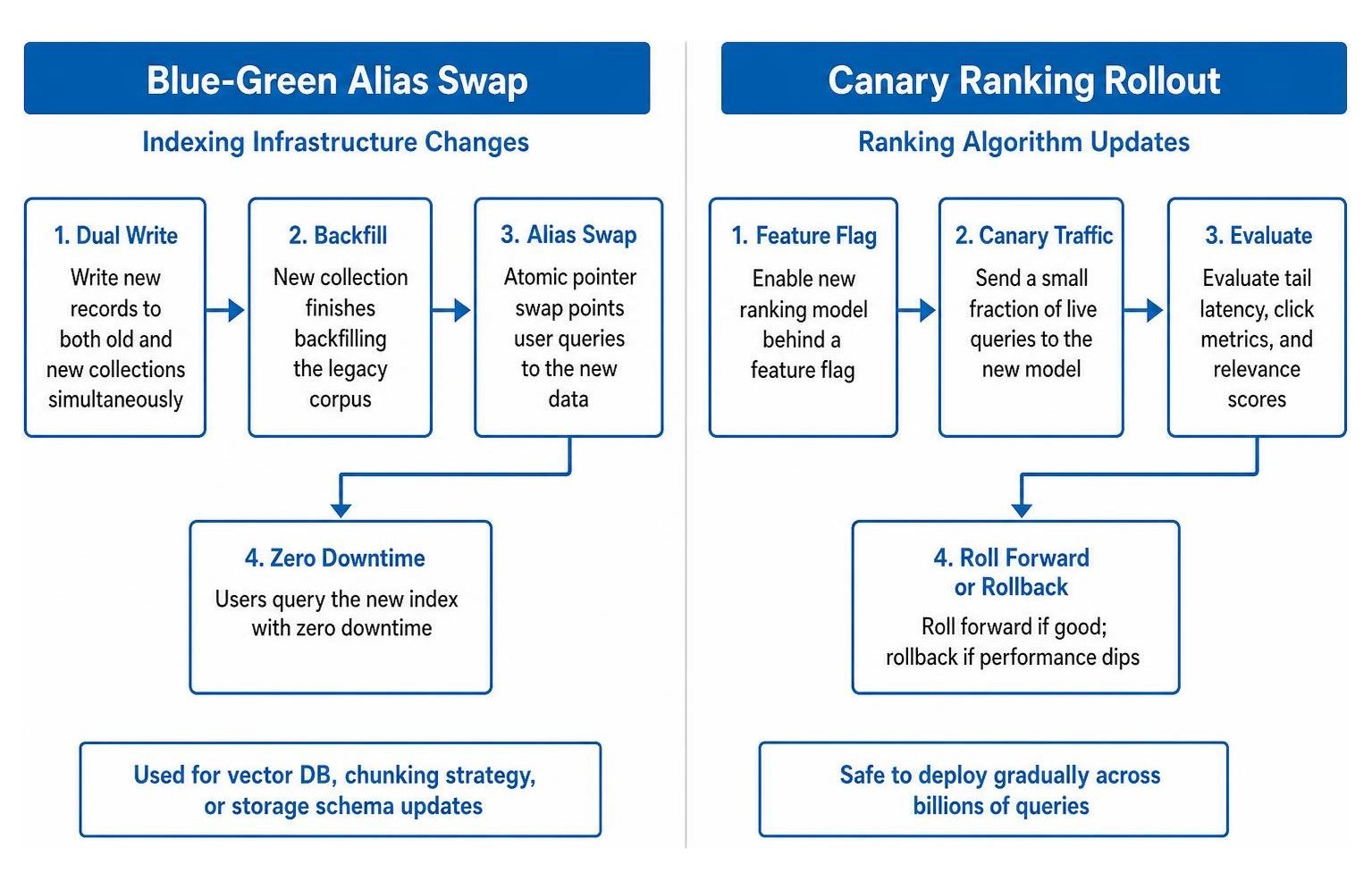
When an enterprise updates its vector database, chunking strategy, or storage schema, it cannot safely modify production data in place. As explained in the guide on How to Do Zero-Downtime RAG Infrastructure Upgrades — wiki, engineering teams use collection alias swaps. The application writes new records to both old and new collections simultaneously. Once the new collection finishes backfilling, an atomic pointer swap points user queries to the new data with zero downtime.
Ranking algorithm adjustments follow a different path. Because ranking systems evaluate retrieved candidate documents on the fly, engineers deploy them using feature flags and canary traffic splits. A search provider can send a small fraction of live queries to a new scoring model, evaluate tail latency, click metrics, and relevance scores, and execute an immediate rollback if performance dips. Ranking rollouts, such as a major news core update, can take weeks to safely calibrate across billions of queries without requiring a rebuild of the underlying physical storage.
How Can You Diagnose Volatility and Future-Proof Technical SEO?
To accurately diagnose search volatility, webmasters must systematically isolate crawling and document indexing health from algorithmic scoring shifts before altering on-page content.
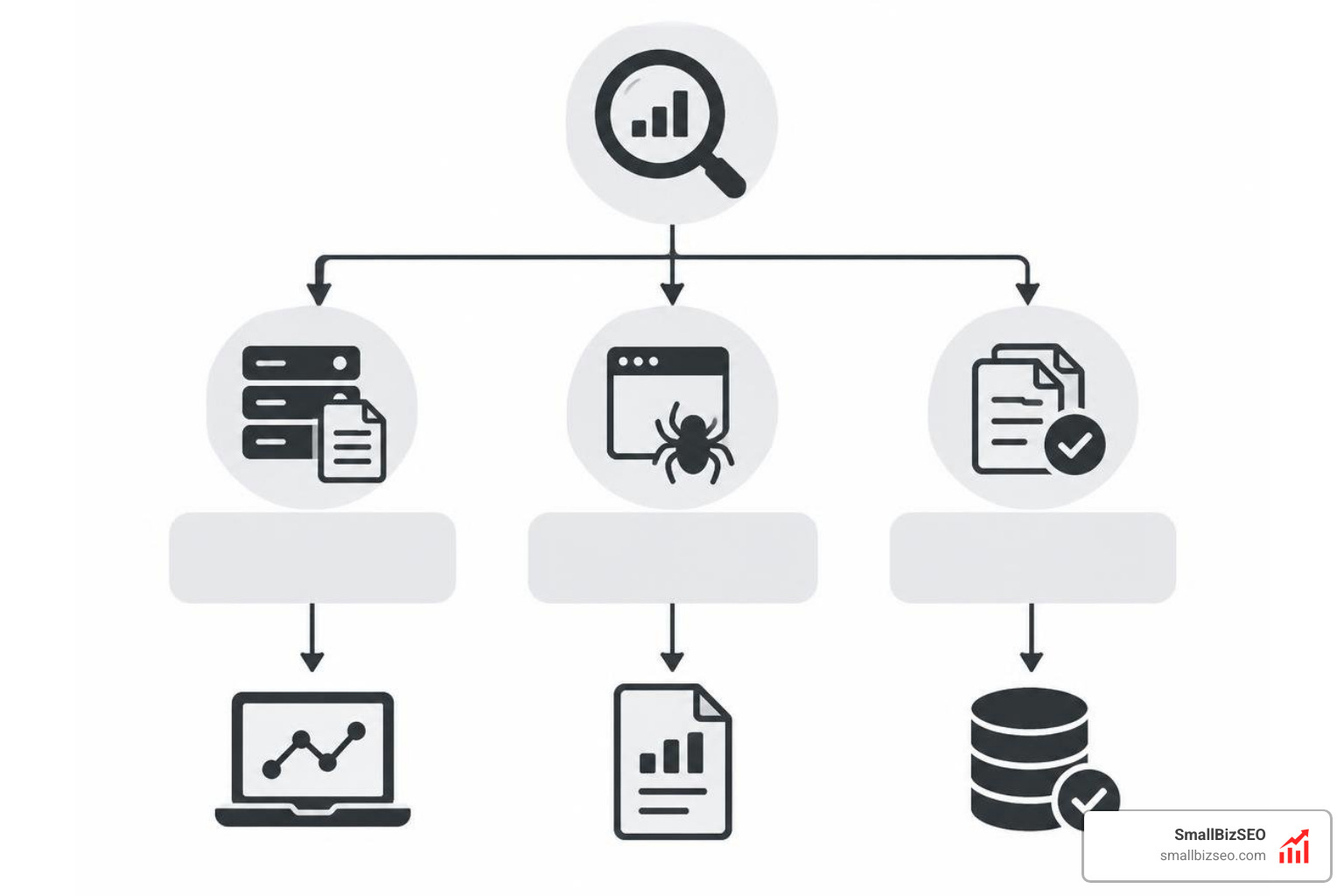
When organic search traffic drops, jumping straight into rewriting copy or disavowing backlinks can waste resources if the underlying issue is technical discovery. We use our data-driven Velocity framework at SmallBizSEO to deliver clear, structured reporting that isolates technical crawl anomalies from broader market algorithm updates.
- Inspect Server Logs First: Verify whether search crawlers are actively hitting the affected directory, check for HTTP response code errors (5xx server errors or 429 rate limits), and confirm crawl frequency.
- Review Crawl Statistics: Open search engine diagnostic tools to verify whether average host response times have spiked, which can cause search engines to temporarily lower their crawl activity.
- Check Document Ingestion Tiers: Inspect individual URLs using live URL testing tools to verify that render engines are seeing the complete Document Object Model (DOM) and that essential content is not trapped behind unrendered client-side scripts.
- Evaluate Query-Level Trends: If crawling and indexing metrics remain completely stable but impressions drop uniformly across broad keyword groups, the shift is likely an algorithmic evaluation update rather than a pipeline failure.
If your website needs deep architectural analysis to resolve complex ingestion bottlenecks, getting a professional SEO visibility audit provides clear diagnostic direction.
How Should Webmasters Audit Index Coverage and Freshness to Avoid Misdiagnosing Drops?
A reliable audit begins with analyzing search engine coverage metrics to ensure technical discovery remains intact before evaluating on-page relevance signals.
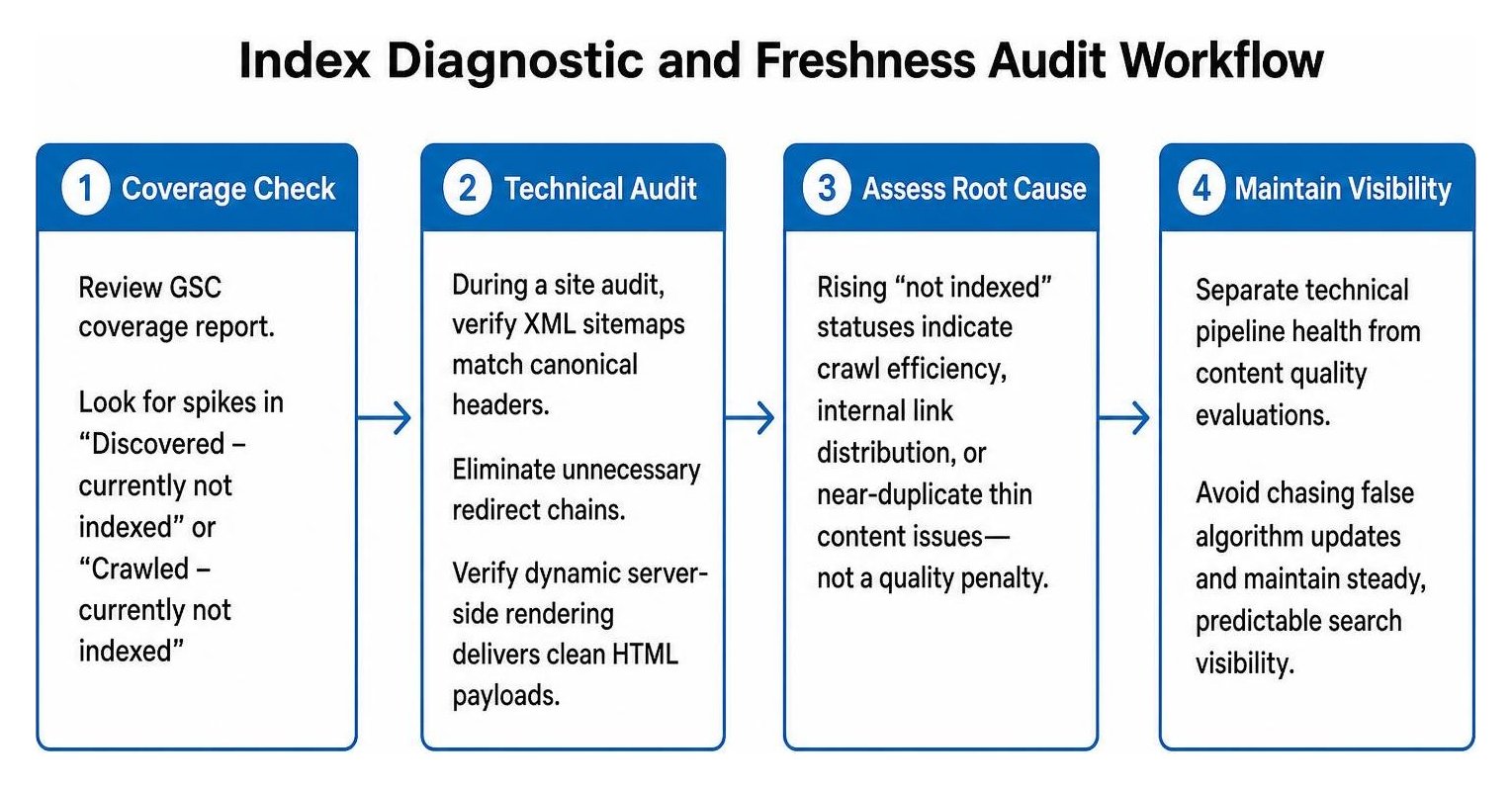
Start by reviewing your gsc coverage report to look for sudden spikes in statuses like "Discovered – currently not indexed" or "Crawled – currently not indexed." A rising number in these categories indicates that search engines are struggling with crawl efficiency, internal link distribution, or near-duplicate thin content, rather than applying a specific quality penalty.
During a routine site audit, verify that your XML sitemaps match your canonical headers, eliminate unnecessary redirect chains, and verify that dynamic server-side rendering delivers clean HTML payloads. By separating technical pipeline health from content quality evaluations, businesses avoid chasing false algorithm updates and maintain steady, predictable search visibility.
Navigating Search Pipeline Shifts with Confidence
Understanding how search engines ingest data versus how they score relevance is the foundation of modern technical optimization. When indexing systems evolve to support near-instant document processing and real-time AI grounding, the mechanics of search visibility shift along with them.
By systematically monitoring crawl stats, maintaining clean site architecture, and auditing index health before rewriting page content, you protect your digital presence against unnecessary panic during industry-wide search volatility. Focus on technical clarity, reliable structured data, and high-quality evidence, and your organic search performance will remain resilient through every infrastructure evolution.