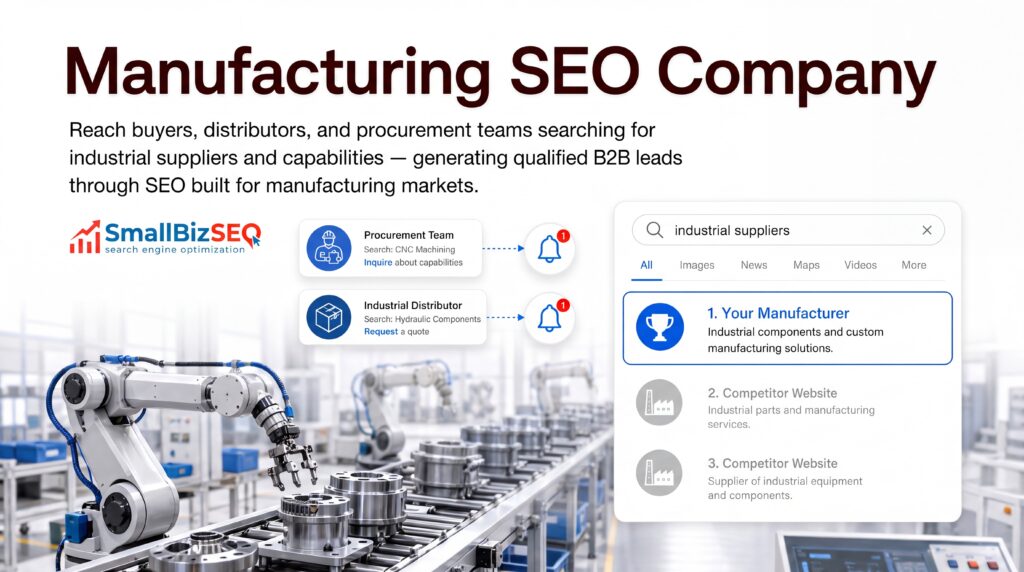
Make the path from an industrial search to a relevant RFQ easier to follow.
A procurement buyer comparing a production process, an engineer researching a component application and an OEM seeking a supplier need different evidence. We organize manufacturing SEO around those decisions. The website should describe your actual capabilities and quote requirements clearly; SmallBizSEO’s role is to market that offering, not provide manufacturing, logistics or production services.
Search intent & content
Connect technical research with supplier inquiries
These example searches illustrate buyer tasks rather than measured demand. Your confirmed processes, materials and applications determine which capability pages deserve priority.
Process and capability searches
Build focused pages for the manufacturing processes actually available, with relevant scope and business-approved specifications. Help buyers identify potential fit without inventing tolerances, equipment, capacity or certification details.
Example searchcontract manufacturing capabilities
Component and application research
Explain the component categories or applications your business serves using genuine project context. Connect technical terminology to the relevant capability rather than creating a product claim from every industrial search phrase.
Example searchmanufacturer for custom industrial components
Material and specification inquiries
Where material expertise is documented, explain the information buyers should provide for a technical discussion. Keep the page useful for specification-led searches without implying that every grade or requirement is supported.
Example searchcustom component manufacturing quote
OEM and procurement RFQs
Provide a clear route for buyers with drawings, quantities and project requirements. Explain the quotation process and appropriate document-sharing method rather than treating an industrial RFQ as a generic contact request.
Example searchOEM manufacturing supplier RFQ
Website priorities
Build useful pages around real customer decisions
Keep capability evidence concrete
Use confirmed equipment, process descriptions and project examples with permission. A buyer needs accurate boundaries more than broad language about unlimited production or universal precision.
Organize applications meaningfully
Connect industries and uses to actual manufacturing work. Application pages should explain relevant requirements and capabilities rather than repeat the same supplier pitch under different sector names.
Support technical and commercial readers
Make scope details available to engineers while explaining inquiry steps for procurement teams. Both should find a path suited to their role without navigating unrelated consumer-style content.
Measure RFQ relevance
Review inquiries by capability and project fit where the business’s tracking supports it. Traffic alone does not show whether the site is attracting work that matches actual production scope.
Our approach
A practical plan for your website
We review your documented capabilities, accepted applications and RFQ workflow first. That evidence shapes technical landing pages and supporting content, with a clear distinction between the manufacturer’s offering and our SEO work.
Review the foundations
Check crawlability, existing pages, customer needs, and the services your business actually offers.
Map services to demand
Connect customer questions to useful service pages and supporting content without duplicating search intent.
Build, measure, improve
Publish useful pages and refine them using search visibility and separately configured inquiry analytics.
- Capability descriptions use verified process and specification information.
- Certifications and qualifications are stated only with accurate scope.
- Project examples respect permissions and commercially sensitive details.
- RFQ routes explain the information and documents needed for assessment.
Frequently asked questions
Questions about your industry SEO strategy
Should every manufacturing process have its own page?
Only when it is genuinely offered and the page adds useful capability information. Closely related processes can share a structured explanation rather than generate repetitive pages for each technical term.
How should manufacturing case studies be written?
Explain the application, the manufacturer’s role and the relevant work with permission. Keep confidential details protected and avoid turning one project’s specification into a universal capability claim.
What belongs in a manufacturing RFQ form?
Ask for the project type, relevant quantities and a brief requirement summary. Explain an appropriate follow-up route for drawings or sensitive specifications so buyers can discuss fit without oversharing publicly.
How do we measure whether SEO is helping?
Use Google Search Console for search visibility and page performance. Measure calls, inquiries, and lead quality separately through analytics and intake tracking where configured.
Can you guarantee rankings or new customers?
No. We focus on the work within our control: technical foundations, useful content, clear navigation, and measurement. Search outcomes depend on competition and other factors.
Build a clearer path from search to inquiry
Bring your capability documentation and the information needed for a useful RFQ. We can build a search strategy that helps industrial buyers evaluate your actual offering.
Search rankings & AI visibility — AI SEO / AEO
- Google AI Mode
- ChatGPT
- Claude
- Gemini
- Perplexity


Related services & strategies