Modern Link Auditing: Build a Lower-Risk Anchor Profile Without Strict Percentages

Why Don’t Universal Anchor Text Percentages Work?
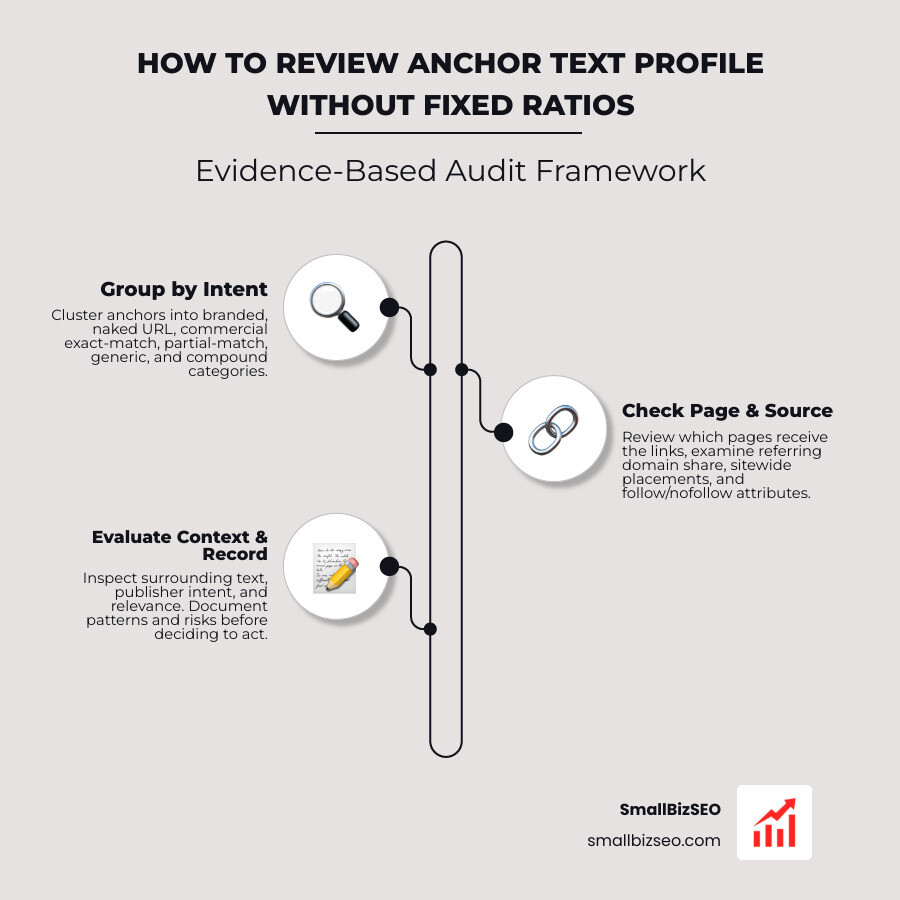
Here’s how to review an anchor text profile without fixed ratios: Group links by anchor type, then check which pages they point to and why the linking sites used them. Look closely at repeated commercial phrases, especially when they appear across unrelated sites or on links you arranged. Record what you find before changing or removing anything.
Google publishes no ideal mix of branded, generic, or keyword-rich anchors. A percentage that looks unusual for one business may make sense for another. The source page, surrounding text, and link history tell you more than a pie chart.
I’m Clayton Johnson, founder of SmallBizSEO. My work in SEO and digital PR shapes how to review an anchor text profile without fixed ratios: start with the evidence behind each link, not a preset target.
Where Did Universal Percentage Rules Come From?
Universal percentage rules originated from third-party correlation studies and vendor heuristics rather than official search engine documentation. When search engines began using hyperlinks as authoritative votes based on PageRank concepts, webmasters realized that clickable text directly passed topical relevance. Following early algorithmic updates like Google Penguin, which cracked down on keyword-stuffed anchor labels, the SEO industry scrambled to define numeric safety boundaries.
Vendors quickly created rule-of-thumb ratios (for example, suggesting exact match must stay under 5% or branded links must exceed 60%). While these targets offer a comforting baseline for beginners, they describe descriptive correlation samples across broad industries rather than prescriptive rules.
A well-known national e-commerce brand naturally receives overwhelming volumes of raw domain URLs and direct brand mentions. Conversely, a niche technical blog or open-source software project might legitimately earn high volumes of topical, descriptive phrase anchors from developers citing documentation. Chasing a single mathematical quota misses this reality entirely.
How Should You Plan and Audit an Anchor Text Profile Without Fixed Ratios?
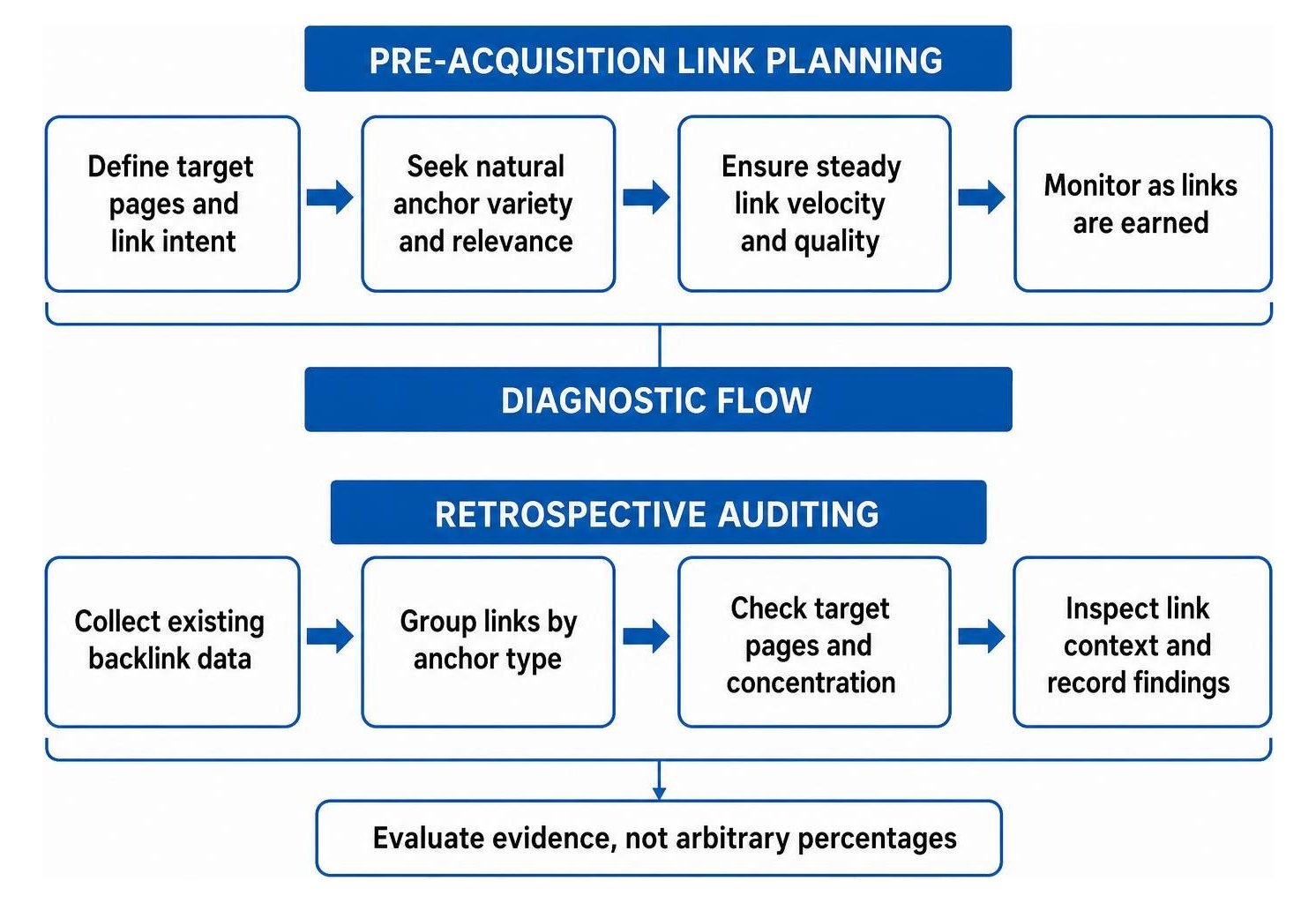
Auditing an established backlink profile is fundamentally different from planning a proactive link acquisition campaign. When planning new link outreach, you exercise caution over your target destinations, ensuring your overall link velocity remains steady. In contrast, post-acquisition auditing requires evaluating historical data where you cannot dictate how external editors naturally phrase their references.
Following proven tips for detecting a naturally grown link profile, an audit should identify manipulative behavioral footprints rather than flag arbitrary mathematical deviations. Manual review triggers rarely fire because your exact-match keywords hit an arbitrary number like 11% instead of 9%; they trigger when unearned commercial phrasing appears systematically across unrelated, low-quality sources.
How Can You Review an Anchor Text Profile Without Fixed Ratios? A 3-Step Framework
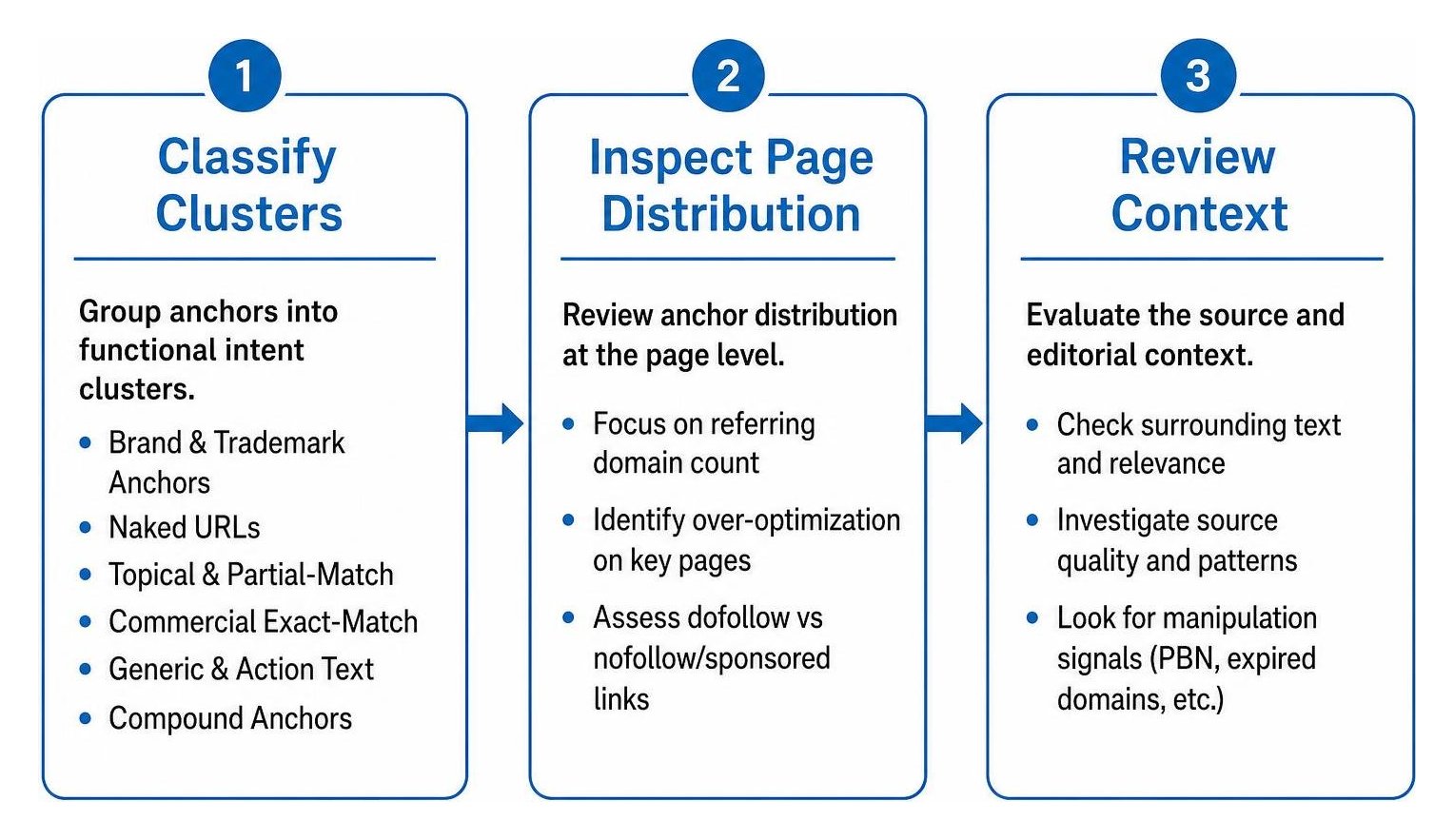
Reviewing an anchor profile without rigid percentages requires a three-step evidence framework: group your incoming links into functional intent categories, evaluate how those anchors concentrate on individual target pages, and inspect the editorial context of the referring domains.
This diagnostic method aligns directly with search engine guidelines. Rather than counting percentages, modern search algorithms like SpamBrain evaluate whether link text appears earned or artificially placed.
| Audit Characteristic | Ratio-Based Audit | Evidence-Based Review |
|---|---|---|
| Primary Metric | Exact percentage quotas per anchor type | Contextual relevance and publisher intent |
| Risk Trigger | Exceeding arbitrary thresholds (e.g., >10% exact match) | Repeated commercial text across low-quality sources |
| Page-Level Scope | Domain-level aggregate data only | Granular deep-page and money-page analysis |
| Action Taken | Premature disavow submissions | Context-driven cleanup and varied outreach |
Step 1: How Do You Group Anchors into Functional Intent Clusters?
To understand your backlink makeup, categorize each inbound link into functional clusters based on user and search intent. Using a comprehensive guide on how to check anchor text of backlinks, organize your data into the following distinct categories:
- Brand & Trademark Anchors: Mentions of your official company name, business variations, or key founders.
- Naked URLs: Raw web addresses (such as domain.com, https://www.domain.com/page, or www.domain.com).
- Topical & Partial-Match: Descriptive phrases that include your target topic alongside other words (for example, "our preferred plumbing repair service").
- Commercial Exact-Match: Unmodified commercial phrases matching specific high-volume queries (such as "emergency plumber").
- Generic & Action Text: Functional navigational text like "click here," "source," "website," or "read more."
- Compound Anchors: Combinations merging brand names with target keywords.
Categorizing your profile into these groups clarifies whether your incoming links reflect natural reader navigation or deliberate commercial manipulation.

Step 2: How Do You Review an Anchor Text Profile at the Page Level?
A healthy domain-level profile can easily conceal hazardous over-optimization on high-value money pages. If your overall domain consists of 70% branded terms pointing to the homepage, but your primary transactional service page receives 90% commercial exact-match text, search filters can easily flag that specific URL.
Conduct an external link analysis to evaluate your link distribution at the page level. Focus on your referring domain count rather than total backlink volume. A single website with a sitewide footer link can generate thousands of duplicate backlinks that artificially distort your profile overview without representing separate endorsements.
Simultaneously, evaluate whether your links pass link equity through dofollow attributes or are properly marked as nofollow or sponsored when placed within paid campaigns or user-generated sections.
Step 3: How Do You Evaluate the Source and Editorial Context?
The surrounding text of a backlink provides critical proof of its legitimacy. A natural anchor flows seamlessly within the surrounding paragraph, helping the human reader navigate to a helpful resource.
Investigate the source URLs behind your primary commercial phrases. When conducting competitive research, analyzing competitor backlink profiles helps establish what standard editorial context looks like within your niche. Check for clear manipulative markers such as unnatural link networks, footprints associated with a private blog network, or content that signals expired domain abuse. If multiple unrelated blogs use identical commercial phrases in disconnected paragraphs, the pattern indicates manipulation regardless of total volume.
How Should You Triage Risks and Track Long-Term Trends?
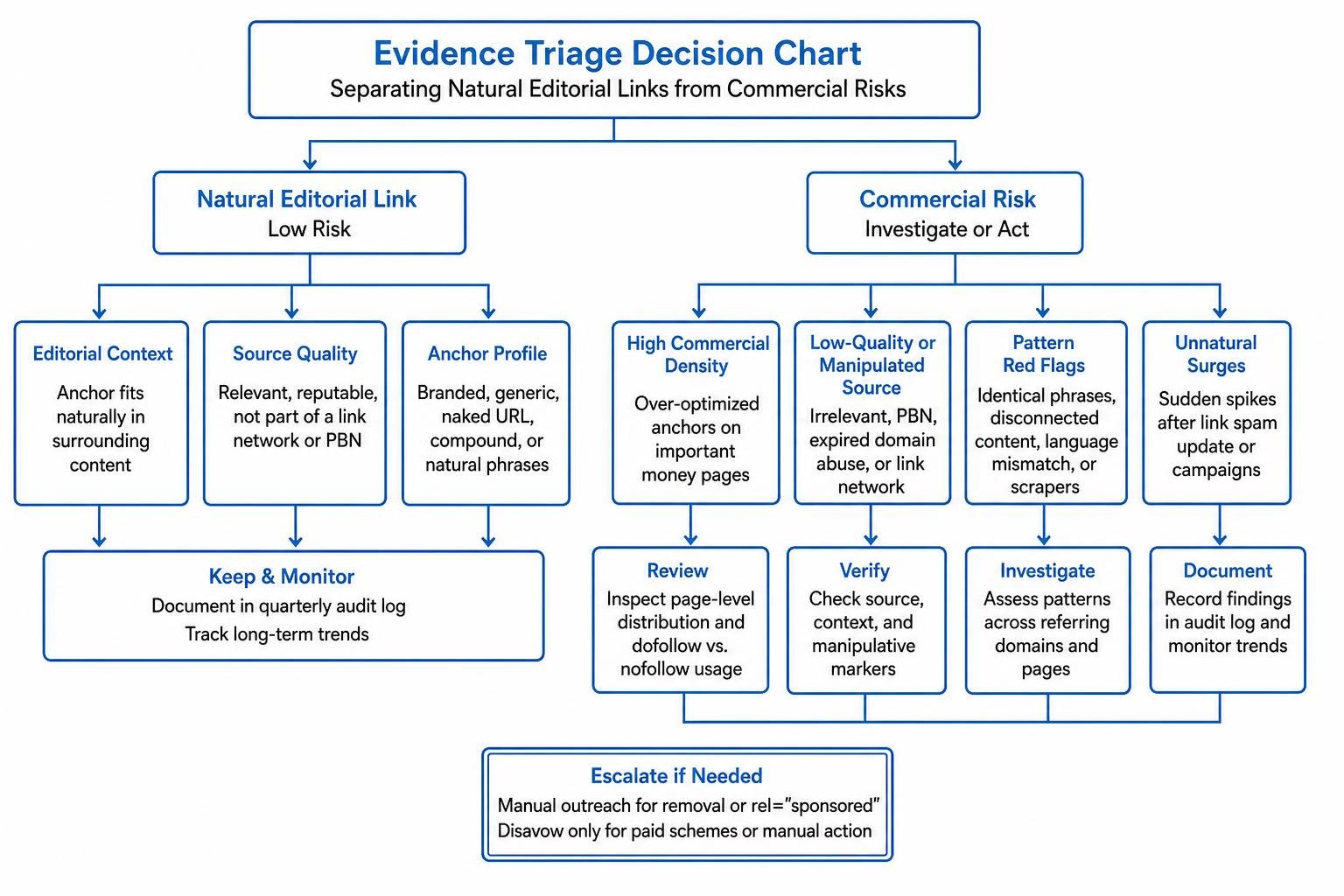
Triage your backlink profile by isolating instances where high commercial keyword density intersects with low-quality, irrelevant, or manipulated publishing environments.
Look out for language mismatches, automated scrapers, and unnatural surges following a search engine link spam update. Instead of reacting impulsively to every odd link, document all findings in a quarterly audit log to track how your profile evolves over time.
When Should You Clean Up Links, and How Can You Avoid Disavow Mistakes?
Cleaning up links should always prioritize manual outreach and genuine remediation before resorting to automated suppression. Search engines have grown adept at automatically ignoring low-quality spam, scrapers, and irrelevant directory links.
Only flag a toxic backlink for technical intervention if you have clear evidence of paid link schemes or if your site has received a manual action notice inside Google Search Console. In those specific scenarios, first attempt to contact webmasters to remove the links or add rel="sponsored" tags.
Reserve the disavow links tool strictly for situations where manual outreach fails and manual penalties are active. Disavowing links casually based on third-party toxicity scores often strips away valuable link equity, harming organic rankings.
At SmallBizSEO, our data-driven Velocity framework focuses on establishing sustainable search visibility by evaluating the true context behind every link. Auditing your anchor text profile with an evidence-based approach ensures your site builds natural, lasting authority without chasing arbitrary percentage targets.
Practical Anchor Auditing: Frequently Asked Questions
Does Google publish an official safe anchor text ratio?
No. Google has never published an official ratio for anchor text types. Official documentation encourages clear, natural, and descriptive link text that provides immediate context for users, rather than adhering to fixed mathematical quotas.
Can exact-match anchors get a website penalized?
Exact-match anchors alone do not trigger penalties. Risk arises when identical, keyword-rich commercial anchors appear repeatedly across paid placements, low-quality guest posts, sitewide footers, or manipulative link networks.
What is the difference between total backlinks and referring domains when checking anchors?
Total backlinks measure every individual link instance, which can be inflated by sitewide sidebars or footers on a single website. Referring domains measure unique web properties linking to you, providing a far more accurate representation of your anchor text diversity.
Should I ask webmasters to change existing brand anchors to commercial keywords?
No. Requesting external editors to replace natural brand mentions with commercial keywords introduces artificial patterns that can increase algorithmic risk. Leave natural, earned editorial links as they are.
How often should a small business conduct an anchor text audit?
Auditing your profile on a quarterly basis or following major content and outreach campaigns is ideal. Regular checkups ensure you catch automated link spikes or targeted over-optimization early.