SEO for Parent Education Workshops: A Practical Page Strategy
What Should a Parent Education Workshop Page Tell Families?
A useful parent education workshop page gives visitors the practical details they need before they register or inquire. State the workshop topic, intended age or developmental stage, delivery format, language options, accessibility accommodations, session date and time, cost, cancellation terms, facilitator qualifications, and a clear booking method. Describe educational content accurately and do not present the workshop as professional treatment, a legal determination, officially approved, or formally endorsed unless the claim can be independently documented.
Parents looking to enroll and organizations looking to book a facilitator have different questions. Family-facing pages should make the session fit and registration process easy to understand. Pages for schools, libraries, community groups, and employers should explain the facilitator's topic, audience range, available formats, group requirements, and booking process.
Use a separate page for each distinct offer when the audience, format, or booking action changes. This makes it easier for visitors to find the right details without relying on vague, one-size-fits-all service pages.
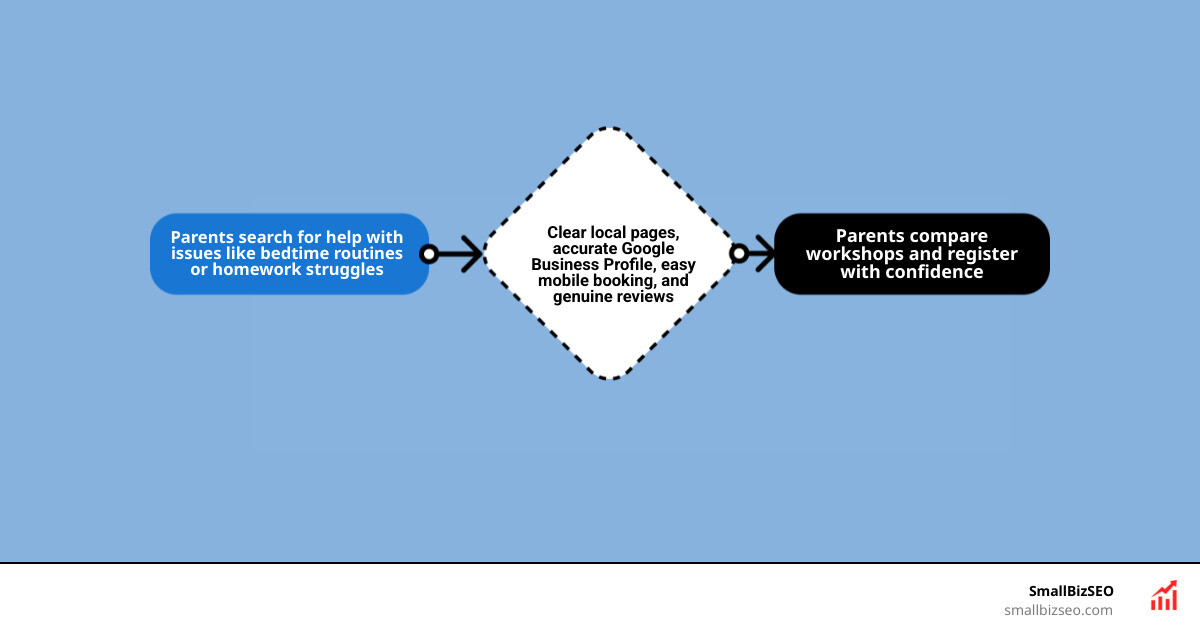
For a broader local SEO implementation framework, see SmallBizSEO's local SEO services.
How Should SEO Pages Serve Parents and Booking Partners?
Parent education workshop SEO works best when each page matches a specific audience, format, and next step. Create separate paths for families enrolling in a session and organizations booking a facilitator, then make the in-person or online format explicit in the page title, headings, event details, and call to action.
Search intent usually falls into two groups: a family comparing a specific workshop and an organization evaluating a facilitator. Build pages around the language each group uses, but do not imply that a page will rank, fill a session, or produce a particular outcome.
| Audience and format | Recommended page and keyword focus | Useful page details and action |
|---|---|---|
| Parents enrolling in person | Individual workshop page; topic plus workshop or class intent | Age or stage, venue, accessibility, language, date and time, cost, cancellation terms, facilitator qualifications, and registration link |
| Parents enrolling online | Individual online workshop page; topic plus online workshop intent | Platform, time zone, access instructions, language, accessibility, cost, cancellation terms, and registration link |
| Schools and community groups booking in person | Facilitator booking page; parent workshop facilitator or speaker intent | Topics, suitable audiences, session length, room needs, travel boundaries where applicable, qualifications, availability process, and inquiry form |
| Schools and community groups booking online | Virtual facilitator booking page; virtual parent workshop facilitator intent | Topics, audience range, platform, participation needs, language, accessibility, qualifications, availability process, and inquiry form |
How Should You Research Keywords and Search Intent for Parents?
Keyword research should reflect the workshop offer rather than unsupported promises. Combine the educational topic with the audience, format, and action, such as a family searching for an online workshop or a community group seeking a facilitator.
Organize page ideas by the educational topic, the age or stage named by the program, and the delivery format. Public workshop examples, including SCCOE parent workshops and Common Sense family-engagement resources, can help identify useful page fields such as audience, format, and registration information. They do not demonstrate a guaranteed SEO effect.
Map each relevant keyword theme to the page that can answer it completely. Avoid creating thin pages that differ only by a town name or repeating the same text across locations. Local SEO services can help organizations audit page structure, technical foundations, and local visibility without making ranking guarantees.
How Can You Optimize Your Google Business Profile and Service Pages?
A Google Business Profile is appropriate only for a qualifying in-person business or service-area operation. An online-only workshop provider is not eligible solely because it offers sessions online. Follow Google's current business representation guidelines when deciding whether a profile applies.
When a profile is eligible, represent the real-world operation accurately: use the genuine business name, choose only categories that describe the core business, maintain accurate contact details and hours, and avoid keyword stuffing. Do not create a separate profile for every venue or town. A service area describes where a qualifying service-area business operates; it does not extend a ranking radius.
Keep venue-specific details on the individual workshop page, including parking or arrival guidance when it is relevant, rather than using duplicate local pages as a substitute for useful event information.
How Can Technical SEO Help Parents Find and Book Workshops?
Technical SEO should help visitors and search engines access accurate workshop information. Use responsive pages, clear navigation, descriptive headings, accessible forms, and stable event details. Test the registration path on common devices, but avoid universal speed or checkout mandates.
Use Event structured data only when it matches visible, accurate event information on the page, including the name, date and time, location or attendance mode, offer details, and organizer. Google's event documentation states that purely virtual events without a real-world component are not supported for the event experience. Valid markup may make a page eligible for enhanced treatment, but it does not guarantee display.
Essential checks include:
- Event details: Keep visible session information and structured data aligned whenever a qualifying event page changes.
- Registration access: Make the registration or inquiry action easy to find and usable with a keyboard and screen reader.
- Content maintenance: Update availability, costs, cancellations, facilitator information, and expired event pages promptly.
How Can Reviews and Educational Backlinks Build Authority?
Trust signals should be accurate, privacy-conscious, and useful to the audience. Publish verified facilitator qualifications and clear program information. Do not use identifiable child or family stories without appropriate permission, and do not imply professional, legal, official, or formal status the program does not hold.
For reviews, invite feedback only from people with a genuine experience. Do not offer incentives, screen out negative feedback, or request particular keywords or ratings. Google's Maps content policy also prohibits misleading or incentivized reviews. Keep public replies brief and avoid sharing personal information.
Earned outreach can include sharing genuinely useful workshop guides with relevant schools, libraries, and community organizations when the material is a good fit. Treat links as an editorial outcome, not a promised result.
How Should You Maintain Workshop Pages and Measure Demand?
Workshop pages need routine maintenance because dates, availability, formats, and facilitators can change. Update the page and any matching structured data whenever those details change, then retire or redirect expired pages when appropriate.
Before publishing or refreshing a workshop page, confirm that it shows:
- The topic and the intended age or stage
- In-person or online format, language options, and accessibility information
- Date, time, cost, cancellation terms, and current availability
- Verified facilitator qualifications and a clear registration or inquiry route
Use actual planning evidence rather than assumed seasonal patterns. Review your own registration history, event calendar, and Search Console data before prioritizing a topic or refresh. Publish useful guides only when they connect to real workshops or resources, and revisit them when session details change.
How Can You Measure Results and Refine SEO for Parent Education Workshops?
Measure performance at the page and query level, then compare it with real registration or inquiry data where available. Search Console can reveal how Google Search users reached live pages, while booking data can show whether the page is producing relevant interest.
Useful measures include:
- Search Console page and query evidence: Review impressions, clicks, and position trends for relevant live pages and queries.
- Registration and inquiry quality: Compare completed registrations and booking inquiries with the page's stated audience and offer.
- Refresh needs: Flag pages with expired dates, changed pricing, inaccessible forms, or outdated facilitator information.
SmallBizSEO can support content planning, writing, ongoing refreshes, and internal linking through its SEO content services. To discuss an SEO plan for your workshop pages, book a consultation.
Keep Workshop Information Useful and Current
Clear, accurate workshop pages help families and booking partners decide whether an offer fits their needs. Separate enrollment and facilitator-booking paths, keep event information current, use Google Business Profile only when eligible, and rely on verified performance data when choosing what to improve next. Ongoing content maintenance and ethical outreach can strengthen the usefulness of the site without promising rankings, attendance, or outcomes.